Diesel engines are the heartbeat of commercial fleet operations — and the single largest source of unplanned downtime costs when PM programmes slip. A Class 8 diesel running 120,000 miles per year accumulates roughly 2,000 operating hours. At that duty cycle, the gap between a structured CMMS-managed PM programme and a reactive maintenance approach is not marginal. It is the difference between an engine that delivers 1,000,000+ miles of service life and one that requires major overhaul at 400,000. Six critical systems determine diesel engine longevity: oil and filter, fuel system, cooling, turbocharger, emissions aftertreatment, and air intake. Each has distinct interval requirements, failure modes, and early-warning signals. OxMaint manages all six diesel PM streams simultaneously per vehicle — triggering work orders by mileage, hours, or calendar interval, whichever fires first.
Automate Your Diesel PM Programme with OxMaint
Manage oil, fuel, cooling, turbo, DPF, and DEF/SCR service intervals per vehicle — triggered by mileage, hours, or calendar. Full CMMS with OBD integration and SAP sync.
The 6 Critical Diesel PM Systems
Diesel engine PM is not a single event — it is a parallel programme of six interconnected service streams, each on its own interval. Missing any one stream cascades into the others: neglected engine oil accelerates bearing wear; a clogged DPF forces regeneration cycles that overheat the exhaust and stress the turbocharger; low coolant concentration causes cylinder liner cavitation that contaminates the oil. Understanding how the six systems interact is the foundation of an effective diesel PM programme. OxMaint tracks all six systems simultaneously per vehicle — eliminating the scheduling complexity that causes individual PM streams to fall behind.
Complete Diesel PM Schedule — All 6 Systems by Mileage
A diesel PM programme fails most often not because the team doesn't know the intervals, but because tracking six parallel schedules per vehicle manually is error-prone at fleet scale. When different vehicles have different mileage histories, the same theoretical schedule produces 50 different due-dates across a 50-unit fleet. OxMaint automates PM scheduling per vehicle so the right work order fires at the right mileage or time — regardless of how staggered the fleet's service history is.
Emissions Aftertreatment: DPF, DEF/SCR, and EGR
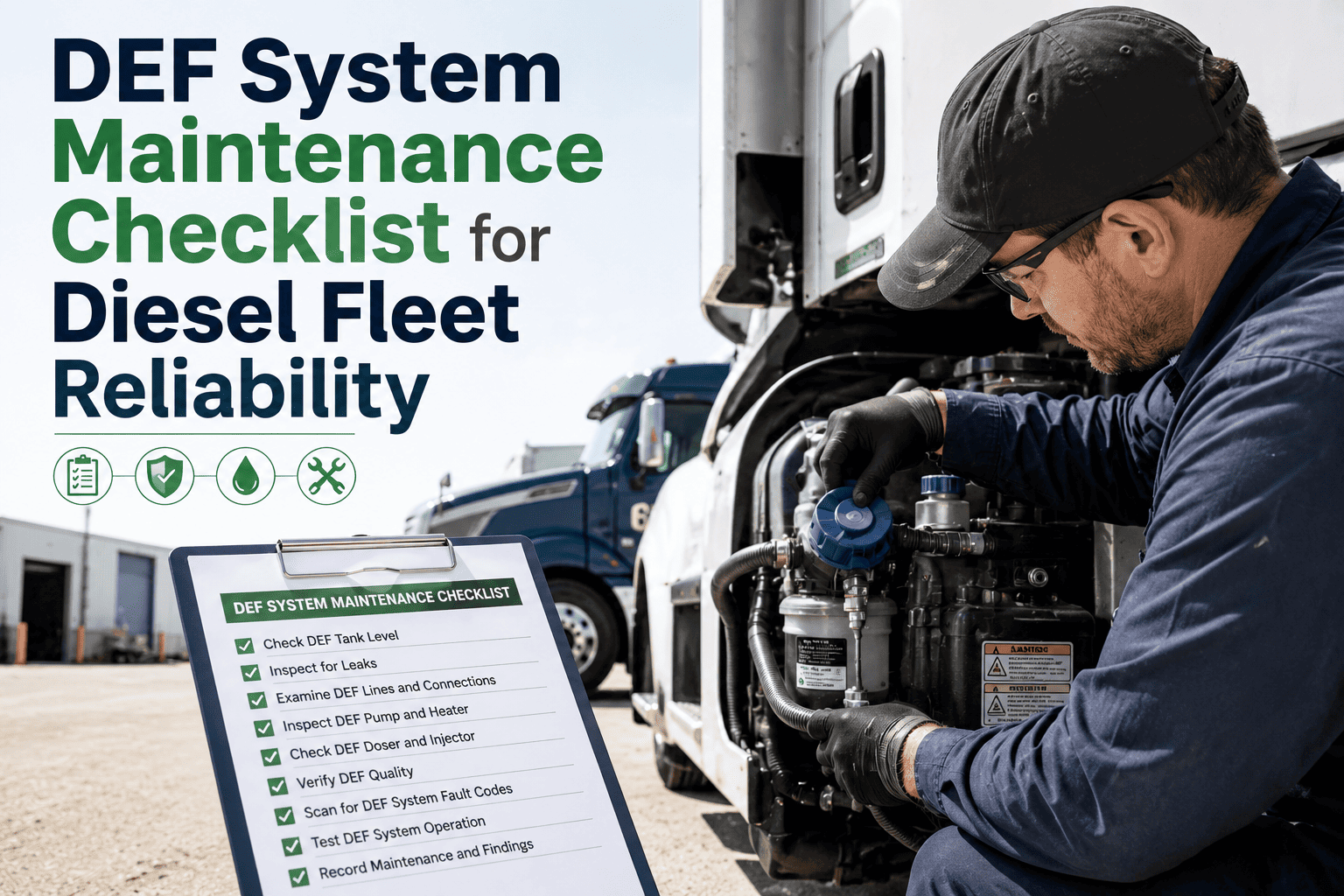
Emissions aftertreatment is the most technically complex and most frequently neglected PM area in modern diesel fleet management. A Diesel Particulate Filter loaded beyond its passive regeneration capacity requires active regeneration — a process that consumes additional fuel and stresses the turbocharger. When active regeneration fails because the DPF is overloaded, forced regeneration requires a stationary vehicle and a shop visit. When even forced regen fails, DPF removal and cleaning or replacement costs $2,000–$6,000 per unit. SCR systems require uninterrupted DEF supply at correct concentration (32.5% urea/water). DEF degradation or dosing system failure triggers derate mode — a governed speed reduction to 5 mph that immobilises the vehicle. OxMaint tracks DPF regen frequency, DEF level, and SCR fault codes from OBD feeds — flagging vehicles approaching forced regen thresholds before they derate or fail.
AI, OBD, and Digital Twin: Predictive Diesel PM
The most significant advance in diesel fleet maintenance over the past decade is not a better lubricant or a longer filter — it is real-time engine condition data. OBD-II and J1939 CAN bus streams provide continuous access to fuel trim, boost pressure, exhaust back pressure, coolant temperature, and SCR efficiency — the exact parameters that predict diesel PM failures 30–60 days before they become roadside events. AI digital twin technology models each engine's wear trajectory against its service history and duty cycle, identifying which units need proactive attention versus those that can safely extend to their next scheduled interval. AI camera vision at depots performs automated walk-around inspections daily — detecting exhaust leaks, coolant weeps, and DPF soot accumulation that technicians would miss on a quick pre-trip check. OxMaint integrates J1939 data feeds into predictive work order triggers — converting continuous OBD monitoring into actionable PM scheduling without manual data analysis. SAP PM integration posts diesel PM completions automatically to the asset maintenance record, creating the full service history documentation that supports warranty claims and compliance audits.
Continuous brake wear %, fuel trim, boost pressure, coolant temp, and SCR efficiency streamed to CMMS daily. Anomalies trigger work orders before they become failures — 30–90 day advance warning on wear events.
Models each engine's wear trajectory against class-specific profiles and duty cycle. Weekly inspection-readiness scoring per vehicle — highest-risk units are prioritised in the shop schedule before failure occurs.
Daily depot walk-around scans detect exhaust leaks, coolant weeps, DPF soot on exterior surfaces, and oil weepage — visual defects technicians miss on pre-trip. Photo evidence per defect attached to CMMS work order automatically.
Diesel PM completions post automatically to SAP PM and S/4HANA — parts consumed, labour hours, and technician sign-off in the asset record. Full service history exportable for warranty claims and asset valuation due diligence.
We were losing engines to DPF-related overtemp events every quarter. OxMaint's OBD integration now flags regen frequency anomalies before they escalate. We've had zero forced regen events in 11 months across a 48-unit fleet — and three engines that previously would have needed early overhaul are running past 800,000 miles.
Track All 6 Diesel PM Streams Per Vehicle — Automatically
OxMaint triggers oil, fuel, cooling, turbo, DPF, and SCR work orders by mileage, hours, or calendar — with OBD condition data integration. Free to start.
Common Challenges in Diesel Fleet PM
Mileage-Only Triggers Missing High-Idle Hours
Vehicles with high idle time — construction, refrigeration, PTO operations — accumulate engine hours without mileage. A unit idling 4 hours daily adds the equivalent of 40–60 road miles of engine wear per session. Mileage-only PM scheduling is dangerously over-extended for these vehicles. OxMaint's dual-trigger scheduling fires whichever threshold — miles or hours — reaches first.
DEF Quality and Contamination
DEF contaminated with diesel, engine coolant, or incorrect urea concentration causes SCR catalyst damage — a $5,000–$15,000 repair not covered by warranty when caused by improper handling. DEF must be stored below 77°F in sealed containers and dispensed through dedicated equipment that never contacts other fluids.
Extended Oil Drains Without Used Oil Analysis
Extended drain intervals are only defensible when backed by Used Oil Analysis (UOA) data showing acceptable contamination, viscosity, and additive depletion. Extending based solely on OEM maximums — without actual oil condition data from the specific vehicle and duty cycle — is a false economy that accelerates engine wear invisibly over tens of thousands of miles.
Coolant SCA Depletion Between Full Changes
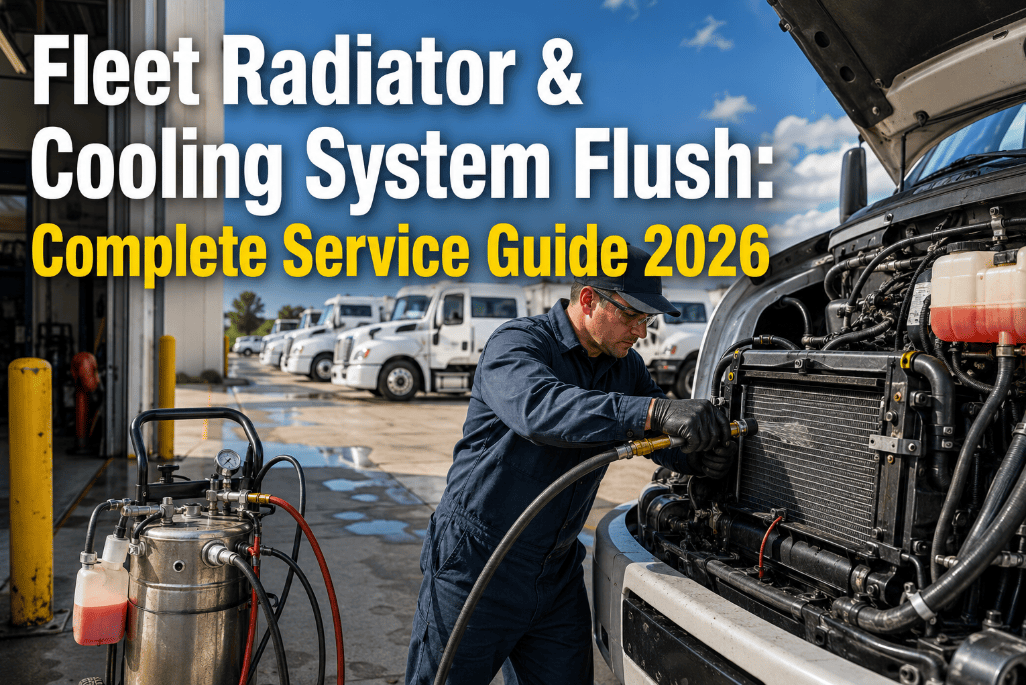
Supplemental Coolant Additives (SCAs) in heavy-duty diesel coolant deplete independently of the base coolant. A 300,000-mile coolant change interval does not mean SCA levels remain adequate — they require top-up at every 15,000–25,000 miles based on SCA test strip results. Depleted SCAs are the primary cause of cylinder liner cavitation erosion.
Frequently Asked Questions
How often should diesel engine oil be changed in a commercial fleet?
OEM standard intervals are 15,000–25,000 miles or 250–500 hours for Class 8 using CK-4 or FA-4 oils. High-idle operations (construction, refrigeration) should use hours as the primary trigger. Used Oil Analysis can support extended intervals — but only when lab data from that specific vehicle and duty cycle confirms it. OxMaint's dual-trigger scheduling manages miles and hour triggers simultaneously.
How do I prevent DPF failures in my diesel fleet?
Monitor regen frequency via OBD — more than 1–2 active regens per week indicates an underlying issue (high idling, oil consumption, fuel system fault). Meet all PM intervals to minimise soot and ash loading. Clean the DPF thermally every 200,000–300,000 miles before ash loading exceeds passive regen capacity. OBD integration with CMMS makes this monitoring automatic.
What causes diesel engine DEF system derates?
The most common causes are: DEF tank empty, concentration incorrect, dosing injector blocked or failed, SCR catalyst efficiency below threshold, and NOx sensor failure. All are detectable via OBD fault monitoring before the derate is triggered. Book a demo to see OxMaint's DEF/SCR monitoring setup.
How can a CMMS improve diesel engine maintenance in a fleet?
A CMMS improves diesel PM in five ways: automated multi-trigger scheduling (miles, hours, calendar); OBD fault code integration for predictive work orders; oil analysis result tracking per vehicle; DPF regen frequency monitoring; and complete service history documentation per engine. OxMaint handles all five simultaneously — start free today.
Stop Losing Engines to Missed PM Intervals. OxMaint Makes It Preventable.
OxMaint's diesel CMMS combines mileage/hour-triggered PM scheduling, OBD condition monitoring, DPF regen tracking, and SAP sync — giving fleet managers the data to eliminate preventable engine failures.