A diesel engine that misses a single PM interval does not fail immediately — it degrades progressively, accumulating wear in injectors, turbocharger bearings, and EGR valves that only becomes visible as a costly breakdown months later. Commercial fleet diesel engines operating across USA, Canada, Germany, Australia, and the UAE share one common vulnerability: the gap between what should be inspected and what is actually documented. This checklist covers all eight critical diesel PM systems — oil and filtration, fuel, air, cooling, turbocharger, belts and hoses, emission systems, and electrical — with the interval triggers, acceptance criteria, and technology integrations that turn a routine service into a data-driven predictive maintenance event. Oxmaint's diesel PM module auto-schedules every interval, captures technician sign-off per system, and feeds OBD fault data directly into service records — so nothing is missed and nothing is undocumented.
Diesel PM Interval Wheel — What Gets Done When
Different diesel systems degrade at different rates. The PM interval wheel below maps every major diesel PM task to its correct service trigger — so technicians and fleet managers know what is due at every service stop before the vehicle enters the bay.
How Technology Is Transforming Diesel PM
Manual diesel PM relies on technician memory and paper service logs — neither of which catches the developing faults that OBD sensors, digital twins, and AI inspection systems detect weeks before failure. These four technologies transform diesel PM from reactive to genuinely predictive. Oxmaint integrates all four into one diesel PM workflow.
1. Oil and Filter System Checklist
Engine oil is the single most important consumable in any diesel engine — and the most common source of failures caused by neglect rather than component wear. Oil analysis at every change provides the leading indicator data that no visual inspection can replicate. Auto-trigger oil change work orders from OBD oil-life data with Oxmaint.
Engine oil level, colour, and viscosity check
Check dipstick cold before start — oil must be within the operating range, not black or gritty, and must not smell burnt. Black oil at half the service interval indicates excessive combustion blow-by from worn rings or a stuck PCV valve. Defect — black oil at mid-interval
Oil and filter change — correct specification
Drain and refill with the engine manufacturer's specified oil grade — not the nearest available grade. Verify filter part number against the vehicle's current engine build. On high-mileage engines, take an oil sample before draining and send for spectrographic analysis — metal particle counts flag developing bearing or ring wear months before visible symptoms. Defect — wrong specification
Oil pressure at idle and full operating temperature
Check oil pressure with a mechanical gauge — not the dashboard warning light alone. Idle pressure should be 10–25 psi; operating pressure 40–70 psi (varies by manufacturer). Low oil pressure at operating temperature indicates worn main bearings or a failing oil pump — investigate before the engine is returned to service. OOS — low pressure
Crankcase ventilation — PCV or open breather condition
Inspect PCV valve for sticking, the breather hose for collapse or blockage, and the crankcase for excessive pressure (check by loosening the oil filler cap with engine running — slight vacuum or minimal pressure is correct). Excessive blowback indicates ring wear or a stuck PCV; a blocked breather causes seal failures. Defect — blocked breather
Oil cooler and lines — leak check
Inspect oil cooler core for external leaks at the oil-to-coolant interface — a leaking oil cooler allows coolant into the oil circuit and vice versa. Check oil cooler lines for chafing and connection leaks. A milky oil dipstick reading is a direct indicator of oil cooler failure requiring immediate engine removal from service. OOS — milky oil
OBD tip: Oil pressure PID monitoring via OBD can alert technicians to developing bearing wear months before a pressure drop is noticed at service. Oxmaint auto-creates a bearing inspection work order when the oil pressure PID trends below a configurable threshold. See Oxmaint's OBD pressure monitoring.
2. Fuel System Checklist
Modern diesel common-rail fuel systems operate at injection pressures above 30,000 psi. At these pressures, even trace levels of water or contamination cause injector erosion that costs $800–$3,000 per injector to remediate. Fuel system PM is the highest-leverage maintenance investment in any diesel operation.
Primary fuel filter replacement and water separator drain
Replace primary filter at every 15,000 mi or sooner if the water separator warning activates. Drain the water separator bowl at every service — water in diesel fuel at any concentration accelerates injector corrosion. Record the amount of water drained; increasing water content across successive services indicates a deteriorating fuel source or tank seal. Defect — water present
Secondary fuel filter replacement
Replace secondary (fine) fuel filter at every 30,000 mi or per manufacturer specification — whichever comes first. Common-rail engines are more sensitive to secondary filter restriction than older mechanical injection systems. A restricted secondary filter causes injector starvation at high load — often misdiagnosed as injector failure rather than the cheaper filter blockage that caused it. Defect — high restriction
Fuel rail pressure — OBD PID check at idle and full load
Check fuel rail pressure via OBD live data. At idle: typically 25–30 MPa; at full load: 140–180 MPa for common-rail systems. A rail pressure below spec at full load indicates a failing high-pressure pump, leaking pressure relief valve, or worn injector return — investigate before injector damage becomes irreversible. Defect — low rail pressure
Injector return flow — leak-off test
Perform injector return flow (leak-off) test using a graduated measuring cylinder at each injector return port. Compare results across all cylinders — a single injector with return flow 3× the baseline reading indicates internal wear requiring replacement before it causes hard starting, white smoke, and ECU fuelling compensation that masks the fault in OBD data. Defect — high return flow
Fuel tank inspection — contamination and cap seal
Inspect tank exterior for corrosion, physical damage, and secure mounting. Check filler cap seal condition — a failed cap seal allows moisture ingress in humid climates. On vehicles with aluminium tanks, inspect for oxidation corrosion at the weld seams. Plastic tanks should be checked for UV degradation and physical impact damage at frame mounting points. Defect — failed cap seal
3. Air Filtration and Turbocharger Checklist
A diesel engine ingests approximately 500 litres of air for every litre of fuel burned — making air filtration and turbocharger condition the two most consequential performance variables after fuel quality. A 25% restricted air filter costs 10% in fuel economy. A failing turbocharger destroys the engine it is supposed to protect. Monitor boost pressure and air filter restriction via OBD in Oxmaint.
Air filter restriction indicator reading
Check the air filter restriction indicator (Vacuator or equivalent) before removing the filter. Replace if the indicator has tripped, or if measured restriction exceeds 25" H₂O on naturally aspirated engines or 20" H₂O on turbocharged engines. Never base replacement decisions on visual inspection alone — a filter can look serviceable and be critically restricted. Defect — indicator tripped
Air intake system — clamps, hoses, and charge air cooler
Inspect all intake clamps for tightness — a loose clamp between the air filter and turbocharger allows unfiltered air to enter the engine, destroying injectors and causing ring wear in as few as 5,000 miles. Check charge air cooler (intercooler) for oil contamination — oil inside the intercooler indicates turbocharger oil seal failure requiring immediate investigation. OOS — unfiltered air ingress
Turbocharger shaft play — radial and axial measurement
Check turbocharger shaft radial play (side-to-side) — should not exceed 0.5mm on most applications. Check axial play (end-to-end) — typically 0.025–0.065mm. Radial play above specification causes impeller-to-housing contact, generating aluminium dust that passes the air filter and enters the engine. Defect — above spec play
Turbocharger oil supply and return lines
Inspect oil supply line for restriction and return line for kinking or blockage. A restricted return line causes turbocharger bearing flooding — oil leaks past the compressor seal into the intercooler and engine. Check the supply line banjo bolt mesh filter — a blocked mesh filter causes turbocharger bearing failure through oil starvation. OOS — restricted return
Boost pressure — OBD PID at full load
Check boost pressure via OBD live data at full engine load. Compare against the manufacturer specification for the engine variant and altitude. Boost below specification at full load indicates a wastegate fault, VGT actuator failure, or exhaust leak before the turbine. Boost above specification indicates a stuck wastegate — causing over-boost faults and potential engine damage. Defect — out of specification
AI Digital Twin tip: A turbocharger digital twin that accumulates boost pressure PID history, oil analysis metal particle counts, and run-time data calculates remaining bearing life — predicting turbocharger failure 6–8 weeks before catastrophic seizure that would otherwise cause complete engine ingestion damage. See predictive turbo monitoring on Oxmaint.
4. Cooling System Checklist
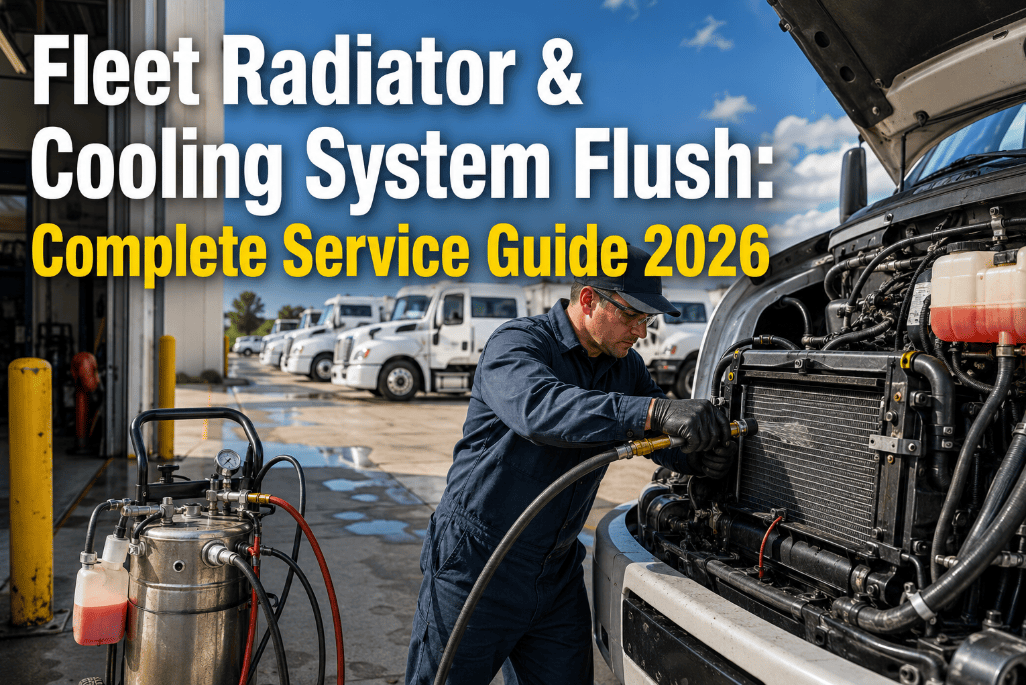
Diesel engines generate significantly more heat than petrol equivalents at the same displacement — making cooling system PM the difference between a 1-million-mile engine and a cylinder head failure at 300,000 miles. A failed water pump or leaking hose that causes a single overheat event can require a complete head gasket replacement costing $6,000–$14,000.
Coolant level, freeze point, and pH measurement
Check expansion tank cold. Test freeze protection with a refractometer — should protect to at least -35°F for cold-region fleets. Test pH with a coolant test strip — coolant below pH 7 is acidic and corroding aluminium components; above pH 10 is also a problem. Replace coolant at 30,000 mi or when pH is outside 7–10. Defect — pH out of range
Radiator hoses — squeeze test and clamp inspection
Squeeze upper and lower radiator hoses — soft, spongy, or mushy texture indicates internal degradation and imminent failure. Hard, brittle hoses indicate heat and oil contamination damage. Check all clamps for tightness and for rust marks or dried coolant at connection points. A burst hose on a diesel at operating temperature loses the entire cooling system in under 90 seconds. Defect — spongy hose
Water pump — bearing play and weep hole inspection
Check water pump bearing radial play by grasping the fan or pulley and applying side force — any play indicates worn bearings requiring replacement. Check the weep hole below the bearing housing for coolant seepage — a weeping water pump is showing bearing seal failure and must be replaced before the bearing collapses and the impeller contacts the housing. Defect — weeping weep hole
Thermostat — function and opening temperature
Test thermostat operation by monitoring engine warm-up via OBD coolant temperature PID. Engine should reach operating temperature within 8–12 minutes of cold start. A thermostat stuck open causes chronic cold-running, increased fuel consumption, and injector bore wash. A thermostat stuck closed causes overheating within minutes of full-load operation. OOS — stuck closed
5. Emission System Checklist — DPF, DEF, and EGR
Emission system faults generate the most expensive reactive repairs in the modern diesel fleet — DPF replacement at $2,000–$5,000, SCR catalyst failure at $3,000+, and EGR-related engine damage at $8,000+. All are preventable with structured PM. Track DPF regen cycles and DEF consumption automatically via OBD in Oxmaint.
DPF backpressure and regen cycle frequency
Check DPF differential pressure sensor data via OBD — backpressure above the manufacturer threshold at operating temperature indicates excessive soot loading requiring forced regen. Monitor regen frequency — if active regens are occurring more than once per 300 miles, investigate for incomplete passive regen due to duty cycle issues, coolant temperature problems, or fuel quality. Defect — frequent regens
DPF ash load — deep clean or replacement at interval
Perform DPF ash load analysis at 150,000–200,000 mi depending on engine and duty cycle — ash accumulation (unlike soot) cannot be burned out by regen and must be removed by ultrasonic or pneumatic cleaning. A DPF cleaned before it reaches full ash capacity lasts 800,000+ miles; one left to full blockage typically requires replacement rather than cleaning. Defect — at ash limit
DEF/AdBlue quality and level — tank and dosing system
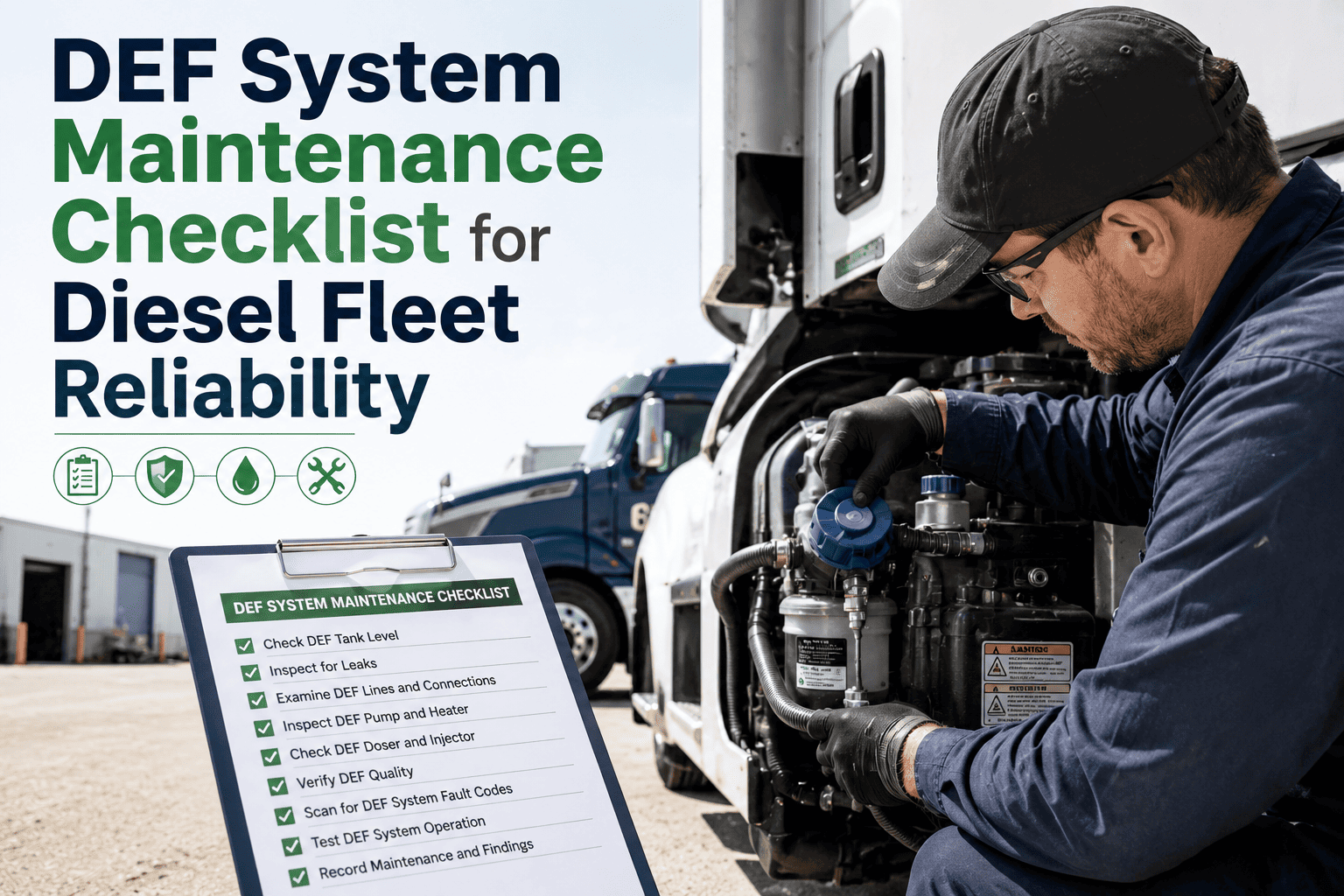
Check DEF level at every service — never let it drop below 10% of tank capacity, as the quality sensor in the tank becomes inaccurate near empty and may trigger a false "poor quality" fault. Test DEF concentration — should be 31.8–33.2% urea by weight. Diluted or degraded DEF causes SCR catalyst failure; contaminated DEF corrodes the dosing pump and injector nozzle. Defect — contaminated DEF
EGR valve — carbon build-up inspection and cleaning
Inspect EGR valve at every 15,000 mi for carbon build-up on the valve face and seat. A partially seized EGR valve causes elevated NOx emissions, rough idle, and black smoke. A fully seized open EGR valve causes excessive combustion dilution, poor power, and oil contamination. Clean with approved EGR cleaning spray if deposits are present and measure valve movement range via OBD. Defect — carbon seized
EGR cooler — coolant and exhaust leak check
Inspect EGR cooler for external coolant leaks at the header connections and for internal failure — an EGR cooler that has developed an internal leak allows coolant into the EGR circuit. White steam from the exhaust that increases under load and a rising coolant loss without visible external leaks are the primary indicators of EGR cooler internal failure. OOS — internal leak
SAP Integration tip: DPF cleaning and DEF dosing pump service work orders generated by Oxmaint sync automatically with SAP Plant Maintenance — triggering parts reservation for cleaning supplies, replacement DEF injectors, and DPF cleaning service appointments with external vendors without manual procurement input. Book a demo to see Oxmaint's SAP PM integration for emission system maintenance.
Before Oxmaint, we had two DPF replacements in a single year — £8,400 in parts alone, plus downtime. Both were caused by missed regen cycle monitoring. Now the system flags abnormal regen frequency automatically and creates an inspection work order. We've had zero DPF replacements in 14 months since deployment.
Diesel PM Compliance — Key Metrics
60% of diesel engine failures are traceable to a missed or delayed PM event in the preceding 12 months — making interval adherence the primary failure prevention strategy.
Average diesel engine overhaul cost in commercial fleet operations — preventable in the majority of cases by adherence to fuel, oil, and cooling PM intervals at the correct triggers.
Digital twin modelling of oil analysis trends, boost data, and DPF backpressure provides 6–8 weeks of advance warning before any diesel system reaches a critical threshold.
Every $1 invested in diesel PM generates $3 in avoided reactive repair costs — rising to $8 per $1 on turbocharger and DPF failure prevention specifically.
Frequently Asked Questions
The most common questions from diesel technicians and fleet managers about diesel engine PM intervals, emission system maintenance, and CMMS integration.
Every 5,000–7,500 miles for most commercial diesels under standard duty cycle conditions; every 3,000–5,000 miles for severe-duty applications (construction, waste, off-road). Use OBD oil-life monitoring data and oil analysis results to calibrate the interval accurately for each vehicle's actual operating conditions rather than applying a fleet-wide fixed interval.
Short-distance duty cycles that keep exhaust temperatures below 550°C (the passive regen threshold), faulty EGR valves that increase soot production, leaking fuel injectors depositing raw fuel in the DPF, or a malfunctioning diesel oxidation catalyst upstream of the DPF. Each requires a different corrective action — investigate the root cause before scheduling a DPF clean.
Injector return flow (leak-off) test results 3× above baseline for any single cylinder, fuel balance corrections in OBD data exceeding ±4mg/stroke per cylinder, visible black smoke on acceleration combined with high rail pressure correction, or cylinder contribution testing showing more than 10% variance between cylinders — any of these indicate injector replacement is due.
Yes. Oxmaint supports PM triggering by mileage, engine hours, calendar date, or any combination — whichever occurs first. Engine hours are pulled automatically from the OBD ECU hour meter, eliminating manual hour recording and ensuring PM is triggered at the correct interval regardless of whether the vehicle is driving or idling.
31.8–33.2% urea by weight — standardised under ISO 22241. DEF outside this range causes SCR system fault codes and, if left untreated, engine derating. Test DEF quality at every tank fill using a refractometer calibrated for urea solution — the 30-second test prevents $3,000+ SCR catalyst failures caused by diluted or contaminated DEF.
A digital twin accumulates the actual sensor data — oil pressure trends, boost history, DPF backpressure curves, coolant pH test results — and uses that data to model wear rates per component. The result is a PM schedule calibrated to each engine's actual condition, not a fleet-average interval — preventing both under-servicing (failures) and over-servicing (unnecessary cost).