Government facilities run on public trust, and every fire alarm test, elevator certificate, and ADA ramp inspection is a record someone can be asked to produce. Most agencies still track that evidence across spreadsheets, paper logs, and a retiring supervisor's memory, which is exactly where audits go wrong and budgets get questioned. A government-grade CMMS closes that gap by pairing FedRAMP-aligned data security with role-based access, automatic audit trails, and compliance scheduling built around OSHA, ADA, and NFPA intervals. Book a demo to see how your agency's facility data can finally hold up under review.
Government Facilities · FedRAMP-Aligned CMMS
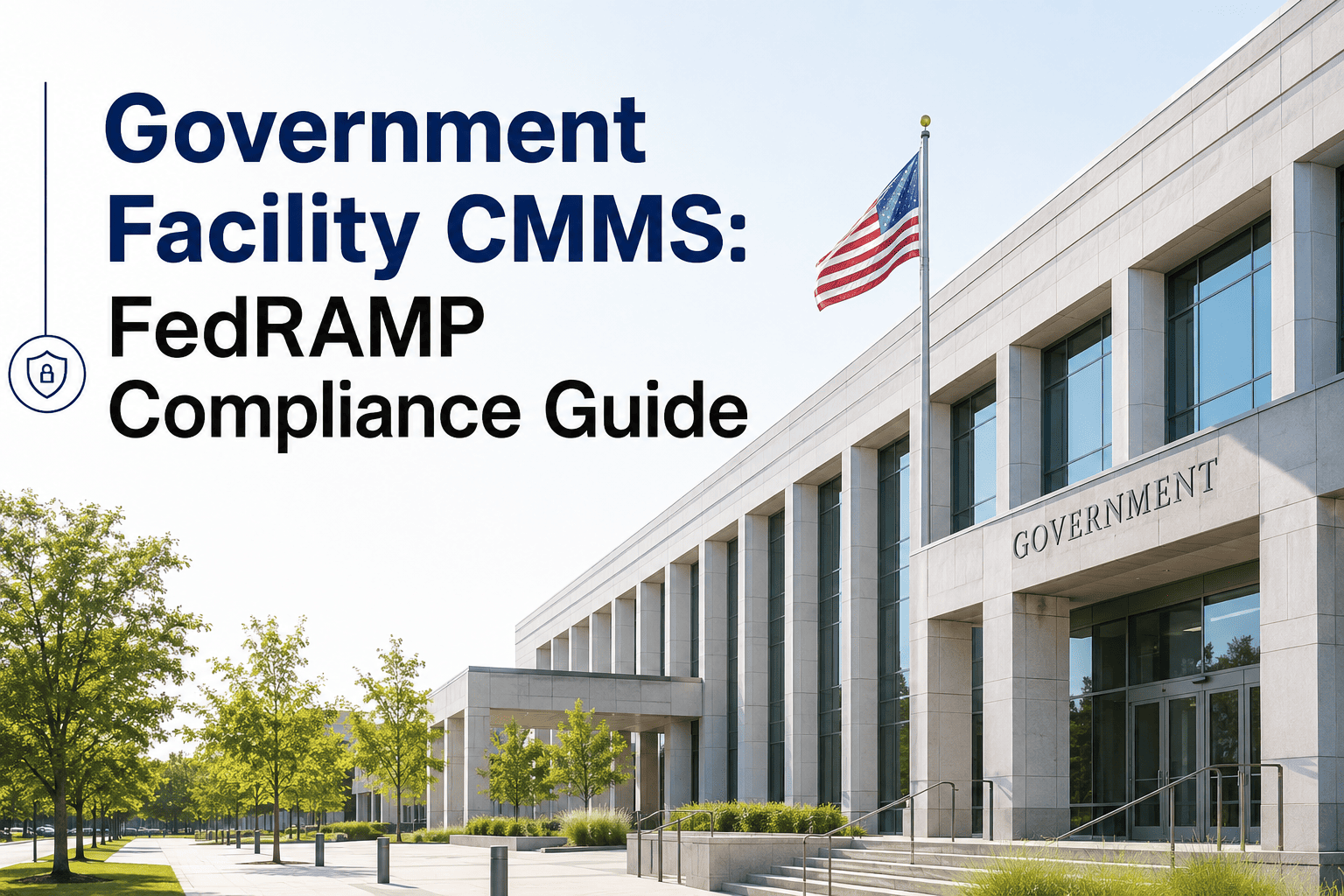
Government Facility CMMS: The FedRAMP Compliance Guide
Federal-grade security controls, role-based access, and automatic audit logging — built for agencies that cannot afford a compliance gap or an unrecorded repair.
65%
of government facility repairs are still reactive, not scheduled
325
NIST 800-53 controls required at FedRAMP Moderate impact level
3x
higher repair cost when maintenance has no documented history
4 hrs
to export a full ADA, OSHA, or NFPA audit package on demand
The Problem Auditors Keep Finding
Where Reactive Maintenance Turns Into a Compliance Risk
Deferred Maintenance
Backlog grows roughly 7% a year once inspections go undocumented across a portfolio
Reactive vs Planned
Best-run public facilities target an 80% planned, 20% reactive work order ratio
Federal Grant Readiness
Agencies without condition data typically see grant win rates near 5 to 12%
Security Architecture
The Federal Compliance Framework a Government CMMS Must Satisfy
FISMA
The federal law requiring every agency to secure its information systems. It creates the mandate; a cloud CMMS satisfies it through FedRAMP authorization rather than a separate agency review.
FedRAMP Moderate
The baseline for most civilian facility systems handling building security data and personal information, covering 325 NIST 800-53 controls across access, encryption, and monitoring.
FedRAMP High
Required where a breach would carry severe consequences — military installations, law enforcement facilities, and national security sites — with 421 controls in scope.
NIST 800-53 / FIPS 199
Your agency's data classification under FIPS 199 sets the required impact level. Getting it wrong either under-secures records or blocks procurement with unnecessary barriers.
Access and Accountability
Role-Based Access and Audit Logging, Built for Public Records
Field Technician
Sees only assigned building, logs work orders, cannot alter compliance records
Facility Supervisor
Full building visibility, approval workflows, escalation alerts
Compliance Officer
Portfolio-wide audit exports, inspection history, deadline dashboards
IT / InfoSec
SSO, PIV/CAC authentication, encryption, and access log configuration
89%
Average PM compliance across public agencies on a structured CMMS
100%
Work orders closed with timestamped technician attribution
Turn Every Inspection Into an Audit-Ready Record
Stop rebuilding compliance reports from memory before every state review. Import your asset list, assign your inspection intervals, and start producing exportable ADA, OSHA, and NFPA documentation within weeks.
Before and After
Spreadsheets and Paper Logs vs a FedRAMP-Aligned CMMS
| Requirement | Legacy Process | OxMaint CMMS |
|---|---|---|
| Cloud data security | Commercial hosting, no FedRAMP review | FedRAMP-aligned controls, AES-256 encryption |
| Access control | Shared logins, no role separation | Role-based access with PIV/CAC support |
| Audit trail | Manual notes, easily lost or altered | Timestamped, tamper-evident work order history |
| OSHA / ADA documentation | Compiled manually before each audit | Exportable audit package in under four hours |
| Multi-site oversight | Separate files per building | One portfolio dashboard, every site |
Who This Is Built For
Public Sector Teams Operating Under Constant Review
01
City and County Facilities
City halls, courthouses, libraries, and public works depots that must justify every dollar of maintenance spend to council and state auditors.
02
State Agencies and Authorities
Portfolios spanning administrative offices and infrastructure assets that require FIPS 199 classification and consistent NIST 800-53 alignment.
03
Public Housing and Education Estates
Agencies balancing ADA accessibility mandates, tenant safety, and federal funding reporting across many aging buildings.
04
Federal Contractors and Critical Sites
Operations where a security or compliance lapse carries severe consequences, requiring FedRAMP High-aligned controls and strict access separation.
From the Field
What Public Sector Facility Leaders Say
5 / 5
Every state audit used to mean three weeks pulling inspection records out of binders and technician memory. Now our compliance officer exports the full package before the auditor has finished their coffee, and nothing is missing.
Facilities Director, County Public Works · 16 yrs public sector
4 / 5
The role-based access mattered more than I expected. Our IT team finally has a straight answer when the state security review asks who can see what, and technicians only ever see their own building.
IT Security Lead, State Agency Facilities · 11 yrs government IT
Common Questions
Government CMMS and FedRAMP Compliance — FAQs
Do we need FedRAMP authorization for a facility CMMS?
Federal agencies generally require it; state and local agencies often set their own security standards instead. Book a demo to review which impact level applies to your data.
What is the difference between FedRAMP Ready and FedRAMP Authorized?
Ready means a third-party assessor has reviewed the vendor's readiness; Authorized means an agency has actually granted operating authority. Only Authorized status satisfies procurement requirements.
Can different buildings and departments have separate access?
Yes. Access is assigned by role and site, so a technician sees only their building while a compliance officer sees the full portfolio. Start a free trial to configure your structure.
How fast can we produce an audit package when a reviewer asks?
Agencies with a structured CMMS typically export a full ADA, OSHA, or NFPA documentation package in under four hours, versus weeks of manual compilation.
What data do we need to start building our register?
A basic asset list with name, category, and location is enough to begin. Records are enriched over time as technicians complete inspections.
Government Facility CMMS · FedRAMP-Aligned
Give Your Agency a Record That Holds Up Under Any Audit
Every inspection, work order, and access log lives in one federally-aligned system your compliance officer can trust and your auditors can verify in hours, not weeks.