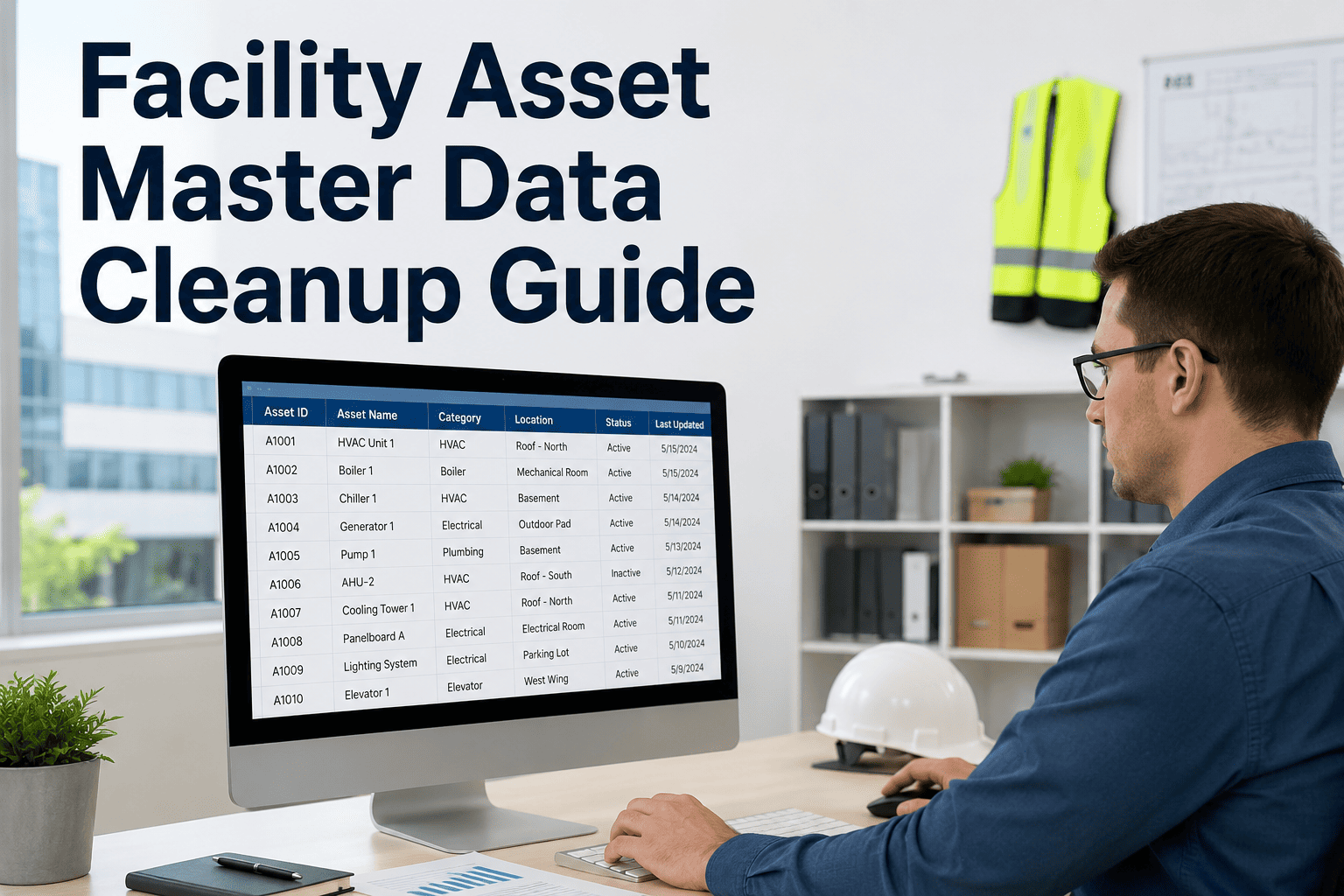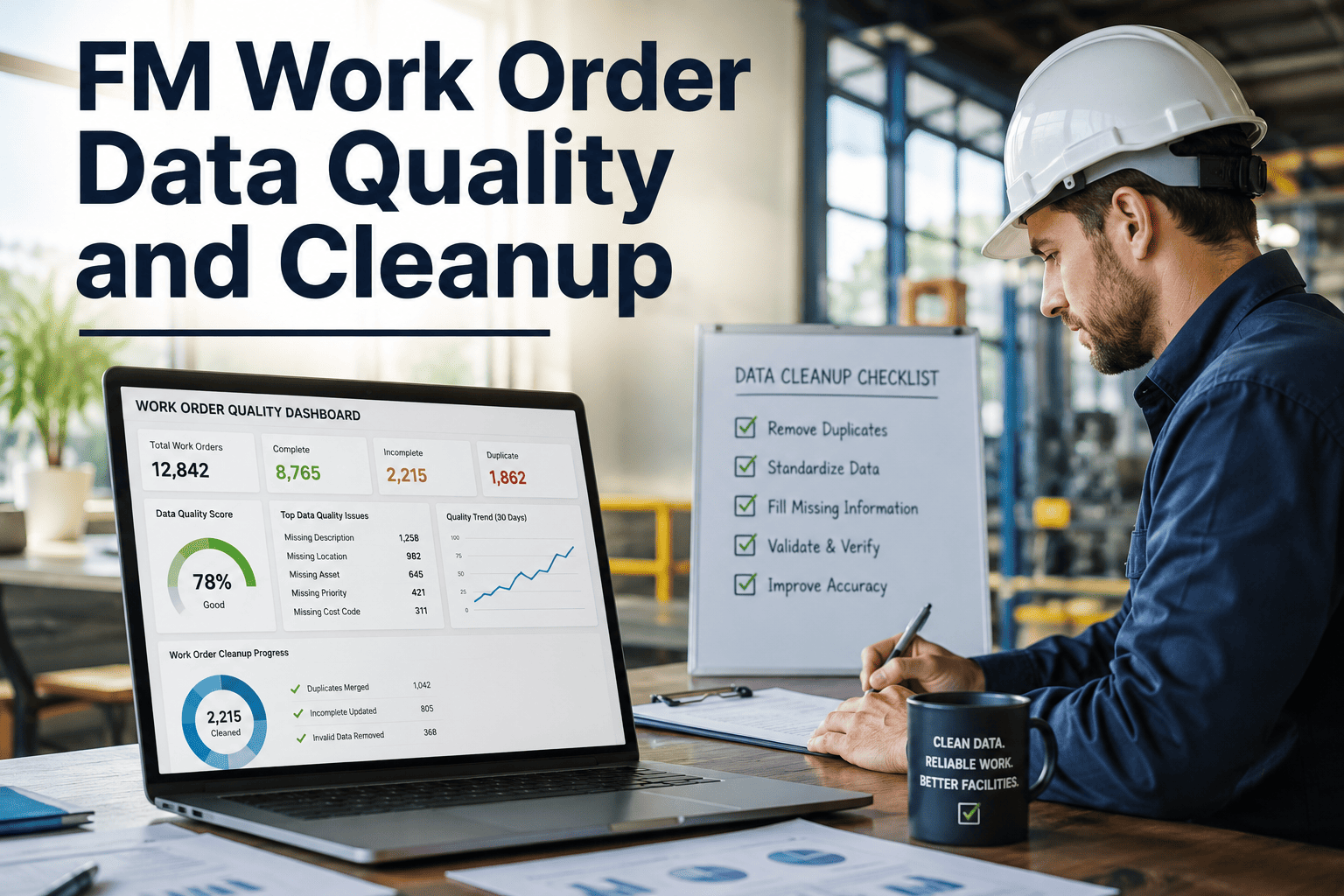
FM work order data quality is the single biggest factor that determines whether your maintenance analytics, KPIs, and AI-driven predictions produce actionable insights or misleading noise. After even three to five years of reactive logging, most facility portfolios accumulate thousands of free-text work orders riddled with typos, missing asset IDs, and vague resolution notes — making it impossible to calculate reliable MTBF, MTTR, or OEE. Cleaning up that facility work order data through standardization, validation rules, and structured taxonomy turns dormant historical records into a reliable foundation for predictive maintenance and compliance reporting. If you want to stop guessing and start making evidence-based reliability decisions, Start Free Trial with OxMaint and see your cleaned data power real analytics in days, not months.
Is Dirty Work Order Data Quietly Wrecking Your Maintenance Analytics?
Years of free-text entries, duplicate asset names, and missing failure codes don't just look messy — they make MTBF, MTTR, and OEE reports unreliable, and they poison AI models before they even start. OxMaint standardizes your historical FM work order data so your reporting and predictive analytics have something solid to stand on.
Why FM Work Order Data Quality Makes or Breaks Your Analytics
When technicians type free-text descriptions like "pump broken" or "fixed it," your CMMS captures noise, not knowledge. Over a five-year period, a typical 500-asset facility accumulates over 15,000 work orders — and without enforced data standards, up to 60% of them lack a proper failure code, asset tag, or root-cause note. This breaks downstream reporting and makes AI-driven predictive maintenance impossible.
A 180-asset commercial facility spending $42K annually on reactive repairs discovered during a data audit that 40% of their HVAC work orders referenced three different spelling variations of the same rooftop unit. Their "top failing asset" report was wrong for three consecutive years because the data was fragmented. OxMaint's FM data hygiene tools normalize those records automatically — merging duplicates, mapping free text to ISO 14224 failure codes, and rebuilding a trustworthy audit trail.
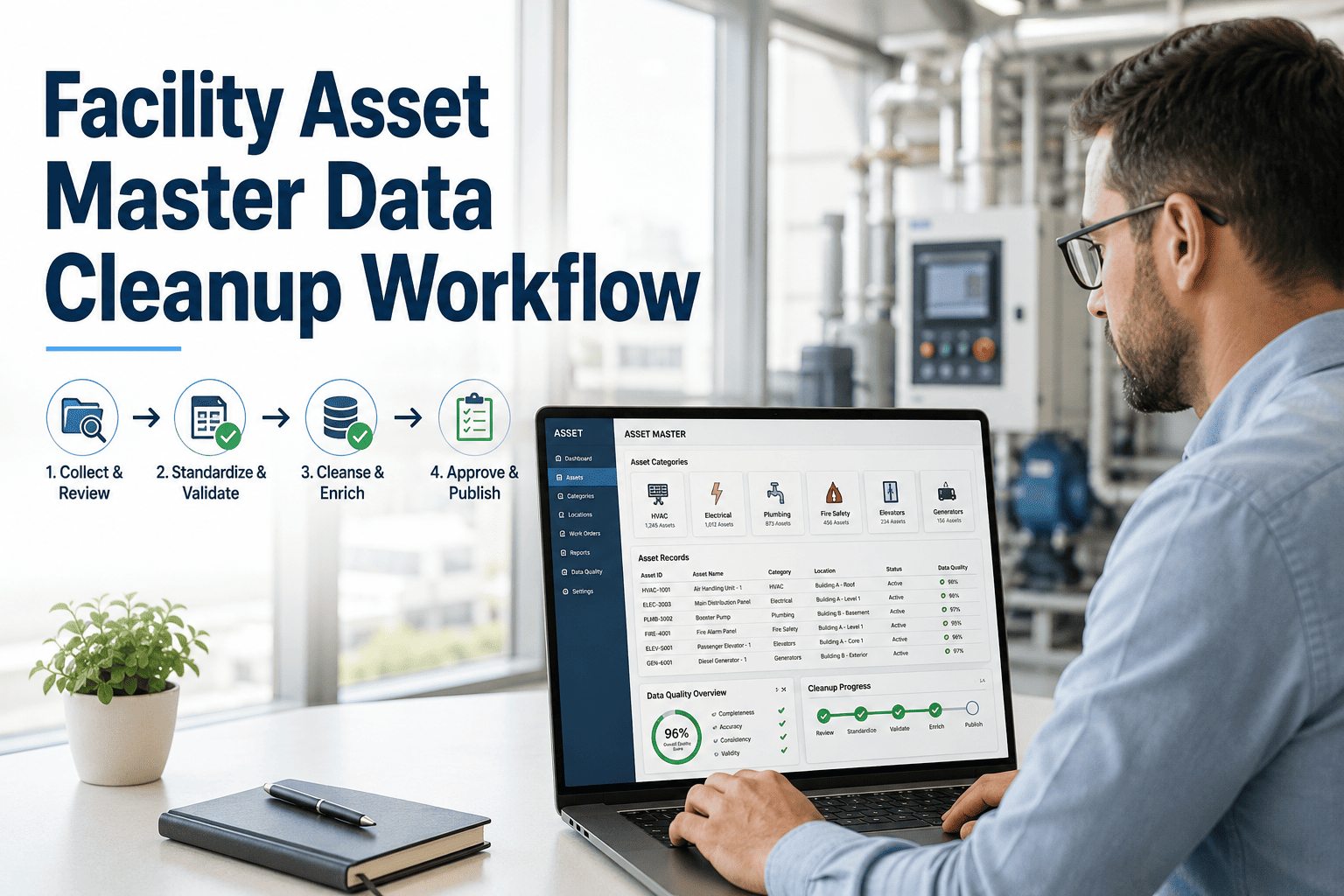
How to Clean Up FM Historical Work Order Data in 4 Phases
Facility data remediation is not a weekend project — it is a phased methodology. Follow this timeline to take your work order data from chaotic to audit-ready in 90 days.
Export all work orders from the last 36 months. Score each record on five dimensions: asset ID completeness, failure-code presence, labor-hours logged, parts consumed, and resolution-note clarity. Most facilities find a baseline data-health score below 45%.
Build a hierarchical asset naming convention aligned with ISO 14224. Map every free-text asset reference to a canonical record. OxMaint's AI engine auto-suggests merges using fuzzy matching, cutting manual deduplication time by 80%.
Map free-text problem descriptions to a standardized failure-mode taxonomy. Train technicians on the new mandatory drop-down fields. Use OxMaint's natural-language processing to backfill historical records — converting "pump making noise" into "Failure Mode: Abnormal Noise / Component: Bearing."
Activate mandatory-field validation rules so no new work order can close without a failure code, labor entry, and structured resolution. Schedule monthly data-quality dashboards. OxMaint blocks incomplete submissions at the source — mobile or desktop.
What Work Order Data Standardization Looks Like Before & After
Below is a real anonymized example from a logistics facility that cleaned up 8,200 historical work orders using OxMaint's FM data cleansing engine. The transformation turned unusable free text into structured, queryable, AI-ready records.
Problem: "RTU 2 acting up again"
Asset: (blank)
Failure Code: N/A
Resolution: "fixed it, replaced thing"
Parts: (not logged)
Labor Hours: 0
Unqueryable · AI-unusable
Problem: Insufficient Cooling
Asset: RTU-BLDG2-02
Failure Code: FM-12 / Refrigerant Leak
Resolution: Replaced condenser coil, recharged R-410A
Parts: Coil-Condenser-X3 · R-410A 25lb
Labor Hours: 4.5
Queryable · AI-ready · Audit-compliant
Stop Letting Dirty Data Undermine Your Reliability Program
See how OxMaint standardizes your facility work order data, enforces quality at the source, and unlocks trustworthy analytics — all in a 30-minute personalized walkthrough.
How OxMaint Solves FM Data Quality at the Source
OxMaint doesn't just give you a blank database — it actively cleans, validates, and governs your work order data so your facility team can trust every report, dashboard, and AI prediction. Here is how four core capabilities map directly to the data-quality problem:
OxMaint's NLP engine scans thousands of historical free-text work orders and maps them to standardized ISO 14224 failure codes and asset hierarchies — cutting manual cleanup time by up to 80%.
Configurable rules block any work order from closing without a failure code, labor entry, parts log, and structured resolution note — enforcing FM data hygiene at the point of entry on mobile or desktop.
Monitor a live data-health score across your portfolio — tracking completeness, accuracy, and standardization rates by site, asset class, and technician so you can intervene before quality degrades.
Once your historical work order data is standardized, OxMaint's predictive models identify failure patterns and recommend preventive interventions — something impossible on free-text garbage.
Facility Data Cleanup Checklist: 8 Must-Fix Items
Use this scannable checklist to assess your current FM work order data health. If more than two of these are unchecked, your analytics are already compromised.
What Changes After FM Data Quality Improvement
"We had 12,000 work orders with 400 different spellings of the same 80 assets. OxMaint's AI engine cleaned and merged everything in under a week. Our MTBF reporting finally matches what the floor team actually experiences."
"The mandatory validation rules alone changed our culture. We went from 60% incomplete work orders to near-zero. The audit-readiness alone justified the switch from spreadsheets."
Frequently Asked Questions About FM Work Order Data Cleanup
The primary cause is allowing free-text entry in fields that should be controlled drop-downs — asset names, failure codes, and resolution notes. When technicians type "pump broken" instead of selecting a standardized failure mode, that record becomes unqueryable. Other causes include lack of mandatory-field validation, duplicate asset records created over years, no enforced naming convention, and high technician turnover without onboarding on data standards.
For a mid-sized facility with 5,000–15,000 historical work orders, a full remediation project takes 8–12 weeks when done manually. With OxMaint's AI-powered cleansing engine, the same volume can be standardized in 3–5 days, followed by 2–3 weeks of technician training and governance rollout. The key is treating it as a phased project: audit, standardize, remediate, then enforce.
Yes. OxMaint runs its data-cleansing engine on a copy of your historical records in parallel with live operations, so technicians continue logging new work orders without interruption. Once the cleaned dataset is validated, it replaces the old records during a scheduled cutover. You can Book a Demo to see exactly how this migration works on a dataset like yours.
AI models learn patterns from historical records. If 60% of those records have missing failure codes, inconsistent asset names, or vague resolution notes, the model cannot distinguish a bearing failure from a refrigerant leak — so it either predicts nothing useful or produces false positives. Standardized, coded, complete data is the non-negotiable prerequisite for any predictive maintenance initiative.
ISO 14224 is the international standard for collection and exchange of reliability and maintenance data for equipment, and it is the most widely adopted framework for standardizing failure modes, asset hierarchies, and maintenance event types. OxMaint ships with ISO 14224 failure-mode taxonomies built in, and also supports custom taxonomies for industries with specialized coding requirements like FMCSA-compliant fleet operations.
Turn Your Work Order Data Into Your Most Reliable Asset
Clean historical records, enforce quality at the source, and unlock analytics and AI you can actually trust. Start with OxMaint today — your reliability program will never look back.
Free 14-day trial · No credit card