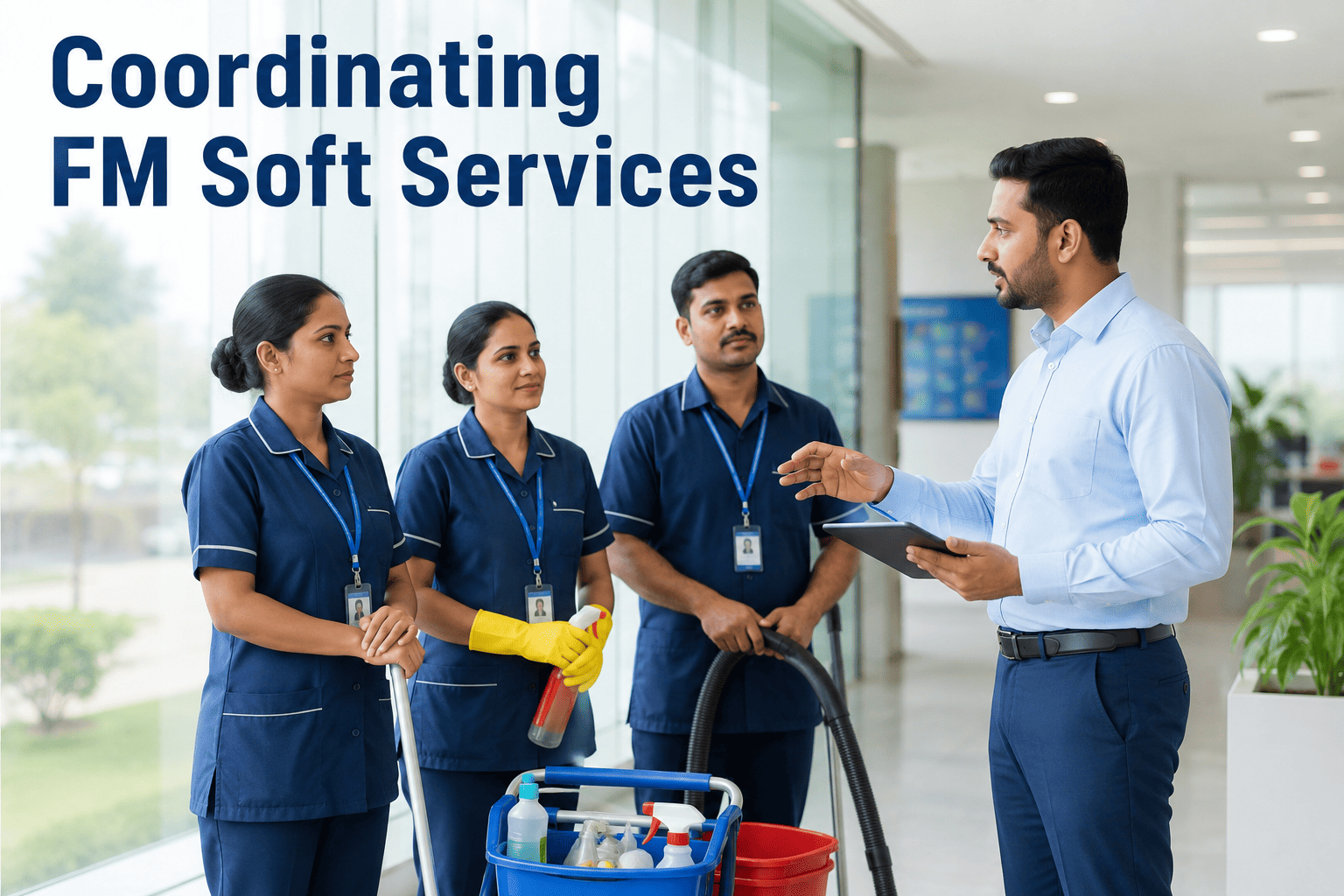
FM soft services — cleaning, catering, and security — run on entirely different rhythms, yet occupants judge them as a single experience. Effective FM soft services coordination aligns these people-facing services so the workplace feels seamless rather than fragmented. When soft services facility management is uncoordinated, the gaps show up as dirty meeting rooms right before executive reviews, cold food at peak service windows, and security patrols that miss unlocked doors. This guide breaks down how to coordinate FM soft services delivery — vendor integration, quality control, and the operational rhythm that keeps everything aligned — and how OxMaint turns disjointed vendor logs into one auditable, occupant-ready service record. You can Start Free Trial to see the unified workflow before you finish reading.
FM SOFT SERVICES COORDINATION
Three services. One occupant experience. Zero dropped handoffs.
Cleaning, catering, and security each follow their own schedules — but the occupant only sees whether the workplace works. Coordinating soft services facility management means aligning those rhythms into one accountable, auditable service record.
THE COORDINATION PROBLEM
Why soft services feel seamless to occupants — or don't
Occupants never experience "cleaning," "catering," and "security" separately. They experience one workplace — and when facility soft services coordination breaks down, they blame the building, not the vendor.
Cleaning
Runs on fixed cycles — daily, weekly, deep-clean — but must flex around occupancy spikes, catering events, and security access windows. A delayed clean before a 9 AM catering setup creates the exact complaint occupants remember.
Catering
Runs on the clock — service windows, temperature holds, allergen logs. When catering overlaps cleaning or security rotations without coordination, food sits cold, rooms stay dirty, and service-level penalties trigger within minutes.
Security
Runs 24/7 with patrol checkpoints, access-control events, and incident escalations. Security unlocks rooms that cleaning hasn't finished, locks areas catering still needs — and logs every mismatch in an incident report someone reads tomorrow.
REAL-WORLD SCENARIO
What misaligned soft services actually cost a facility
Consider a 12-floor corporate campus with 1,800 daily occupants, three soft-service vendors, and a facilities team running coordination on shared spreadsheets and WhatsApp groups.
The services themselves were performing. The coordination layer — the part occupants actually feel — was broken. That's the gap FM soft services management exists to close.
COORDINATION FRAMEWORK
How to coordinate FM soft services into one service experience
Effective facility soft services coordination follows a four-stream model. Each stream runs independently but feeds a single service record, so every cleaning task, catering setup, and security patrol is visible to the FM team in real time.
Service Integration
Map every soft-service task to a shared schedule so cleaning, catering, and security see each other's windows. A catering setup at 8:30 AM automatically triggers a cleaning completion check at 8:15 AM and a security unlock at 8:00 AM — no phone calls, no missed handoffs.
Vendor Management
Hold each vendor to the same work-order structure, SLA definitions, and escalation rules. When every vendor logs tasks in one CMMS — not three disconnected portals — the FM team can compare performance apples-to-apples and penalise or reward based on data, not noise.
Quality Control
Run standardised checklists for each service type — cleaning inspection forms, catering temperature logs, security patrol confirmations — attached to the work order that triggered them. Quality scores feed vendor scorecards automatically, so performance reviews take minutes instead of days.
Operational Rhythm
Establish a daily FM operational rhythm: morning briefing on overnight security events, midday catering and cleaning status review, end-of-day SLA dashboard check. This rhythm is what keeps soft services FM operations aligned into a coherent occupant experience rather than three siloed contracts.
QUALITY & SLA CONTROL
Soft service delivery FM: what to measure and when
If you can't measure soft-service coordination, you can't improve it. These are the metrics that separate facilities running coordinated soft services from those running three vendors in parallel and hoping for the best.
| Service Stream | Key Coordination Metric | Target | Measurement Cadence | Owner |
|---|---|---|---|---|
| Cleaning | Room-ready-before-event rate | ≥ 98% | Per event | Cleaning supervisor |
| Catering | Service-window start variance | ≤ 3 min | Per service | Catering lead |
| Security | Patrol checkpoint completion | 100% | Per shift | Security controller |
| Cross-service | Inter-vendor handoff delay | ≤ 5 min | Daily aggregate | FM coordinator |
| Occupant experience | "Room not ready" complaints | ≤ 2 / quarter | Monthly review | Facilities manager |
| Compliance | Unified audit trail coverage | 100% | Quarterly audit | Facilities director |
PRODUCT FIT
How OxMaint coordinates FM support services into one platform
OxMaint is an AI-powered CMMS and EAM platform built for maintenance and reliability teams — and it treats soft services the same way it treats critical assets: every task is a tracked work order, every vendor is accountable, and every handoff is logged. Here's what changes when soft services move from spreadsheets to OxMaint.
Unified Work Orders for Every Vendor
Cleaning, catering, and security tasks all flow through one work-order system. Each task carries its SLA, assigned vendor, required checklist, and photo evidence — so the FM team sees a single timeline instead of three inboxes.
Trigger-Based Task Chaining
Link tasks across services: when a cleaning work order closes, OxMaint can auto-trigger the catering setup work order and notify security to unlock. No manual handoffs, no phone trees, no "I thought you were handling it."
Mobile Checklists & Photo Evidence
Vendors complete inspection forms, temperature logs, and patrol confirmations on their phone — attached to the work order that triggered them. Every checklist is timestamped, geotagged, and stored in an audit-ready trail.
Real-Time SLA & Vendor Scorecards
OxMaint tracks on-time completion, checklist pass rates, and complaint correlations per vendor — automatically. Vendor performance reviews take minutes because the data is already compiled, scored, and trended.
VENDOR PERFORMANCE
Facility support services: measuring what occupants feel
Coordinated soft services management facility teams trust comes down to one question: can you see — in a single dashboard — whether every vendor hit their SLA today? If the answer requires opening three vendor portals and a spreadsheet, the coordination layer is the problem.
"We cut 'room not ready' complaints from 31 to 4 in one quarter. The services didn't change — the coordination did. OxMaint made every handoff visible."
"Our ISO 41001 audit took a day instead of a week. Every cleaning checklist, catering temperature log, and security patrol was already in OxMaint — timestamped and searchable."
See how OxMaint aligns your soft services — book a 30-minute demo
Walk through a live workspace where cleaning, catering, and security work orders share one timeline, one SLA dashboard, and one audit trail. Bring your vendor list.
FAQ
FM soft services coordination: common questions
What are FM soft services and how do they differ from hard services?
FM soft services are people-facing, non-engineering services — primarily cleaning, catering, and security — that occupants experience directly. Hard services (HVAC, electrical, plumbing) keep the building running mechanically. Soft services shape how the workplace feels; coordinating them is what turns three vendor contracts into one seamless occupant experience.
How do you coordinate cleaning, catering, and security in one facility?
Coordinate them through a shared work-order system where each service's tasks are linked by triggers — a completed cleaning task opens the catering setup, which notifies security to unlock. Run a daily FM rhythm: morning security review, midday service check, end-of-day SLA dashboard. OxMaint automates the trigger layer so handoffs happen without phone calls — you can Start Free Trial to test it on your vendors.
What metrics should facility soft services coordination track?
Track room-ready-before-event rate (cleaning), service-window start variance (catering), patrol checkpoint completion (security), inter-vendor handoff delay (cross-service), and "room not ready" complaints (occupant experience). The first four predict the fifth — if handoff delays are climbing, complaints will follow within a week.
Can a CMMS manage soft services or is it only for maintenance?
A modern CMMS like OxMaint manages soft services effectively because it treats every task — cleaning inspection, catering setup, security patrol — as a tracked work order with SLA, checklist, photo evidence, and vendor accountability. The same work-order engine that schedules preventive maintenance can chain a cleaning completion to a catering trigger and log the security unlock.
How long does it take to implement FM soft services coordination software?
Most facilities are live on OxMaint within 2–4 weeks: vendor onboarding takes a few days, checklist configuration maps to your existing SLA documents, and the trigger chains are built from your current service schedule. Switching from spreadsheets is faster than switching from another CMMS because there's no data migration conflict — just import your vendor list, asset register, and SLA targets.
READY TO COORDINATE?
Turn three vendors into one service experience
Stop reconciling three vendor portals. Give every cleaning task, catering setup, and security patrol one timeline, one SLA dashboard, and one audit trail — in OxMaint.
Free 14-day trial · No credit card