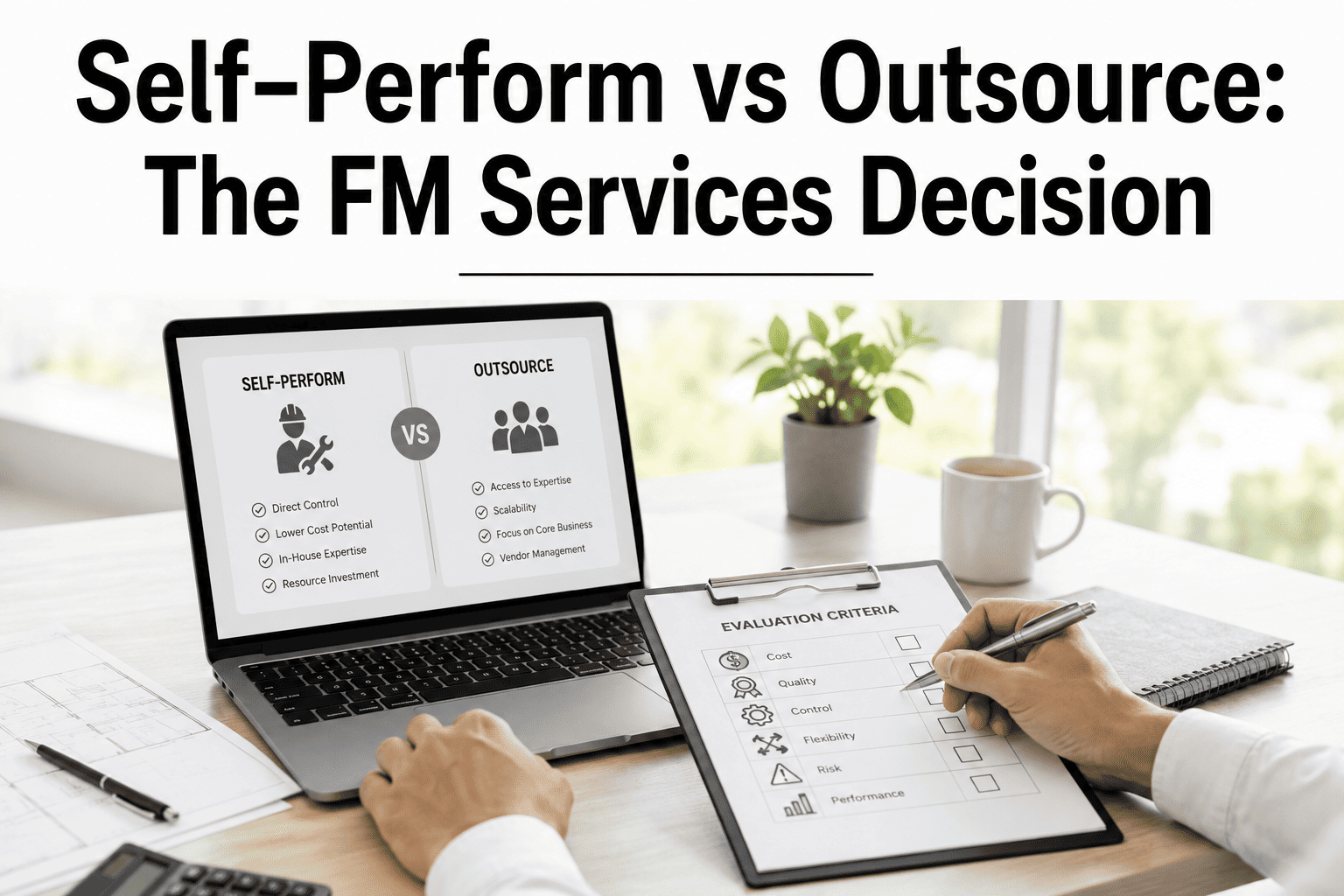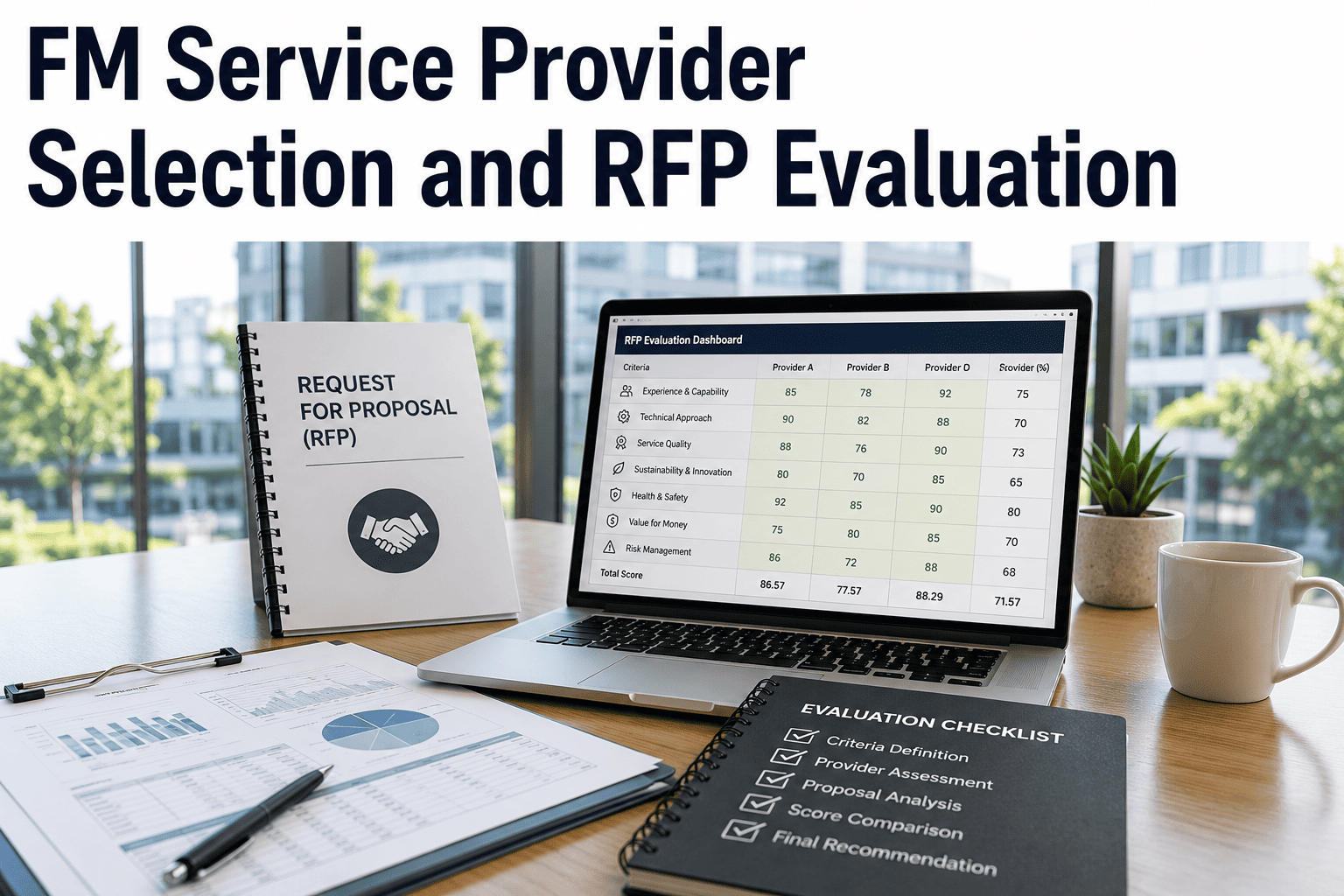
FM service provider selection through a structured RFP process is one of the highest-value procurement decisions in a real estate portfolio, often locking in service quality, operational risk, and cost trajectories for three to five years. A weak facility management RFP evaluates only headline pricing, leading to change orders, compliance gaps, and equipment neglect that cost far more than the initial savings. This guide breaks down the FM RFP evaluation criteria, weighted scoring models, and provider verification strategies that consistently produce long-term, high-performing facility services partnerships. To see how modern maintenance software can give you the data to hold any provider accountable, you can Start Free Trial with OxMaint today.
Is your next facility management RFP buying years of reliable service — or years of hidden costs?
Over 60% of FM partnerships fail to meet expectations because the RFP evaluation criteria rewarded low bids over technical competence, SLA rigor, and data transparency. Selecting the right FM service provider requires a weighted scoring methodology that predicts real-world performance.
How to structure an FM RFP that filters out weak providers
A high-performing facility services RFP moves beyond a generic scope of work. It forces bidders to commit to specific technical processes, staffing models, KPIs, and technology integration capabilities before price is ever evaluated.
Portfolio & Asset Baseline
Require bidders to analyze your asset registry, equipment criticality, and historical work order volume. Providers cannot price risk accurately without an ISO 55000-aligned asset baseline.
SLA & KPI Definition
Define exact response times, first-time-fix rates, and uptime targets. Award points to FM providers who offer liquidated damages for missing critical compliance and maintenance KPIs.
Technical & Methodology Review
Evaluate their preventive maintenance schedules, spare parts inventory strategy, and safety protocols (e.g., OSHA compliance). Do they rely on reactive fixes or predictive maintenance analytics?
Technology & Data Integration
Mandate that the FM provider uses a modern CMMS or EAM platform. If they cannot integrate with your work order system and provide real-time dashboards, eliminate them from the FM bid evaluation.
FM RFP criteria: Building a weighted scoring model
Price-only evaluations consistently select the least capable provider. A defensible FM procurement RFP uses a weighted scoring matrix to quantify qualitative capabilities and technical rigor.
| Evaluation Category | Weight | What to Verify in the FM RFP |
|---|---|---|
| Technical & PM Methodology | 35% | Evidence of preventive maintenance schedules, OEM compliance, and root-cause failure analysis protocols. |
| Compliance & Safety | 25% | OSHA records, incident rates (TRIR), environmental compliance, and technician certification tracking. |
| Technology & Integration | 20% | Use of a modern CMMS, mobile work order access, IoT/predictive capabilities, and API integration readiness. |
| Price & Total Cost | 20% | Transparent labor rates, material markups, and a 5-year total cost of ownership (TCO) projection. |
FM bid evaluation in practice: A worked scenario
Consider a 180-asset commercial portfolio spending $42K annually on reactive maintenance. The procurement team issues a facility management RFP to four providers. Here is how a weighted evaluation reveals the true long-term cost.
Annual Cost: $38,000
Scored high on price (20pts) but failed technology and PM methodology checks. They use spreadsheet tracking. Within 18 months, untracked HVAC failures lead to $15K in emergency repair premiums and tenant dissatisfaction.
Annual Cost: $46,000
Scored highest in technology (CMMS integrated) and PM methodology. Slightly higher upfront cost, but predictive maintenance alerts prevent catastrophic HVAC failures and reduce unplanned downtime by 35%.
The lowest bid cost 25% more over five years. Effective FM supplier selection requires modeling these long-term impacts, which is impossible without requiring bidders to submit their maintenance data and technology stack as part of the RFP.
How OxMaint strengthens your FM provider evaluation
You cannot hold an FM service provider accountable without real-time data. OxMaint provides the AI-powered CMMS infrastructure to track provider performance, validate SLA compliance, and manage asset health from day one of the contract.
SLA & KPI Tracking
Automatically track response times, first-time-fix rates, and work order completion against the exact SLAs defined in your RFP. Eliminate manual reporting disputes and enforce liquidated damages with verified audit trails.
Predictive Analytics
Require providers to act on data, not just react. OxMaint uses AI to predict equipment failures before they happen, helping your chosen FM provider shift from reactive repairs to preventive maintenance—cutting unplanned downtime by up to 50%.
Spare Parts Inventory
Stop paying hidden material markups. OxMaint tracks spare parts consumption down to the asset level, giving you full visibility into provider procurement and ensuring critical parts are always in stock for high-priority assets.
Compliance & Audit Readiness
Maintain ISO 55000 and OSHA compliance effortlessly. Every work order, safety check, and technician certification is logged digitally, giving you instant proof of compliance for insurance and regulatory audits.
See how OxMaint enforces your FM service agreements
Stop relying on provider-generated reports. Bring your own CMMS data to the next facility management tender evaluation and negotiate from a position of strength.
Facility management RFP evaluation: Common questions
What is the most important criteria in FM service provider selection?
While price matters, technical methodology and technology integration are the most critical criteria in FM service provider selection. A provider using a modern CMMS with preventive maintenance analytics will consistently deliver lower total cost of ownership than a cheaper provider relying on reactive fixes and spreadsheets.
How do you weight price in a facility services procurement RFP?
Price should rarely exceed 20% to 25% of the total weighted score in a facility services procurement RFP. Over-weighting price incentivizes providers to underbid and recover margins through change orders, deferred maintenance, and cheap labor that compromises service quality and safety compliance.
How can I verify an FM provider's references during tender evaluation?
Go beyond the provider's curated reference list. Ask for access to their actual CMMS dashboards or recent work order data from similar portfolios. To easily track and verify this data, you can Start Free Trial with OxMaint and require your shortlisted providers to log their trial performance directly into the platform.
What technology should an FM provider bring to an FM RFP?
Any competitive FM provider responding to a facility management tender must utilize a robust CMMS or EAM platform. Essential features include mobile work order access, asset lifecycle tracking, real-time KPI reporting, and predictive maintenance capabilities. If they cannot integrate with your systems, they are not qualified for a modern portfolio.
What is the standard contract length for a facility management provider?
Standard FM contracts typically run for three to five years, often with annual performance review clauses. This length allows the provider to implement preventive maintenance schedules and realize lifecycle improvements, while giving the client enough time to evaluate KPIs, SLA adherence, and total cost of ownership before renewing.
Upgrade your maintenance operations with OxMaint
Whether you are evaluating new FM providers or bringing maintenance in-house, OxMaint gives you the AI-powered tools to eliminate downtime and control costs.
Free 14-day trial · No credit card required