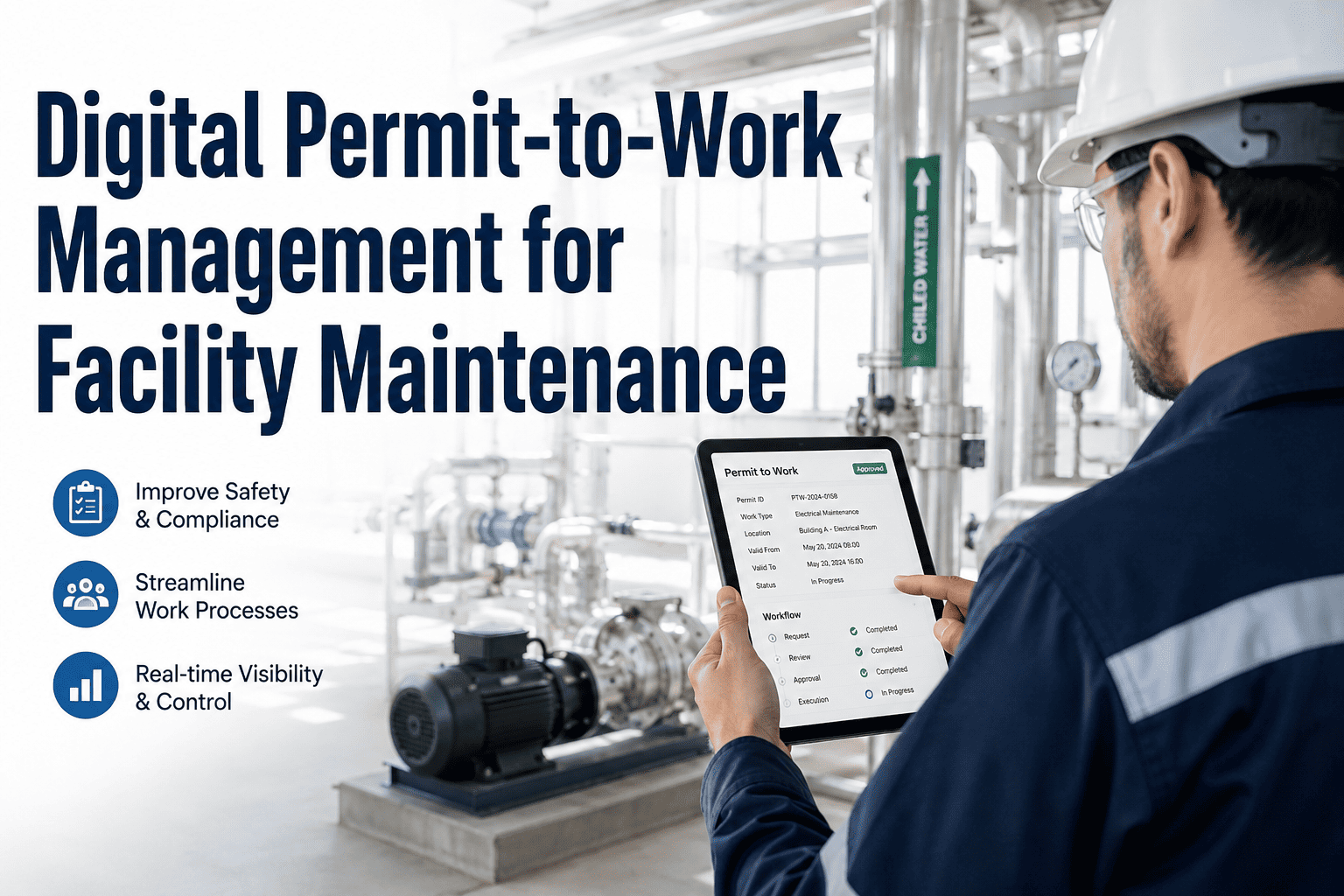
Permit to work FM systems are the operational safety discipline that prevents contractors and staff from being killed or injured during high-risk building work — hot works, confined-space entry, live electrical isolation, work at height, and similar hazardous tasks. A facility permit to work system formalises exactly who is authorised to do what, when, and under which controls, closing the gap between a contractor showing up on site and a controlled, risk-assessed task being executed. FM health safety compliance failures are among the most cited causes of catastrophic building loss: uncontrolled hot works alone account for a significant share of major non-residential fires every year. OxMaint digitises the entire FM permit system — from permit application and risk assessment through isolation verification, sign-off, and audit trail — so facility health safety management becomes provable rather than hoped for. Start your Start Free Trial today and see how a digital permit to work system changes your risk profile within the first week.
One unpermitted hot-work job is all it takes to lose a building.
Paper permit books, verbal authorisations and WhatsApp approvals are not FM safety systems. OxMaint digitises every permit to work contractor facility workflow — application, risk assessment, isolation lockout, gas-test verification, and sign-off — so nothing high-risk starts without documented, auditable control. Stop hoping your facility safety compliance FM process holds. Make it provable.
What a facility permit to work system actually controls
An FM permit system is not a form. It is a gated, authorise-verify-execute-sign-off workflow that prevents high-risk work from starting until every safety condition is met and an accountable authoriser has signed. The six permit categories below account for over 95% of facility safety permit activity in commercial and industrial buildings.
Hot Works
Welding, cutting, grinding, brazing, soldering, and any spark or heat-producing task. Requires gas-free verification, fire-watch posting for the duration plus 60 minutes after, removal of combustibles within a 10-metre radius, and a documented fire-extinguisher check before approval.
Confined Space Entry
Tanks, ducts, risers, manholes, ceiling voids, and plant rooms with restricted access. Mandates atmospheric testing (oxygen, LEL, toxic gases), a standby attendant, rescue plan, two-way communication, and continuous monitoring throughout the entry period.
Live Electrical Isolation
Work on or near energised switchgear, busbars, transformers, and distribution panels. Requires documented Lock-Out/Tag-Out (LOTO), voltage verification at the point of work, earth bond applied, and a Permit-To-Test sub-permit where energised testing is necessary.
Work at Height
Tasks above 2 metres — roof access, MEWP operation, scaffold work, ladder use beyond short duration. Controls include fall-arrest equipment inspection, anchor-point verification, exclusion zones below, rescue plan, and weather-condition limits documented on the permit.
Mechanical Isolation
Work on rotating equipment, pressurised systems, steam lines, chilled-water circuits, and conveyor systems. Requires double-block-and-bleed or full isolation, stored-energy release verification, valve lock-off, and a system status confirmation before work commences.
Ground Disturbance & Excavation
Digging, core drilling, and penetration of slabs or ground. Mandatory utility scans (electromagnetic, GPR), permit-to-dig register, hand-dig zones within 500 mm of services, shoring for excavations over 1.2 m, and battering or trench-box verification.
Paper permit to work systems vs digital FM permit software
Most facility health safety management gaps are not caused by missing rules — they are caused by paper systems that cannot verify compliance in real time. Here is how a paper-based permit to work building process compares to OxMaint's digital FM permit system across the audit-critical control points.
| Control Point | Paper Permit Book | OxMaint Digital Permit System |
|---|---|---|
| Permit Application | Contractor fills carbon-copy form by hand; FM chases signatures in person; 30–45 min average. | Mobile or web application with pre-loaded risk templates; auto-populates asset, location, and contractor data in under 12 minutes. |
| Risk Assessment Verification | Generic RAMS stapled to permit; method statement rarely checked against the specific task on the day. | Task-specific risk questions mandatory before submission; system blocks progress if any control is unverified. |
| Authoriser Approval | Physical signature required; if the authoriser is off-site the job either starts without a permit or is delayed. | Role-based digital approval from any device; authoriser sees full risk context, gas-test results, and isolation status before signing. |
| Isolation & LOTO Tracking | Lock-off recorded on a whiteboard or loose sheet; no verification that the lock was actually applied at the point of work. | Each isolation point logged with photo evidence, lock number, and applied-by timestamp; verified before permit activates. |
| Gas Test / Atmosphere Check | Contractor writes a number on the permit; no proof of when, where, or with which calibrated instrument. | Gas-test result entered with timestamp, instrument serial, and geo-tag; out-of-range readings block permit activation automatically. |
| Permit Closure & Audit Trail | Closure form often filed days later or lost; audit requires manually searching boxes of carbon copies. | Digital closure with return-to-service confirmation; full audit trail — every field, signature, photo, and timestamp — exportable in one click for any date range. |
| Permit Suspension Management | If work stops overnight or conditions change, re-validation is informal; permits often stay "open" for days. | Permit suspends automatically at shift end or on condition change; re-validation requires fresh gas test and authoriser re-approval before work resumes. |
How a digital FM permit to work system controls risk at every stage
A permit to work contractor facility workflow is only as strong as its weakest gate. OxMaint enforces a six-stage sequence — each stage electronically gated to the previous one — so no high-risk task can bypass a control point without a visible, auditable exception.
Permit Application & Task Scoping
Contractor submits permit via mobile app, selecting the asset, location, work type, and planned duration. OxMaint auto-loads the asset's isolation points, hazard register, and previous permit history so the application starts with full context — not a blank form.
Dynamic Risk Assessment
The system presents task-specific risk questions: Is gas detection required? Are combustibles removed? Is fall protection needed? Any "yes" answer triggers mandatory control fields. Incomplete risk assessments cannot be submitted — the system physically prevents advancement.
Isolation & LOTO Verification
Each isolation point is photographed, tagged with a lock number, and confirmed by the isolator. For electrical work, voltage verification at the point of work is recorded. No permit moves to "Active" until every isolation is verified with evidence.
Authoriser Sign-Off
The duty authoriser reviews the complete permit package — risk assessment, isolation evidence, gas-test results, contractor competence records — on their device and either approves, rejects with comments, or requests modification. Digital signature with timestamp and geo-location.
Controlled Execution & Monitoring
Permit is "Active" — work proceeds under the documented controls. Fire-watch, gas-monitoring, or standby-attendant roles are assigned and confirmed. If conditions change (weather shift, system pressure detected, alarm triggered), the permit auto-suspends and requires re-validation.
Closure & Return to Service
Contractor confirms work complete, all tools removed, isolations removed in reverse order, and area inspected. The authoriser closes the permit with a return-to-service declaration. The full record — every field, photo, signature, and timestamp — is archived permanently for audit.
See how OxMaint digitises your permit to work system in 30 minutes
Book a demo and we will walk you through a live hot-works permit — from application to closure — on your own asset hierarchy. You will see exactly how isolation evidence, gas-test verification, and authoriser sign-off work in a real FM safety compliance workflow.
How OxMaint delivers FM health and safety compliance that holds up under audit
OxMaint replaces paper permit books, spreadsheets, and disconnected approval chains with a single AI-powered CMMS platform that enforces your permit to work system facility rules — and proves it with an immutable audit trail. Four capabilities, each with a measurable safety and compliance outcome.
Digital Permit Builder with Risk Gate Logic
Configurable permit templates for all six high-risk categories. The system blocks submission until every mandatory control field is completed — no more permits issued with blank risk assessments or missing gas-test readings.
Outcome: 100% of permits carry a complete, task-specific risk assessment before approvalIsolation & LOTO Verification with Photo Evidence
Every isolation point — electrical, mechanical, pneumatic — is photographed, tagged with a lock number and isolator name, and time-stamped. The permit cannot activate until all isolations are verified, eliminating the "lock was on the board" ambiguity.
Outcome: Zero unverified isolations — every LOTO point has photo and timestamp proofReal-Time Compliance Dashboard
Live visibility of every active, suspended, and expired permit across all facilities and contractors. Overdue permits, missing re-validations, and expired contractor competence certificates trigger automatic alerts to the FM team before they become audit findings.
Outcome: Audit-ready in minutes — export any permit, any date range, any site in one clickContractor Competence & Insurance Tracking
No permit is issued to a contractor whose competence certificate, insurance, or RAMS has expired. OxMaint maintains a live contractor register linked to every permit — so you know before approval that the welder is certified, insured, and inducted.
Outcome: No permit issued to an unqualified or uninsured contractor — everThe cost of a paper permit: a worked facility example
Consider a 12-building corporate campus running 340 high-risk permits per year on a paper-based FM permit system. A typical hot-works permit takes 45 minutes to process manually, requires three physical signatures across two buildings, and has a 15% re-issue rate because of incomplete risk assessments or missing gas-test data. During their last insurance audit, the FM team could produce complete, closed permit records for only 68% of the previous year's high-risk work — the rest were lost, illegible, or never formally closed.
The same campus migrated to OxMaint's digital permit to work FM system in six weeks. In the first post-migration audit, the insurance assessor reviewed three years of permit records in under 20 minutes — every permit, every gas test, every isolation photo, every signature, time-stamped and exportable. The campus's property insurance premium was reduced by 8% at renewal because the documented permit system demonstrably controlled contractor fire risk.
Facility permit to work system: common questions
What is a permit to work system in facility management?
A permit to work system in FM is a formal, documented procedure that controls high-risk maintenance and contractor activities — hot works, confined space entry, electrical isolation, work at height — by requiring a documented risk assessment, defined safety controls, and authorised sign-off before work begins, and formal closure with return-to-service confirmation after work ends. It ensures that no high-risk task starts without verified controls and an accountable authoriser, and that the full record is auditable. OxMaint digitises this entire workflow so every gate is enforced electronically rather than left to a paper form and human diligence.
Who is responsible for issuing a facility safety permit?
A designated Permit Authoriser — typically a senior FM team member, facilities manager, or qualified duty engineer — is responsible for reviewing the risk assessment, confirming that all controls and isolations are in place, and signing the permit before work begins. The authoriser must be competent in the specific hazard category and must not be the person performing the work. OxMaint enforces role-based approval so only an authorised individual can activate a permit, and every approval carries a digital signature, timestamp, and geo-location for audit purposes.
How long is a permit to work valid for in a building?
Most facility permits are valid for a single shift — typically 8 to 12 hours — and must be formally closed or suspended at the end of that period. If work continues across multiple shifts, the permit must be re-validated with a fresh risk assessment, gas test (where applicable), and authoriser approval at the start of each new shift. Permits that remain open overnight without suspension are a common audit failure. OxMaint auto-suspends permits at shift end and requires full re-validation before reactivation — see how it works when you Book a Demo.
Can a contractor start work before the permit is signed?
No. Work must not begin until the permit is fully signed and active. Starting high-risk work without a valid, signed permit is a serious safety violation and, in most jurisdictions, a breach of health and safety law that can result in prosecution, fines, and insurance invalidation. OxMaint prevents this by making the permit status visible to everyone — the contractor sees "Pending" until the authoriser digitally signs, and the system cannot be overridden. A digital permit is either Active or it is not — there is no ambiguous "it was being processed" grey zone.
What records must be kept for FM safety compliance audits?
For each high-risk permit, you must retain the completed risk assessment, method statement reference, isolation records (including LOTO lock numbers and verification), gas-test results with instrument serial numbers, authoriser approval with timestamp, execution monitoring records (fire-watch, standby attendant), and formal closure with return-to-service declaration. These records are typically retained for a minimum of three to five years depending on jurisdiction and insurance requirements. OxMaint archives every field, photo, signature, and timestamp permanently and makes any permit record exportable in one click for any date range — start your Start Free Trial to see the audit export.
Stop running building safety on paper and hope
Every day without a digital FM permit system is a day a contractor could start an uncontrolled hot-works job in your building. OxMaint gives you enforced permit workflows, photo-verified isolations, real-time compliance visibility, and an audit trail that holds up under scrutiny — deployed on your assets in weeks, not months.
Free 14-day trial · No credit card