Facilities running structured preventive maintenance programmes reduce unplanned breakdowns by up to 45% and cut total maintenance costs by 18–25% annually — yet the majority of facility teams still build PM schedules in spreadsheets that cannot enforce task completion, track compliance rates, or integrate manufacturer-recommended service intervals into automated work orders. The gap between having a PM template and having a PM programme that actually executes is where most facilities lose equipment life, budget, and audit readiness. A CMMS-integrated template library turns static checklists into recurring, tracked, and auditable work orders assigned to the right technician at the right frequency — from daily HVAC log checks to annual fire suppression inspections. World-class PM compliance is 90% or higher according to SMRP Best Practices, but facilities relying on manual scheduling typically operate between 55% and 70%, meaning nearly a third of scheduled maintenance is missed every period. Book a demo to see OxMaint's pre-built PM template library configured for your facility systems, or start free today.
Guide · Preventive Maintenance Templates · CMMS Deployment
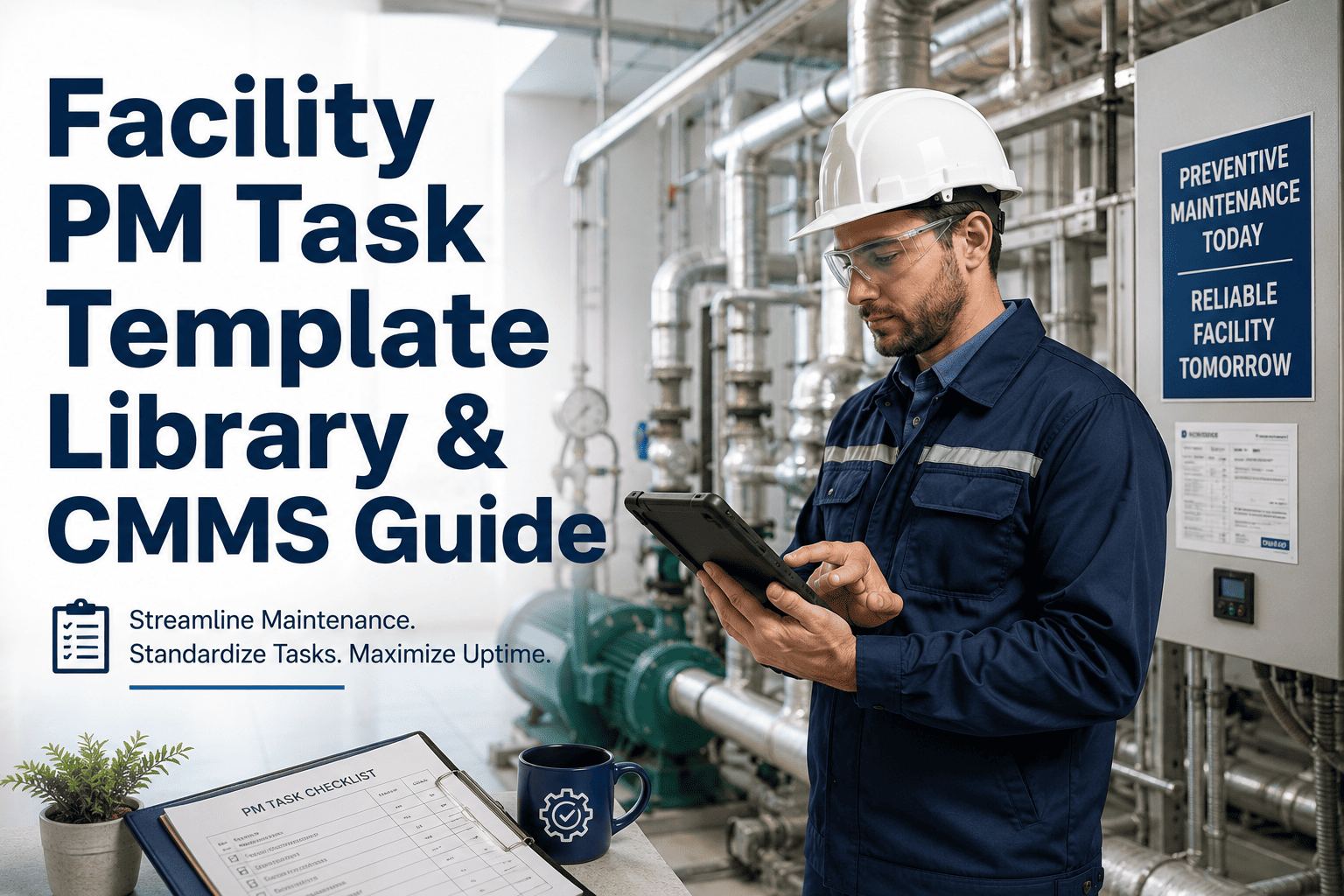
Facility PM Task Template Library and CMMS Guide
Equipment-specific PM checklists, manufacturer-recommended service intervals, frequency-based scheduling, and CMMS-ready templates that turn static documents into automated, tracked, and auditable work orders across every facility system.
18–25%
Annual maintenance cost reduction with structured PM programmes
90%+
World-class PM compliance target (SMRP Best Practices 6th Edition)
545%
Documented ROI per dollar invested in proactive preventive maintenance
Anatomy of a Production-Ready PM Template — 7 Components That Separate Compliance from Chaos
A PM template downloaded from the internet and saved in a shared folder is not a maintenance programme. A production-ready PM template contains seven integrated components that connect scheduling to execution to documentation — and every component must be present before the template can generate consistent, auditable results.
01
Asset Identification
Unique asset ID, location code, manufacturer, model, serial number, and criticality rating (A/B/C) tied to the physical asset. Without this, PM tasks are assigned to equipment categories instead of specific machines — and compliance tracking becomes impossible.
02
Manufacturer Intervals
OEM-recommended service frequencies as the baseline — then adjusted for equipment age, operating hours per day, and consequences of failure. Critical assets like chillers and generators warrant more frequent checks than secondary systems.
03
Task Instructions
Step-by-step procedures with specific tolerances, pass/fail thresholds, and acceptance criteria — not vague instructions like "check motor." A technician reading the template for the first time should know exactly what to measure and what constitutes a failure.
04
Frequency Assignment
Calendar-based (daily, weekly, monthly, quarterly, annual), runtime-based (hours, cycles, production counts), or condition-based (sensor trigger thresholds). Each task mapped to the interval that matches its failure mode — not a single blanket frequency.
05
Skill and Assignment
Each task tagged with the required skill level — in-house technician, licensed contractor, or specialist vendor. Daily and weekly visual checks typically handled internally; quarterly and annual tasks involving electrical testing or certified inspections require licensed contractors.
06
Documentation Requirements
Mandatory fields for each task completion: numeric readings, photos, technician sign-off, time stamps, and parts consumed. A completed PM without documentation is an unverifiable PM — and unverifiable PMs do not survive audits.
07
Compliance Window
A PM is compliant only if completed within 10% of its scheduled interval. A monthly PM (30 days) must be completed within plus or minus 3 days. A quarterly PM within plus or minus 9 days. Tracking compliance without this window definition overstates true execution quality and masks scheduling problems.
PM TEMPLATE LIBRARY · OXMAINT · CMMS DEPLOYMENT
Stop Building PM Schedules in Spreadsheets. Start Running PM Programmes That Execute.
OxMaint ships with pre-built PM templates for HVAC, electrical, plumbing, fire safety, elevators, and every major facility system. Templates are configurable by calendar interval, runtime hours, or condition-based triggers — and every task generates a tracked, assigned, and auditable work order.
PM Frequency Matrix — Equipment Systems, Intervals, and Task Counts for a Typical 100,000 Sq Ft Facility
A typical 100,000 sq ft commercial facility manages between 300 and 800 individual PM tasks per year across all frequencies and equipment types. The matrix below maps the major facility systems to their recommended PM frequencies and the key tasks at each interval.
| Equipment System |
Daily |
Weekly |
Monthly |
Quarterly |
Annual |
Key Failure If Missed |
| HVAC — AHUs and RTUs |
Operating log |
Belt and bearing check |
Filter replacement |
Coil cleaning |
Full system audit |
15% energy spike per dirty filter; 3–5x repair cost on failure |
| Chillers |
Pressure and temp log |
Electrical and VFD check |
Refrigerant leak test |
Tube brushing |
Oil analysis and overhaul |
$16,000 average cost per unplanned summer shutdown |
| Boilers |
Flame and pressure log |
Water treatment check |
Safety valve test |
Combustion analysis |
Tube inspection |
Regulatory shutdown risk; explosion hazard from deferred testing |
| Electrical Panels |
Visual and temp scan |
— |
Breaker exercise |
Infrared thermography |
Arc flash study review |
Arc flash incident; insurance liability from expired IR survey |
| Fire Suppression |
— |
Visual inspection |
Alarm panel test |
Sprinkler flow test |
Full NFPA inspection |
Code violation; insurance voided; occupancy permit at risk |
| Elevators and Lifts |
— |
— |
Ride quality check |
Safety device test |
Full code inspection |
Entrapment risk; statutory violation; tenant complaint escalation |
| Plumbing and Water |
— |
Fixture check |
Backflow test |
Water heater flush |
Pipe survey |
Legionella risk; flood damage from undetected pipe degradation |
| Emergency Power |
— |
Visual and battery check |
Load bank test |
Transfer switch exercise |
Full load run and fuel test |
Generator fails on demand; life safety system inoperable |
Spreadsheet PM vs. CMMS PM — Why Templates Alone Do Not Deliver Compliance
A PM schedule template in a spreadsheet is an intention. A PM programme in a CMMS is an operational system. The comparison below shows where spreadsheet-based PM programmes fail — and what changes when the same templates run inside a CMMS.
PM Compliance Tracking
Manual count — typically 55–70% reported, actual execution lower
PM Compliance Tracking
Automated — real-time compliance rate per asset, system, and site
Work Order Generation
Coordinator manually creates tasks — human intervention every cycle
Work Order Generation
Auto-generated before due dates — assigned by skill and location
Overdue Escalation
Discovered during monthly review — weeks after the deadline passed
Overdue Escalation
Automatic escalation to supervisor within 24 hours of missed window
Audit Readiness
Days of manual assembly — incomplete records common
Audit Readiness
Export-ready compliance report in under 5 minutes — timestamped records
Manufacturer Interval Updates
Rarely updated — original intervals from installation year persist
Manufacturer Interval Updates
Templates updated centrally — changes propagate to all scheduled work orders
PM Template Deployment Roadmap — From Import to Live Compliance in 30 Days
Most facilities can move from spreadsheet-based PM to a fully operational CMMS programme in 30 days. The roadmap below shows the four-week sequence that generates the fastest path to measurable PM compliance.
Week 1
Asset Registry Import
Import your complete asset list — equipment name, manufacturer, model, serial number, location, criticality rating, and installation date. QR tags assigned to each asset for mobile access from day one. Existing data from spreadsheets or legacy systems imports via standard CSV in under 2 hours.
Week 2
PM Template Configuration
Select from OxMaint's pre-built template library or import your existing PM checklists. Configure frequencies by calendar interval, runtime hours, or condition triggers. Assign each task to the correct technician or contractor based on skill requirements and certifications.
Week 3
Team Training and Mobile Setup
Technicians trained on mobile work order execution — accept task, scan QR asset tag, complete checklist with numeric readings and photos, close work order. Target: every technician completing a work order independently in under 3 minutes without desktop access.
Week 4
Go Live and Compliance Baseline
All PM templates active and generating automated work orders. First PM compliance rate measured against the 90% SMRP benchmark. Overdue escalation workflows operational. KPI dashboard showing compliance rate by system, by building, and across the full portfolio in real time.
Expert Review
"The single biggest mistake facility teams make is building their PM schedule in a spreadsheet and then wondering why compliance drops to 40% within six months. A digital PM system that auto-assigns, reminds, and tracks is not a luxury — it is the only way a lean team can sustain a structured PM programme across 200-plus assets without things falling through the cracks. The template is the starting point, not the programme. The programme is the system that ensures every task in that template is generated, assigned, completed, documented, and measured — every cycle, without human intervention to keep it running."
Rebecca Torres, CFM, FMP, SFP
IFMA Certified Facility Manager · Sustainability Facility Professional (IFMA) · 16 years multi-site facility management, PM programme design, and CMMS deployment across commercial, institutional, and industrial portfolios
Frequently Asked Questions
What is the difference between a PM schedule template and a PM checklist template?
A PM schedule defines when maintenance tasks occur — the frequency calendar across daily, monthly, quarterly, and annual intervals. A PM checklist defines what to do during each task — the step-by-step procedure with pass/fail thresholds. Both are required: the schedule drives when to dispatch, and the checklist ensures correct execution.
Start free to access both in OxMaint.
How many PM tasks does a typical facility manage per year?
A typical 100,000 sq ft commercial facility manages between 300 and 800 PM tasks per year across all frequencies and systems. A team of 3–5 technicians can handle this with a CMMS that auto-schedules and tracks completion. Without software, the same workload achieves only 50–65% compliance.
Book a demo to see how OxMaint manages this at scale.
Should PM tasks be handled in-house or contracted out?
Daily and weekly visual checks, filter replacements, and log readings are typically in-house. Quarterly and annual tasks involving electrical testing, certified inspections, and specialised equipment require licensed contractors. A practical split is 70% in-house for routine work and 30% contractor for compliance-driven tasks.
Start free to track both in one system.
How does OxMaint integrate manufacturer-recommended service intervals?
OxMaint ships with pre-built PM templates aligned to OEM specifications for HVAC, electrical, plumbing, fire suppression, elevators, and emergency power. Templates are configurable by calendar, runtime hours, or condition-based triggers from IoT sensors. Start with OEM intervals and adjust based on actual failure data.
Book a demo to see templates for your systems.
What PM compliance rate should a facility target?
World-class PM compliance per SMRP is 90% or higher. For critical A-class assets, target 95%. Facilities using spreadsheets typically achieve 55–70%. Moving to a CMMS with automated reminders and mobile access lifts compliance by 20–35 percentage points within the first quarter.
Start free to measure your PM compliance in OxMaint.
PM TEMPLATE LIBRARY · CMMS DEPLOYMENT · OXMAINT
Your PM Templates Are Only as Good as the System That Executes Them. OxMaint Is That System.
OxMaint converts your PM templates into automated recurring work orders, assigns them by skill and location, tracks compliance in real time, escalates overdue tasks automatically, and produces audit-ready reports in minutes — not days. Pre-built templates for every major facility system included. No implementation fee. Live in 30 days.