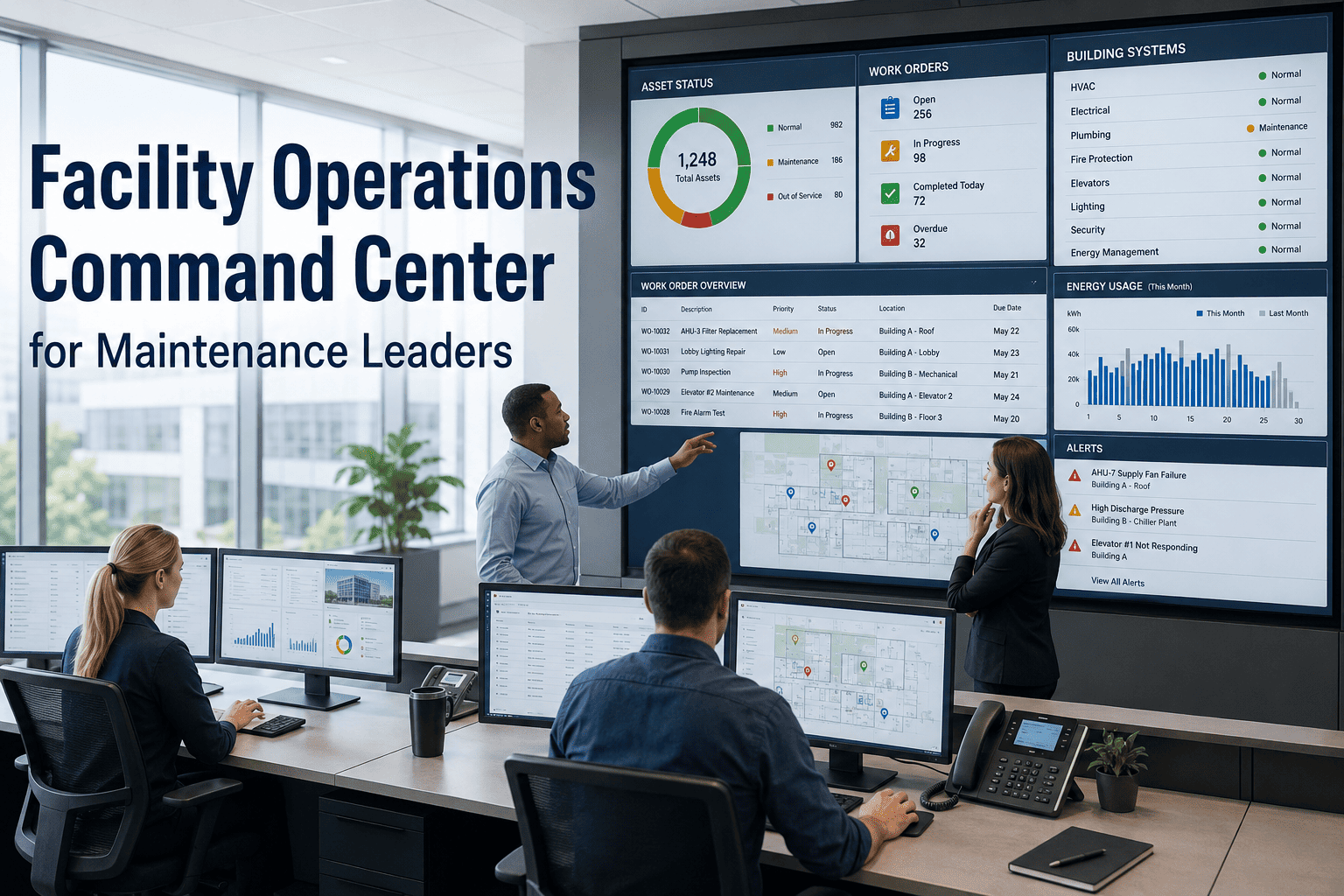
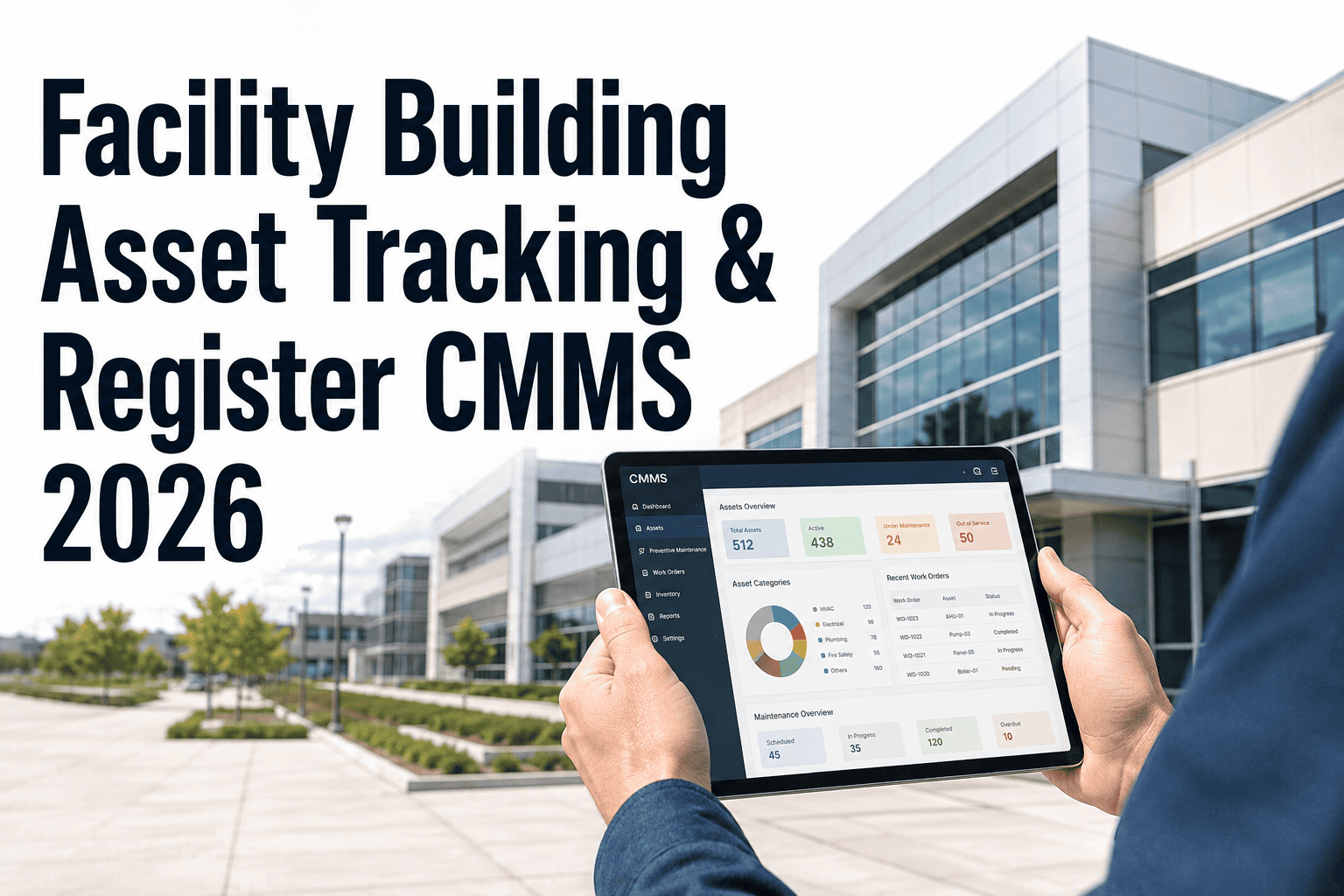
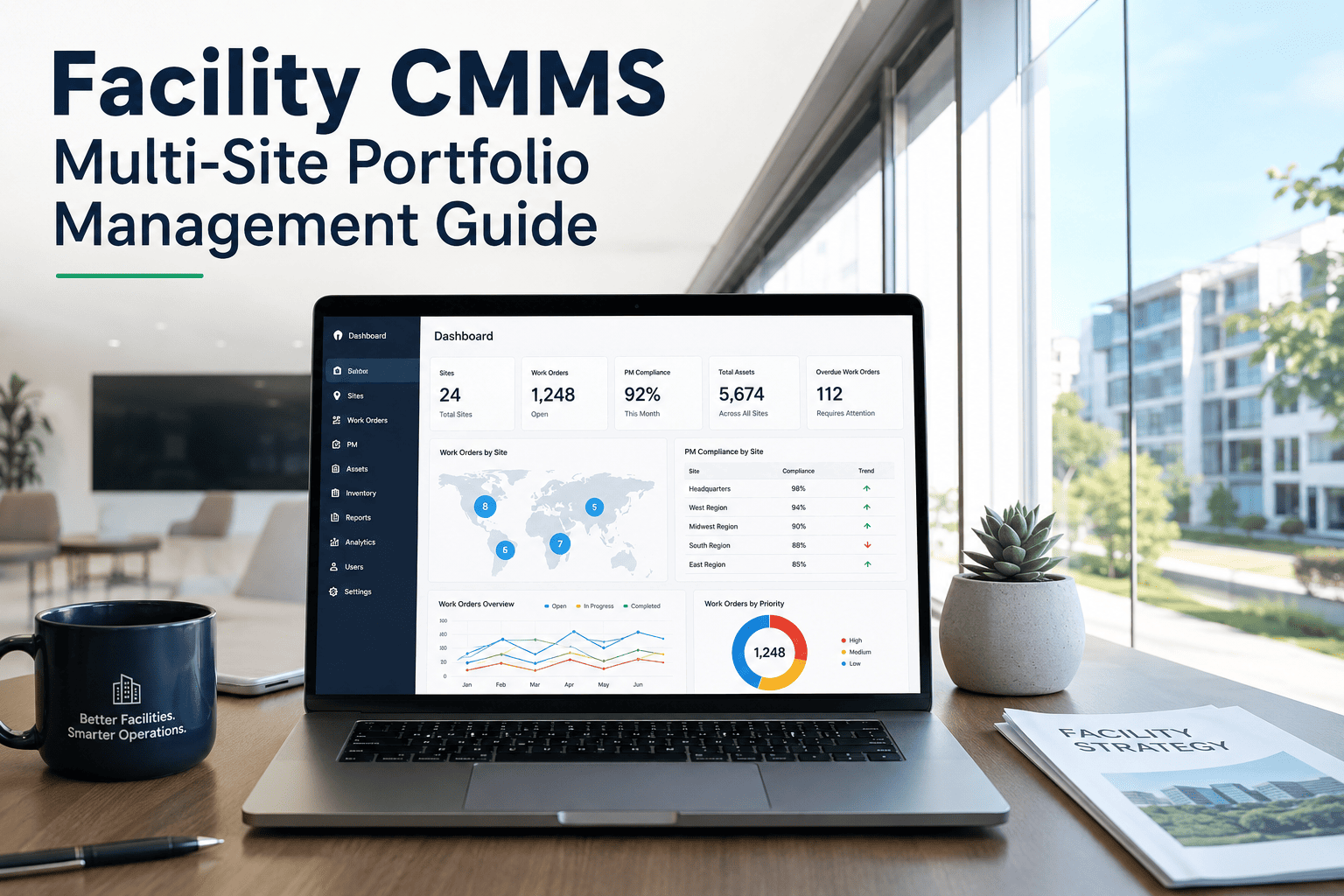
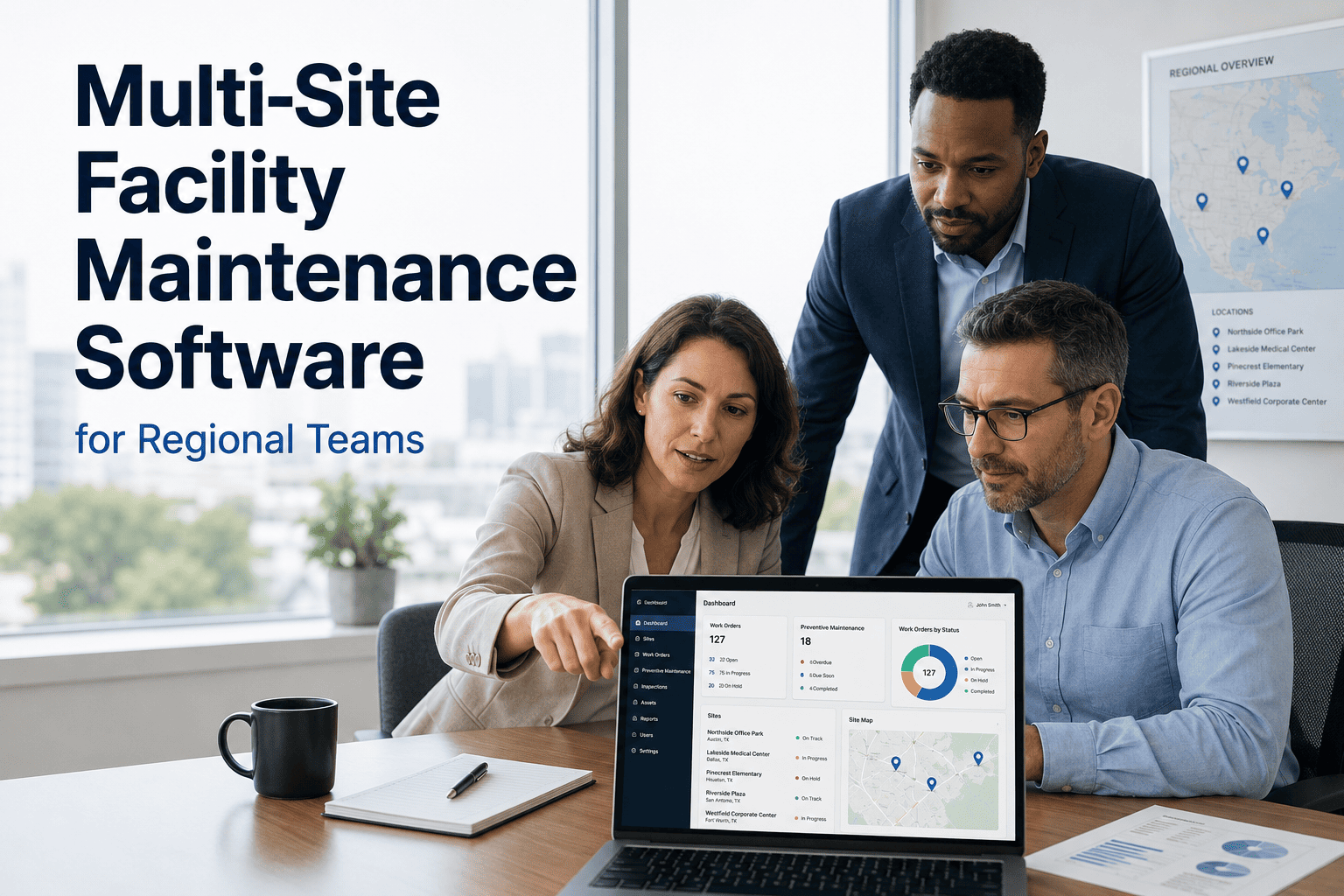
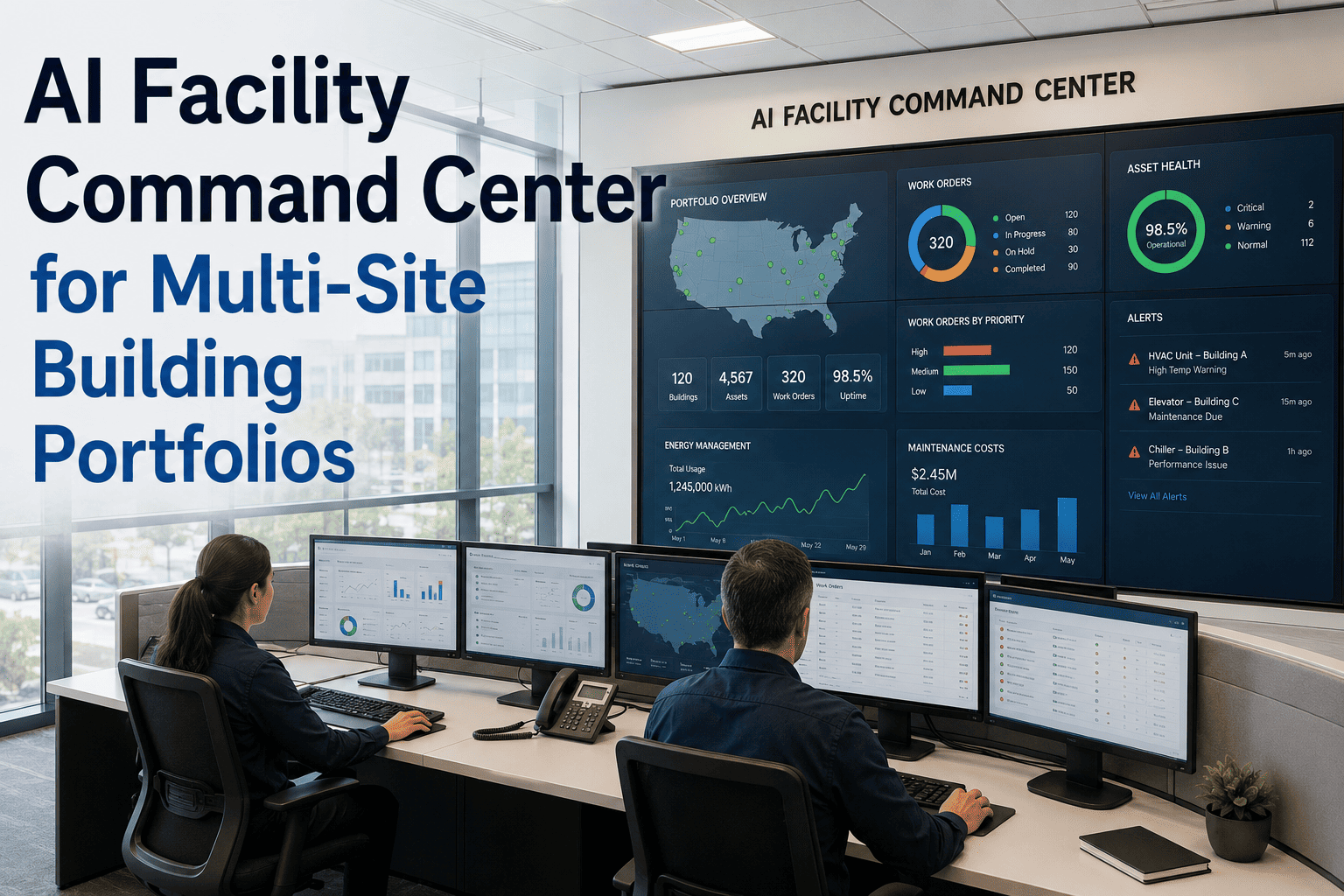
A 200,000 square foot commercial building generates over 1,400 maintenance tasks a year on its own. Multiply that across a six-site portfolio and a regional facilities director is suddenly responsible for nearly 8,500 individual work items, five separate compliance calendars, and five different contractor lists — none of which talk to each other. That is not a staffing problem, it is a visibility problem, and it shows up the same way every time: a site that has been quietly missing its PM targets for two quarters doesn't surface until the budget review, by which point the deferred maintenance has already become an expensive repair. A facility operations command center exists to close that exact gap, and the rest of this page covers what changes when a portfolio finally has one source of truth.
MULTI-SITE FACILITY OPERATIONS · PORTFOLIO VISIBILITY
Five Buildings, Five Spreadsheets, Zero Single View of What's Overdue.
Facility directors running multi-site portfolios consistently report the same gap: no way to benchmark one site against another, no way to see what's slipping until it's already a problem, and no way to redeploy technicians where the workload actually peaks.
THE COST OF RUNNING SITES INDEPENDENTLY
Why Five Spreadsheets Create Five Failure Points, Not One
No Comparable Numbers
If Site A measures response time from request submission and Site B measures it from technician dispatch, the two "response times" are not the same metric — and any benchmark built on them is fiction.
Underperformance Hides Until Review
A site running 15% below its PM target stays invisible at the corporate level until a scheduled quarterly review — by which point the gap has already compounded for months.
Vendors Answer to No One Consistently
A contractor missing SLA targets at two sites looks fine at each site in isolation, because nobody is comparing their performance across the portfolio in one place.
HOW VISIBILITY SHOULD BE STRUCTURED
One Platform, Different Views by Role
CORPORATE
Sees every site, every KPI, portfolio-wide — PM compliance, vendor SLA performance, and energy benchmarking as a single number, not a manually collated report.
↓
REGIONAL
Sees their assigned sites only — able to compare buildings within their region and reallocate technicians where workload is spiking.
↓
SITE
Sees their building's work orders, inspections, and contractor activity, with local autonomy over day-to-day scheduling.
↓
TECHNICIAN
Sees only their assigned work orders on mobile, with photo and parts capture syncing to the central record in real time.
OXMAINT · MULTI-SITE COMMAND CENTER
Stop Finding Out a Site Is Behind at the Quarterly Review
Give every level of your organization — corporate, regional, site, technician — the same real-time numbers, defined the same way, across every building you operate.
WHAT A CENTRALIZED DASHBOARD ACTUALLY SURFACES
Four Numbers Worth Watching Across a Portfolio
28%
Average reduction in maintenance costs after centralizing across sites
20%
Increase in equipment uptime with a single portfolio-wide system
8,500+
Annual work items a six-site, 200,000 sq ft portfolio typically generates
34%
Energy variance per sq ft a dashboard can reveal between similar buildings
VENDOR ACCOUNTABILITY ACROSS SITES
A Contractor's Performance Should Follow Them Across Every Building
Approved contractor lists, structured work packages, and permit-to-work tracking only become useful when they're visible at the portfolio level, not buried in five separate site files. When a vendor consistently misses response time targets at two locations, that pattern needs to be visible the moment it starts — not discovered three months later during a contract renewal conversation. A centralized vendor record turns scattered site-level tracking into one accountability trail spanning every property in the portfolio.
“
The single biggest gain I have seen from a centralized dashboard is not the automation, it's the visibility. When every site director knows the regional lead can see their PM compliance and vendor performance in real time, the behavior across the portfolio changes — without adding headcount.
— VP of Facilities, Commercial Real Estate Portfolio, 22 Years Multi-Site Experience
FREQUENTLY ASKED
Multi-Site Facility Operations, Explained
How many sites does a portfolio need before centralization matters?
Most facility directors feel the gap once they pass three buildings, and organizations managing 25 or more sites typically need enterprise features like scheduled reports and granular role permissions.
Sign up free to see which tier fits your portfolio.
Can regional managers customize their own PM schedules?
Yes. The best setups use hybrid governance — work order categories and KPI definitions locked centrally, while local teams retain autonomy over their own PM scheduling and technician assignments.
How does cross-site benchmarking actually work?
Costs and performance are normalized per square foot, so a 40,000 sq ft site and a 120,000 sq ft site can be compared fairly on response time, PM completion, and cost rather than raw totals.
Does this require replacing each site's existing process?
No. PM templates can be built once at corporate and deployed identically across every site, while technicians keep working from mobile with offline capability when connectivity is limited.
Can the dashboard track regulatory and inspection deadlines across sites?
Yes. Statutory inspections, certificate expirations, and safety compliance deadlines are tracked by site and category with color-coded status, so no building falls through the cracks.
Book a demo to see a live portfolio view.
OXMAINT · PORTFOLIO OPERATIONS COMMAND CENTER
One Dashboard. Every Site. One Source of Truth.
Replace five disconnected spreadsheets with a single platform that gives corporate, regional, and site teams the same real-time numbers — so nothing slips through the cracks between reviews.