A chiller plant that quietly drifts 8% off its design efficiency doesn't ring an alarm — it just adds tens of thousands of dollars a year to the utility bill and shaves years off compressor life. Chiller plants consume 45–60% of total cooling energy in large commercial and institutional facilities, which makes them the single biggest lever a facility team has. Yet most plants are still run reactively: fixed-calendar PMs, quarterly service visits, and no visibility into approach temperature, kW/ton, or condenser fouling until performance has already collapsed. This guide gives facility directors a complete CMMS-driven framework for managing chiller assets in 2026 — approach temperature tracking, refrigerant compliance under the new EPA rules, condenser fouling detection, and structured PM. Pair it with OxMaint's chiller asset management and you'll catch problems weeks before they show up on the meter.
Facility Management / HVAC & Utility Guide
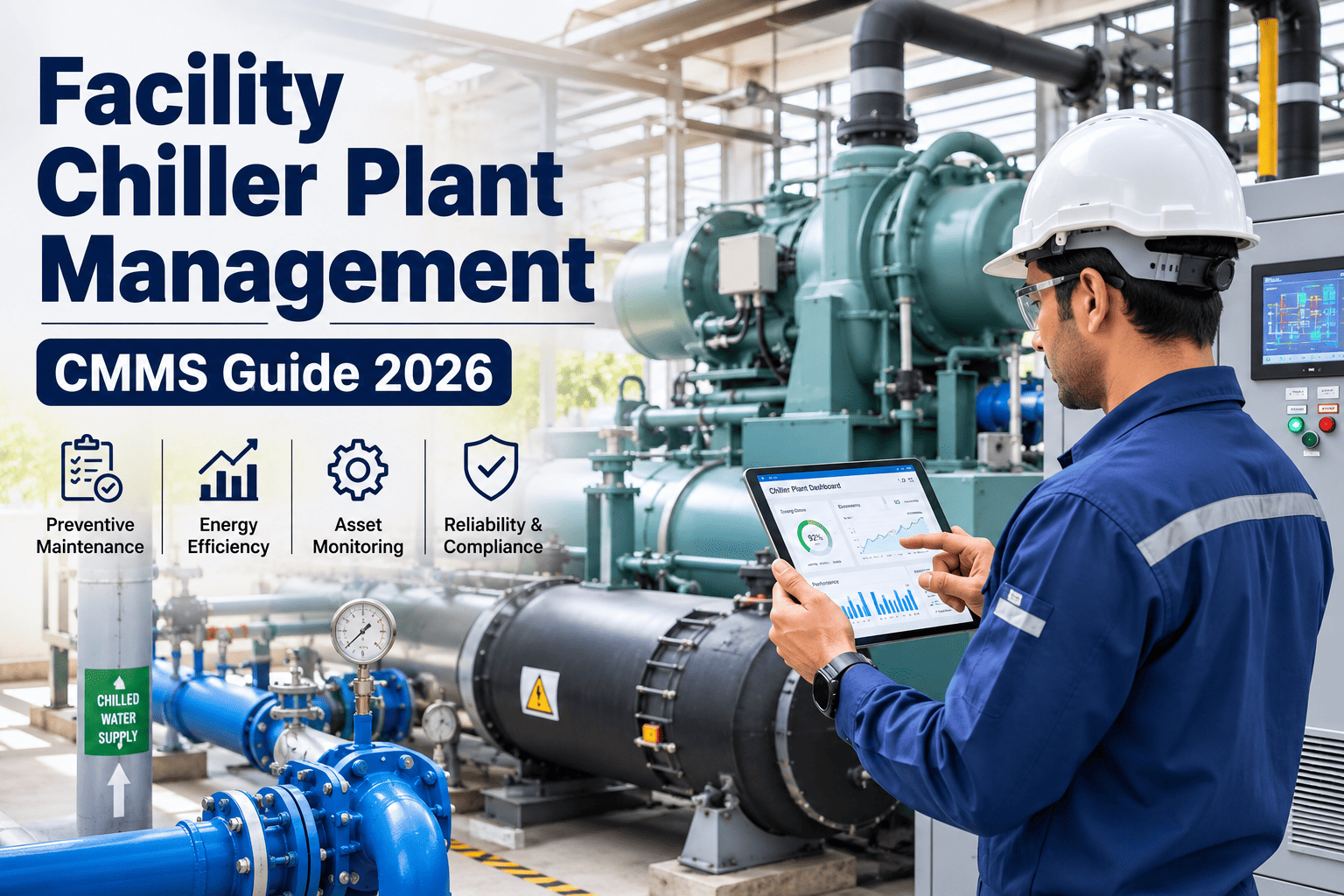
The 2026 Facility Chiller Plant Management CMMS Guide
Approach temperature monitoring, refrigerant compliance, condenser fouling detection, and a structured CMMS program that keeps your kW/ton where it should be — season after season.
45–60%
of cooling energy consumed by chiller plants in large facilities
15–40%
total plant energy savings from comprehensive optimization
75%
breakdown reduction from CMMS predictive maintenance
Jan 1, 2026
EPA low-GWP refrigerant deadline for process cooling systems
The Core Problem
Why Facility Chiller Plants Silently Lose 8–20% Efficiency Every Year
A chiller plant isn't one machine — it's a coordinated system of chillers, pumps, cooling towers, and controls, each with its own efficiency curve that shifts constantly with load, weather, and equipment condition. When facilities manage it as if efficiency were a single setpoint, the plant slowly drifts. Here are the four hidden losses that appear in almost every unmanaged chiller plant.
Loss Type 1
Condenser Tube Fouling
Scale, biofilm, and sediment build up on heat transfer surfaces over months. Compressors work harder for the same cooling output, kW/ton rises, and severe fouling eventually causes compressor surge and motor damage costing $15,000–$50,000+ to repair.
Typical hidden cost: 5–15% efficiency loss before detection
Loss Type 2
Refrigerant Charge Drift
Slow leaks reduce charge below optimal levels. Cooling capacity drops, approach temperature widens, and the plant compensates by staging additional chillers. Three consecutive top-ups in a year is a slow-leak signal that triggers EPA documentation requirements.
Typical hidden cost: 3–10% capacity loss + compliance risk
Loss Type 3
Setpoint & Sequencing Drift
Static chilled-water and condenser-water setpoints ignore changing wet-bulb, load, and equipment condition. Chillers stage inefficiently, tower fans run at full when they don't need to, and pumps waste flow. The plant "wins locally" and loses globally.
Typical hidden cost: 10–20% energy waste at partial loads
Loss Type 4
Sensor & Instrumentation Drift
Temperature sensors, flow meters, and pressure transmitters degrade. Operators end up controlling noise instead of reality. Fault detection breaks down because the baseline itself has drifted. Bad data is worse than no data.
Typical hidden cost: false optimization signals + missed early faults
Chiller Asset Management, Built for CMMS
Turn every chiller into a monitored, predictable asset
OxMaint connects to your BMS or chiller controllers, tracks approach temperature and kW/ton continuously, and auto-generates work orders the moment fouling, refrigerant drift, or sensor faults appear — before efficiency shows up on the utility bill.
The One Number That Matters Most
Approach Temperature — The Single Best Predictor of Chiller Health
If you can only monitor one parameter on a chiller, monitor approach temperature — the difference between leaving condenser water temperature and refrigerant condensing saturation temperature. A rising trend detects condenser fouling, non-condensable gas accumulation, and refrigerant issues weeks before capacity is affected. Here's the diagnostic scale every facility team should have on the wall.
0.5 – 1.5°C
Healthy
Design range for centrifugal chillers under normal load. Heat transfer surfaces clean, refrigerant charge correct, non-condensables under control.
Action: Log weekly, trend monthly. No intervention needed.
1.5 – 2.0°C
Watch
Early fouling or minor refrigerant drift. Efficiency starting to slip. Kw/ton typically 3–7% above baseline.
Action: Increase log frequency to daily, schedule tube inspection at next planned downtime.
2.0 – 3.0°C
Warning
Confirmed condenser fouling, refrigerant charge loss, or non-condensable gas buildup. Capacity impacted, energy waste climbing.
Action: Generate work order — tube cleaning, purge unit check, leak detection inspection within 14 days.
Above 3.0°C
Critical
Severe fouling, low refrigerant charge, or compressor damage risk. Surge, motor stress, and catastrophic failure possible within weeks if unaddressed.
Action: Take chiller offline for full inspection. Escalate to OEM service if approach persists after cleaning.
Rule of thumb
A rising trend of just 0.3°C per week in condenser approach is the earliest reliable signal of tube fouling — long before compressor amps or kW/ton show a meaningful change. Catch it here, and cleaning restores efficiency. Miss it, and the next intervention is a $15,000+ compressor rebuild.
2026 Compliance
EPA Low-GWP Refrigerant Rules — What Facility Teams Must Track
The EPA's Technology Transitions Rule requires all process cooling systems operating above –22°F (–30°C) to use refrigerants with a global warming potential of 700 or lower, effective January 1, 2026. Twelve states — California, New York, Washington, Colorado, and others — have parallel rules. For facility teams running R-410A, R-134a, or R-404A chillers, this reshapes replacement planning, leak documentation, and PM schedules.
01
Inventory every refrigerant-containing asset
CMMS record for each chiller: refrigerant type, charge quantity, GWP rating, in-service date, and regulatory classification. Anything above the size threshold triggers EPA Section 608 documented leak inspection.
02
Log every refrigerant top-up and repair
Three consecutive top-ups in a rolling 12-month window is a documented slow-leak flag. The CMMS becomes the audit trail — quantity added, technician certification, leak test outcome, and corrective action all captured against the asset record.
03
Set replacement horizons by refrigerant class
R-410A and R-134a chillers can continue operating, but new equipment must use A2L refrigerants like R-454B or R-32. Plan capital replacement based on remaining useful life and refrigerant availability — not just calendar age.
04
Update PM schedules for A2L safety requirements
Mildly flammable A2L refrigerants require refrigerant sensors, ventilation checks, and updated technician procedures. PM tasks tied to UL 60335-2-40 compliance where applicable, with recertification tracked in the asset record.
The Program Framework
The 5 Pillars of a CMMS-Powered Chiller Program
A high-performing facility chiller program isn't a checklist — it's five coordinated pillars sitting on top of a CMMS backbone. Each pillar answers a different question, and they only work together. Skip one and the whole program regresses toward reactive service calls.
Pillar 1
Asset Master Data
Every chiller, tower, pump, and heat exchanger with a complete record — nameplate data, refrigerant, capacity, in-service date, warranty terms, and OEM PM specifications. Without this, every other pillar builds on sand.
Delivers: Auditable asset registry, warranty tracking, replacement forecasting
Pillar 2
Preventive Maintenance Schedule
Daily operator logs (4x per day per FEMP guidance), weekly performance review, quarterly deep maintenance, annual tube brushing and oil spectrometric analysis. Each task assigned, tracked, and closed with digital sign-off.
Delivers: 10–15% efficiency improvement, 25–30% lifespan extension
Pillar 3
Condition Monitoring & Approach Tracking
Continuous kW/ton, approach temperature, and compressor amps flowing into the CMMS. Threshold alerts auto-generate work orders. This is the layer that catches condenser fouling and refrigerant drift weeks early.
Delivers: 75% breakdown reduction, 30% lower maintenance cost
Pillar 4
Refrigerant & Compliance Ledger
Every top-up, leak test, technician certification, and disposal record captured against the asset. EPA Section 608, state parallel rules, and internal ESG reporting all pull from the same source of truth — with digital export ready for auditors.
Delivers: Audit-ready records, zero-scramble compliance
Pillar 5
Energy & Cost Analytics
Chiller-level kW/ton trended against baseline, cost of degraded operation calculated automatically, and ROI on each intervention (tube cleaning, refrigerant top-up, replacement) tracked. Finance and facilities see the same number.
Delivers: Board-ready energy narrative, capital planning confidence
All 5 Pillars in One Platform
OxMaint gives your chiller plant a single source of truth
Asset registry, PM scheduling, condition alerts, refrigerant ledger, and energy analytics — all connected. Set it up in days, not months, and start closing the efficiency gap on your very next billing cycle.
Benchmarks
What "Good" Looks Like — Chiller Plant Performance Benchmarks
Every facility team wants to know where they stand. These benchmarks come from ASHRAE guidance, DOE FEMP data, and validated field studies across commercial, institutional, and industrial chiller plants. Use them as targets in your CMMS dashboard.
| Performance Metric |
World-Class |
Good |
Needs Improvement |
Reactive Plant |
| Chiller efficiency (kW/ton, centrifugal) |
Below 0.50 |
0.50 – 0.60 |
0.60 – 0.75 |
Above 0.75 |
| Condenser approach temperature |
Below 1.0°C |
1.0 – 1.5°C |
1.5 – 2.5°C |
Above 2.5°C |
| Annual unplanned downtime hours |
Below 12 |
12 – 40 |
40 – 100 |
Above 100 |
| Refrigerant leak rate (annual) |
Below 5% |
5 – 10% |
10 – 15% |
Above 15% |
| PM completion rate |
Above 95% |
85 – 95% |
70 – 85% |
Below 70% |
| Tube fouling factor |
Below 0.0002 |
0.0002 – 0.0005 |
0.0005 – 0.001 |
Above 0.001 |
| Mean time between chiller failures |
Above 5 years |
3 – 5 years |
1 – 3 years |
Below 1 year |
The Payoff
What a Mature Chiller Program Actually Delivers
Facilities that transition from reactive chiller management to a structured, CMMS-driven program see measurable results within a single cooling season — validated by ASHRAE, DOE, and independent field studies.
20–40%
Total plant energy savings
Comprehensive optimization vs. baseline unmanaged plant
10–15%
Chiller efficiency gain
Regular preventive maintenance (ASHRAE)
25–30%
Equipment lifespan extension
Proper maintenance (Energy Engineering Journal)
75%
Breakdown elimination
Predictive maintenance program
30%
Maintenance cost reduction
Shift from reactive to predictive workflow
Weeks
Earlier fault detection
Approach temperature and kW/ton trending
FAQ
Frequently Asked Questions
What is the single most important parameter to monitor on a facility chiller?
Condenser approach temperature. A rising trend of 0.3°C per week is the earliest reliable signal of tube fouling and refrigerant drift, appearing weeks before kW/ton or compressor amps show meaningful change. Every chiller in your
OxMaint asset registry should have approach temperature trended continuously.
How often should a commercial chiller plant be maintained?
FEMP recommends operating logs updated four times daily, weekly performance reviews, quarterly deep maintenance, and annual tube brushing plus oil spectrometric analysis. Large institutional plants should also schedule mid-season condenser cleaning if approach rises more than 2°F above spring baseline.
Does the 2026 EPA refrigerant rule mean I have to replace my chillers?
No — existing R-410A, R-134a, and R-404A chillers can continue operating. The rule affects new equipment and process cooling systems above –22°F, which must use refrigerants with GWP of 700 or lower starting January 1, 2026. Twelve states have parallel rules that stay in effect regardless of federal changes.
Can a CMMS integrate with my existing BMS and chiller controllers?
Yes. OxMaint connects to BACnet, Modbus, and OEM protocols used by major chiller brands including Trane, York, Carrier, and Daikin. Approach temperature, kW/ton, and fault codes flow into the asset record and auto-generate work orders.
Book a demo to see it connected to your equipment.
What ROI can a facility expect from a structured chiller program?
Field data shows 20–40% total plant energy savings, 75% breakdown reduction, and 25–30% equipment lifespan extension. For a typical 1,000-ton commercial plant, that translates to six-figure annual savings — usually paying back the CMMS and monitoring investment within a single cooling season.
Build Your 2026 Chiller Program
Take a live, one-on-one tour with a product expert
See how OxMaint tracks approach temperature, kW/ton, refrigerant compliance, and PM schedules in one connected platform — configured for your exact chiller inventory in under 30 minutes.