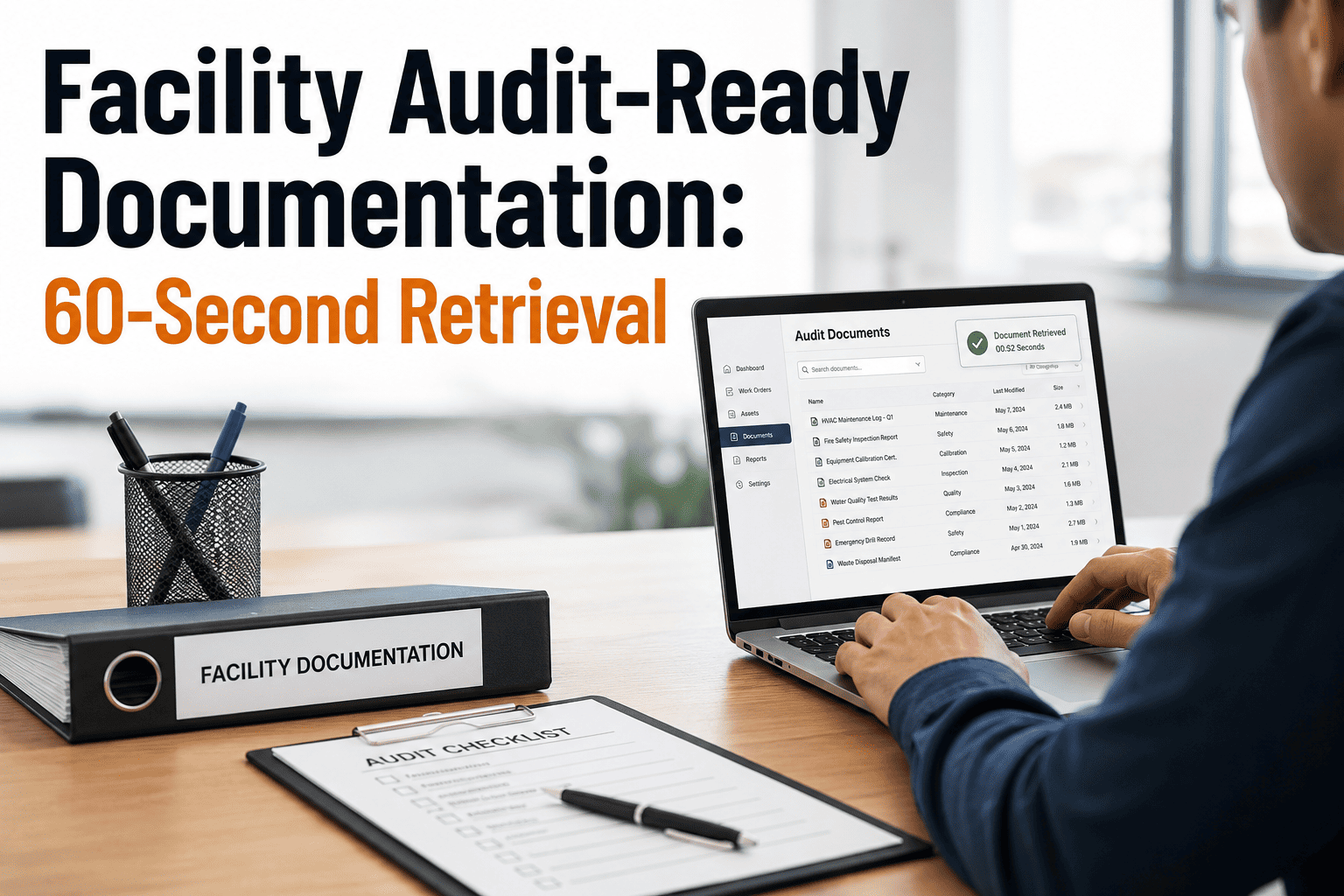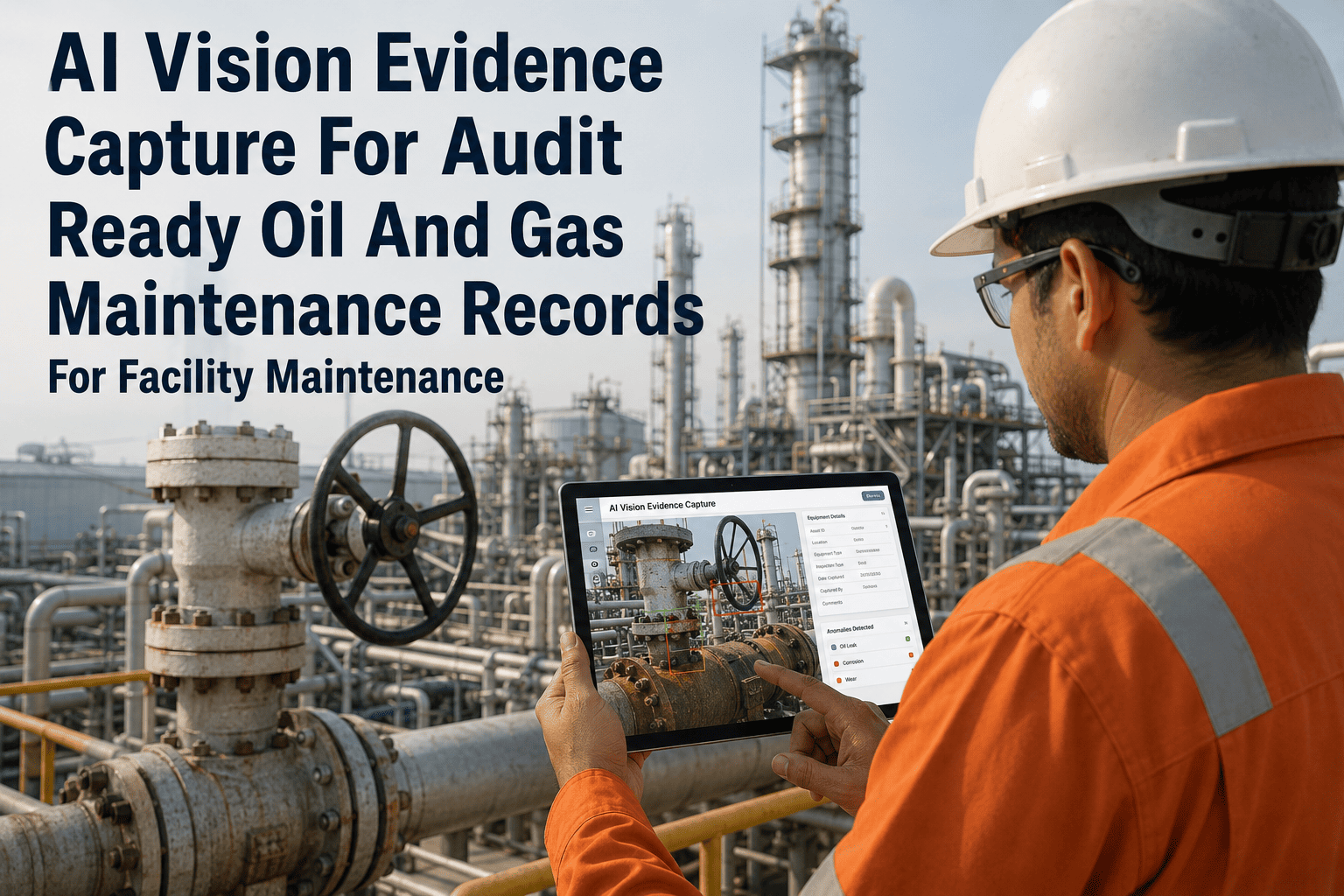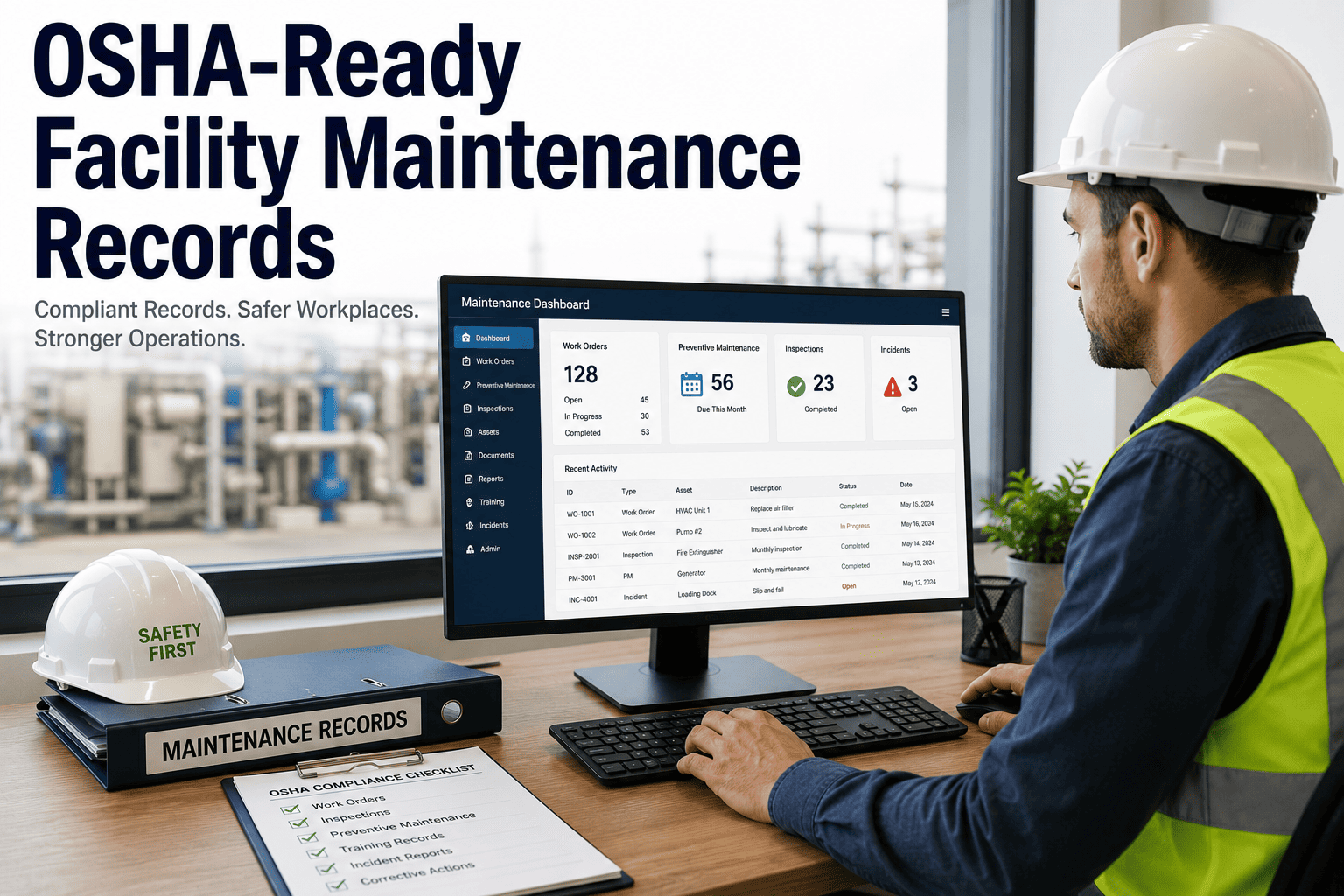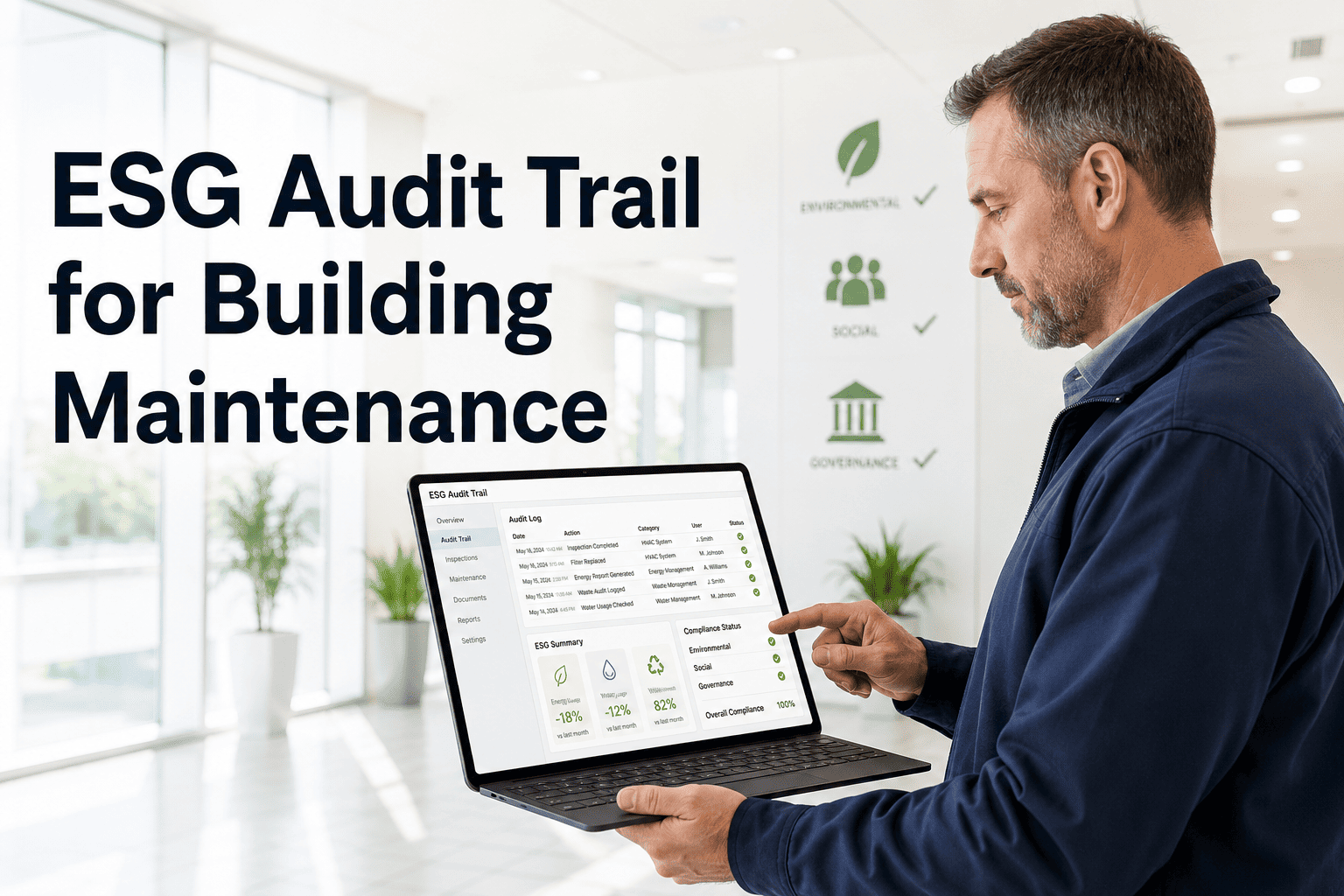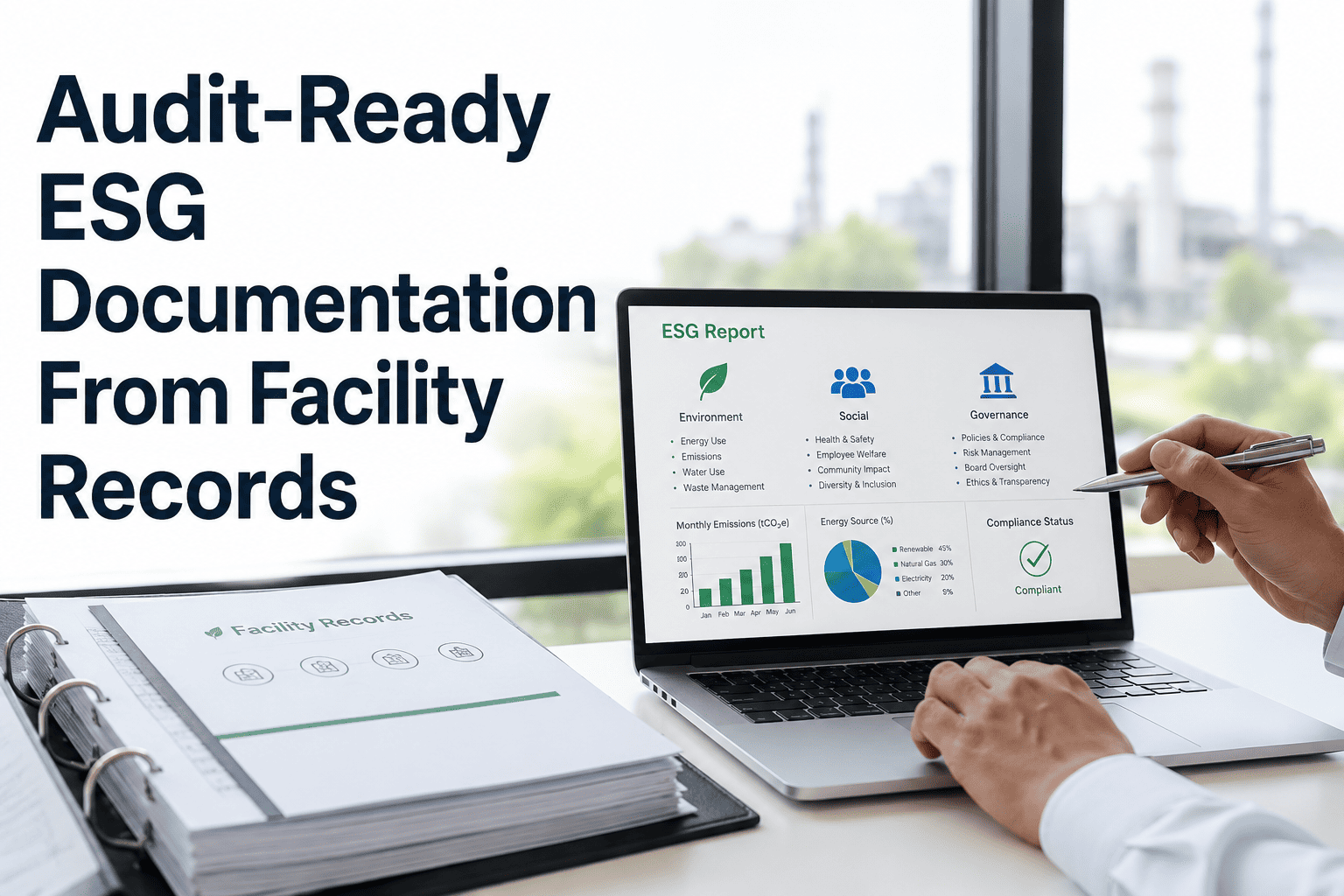
ESG audit documentation at the facility level is no longer a year-end scramble — investors, regulators, and rating agencies now demand a verifiable evidence chain built from live operational data, not retrofitted spreadsheets. Audit-ready ESG facility records tie every energy reading, work order, and asset event to a timestamp, a technician, and a source meter, so auditors can trace any sustainability claim back to its origin in seconds. Building ESG documentation from facilities data that already lives in your CMMS turns compliance into a routine by-product of maintenance execution. This guide breaks down how to engineer an ESG evidence chain, design data provenance, and run a verification workflow that makes your next facility sustainability audit a pass on the first pass. Ready to replace manual logbooks with automated audit trails? Start Free Trial and see your live facility records become audit-ready ESG documentation today.
Audit-Ready ESG Documentation
Can your facility prove every sustainability claim in under five minutes?
When auditors arrive, they want an evidence chain — not a spreadsheet. OxMaint turns live work orders, asset telemetry, and meter readings into an immutable, audit-ready ESG record that traces every data point to its source. No more retroactive data hunts, no more compliance gaps.
The Documentation Gap
Why ESG audit facility records fail without an evidence chain
A facility sustainability audit typically requests three to five years of historical evidence: energy consumption by asset, refrigerant logs, waste manifests, preventive maintenance completion rates, and capital replacement records. Teams that rely on spreadsheets spend an average of 140 staff-hours per audit cycle reconstructing this trail, and 1 in 3 submissions still receives a qualified opinion due to missing provenance. Audit-ready sustainability facility documentation solves this by capturing data at the point of execution — the work order, the meter reading, the parts issuance — and locking it into a tamper-evident record.
How-To Guide
How to build an ESG evidence chain from facility data
An ESG evidence chain is only as strong as its weakest link. Building ESG audit trail capability requires connecting asset identity, operational execution, and sustainability outcomes into one verifiable thread. Here is the five-step sequence that turns raw facility data into audit-ready ESG documentation.
Anchor every asset and meter
Assign a unique ID to each piece of equipment, sub-meter, and utility feed. ISO 55000-aligned asset hierarchies ensure auditors can trace a Scope 2 emission figure back to a specific HVAC chiller or compressed-air unit without ambiguity.
Capture execution data at the source
Replace paper work orders with digital records that auto-stamp the technician, timestamp, GPS location, and readings taken. Manual data entry introduces a 12–18% error rate; mobile CMMS capture reduces it below 2%.
Link maintenance actions to sustainability metrics
Tag each work order with an ESG category — energy, refrigerant, water, waste, or safety. When a tech replaces a refrigerant filter or completes a predictive-maintenance alert, the system logs the avoided emission and asset-efficiency gain.
Lock records into a tamper-evident audit trail
Every status change, reading, and approval must write to an immutable log. Auditors need to see who touched the record, when, and what changed — a requirement under CSRD, GRESB, and ISO 14064 verification standards.
Generate on-demand evidence reports
Compile filtered evidence packs by date range, asset class, or ESG pillar in minutes. A properly built facility ESG evidence system outputs a structured CSV or PDF that maps directly to the auditor's checklist.
Workflow Design
ESG reporting documentation: facility checklist for audit readiness
Use this checklist to evaluate whether your facility ESG evidence is truly audit-ready. Each item maps to a common auditor request and the operational system that should supply the answer.
- Monthly energy consumption by asset and sub-meter
- Refrigerant purchase logs with type, mass, and asset ID
- Water withdrawal and discharge readings
- Waste manifests with hauler and disposal method
- Preventive maintenance completion rate by technician
- Safety inspection logs with corrective actions closed
- Training records linked to work-order qualifications
- Incident reports with root-cause and remediation evidence
- Immutable change log for every maintenance record
- Capital asset replacement history with depreciation
- Vendor compliance certificates and calibration records
- Sign-off chain for sustainability data approvals
Mini Case Study
From 140 hours to 11 hours: a 180-asset plant's ESG audit turnaround
A 180-asset food-processing plant spent $42,000 annually on external consultants to assemble ESG documentation for facilities. Maintenance logs lived across three Excel spreadsheets and a paper archive. During their last GRESB submission, auditors flagged 28 data points with no verifiable source, resulting in a downgraded score and a 15-basis-point increase on their sustainability-linked loan.
By migrating to OxMaint, every work order, meter reading, and parts issuance auto-populated a timestamped audit trail. The plant generated their full evidence pack in 11 hours instead of 140, eliminated all 28 flagged data gaps, and improved their GRESB score by 14 points — preserving the favorable loan rate.
Product Fit
How OxMaint builds your audit-ready ESG facility records
OxMaint is engineered to make ESG audit-readiness a routine output of maintenance execution. These four capabilities map directly to the evidence-chain requirements auditors enforce.
Immutable Asset & Work-Order History
Every digital work order writes to a tamper-evident log the moment a technician changes its status. OxMaint stores the user, timestamp, readings, and attached photos — giving auditors a complete provenance trail for any maintenance action tied to an ESG metric.
Live Meter & Telemetry Capture
OxMaint ingests energy, water, and runtime data directly from IoT meters and sensor-enabled assets. Readings are stamped to the asset ID and stored in time-series format, so Scope 1 and Scope 2 figures draw from the same source your maintenance team uses daily.
Preventive Maintenance Compliance Tracking
OxMaint tracks PM completion rates against schedule and auto-flags overdue tasks. Auditors use PM adherence as a proxy for asset stewardship and risk governance — OxMaint delivers the percentage, the specific assets, and the technician sign-offs in one click.
One-Click Evidence Pack Generation
Filter by date, asset class, or ESG category and export a structured evidence pack mapped to major reporting frameworks (CSRD, GRI, GRESB, SASB). No more rebuilding spreadsheets — OxMaint outputs the auditor-ready file from live data in under 60 seconds.
Verification Standards
Facility ESG audit requirements: what auditors actually verify
Auditors apply consistent verification criteria regardless of the reporting framework. Understanding these lets you pre-empt findings before the engagement begins. This table maps the four core verification domains to the facility ESG evidence your CMMS should supply.
| Verification Domain | What the Auditor Checks | Evidence Source in OxMaint | Risk If Missing |
|---|---|---|---|
| Data Provenance | Can each figure be traced to a source record with timestamp and author? | Immutable work-order log with user ID, time stamp, and reading | Qualified opinion; figure excluded from report |
| Completeness | Are all in-scope assets and periods represented with no gaps? | Asset registry cross-referenced with PM schedule and meter data | Material misstatement; restatement required |
| Accuracy | Do source readings match the aggregated totals in the report? | Time-series meter data rolled up to monthly and annual totals | Score downgrade; loan rate penalty |
| Consistency | Are calculation methodologies applied uniformly year over year? | Standardized ESG tags on work orders and asset categories | Comparability finding; prior-year restatement |
See OxMaint turn your live facility records into audit-ready ESG evidence
Stop rebuilding documentation from scratch every audit cycle. Book a 30-minute demo and we will show you exactly how your work orders, meters, and asset data become a verifiable evidence chain.
FAQ
Facility ESG audit documentation: frequently asked questions
What makes ESG documentation audit-ready at the facility level?
Audit-ready ESG documentation means every data point — energy reading, maintenance action, refrigerant log — is traceable to a source record with a timestamp, author, and asset ID, stored in a tamper-evident system. It eliminates the gap between reported figures and operational evidence, so auditors can verify any claim without requesting supplementary files. You can build this chain automatically in OxMaint — book a demo to see it live.
How do you build an ESG evidence chain from facility records?
Start by assigning unique IDs to every asset and meter, then capture all maintenance and operational data digitally through a CMMS. Tag each work order and reading with an ESG category, lock records into an immutable audit trail, and generate filtered evidence packs on demand. The chain is only as strong as its weakest link, so manual data entry must be minimized.
How long should facility ESG records be retained for audit purposes?
Most frameworks — CSRD, GRESB, and ISO 14064 — require a minimum of five years of historical evidence, and some regulated industries demand seven to ten. A CMMS like OxMaint retains the full immutable history for the life of the asset, so you can pull a seven-year evidence pack in the same time it takes to generate a one-month report.
Can a CMMS really replace spreadsheets for ESG audit documentation?
Yes — a CMMS that captures digital work orders, meter readings, and asset history at the point of execution is inherently more audit-ready than any spreadsheet. Spreadsheets lack provenance, change tracking, and source-data validation. OxMaint closes those gaps by turning maintenance execution into structured, timestamped evidence. Start your free trial to test it on your assets.
What ESG reporting frameworks accept facility maintenance data as evidence?
CSRD, GRI, GRESB, SASB, and TCFD all accept facility-level maintenance and operational data as primary evidence, provided it includes provenance and is stored in a verifiable system. Preventive maintenance completion rates, energy consumption by asset, and refrigerant logs are standard evidence types auditors expect to see across all major frameworks.
Make your next facility sustainability audit a routine output
Join the maintenance teams using OxMaint to generate audit-ready ESG documentation from live work orders, asset telemetry, and meter readings — no spreadsheets, no scrambling.
Free 14-day trial · No credit card