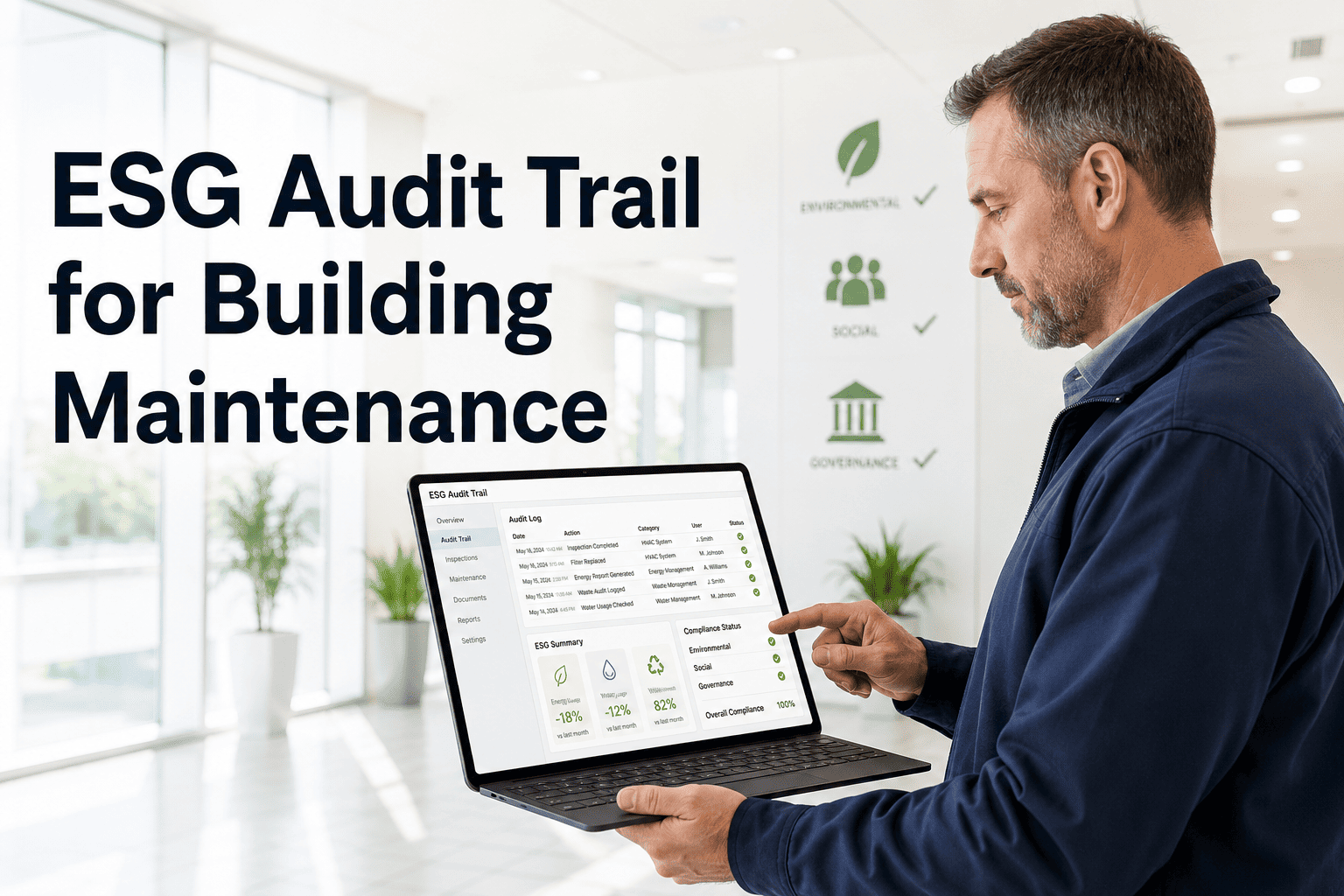
Building owners and facility managers facing ESG reporting requirements discover quickly that the hardest data to produce is not energy consumption data — it is the maintenance audit trail that proves actions were taken to achieve it. Inspection records, repair histories, energy system work orders, and asset lifecycle documents must be organized, timestamped, and auditor-ready long before the reporting period closes. Book a demo with OxMaint to see how facility teams make maintenance records ESG-ready, or start a free trial and experience compliance tracking built for real buildings.
ESG Audit Trail for Building Maintenance
Keep inspection records, repairs, energy actions, and asset histories audit-ready for ESG and sustainability reporting — without rebuilding documentation under deadline pressure.
ESG reporting frameworks — GRI, SASB, TCFD, and LEED — do not just ask for energy meter readings. They require evidence that a facility actively manages its assets, tracks interventions, and links maintenance actions to sustainability outcomes. Here is what auditors request and where most facilities fall short.
Auditors verify that critical building systems — HVAC, electrical, lighting, water — are inspected on schedule. Missing inspection records or records without timestamps and technician names fail the evidence standard under GRI 302 (Energy) and ISO 14001 facility audits.
Every equipment repair that affects energy efficiency, emissions, or water usage must be documented with a work order, completion date, and outcome. Verbal records and spreadsheet notes do not qualify as audit-ready evidence under GRI 305 or LEED O+M requirements.
Retrofits, setpoint changes, equipment upgrades, and efficiency interventions must be linked to the specific asset and timestamped. Auditors cross-reference energy consumption data against documented facility actions — unsupported consumption reductions raise verification flags.
The full service history of energy-consuming assets (chillers, boilers, cooling towers, lighting systems) demonstrates responsible asset management — a core requirement in TCFD physical risk disclosures and green building certification renewals.
| ESG Framework | Relevant Disclosure | Maintenance Record Required | OxMaint Record Type |
|---|---|---|---|
| GRI 302 | Energy consumption and reduction initiatives | Energy system work orders with efficiency outcomes | Work order + energy category tag |
| GRI 305 | Emissions reduction actions | HVAC, refrigerant, and combustion system repair logs | Asset repair history + compliance flag |
| GRI 413 | Local community and facility impact | Inspection records for health and safety systems | Inspection log + technician + timestamp |
| LEED O+M | Ongoing operations performance | Preventive maintenance completion rates by system | PM compliance dashboard + export |
| TCFD | Physical climate risk management | Asset condition records and resilience actions | Asset lifecycle record + condition score |
| ISO 14001 | Environmental management system | Corrective action records for environmental incidents | CAPA-linked work order |
| SASB RE-010 | Energy and water management | Metering and equipment service records | Meter read + equipment work order |
From the moment a work order is created to the moment it is closed with technician sign-off, OxMaint records every action with date, time, user, and asset context. There is no separate step to create an audit trail — the trail is built as work is done.
Assets in OxMaint are tagged with ESG-relevant categories — Energy, Emissions, Water, Waste, Safety — so that all maintenance activity on a tagged asset is automatically included in ESG reports. No manual re-tagging of work orders at report time.
OxMaint compares inspection completion against defined schedules and generates a compliance percentage per asset, location, and reporting period. This is the specific data point required by LEED O+M and ISO 14001 auditors — not just that inspections were done, but what percentage were done on time.
Maintenance records can be filtered by date range, asset class, ESG category, and location, then exported as a structured report package. Whether the requirement is a GRI appendix, a LEED performance period report, or a TCFD physical risk disclosure, OxMaint generates the underlying evidence without manual assembly.
The moment that changes ESG reporting for building teams is when they stop treating maintenance data and sustainability data as two separate things. The audit evidence auditors want — inspection logs, repair records, energy action documentation — is the same data your maintenance team creates every day. The problem is that most facilities cannot retrieve it in a usable form at reporting time because it lives in clipboards, paper folders, and disconnected spreadsheets. A CMMS changes this completely. When I work with clients using OxMaint, the ESG evidence package that used to take three weeks of manual retrieval takes two days. The records are already there — they just become accessible.
OxMaint turns everyday maintenance work into audit-ready ESG evidence — timestamped, categorized, and exportable for every framework your building reports against.