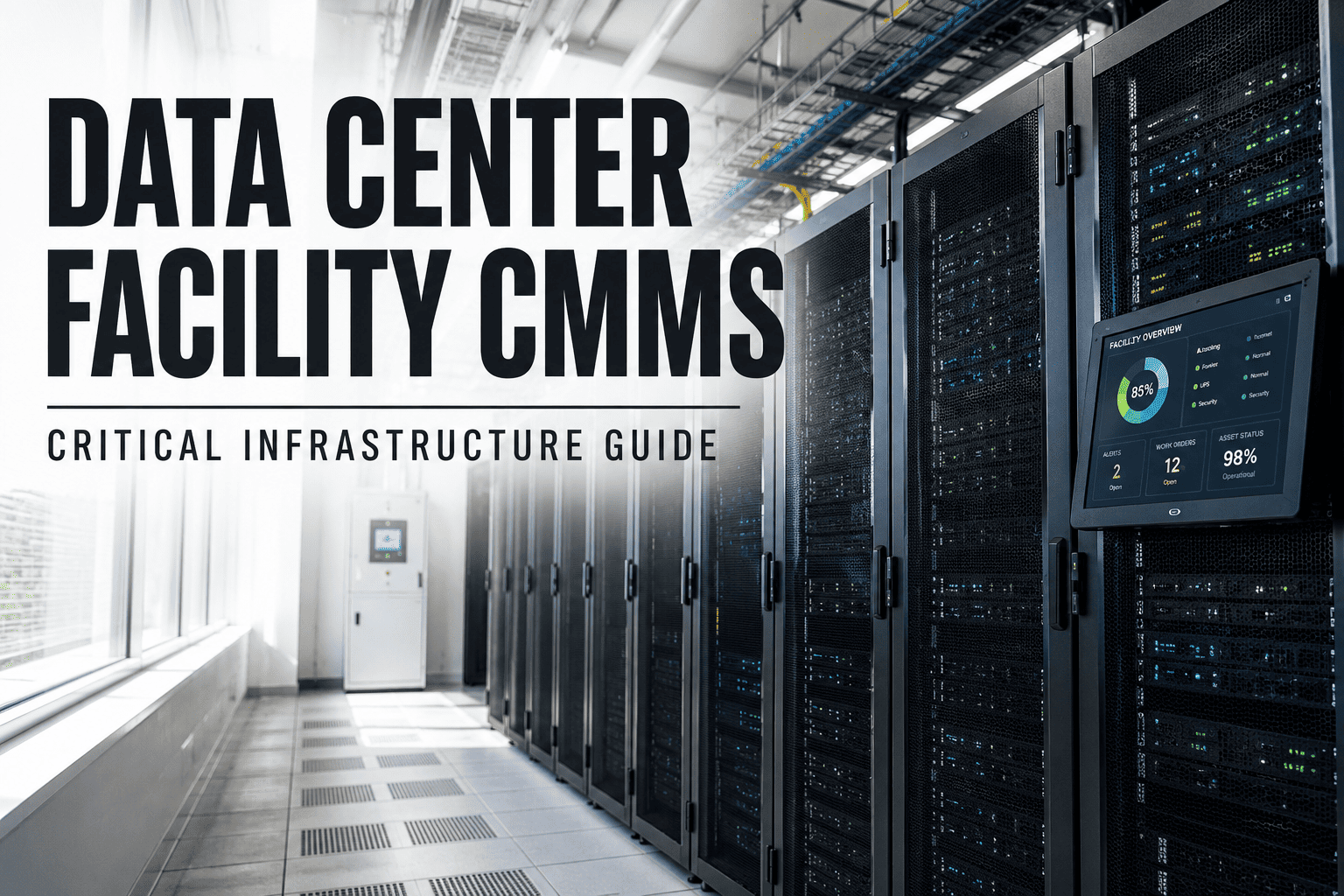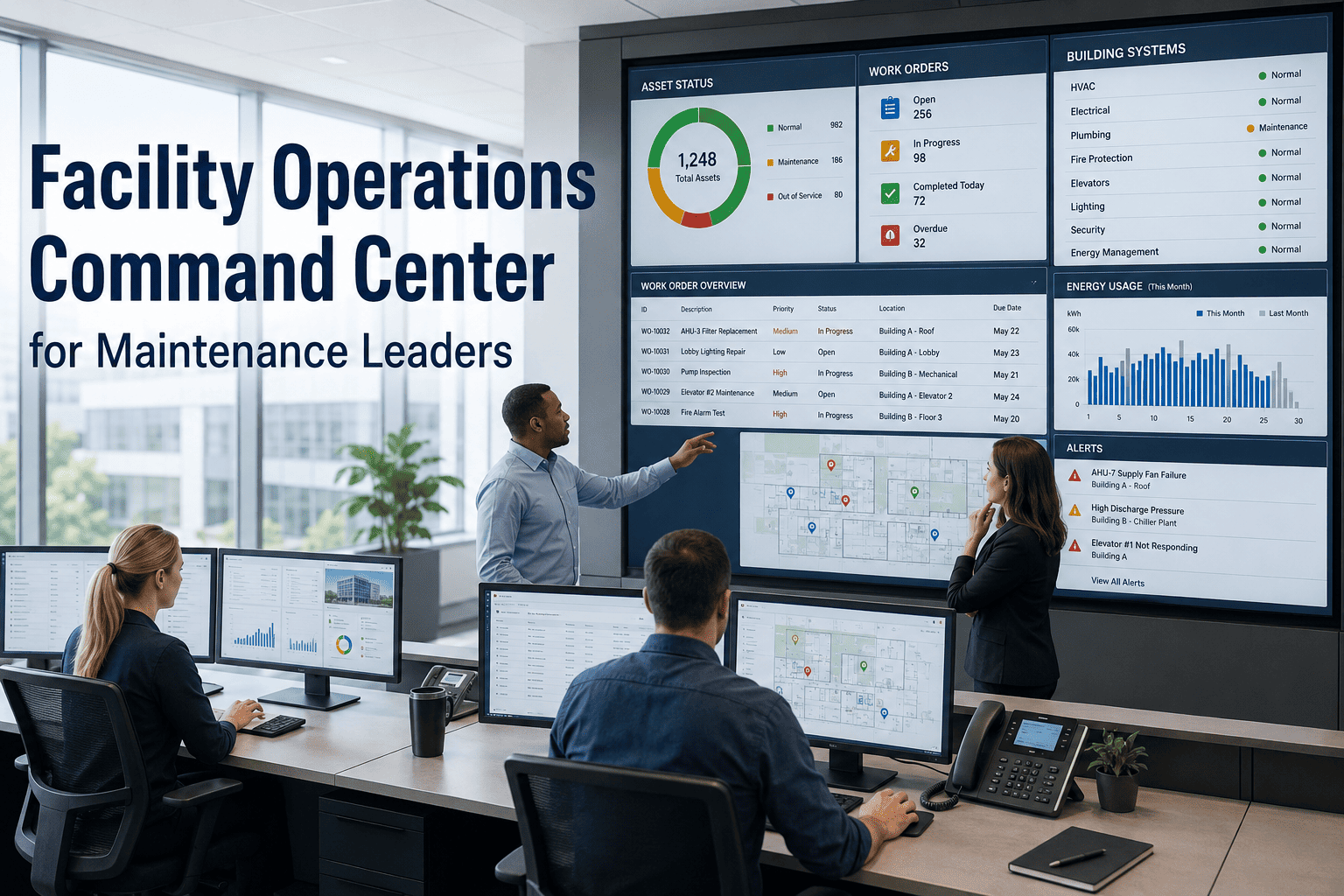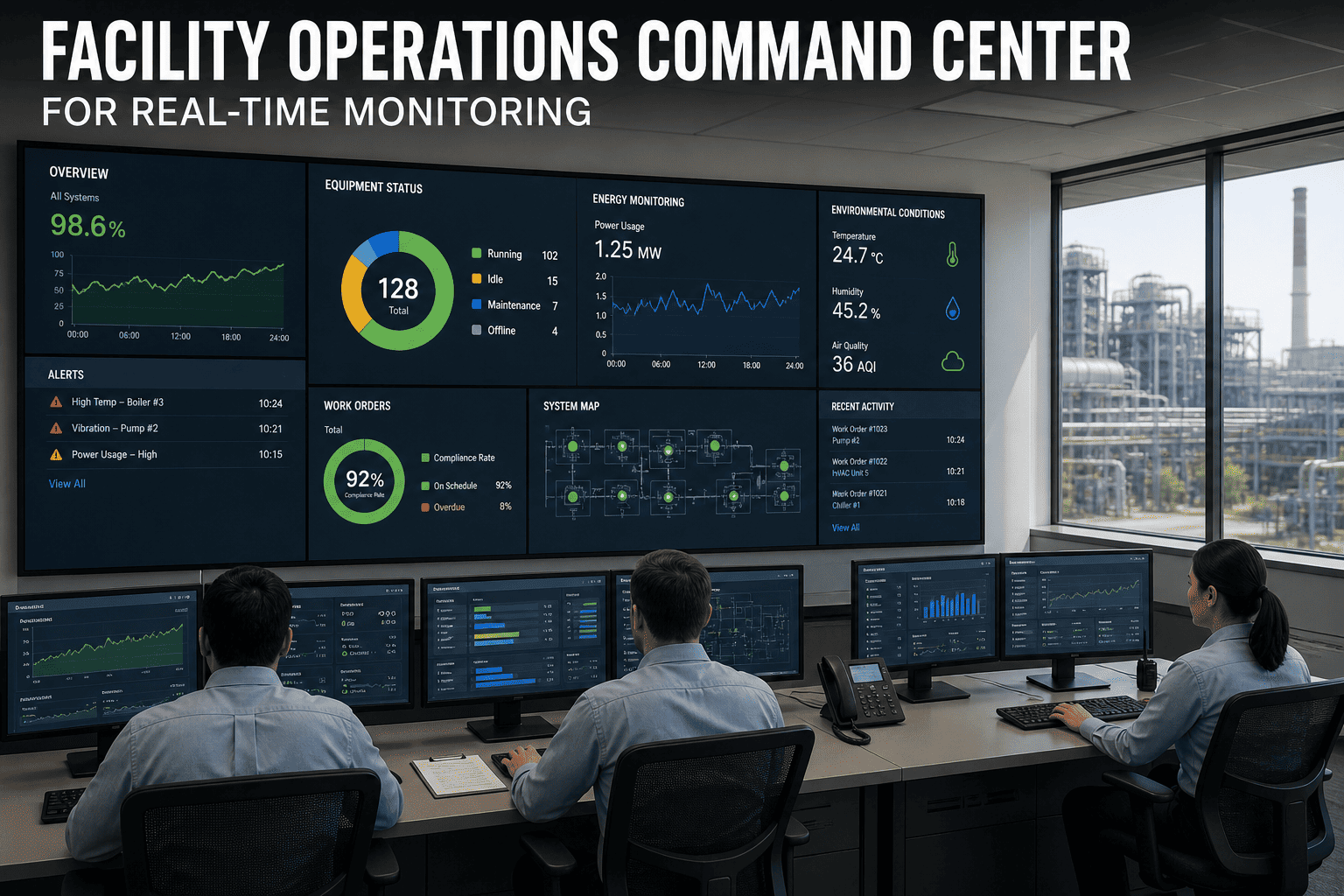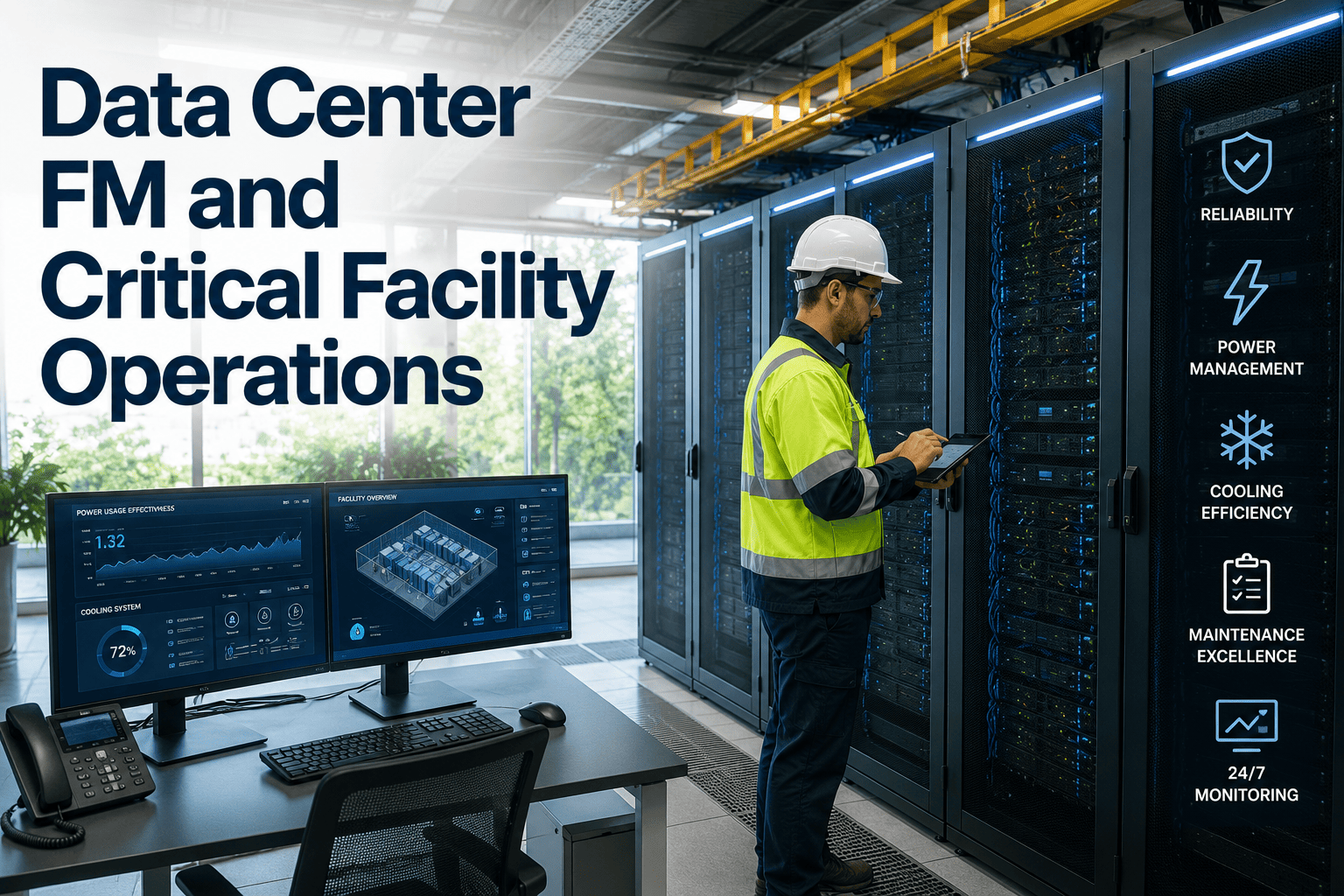
Data center facility management (FM) represents one of the highest-stakes operational environments in modern engineering, where a single minute of downtime can cost upwards of $9,000 and permanently damage enterprise reputations. Effective data center FM combines rigorous reliability engineering, strict change control, and redundant infrastructure operations to maintain the 99.999% uptime that hyperscale and colocation providers demand. This guide breaks down the critical facility operations, maintenance disciplines, and software frameworks required to keep mission-critical power, cooling, and network systems online. To see how an AI-powered CMMS can transform your uptime strategy, you can Start Free Trial or explore the platform in a live demo.
When five-nines is the baseline, your data center FM operations can't rely on spreadsheets.
Unplanned downtime costs the industry over $50B annually. Transition from reactive firefighting to predictive data center facility operations with unified work orders, asset tracking, and compliance logging.
The core pillars of data center critical operations
Data center facilities operate on the edge of maximum capacity. Achieving continuous uptime requires a strict operational discipline across four foundational pillars that govern data center building operations.
Redundancy Operations (N+1 / 2N)
Maintaining and testing failover protocols for UPS arrays, generators, and CRAH/CRAC units. True redundancy requires regular load-bank testing and automated transfer switch verification to ensure backup systems engage within milliseconds.
Strict Change Management
Hardware swaps, firmware updates, and topology changes carry cascading risks. Data center facility teams must enforce MP-cab (Method Procedure) approvals and locked maintenance windows to prevent human-error outages.
Real-Time Environmental Monitoring
Continuously tracking temperature, humidity, water leak detection, and particulate contamination. Thermal runaway can destroy a rack in minutes; proactive sensor integration is non-negotiable for critical data center FM.
Compliance & Audit Readiness
Adhering to Uptime Institute Tier standards, SOC 2, ISO 27001, and TIA-942 requires immaculate maintenance logs. Data center facility services must produce instant audit trails for every PM and incident response.
How to run data center FM operations: A 4-phase reliability cycle
Managing data centre facility management requires a rhythmic, scheduled approach. Skipping maintenance windows or deferring predictive checks directly threatens your SLA.
Asset Health & Telemetry Tracking
SCADA and BMS systems feed vibration, thermal, and power draw data into the CMMS. Anomalies like a 5-degree spike in a server room return aisle trigger automated work orders before thresholds breach critical limits.
Change Control & Method of Procedure
Before any physical intervention, engineers draft an MP-cab. The data center operations FM team assesses blast radius, schedules the change during off-peak volumes, and verifies rollback procedures.
Scheduled PM & Predictive Intervention
Technicians execute the approved work order—whether replacing a degraded UPS battery or cleaning HVAC coils. Digital checklists mandate photo verification and step sign-offs to guarantee zero skipped steps.
RCFA & Reliability Engineering
For any near-miss or incident, Root Cause Failure Analysis (RCFA) is mandatory. Data is fed back into maintenance analytics to update PM frequencies, recalibrate sensor thresholds, and refine predictive models.
The cost of reactive data center facility operations
A 2 MW colocation facility managing 5,000 assets under a reactive maintenance model loses tens of thousands annually to preventable hardware failures, emergency labor premiums, and SLA penalties. Quantifying this gap is the first step toward justifying a CMMS upgrade.
If a data center facility team experiences 4 hours of avoidable downtime annually at $540K/hr revenue impact with $100K SLA penalties, the exposure is $2.26M. OxMaint cuts this risk by enabling predictive intervention.
Before vs. After OxMaint CMMS
- 18 emergency outages per year
- $340K spent on emergency parts & expedited labor
- 2.5 days lost monthly to audit prep
- Spare parts stockouts causing 6-hr delays
- 5 unplanned outages per year (-72%)
- $95K spent on planned maintenance
- Audit prep reduced to 2 hours (instant logs)
- 97% spare parts availability via auto-reorder
Stop scrambling during uptime institute and SOC 2 audits
Manual logs and fragmented spreadsheets are your biggest compliance risk. See how OxMaint centralizes your data center critical operations into a fully traceable, AI-powered system of record.
How OxMaint solves data center FM uptime challenges
OxMaint is engineered for maintenance and reliability teams operating mission-critical infrastructure. By replacing disconnected spreadsheets with an AI-powered CMMS and EAM, data center facility teams gain total visibility and control over their assets.
AI-Driven Failure Prediction
OxMaint ingests BMS and IoT sensor data to predict bearing failures, thermal anomalies, and power fluctuations before they trigger an alarm. Move from time-based PMs to condition-based interventions.
Critical Parts Inventory Tracking
Track every generator, UPS module, and chiller down to the serial number. OxMaint's EAM maps critical spares to parent assets and sets automated reorder points so you never face a stockout during a failover event.
Automated Method of Procedure (MOP)
Enforce strict change control with digital MOP templates, mandatory technician sign-offs, and photo verification. OxMaint logs every action with immutable timestamps, creating instant audit trails for Uptime Institute and SOC 2.
Data center FM operations compliance matrix
Critical facility operations data center teams must adhere to multiple overlapping regulatory and certification frameworks. Here is how OxMaint maps to the most stringent data center facility services requirements.
| Compliance Standard | Core FM Requirement | How OxMaint Addresses It |
|---|---|---|
| Uptime Institute Tier | Documented maintenance windows & redundancy testing | Automated PM scheduling for load-bank tests & failover drills |
| SOC 2 Type II | Access controls & change management audit trails | Role-based access, digital MOP sign-offs, immutable logs |
| ISO 27001 | Risk assessment & incident response readiness | Integrated RCFA workflows and risk-based asset prioritization |
| TIA-942 | Environmental monitoring & capacity planning | IoT telemetry integration and maintenance analytics dashboards |
Data center facility management FAQs
What is data center FM?
Data center FM (Facility Management) is the discipline of operating, maintaining, and monitoring the physical infrastructure of a data center—power, cooling, security, and environmental systems—to ensure continuous uptime. It relies on a combination of reliability engineering, change control, and CMMS software to prevent downtime and meet SLA targets.
How does data center facility operations differ from IT operations?
Data center facility operations focuses strictly on the physical building and critical infrastructure (generators, UPS, HVAC, fire suppression), whereas IT operations manages servers, networking, and data. The two intersect at the rack level, but facility teams are responsible for maintaining the environmental conditions and power reliability that allow IT equipment to function.
How much downtime can predictive maintenance prevent?
Predictive maintenance can reduce unplanned downtime by 30–50% and cut overall maintenance costs by up to 25%. By using IoT sensors and AI to detect anomalies like thermal runaway or vibration spikes, teams can intervene before a catastrophic failure occurs. Book a Demo to see how OxMaint configures these alerts for critical infrastructure.
Why is change management critical for data center building operations?
Over 70% of data center outages are caused by human error during maintenance or changes. Strict change management—enforced via Method of Procedure (MOP) templates, locked maintenance windows, and dual-technician sign-offs—ensures that every physical intervention is vetted, preventing accidental cascading failures across redundant systems.
What features should a CMMS have for critical data center FM?
A CMMS for critical data center FM must support predictive maintenance via IoT integration, digital MOP and change control workflows, critical spare parts auto-reorder, and comprehensive audit logging for Uptime Institute and SOC 2 compliance. It should also provide real-time asset health dashboards for reliability engineering teams.
See OxMaint on your assets — book a 30-min demo
Join the maintenance & reliability teams using OxMaint to eliminate paper work orders, predict failures before they happen, and secure five-nines uptime for their critical facilities.
Free 14-day trial · No credit card required