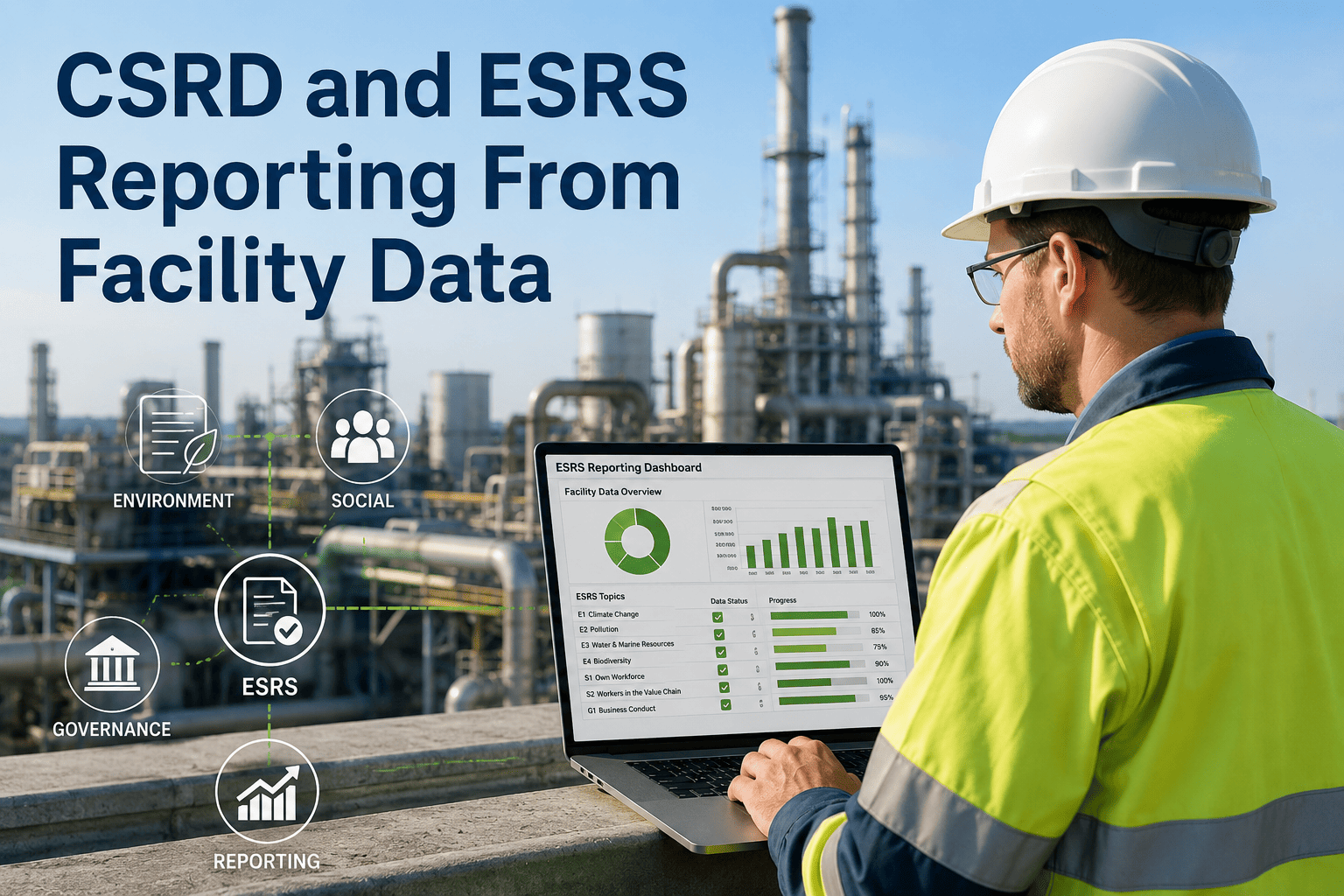
CSRD and ESRS reporting requirements now cascade down to building-level operational data, and facility management teams are the source of the auditable evidence sustainability disclosures demand. Under the Corporate Sustainability Reporting Directive, estimated utility figures and annual averages no longer satisfy auditors; you need granular, facility-specific energy consumption, refrigerant logs, and asset efficiency records tied directly to your maintenance operations. By centralizing this data through a CMMS, FM teams can automate the collection of CSRD building emissions metrics and eliminate the manual scramble every quarter. See how OxMaint streamlines this compliance pipeline when you Start Free Trial or read on to map your ESRS facility disclosure requirements.
Is your facility data audit-ready for ESRS E1 climate disclosures?
The Corporate Sustainability Reporting Directive shifts the burden of proof to the asset level. Spreadsheets and manual utility estimates will fail limited assurance reviews. OxMaint captures the building-level operational evidence ESRS requires—automatically, every day.
CSRD reporting requirements for buildings: What auditors actually check
The European Sustainability Reporting Standards (ESRS) E1 climate disclosure mandates that organizations report building-level energy consumption, greenhouse gas emissions, and transition risks. For facility managers, CSRD compliance means translating daily maintenance activities into structured, auditable sustainability data. Auditors enforcing limited assurance—moving to reasonable assurance by 2028—will scrutinize four core data streams from your buildings.
Scope 1 & 2 Building Emissions
Direct emissions from stationary combustion (boilers, backup generators) and purchased electricity for HVAC and lighting. Auditors require monthly consumption logs matched to utility meters and asset-level sub-meters—not annual estimates divided by 12.
Refrigerant Fugitive Emissions
HVAC refrigerant top-ups and leaks carry high Global Warming Potential (GWP). CSRD building emissions reporting demands a full log of refrigerant type, charge capacity, top-up volumes, and service dates tied to the specific chiller or RTU asset tag.
Asset Energy Performance
Energy intensity per square meter and operational asset efficiency. This requires tracking runtime hours, filter replacements, and compressor cycling to prove that equipment is maintained to OEM efficiency specs and not wasting energy.
Maintenance Audit Trails
Evidence that preventive maintenance was executed on climate-impacting equipment. Missed PMs on HVAC systems directly inflate energy consumption and Scope 2 emissions. Auditors check timestamps, technician signatures, and parts consumed.
CSRD audit facility data: Moving from estimates to evidence
A CSRD audit facility data review demands the same rigor as a financial audit. If a maintenance team tracks reactive work orders on paper and logs utility bills in a separate spreadsheet, there is no continuous thread connecting an asset's physical condition to its energy output and emissions. This fragmentation creates material risks during assurance reviews.
| Data Requirement | Traditional FM Tracking | CSRD-Compliant Evidence |
|---|---|---|
| Energy Consumption | Annual utility bill estimates | Sub-metered, asset-level kWh data timestamped daily |
| Refrigerant Logs | Paper service tickets in a filing cabinet | Digital work order records with exact top-up weight and GWP factor |
| PM Compliance | Calendar reminders with no completion proof | Closed work orders with technician sign-off and runtime meter readings |
| Asset Hierarchy | Flat equipment list | Parent-child asset tree mapping components to building energy meters |
| Data Retention | Ad-hoc, often lost in staff turnover | Tamper-proof, exportable history retained for 10+ years |
The hidden cost of manual CSRD facility evidence compilation
Consider a 180-asset commercial facility spending $42,000 annually on energy. When CSRD reporting season arrives, the facility manager spends upwards of 60 hours pulling utility bills, cross-referencing paper HVAC service tickets, and manually calculating refrigerant top-ups in Excel. This manual compilation costs $4,500 in labor per quarter and still produces a data trail that auditors flag for insufficient granularity—risking penalties and reputational damage for incomplete ESRS compliance FM practices.
How OxMaint powers CSRD-compliant sustainability reporting buildings
OxMaint is an AI-powered CMMS and EAM platform designed to be the single source of truth for your physical assets. By tying maintenance execution directly to asset energy profiles, OxMaint eliminates the gap between facility operations and sustainability reporting. Here is how OxMaint maps to your ESRS data requirements:
Automated Asset Energy Metering
Integrate sub-meter data directly into asset profiles. OxMaint captures real-time kWh consumption for HVAC and lighting systems, feeding precise Scope 2 calculations and eliminating estimated utility averages.
Refrigerant & Fugitive Emission Tracking
Custom fields on chiller and RTU work orders capture refrigerant type, GWP, and exact top-up weight. OxMaint maintains a tamper-proof log of every service event, instantly generating your fugitive emissions report.
PM Compliance for Energy Efficiency
Schedule and enforce preventive maintenance on climate-impacting equipment. Completed PMs with digital sign-offs prove to auditors that assets are operating at OEM efficiency, reducing energy waste and supporting transition plan targets.
One-Click ESRS Data Export
Generate structured data extracts mapping asset hierarchies, energy consumption, and maintenance histories directly to ESRS E1 disclosure fields. No more manual data manipulation in spreadsheets before submitting to your sustainability team.
See how OxMaint automates your CSRD facility reporting
Stop spending 60 hours a quarter manually compiling building data for sustainability audits. Book a 30-minute demo and see your asset hierarchy turned into audit-ready ESRS evidence.
CSRD and ESRS facility reporting FAQs
What is CSRD facility reporting?
CSRD facility reporting is the process of extracting granular, building-level operational data—such as energy consumption, refrigerant logs, and asset maintenance records—to fulfill Corporate Sustainability Reporting Directive requirements. Facility teams must provide auditable evidence that feeds into the organization's overall ESRS disclosures, rather than relying on estimated annual averages.
How does ESRS E1 affect facility management?
ESRS E1 requires detailed climate disclosures, including Scope 1 and 2 emissions, which directly tie to building operations. Facility management teams become responsible for tracking and proving the efficiency of HVAC, lighting, and backup generators, as well as documenting preventive maintenance that impacts energy use and equipment emissions.
Do small facilities need CSRD compliance?
If your parent organization meets CSRD thresholds (250+ employees, €50M turnover, €25M assets), all facilities within its operational control fall under the reporting scope. Even smaller buildings must provide auditable utility and refrigerant data. To see how OxMaint scales compliance from a single site to hundreds of assets, Book a Demo.
What data is needed for a CSRD building emissions audit?
Auditors require sub-metered energy consumption, refrigerant top-up volumes with GWP factors, asset-level maintenance histories, and proof of PM compliance for climate-impacting equipment. All data must be time-stamped, traceable to specific asset tags, and retained in a tamper-proof system.
Can a CMMS automate ESRS reporting for buildings?
Yes, a modern CMMS like OxMaint automates ESRS reporting by linking daily maintenance workflows to energy and emissions data. It captures refrigerant logs during work order completion, tracks asset runtime for energy efficiency, and exports structured data directly mapped to ESRS E1 fields, reducing manual compilation by up to 90%.
Turn your maintenance data into ESRS-ready evidence today
Join the FM teams using OxMaint to eliminate manual reporting, pass audits with confidence, and cut energy waste through proactive asset management.
Free 14-day trial · No credit card