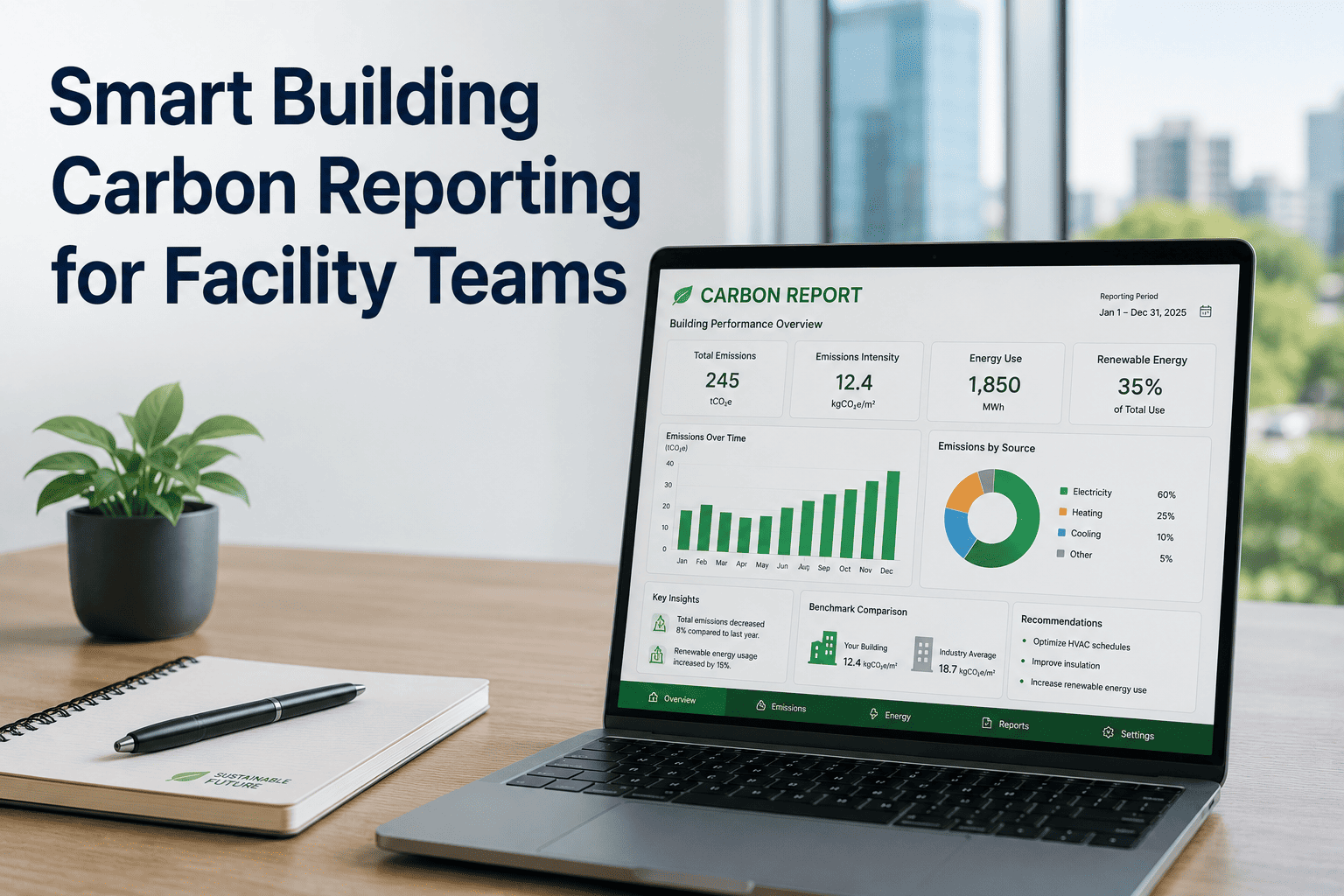
Carbon reporting for commercial buildings has crossed from voluntary disclosure to regulatory obligation in major markets worldwide — and facility teams are at the center of it. OxMaint's smart building carbon reporting module automates the collection, verification, and formatting of energy, maintenance, and utility data into Scope 1, 2, and 3 emissions reports that satisfy GRI, SASB, TCFD, and SEC climate disclosure requirements — without weeks of manual data assembly.
Sustainability & ESG · Carbon Reporting · 2026
Smart Building Carbon Reporting for Facility Teams
Automate your facility carbon footprint — from energy meter to auditor-ready ESG report. Verified data, zero manual assembly, full regulatory alignment.
2026 Regulatory Deadlines
SEC Climate Rule — US public companies
EU CSRD — European portfolio holders
ISSB S2 — Global capital market disclosure
GRESB — Real estate fund reporting
74%
Reduction in ESG report preparation time with automated facility data collection
38%
Of real estate portfolios report incomplete or unverifiable carbon data — PwC 2025
$2.6M
Average regulatory fine exposure for major EU CSRD non-compliance in 2025
What Scope 1, 2, and 3 Mean for Facility Teams
Scope 1
Direct Emissions
On-site gas boilers and heating
Diesel backup generators
Refrigerant leakage (HFCs)
Fleet vehicles (where applicable)
OxMaint tracks: Fuel consumption logs, generator runtime, refrigerant top-up work orders
Scope 2
Purchased Energy
Grid electricity consumption
District heating and cooling
Market-based vs location-based
Renewable energy certificates (RECs)
OxMaint tracks: Utility meter integration, energy drift detection, renewable source tagging
Scope 3
Value Chain Emissions
Embodied carbon in maintenance materials
Contractor and vendor travel
Waste from renovation and repairs
Tenant energy use (where reported)
OxMaint tracks: Parts procurement data, contractor work orders, waste disposal records
Carbon Reporting Frameworks — OxMaint Alignment
| Framework |
Required Data |
OxMaint Coverage |
Report Format |
| GRI 302 / 305 |
Energy intensity, direct/indirect emissions |
Full |
Auto-generated PDF + CSV |
| SASB Real Estate |
Energy consumption, GHG, water, waste |
Full |
SASB template export |
| TCFD |
Climate risk + emissions scenario data |
Partial |
Data export for analyst |
| GRESB |
Asset-level energy, water, carbon |
Full |
GRESB portal import file |
| WELL v2 / LEED |
IAQ, energy, maintenance records |
Full |
Certification audit package |
| SEC Climate Rule |
Scope 1 & 2 material emissions |
Full |
10-K disclosure data pack |
HOW OXMAINT BUILDS YOUR CARBON REPORT — AUTOMATED DATA PIPELINE
M
Meter Data
Utility API + BMS energy reads
→
W
Work Orders
Fuel, refrigerant, parts usage
→
N
Normalization
Weather, occupancy, EF factors
→
V
Verification
Audit trail + data confidence score
→
R
Report
GRI / GRESB / SEC format export
Expert Review
"The buildings sector faces an unavoidable reality: carbon data quality will determine which assets remain financeable in the next decade. Facility teams that automate their carbon data collection now — integrating energy meters, maintenance records, and utility data into a single verified source — will spend 70–80% less on ESG audit preparation than those still reconciling spreadsheets in 2027. The regulatory trajectory is clear and the window to get ahead of it is narrowing."
— James Harrington, Head of Real Assets Sustainability, KPMG Climate & ESG Advisory · Published in Real Estate Finance 2025
Your Next ESG Report — Generated, Not Assembled
See how OxMaint connects your facility data to your carbon report in a live demonstration tailored to your reporting framework and portfolio size.
Frequently Asked Questions
How does OxMaint handle third-party audit verification of carbon data?
OxMaint's carbon data pipeline maintains a complete audit trail — every data point is timestamped, source-attributed, and linked to the original meter reading or maintenance record that generated it. This chain of custody meets the data verification requirements of ISAE 3410 (greenhouse gas assurance), which is the standard most third-party auditors use for Scope 1 and 2 emissions verification.
Start free and see how your facility data maps to the verification standard — our team has guided dozens of customers through their first third-party assurance engagement.
Can OxMaint report at the individual asset or floor level, not just building level?
Yes — OxMaint supports sub-metering and zone-level energy allocation, enabling carbon reporting at tenant, floor, or cost center granularity. This is particularly relevant for mixed-use portfolios where Scope 2 emissions need to be allocated between landlord and tenant, and for GRESB reporting that requires asset-level intensity metrics.
Book a demo to see how granular your current data sources can support carbon attribution reporting without new sub-metering investment.
How does OxMaint calculate emission factors and keep them current as grids decarbonize?
OxMaint maintains a continuously updated library of location-based and market-based emission factors sourced from the IEA, EPA eGRID, DEFRA, and national grid operators — updated quarterly to reflect actual grid decarbonization. For market-based reporting (where renewable energy contracts or RECs apply), OxMaint supports manual or API-fed renewable certificate attribution that automatically adjusts the Scope 2 market-based figure. Customers operating across multiple countries see their emission factors updated automatically without any manual configuration.
Carbon Compliance Doesn't Have to Be a Manual Process
OxMaint automates your building carbon data pipeline — from meter to ESG report — free to start, no consultant required.




.jpeg)