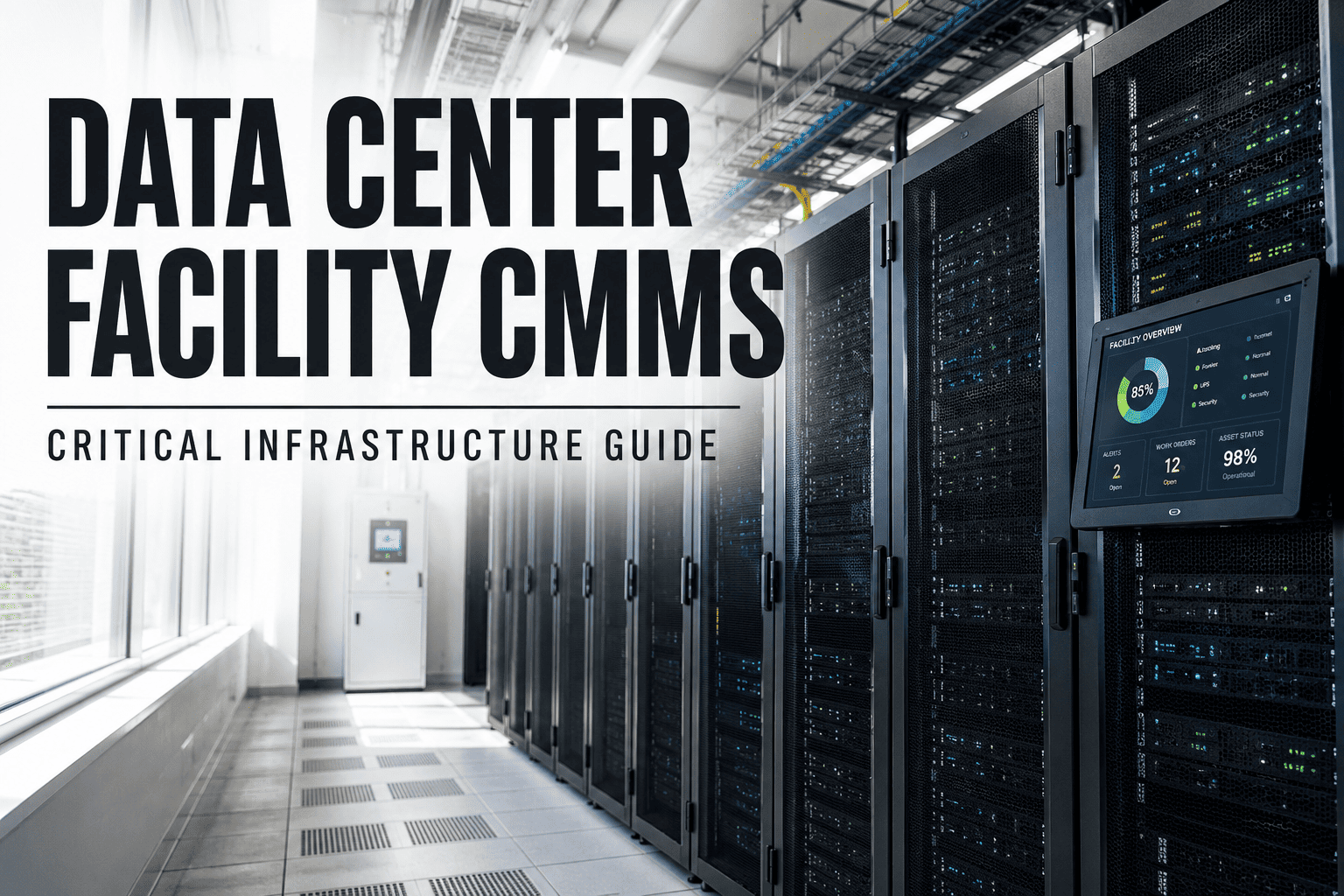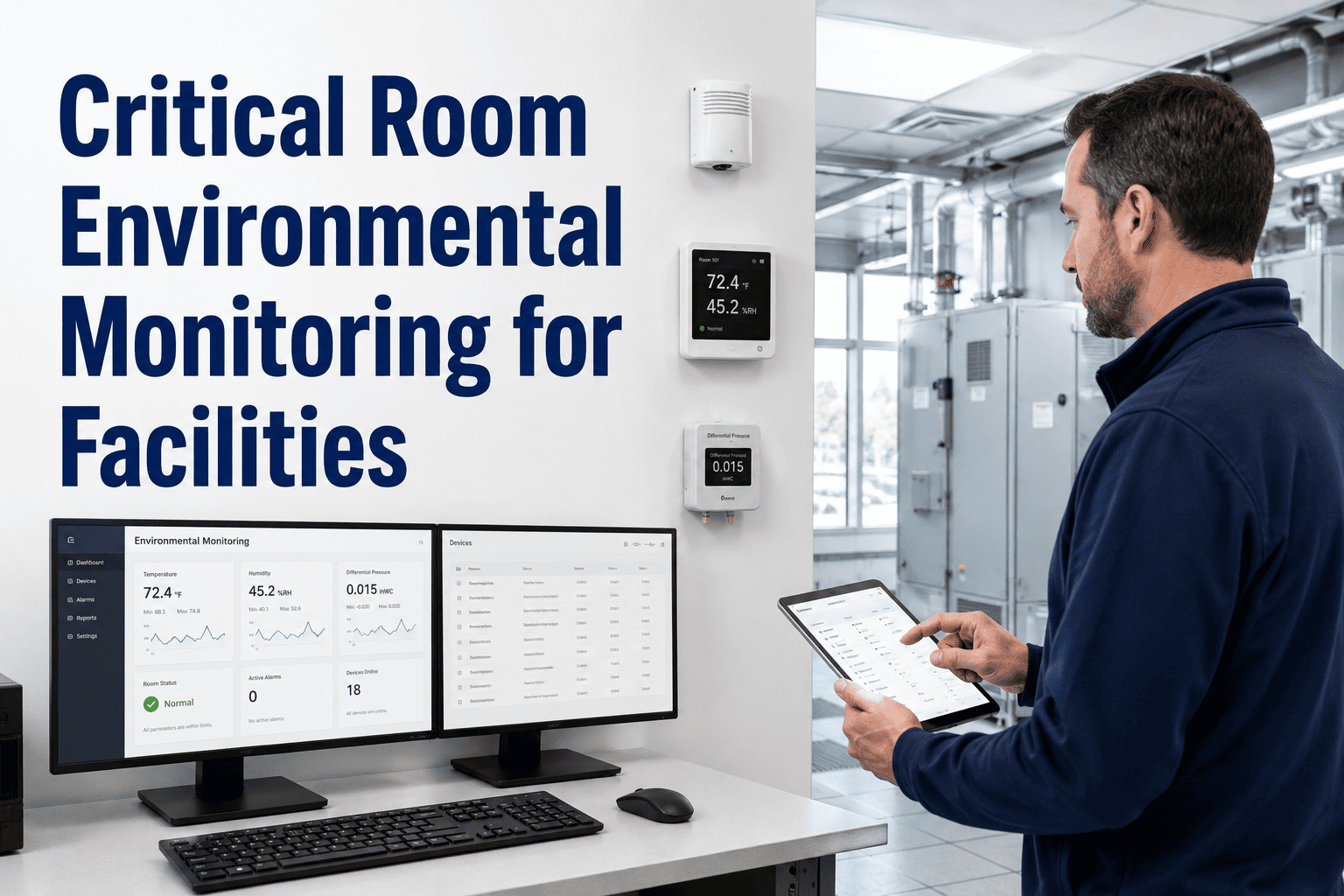
Critical environment uptime in FM is the discipline of keeping data rooms, laboratories, clean spaces and control rooms continuously operational through reliability engineering, redundancy management and rigorous change control. For facilities teams, critical environment management means moving beyond reactive repairs to predictive maintenance strategies that protect uptime in spaces where even a five-minute outage can cost millions. Modern FM critical environments require AI-powered CMMS platforms like OxMaint to automate work orders, track assets and deliver the maintenance analytics that keep critical facility uptime at the 99.999% levels these operations demand. Ready to eliminate downtime? Start Free Trial and see how AI-driven maintenance transforms your reliability program.
FM Mission Critical Reliability
Some rooms can never go down — is your FM operation ready?
Critical environment uptime demands more than scheduled servicing. It requires redundancy engineering, change control and real-time maintenance analytics that catch failures before they happen. OxMaint brings AI-powered CMMS discipline to every critical space.
Critical Environment Reliability
What defines a critical environment in facility management?
A critical environment is any facility space where an outage threatens business continuity, product integrity, safety or regulatory compliance. These spaces — data centers, pharmaceutical labs, semiconductor cleanrooms, hospital imaging suites, utility control rooms — operate under reliability requirements that far exceed standard FM. The Uptime Institute reports that 60% of data center outages cost over $100,000, with roughly one in six exceeding $1 million. For a 180-asset critical facility spending $42K annually on reactive repairs, moving to structured critical environment maintenance can cut unplanned downtime 30–50% within the first year.
Data Rooms & Server Hubs
Tier III/IV data centers require concurrent maintainability — every cooling unit, UPS and PDU must be serviceable without bringing critical load offline. FM data room uptime depends on N+1 or 2N redundancy managed through live work-order visibility.
Laboratories & Clean Spaces
Pharma labs and semiconductor cleanrooms lose product batches when HVAC, fume hoods or filtration drift outside spec. ISO 14644 and GMP compliance demand documented, timestamped maintenance for every critical asset — auditable on demand.
Control & Command Rooms
Utility grid control rooms, hospital command centers and transportation operations centers cannot tolerate display, network or environmental failures. Critical environment operations here mean zero-tolerance change windows and instant escalation paths.
Reliability Engineering Framework
The four pillars of critical environment uptime in FM
Sustaining critical facility uptime at 99.995% or higher requires four interlocking engineering disciplines. Each pillar addresses a distinct failure mode — and each is amplified when maintenance teams use an AI-powered CMMS to enforce it consistently.
N+1, 2N and 2(N+1) architectures ensure no single component failure drops the critical load. OxMaint tracks redundancy paths per asset so technicians know exactly which unit can be taken offline for maintenance without breaching capacity.
Up to 70% of critical environment outages stem from human error during planned changes. Rigorous change-control workflows — MOP, method-of-procedure checklists, rollback plans and dual authorization — prevent uncontrolled modifications.
Vibration analysis, thermal imaging and sensor data predict bearing failures and chiller degradation weeks before breakdown. AI-driven condition monitoring reduces unplanned downtime by 30–50% and cuts spare-parts spend 15–20%.
ISO 55000, GxP and FDA 21 CFR Part 11 require complete, timestamped maintenance records. Digital work-order trails and automated audit logs eliminate the documentation gaps that fail inspections and risk fines.
Uptime Economics
The cost of downtime in critical environments — and the math that prevents it
Critical environment reliability is fundamentally an ROI conversation. The Ponemon Institute's data-center study places the average cost of a single unplanned outage at roughly $740,000, with the most severe exceeding $2.4 million. When you annualize even a modest improvement — say, cutting four outage events per year down to one — the savings dwarf the cost of a CMMS platform many times over.
Annual Downtime Cost
Outage Events × Duration × Cost-per-Minute = Annual Loss
Example: 6 events × 90 min × $9,000 = $4.86M annual exposure
OxMaint Payback
(Events Prevented × Cost-per-Event) − Platform Cost = Net Year-1 Savings
Example: 4 prevented events × $740K − $18K = $2.94M net savings
| Critical Space Type | Avg. Outage Cost | Typical Failure Root Cause | Preventive Strategy |
|---|---|---|---|
| Data center (Tier III) | $9,000/min | UPS battery failure, cooling loss | Predictive battery monitoring + N+1 cooling rotation |
| Pharma cleanroom (ISO 7) | $250K–$1M/batch | HVAC pressure drift, filter saturation | Sensor-linked PM triggers + differential-pressure logging |
| Hospital imaging suite | $2,200/hr idle | Chiller failure, power fluctuation | Condition-based maintenance + redundant cooling loop |
| Utility control room | $500K+/event | Display network outage, HVAC failure | 2N power feeds + automated failover testing |
Operational Discipline
Critical environment maintenance checklist for FM teams
Use this tiered checklist to benchmark your critical space FM maturity. Each item maps to a discipline that OxMaint automates, documents and enforces — turning ad-hoc maintenance into a controlled, auditable process.
Tier 1 — Foundational
- Complete asset register with criticality ratings
- Digital work orders replacing paper and email
- Preventive maintenance schedule ≥ 90% on-time
- Spare-parts inventory with min-max triggers
Tier 2 — Advanced
- Redundancy path documented per critical asset
- Change-control MOP with rollback steps enforced
- MTBF and MTTR tracked and trending down
- Vendor SLA performance monitored automatically
Tier 3 — Optimized
- AI-driven failure predictions in production
- IoT sensor data feeding condition-based PM
- Real-time uptime dashboard with drill-down
- Audit-ready compliance log auto-generated
See OxMaint protect your critical environment — book a 30-minute demo
Watch how AI-driven work orders, predictive maintenance and live asset tracking keep data rooms, labs and clean spaces online. Get a tailored walkthrough on your own critical assets.
Platform Capabilities
How OxMaint drives critical environment uptime
OxMaint is an AI-powered CMMS and EAM platform built for the maintenance and reliability teams responsible for mission-critical spaces. Each capability below maps directly to a critical environment uptime challenge — and delivers a measurable outcome within the first 90 days of deployment.
AI-Powered Predictive Maintenance
OxMaint analyzes vibration, temperature and run-time data to predict bearing, motor and chiller failures weeks before they occur — cutting unplanned downtime 30–50% and extending asset life by 20%.
Enforced Change Control
MOP templates, dual-authorization gates and rollback checklists are built into every critical-asset work order — eliminating the uncontrolled changes that cause 70% of outages.
Live Maintenance Analytics
Real-time dashboards track MTBF, MTTR, PM compliance and uptime per critical asset — giving reliability engineers the data to act before a trend becomes a failure.
Audit-Ready Compliance Logs
Every work order, spare-part issue and sensor reading is timestamped and logged automatically — generating ISO 55000, GxP and FDA-compliant audit trails with zero manual effort.
Real-World Impact
What critical facility teams achieve with OxMaint
"We managed our data room cooling on spreadsheets and sticky notes. After switching to OxMaint, our PM compliance hit 97% in the first quarter and we caught two chiller bearing failures before they became outages. The platform paid for itself in a single prevented event."
— Facilities Director, 200-rack colocation data center
Frequently Asked Questions
Critical environment uptime in FM — your questions answered
What is a critical environment in facility management?
A critical environment is any facility space where downtime threatens business continuity, product integrity, safety or compliance — data centers, labs, cleanrooms, control rooms and hospital imaging suites. These spaces require FM critical facility strategies like redundancy management, change control and predictive maintenance to sustain uptime above 99.99%.
How much does downtime cost in a critical facility?
Data center downtime averages $9,000 per minute, with full outage events often exceeding $740,000 according to Ponemon Institute research. Pharma cleanroom batch losses can reach $1 million, and utility control-room failures may top $500,000 per event. Preventing even two or three outages per year typically delivers seven-figure savings.
How does a CMMS improve critical environment reliability?
A CMMS like OxMaint enforces preventive maintenance schedules, tracks asset criticality and redundancy paths, digitizes work orders with change-control MOPs, and provides real-time analytics on MTBF and MTTR. Teams using OxMaint cut unplanned downtime 30–50% by catching failures early and eliminating the documentation gaps that fail audits.
What is the difference between preventive and predictive maintenance for critical spaces?
Preventive maintenance follows a fixed schedule — inspect a chiller every 90 days, replace a filter every 6 months. Predictive maintenance uses IoT sensor data and AI to trigger service only when condition indicators — vibration, temperature, pressure — show degradation. For critical environment operations, predictive maintenance prevents over-servicing while catching failures weeks earlier. Start Free Trial to see OxMaint's predictive engine on your assets.
How long does it take to implement OxMaint for a critical facility?
Most critical facility teams are live on OxMaint within 2–4 weeks. The platform imports your existing asset register, PM schedules and spare-parts data, then configures work-order templates and dashboards for your specific critical spaces. Full predictive-maturity — sensor integration and AI failure prediction — typically follows within 60–90 days of go-live.
Protect every critical room — start your OxMaint trial today
Join the maintenance and reliability teams using OxMaint to keep data rooms, labs and clean spaces online with AI-powered work orders, predictive maintenance and audit-ready compliance logs.
Free 14-day trial · No credit card