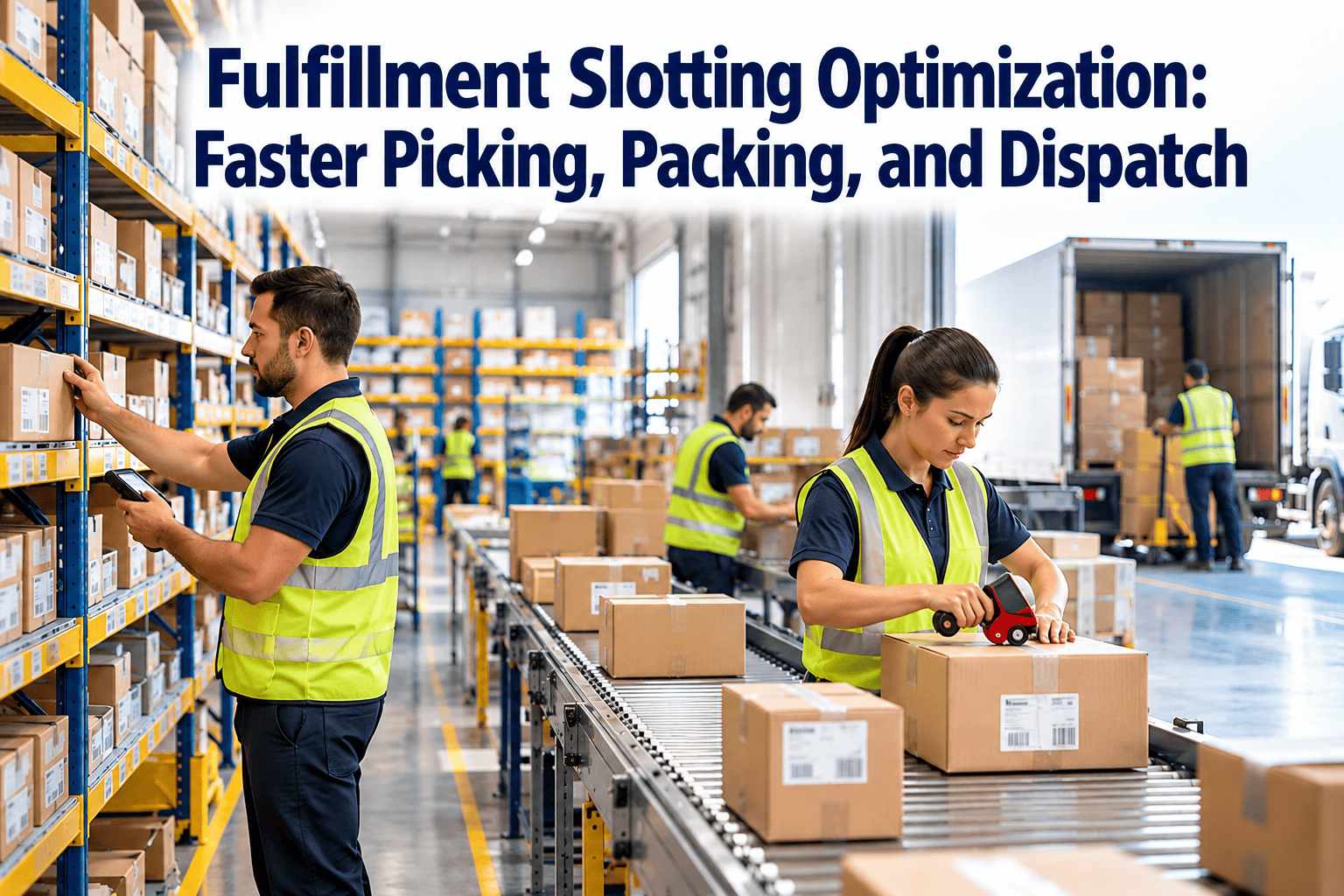
Walk a busy pick aisle and you can usually see the problem: the fastest-moving item sits at the far end, two heavy cases are stored at floor level, and a slow mover holds a prime location by the pack station. Pickers cover extra distance on every order, and that wasted travel is the largest single component of labor in most piece-pick operations. Slotting optimization fixes this by placing each item where its demand, size, and handling needs fit best. This guide explains the logic, the cadence, and how maintenance planning software protects the racks and equipment a slotting plan relies on.
Fulfillment Slotting Optimization: Faster Picking, Packing, and Dispatch
Bad slotting sends pickers walking miles for nothing. Place inventory by velocity, cube, and ergonomics to cut travel time and move orders to dispatch sooner.
A
A
B
B
C
C
A
B
B
C
C
C
B
B
C
C
C
C
Fastest movers sit closest to the pack and dispatch end, at waist-to-shoulder height. Slower items move outward.
Where Poor Slotting Costs You
Travel time
Fast movers spread across the building multiply steps on every wave.
Congestion
Popular items concentrated in one aisle create picker traffic jams.
Replenishment
Small pick faces for fast items force constant restocking.
Injury risk
Heavy items stored high or very low drive strain and lifting hazards.
Space waste
Large locations hold small items, so cube capacity is lost.
The Four Slotting Rules
Good slotting balances competing goals. Rank them for your operation rather than applying one in isolation.
Velocity
Rank items by pick frequency, not units shipped. A slow-selling bulky item picked rarely does not need a prime face.
Cube and fit
Match location size to item dimensions and quantity so each slot holds a sensible replenishment quantity.
Affinity
Store items often ordered together near each other to shorten multi-line orders.
Ergonomics
Keep heavy, awkward, and frequently handled items between knee and shoulder height.
Data You Need Before You Re-Slot
| Data | Used for | Common problem |
|---|---|---|
| Order lines by item for a representative period | Velocity ranking and affinity | Period includes a promotion that skews rankings |
| Item dimensions and weight | Cube fit and ergonomic placement | Master data entered from vendor estimates |
| Location dimensions and type | Matching items to slots | Locations modified but records not updated |
| Replenishment data | Pick face sizing | Emergency replenishments not recorded |
| Seasonality and forecast | Planning future slot needs | Using history only, ignoring planned launches |
Travel Before and After a Re-Slot
Before
Top sellers spread across several aisles
Heavy cartons at upper levels
Multiple replenishments per shift on fast items
Pickers cross the building for one order
After
Top sellers grouped near pack and dispatch
Heavy items at ergonomic heights
Pick faces sized for fewer replenishments
Shorter, more predictable pick paths
Results depend on your starting layout and order profile, so measure the baseline before changing anything.
Keep the Slotting Plan Running on Reliable Equipment
A good layout only works if racks, forklifts, and conveyors stay available. Oxmaint helps schedule inspections and repairs across them.
Re-Slotting Cadence: Stopping the Decay
Slotting gains erode as demand shifts and new items arrive. Plan the maintenance of the layout itself.
Continuous
Assign new items by rule at receiving instead of the first open location.
Weekly
Review top movers whose pick face has run empty or overflowed.
Monthly or quarterly
Rerun velocity rankings and move the highest-impact items first.
Before peak and after peak
Reslot for seasonal items, then return them to reserve storage.
Move in small batches
- Schedule moves during low-volume windows so picking continues.
- Prioritize items where the move saves the most travel.
- Verify each new location with a scan so the system matches the floor.
Slotting and Equipment Maintenance Meet on the Rack
Racking inspection
Re-slotting increases handling at the rack. Inspect uprights, beams, and safety clips on a scheduled basis and after impacts.
Lift truck availability
Reslot projects depend on trucks. Keep preventive maintenance current so moves are not delayed.
Conveyor and pick module upkeep
Moving fast items near pack stations raises load on nearby equipment. Watch wear after the change.
Slotting KPIs
Lines picked per labor hour
Main productivity measure to compare before and after.
Travel distance per order
Direct measure of layout efficiency.
Replenishments per pick face
Shows whether faces are sized correctly.
Cube utilization
Space used compared with space available.
Order cycle time to dispatch
Connects picking gains to delivery cutoffs.
Oxmaint Capabilities for Slotting Programs
- Recurring rack and aisle inspections with photo evidence of damage.
- Preventive maintenance for lift trucks, pick carts, and conveyors.
- Work orders for repairs identified during re-slot projects.
- Asset and parts records for storage equipment and material handling units.
- Reporting on equipment downtime that affects pick and dispatch performance.
Velocity Classes in Practice
| Class | What it looks like | Placement approach |
|---|---|---|
| A items | A small share of items generating a large share of picks | Closest to pack and dispatch, easy-reach heights, generous pick faces |
| B items | Moderate frequency, steady demand | Middle zones, standard pick faces, grouped by affinity |
| C items | Long tail of slow movers | Outer zones or higher levels, smaller faces, fewer relocations |
| Seasonal items | Demand spikes at predictable times | Move forward before the season and back to reserve afterward |
| New items | No history, uncertain demand | Temporary location, review after several weeks of orders |
| Bulky or heavy items | Awkward regardless of velocity | Ground level or dedicated zones with suitable equipment |
Ergonomic Zones by Height
Placing items at a comfortable height reduces strain and speeds each pick, so ergonomics supports productivity instead of competing with it.
Shoulder to eye level
Light, small, frequently picked items that can be reached without stretching.
Waist level
The best position for the fastest movers and moderately heavy items.
Knee to waist
Heavier items and larger cartons that are lifted but not carried far.
Floor level
The heaviest, bulkiest items, ideally moved by cart or equipment.
Above shoulder
Slow movers and reserve stock, accessed with ladders or lift equipment.
Slotting for Different Storage Types
Shelving and bins
Best for small, fast pieces. Size bins to hold a sensible replenishment quantity and avoid mixing very different sizes in one bin.
Pallet flow and carton flow
Strong for high-volume items. Lanes must match case size and quantity, and rollers and brakes need regular inspection.
Selective pallet racking
Flexible for varied sizes. Keep fast pallets at accessible levels and slow pallets higher, respecting load ratings.
Mezzanine pick modules
Efficient for small parts with high pick density. Plan access for replenishment and keep walkways clear.
Automated storage
Slotting logic moves into software rules, but equipment availability and maintenance still determine real throughput.
A Step-by-Step Slotting Project
Step 1: Baseline
Record current picks per hour, travel distance, replenishment counts, and congestion points so results can be compared honestly.
Step 2: Clean data
Correct item dimensions, location sizes, and order history, and decide how to treat promotions and one-time spikes.
Step 3: Classify
Rank items by pick frequency, flag bulky and heavy items, and identify groups that are often ordered together.
Step 4: Design zones
Define the pick zones, assign classes to them, and set pick face sizes based on demand and replenishment practicality.
Step 5: Move in waves
Relocate the highest-impact items first during low-volume windows, and confirm each move by scan.
Step 6: Review
Measure results after several weeks, adjust problem areas, and set the next review date.
Mistakes That Undo Slotting Gains
- Slotting from units shipped instead of pick lines, which rewards bulk orders and misplaces items that are picked often in small quantities.
- Putting all fast movers in one aisle, which creates congestion and cancels the travel savings.
- Ignoring replenishment effort, so pickers save steps while the replenishment team falls behind.
- Letting new items fill any open location, which slowly rebuilds the original problem.
- Moving too much at once, which disrupts picking and leads to location errors.
- Forgetting equipment condition, such as damaged racks, slow lift trucks, and failing scanners, which limits what the new layout can deliver.
Measuring the Impact Honestly
The size of the gain depends on how poor the starting layout was, how steady demand is, and how well the plan is maintained. Avoid quoting someone else's percentages as a promise for your site.
Good measurement habits
- Compare similar weeks, adjusting for volume and order mix.
- Track travel and picks per hour by zone to see where gains and losses occur.
- Include replenishment labor and congestion, not only pick labor.
- Check order cycle time to dispatch to confirm the benefit reaches delivery cutoffs.
- Record equipment downtime during and after the project to separate layout effects from reliability effects.
Affinity and Order Profile Analysis
Velocity tells you what is picked most often. Order profiles tell you what is picked together, which often changes the best layout.
- Look at the most common item pairs and groups across orders, and place those items in the same or neighboring zones.
- Separate single-line orders from multi-line orders, since the best layout for each can differ.
- Check how orders are batched and waved, because slotting should support the picking method actually used.
- Identify items that appear in many orders but in small quantities, which benefit from convenient pick faces.
- Review customer or channel patterns, such as delivery routes or cutoff times, that affect which orders must leave first.
Pick Path and Zone Design
Where the fast items sit is only part of the story. The path pickers walk between them determines the final travel distance.
Serpentine paths
Pickers move through each aisle in a continuous pattern. This works well when most orders touch many aisles.
Zone picking
Pickers stay in one area while orders pass between zones, reducing walking but requiring consolidation.
Wave and batch picking
Several orders are picked together, which rewards grouping popular items close to one another.
Cross-aisle access
Added or relocated cross-aisles shorten routes and reduce congestion around busy locations.
Replenishment Planning for Fast Movers
A fast item in a prime slot only helps if the slot stays full. Slotting and replenishment need to be designed together.
- Size pick faces so that a full face lasts at least a shift or a planned replenishment cycle.
- Use min and max triggers or system-directed tasks, so replenishment happens before pickers find empty locations.
- Place reserve stock for fast items close to the pick area to shorten replenishment trips.
- Schedule replenishment during low-activity periods where possible to avoid blocking aisles.
- Track the number of emergency replenishments, which signals pick faces that are too small or reserve stock that is too far.
Slotting During Peak Season
Peak changes the order profile, and the layout that worked in a quiet month may slow you down when volume doubles.
- Forecast which items will surge and move them into prime locations before the rush, not during it.
- Create temporary pick locations for promotional items so regular stock is not displaced.
- Add overflow and reserve space near pick modules to keep replenishment within reach.
- Reduce congestion by splitting very popular items across two locations in different zones.
- Complete preventive maintenance on racks, lift trucks, and pick equipment before the layout changes, so the new plan is not limited by equipment downtime.
- After peak, return seasonal stock to reserve and review which temporary changes should stay.
Change Management for Slotting Projects
A technically sound plan fails when people cannot find items. Make the transition easy for the team who picks, replenishes, and counts.
- Explain why locations are changing and how the new layout will make picking easier.
- Update labels, signage, and system locations together, so the floor and the data match on the first day.
- Brief supervisors and pickers on the changed zones before each wave of moves.
- Collect feedback after the first week and correct problems quickly.
- Recognize improvements in picks per hour and error reduction, so the team sees the benefit of the work.
Slotting Optimization FAQs
How often should we re-slot?
Assign new items by rule continuously and review rankings at least quarterly. Fast-changing assortments need more frequent reviews.
Do we need software for slotting?
Spreadsheets work for small sites, but larger catalogs benefit from tools that analyze velocity, cube, and affinity together.
What is a golden zone?
It is the easy-reach band between knee and shoulder height closest to the pack area, reserved for the fastest items.
How does maintenance affect slotting?
Damaged racks and unreliable trucks limit where you can place goods. Schedule inspections to protect your layout.
Can we maintain several warehouses together?
Yes, equipment and inspections can be organized by site. Book a demo to see it in action.
Hold On to Your Pick Efficiency Gains
Pair a disciplined re-slotting cadence with scheduled maintenance for the racks and equipment behind it.