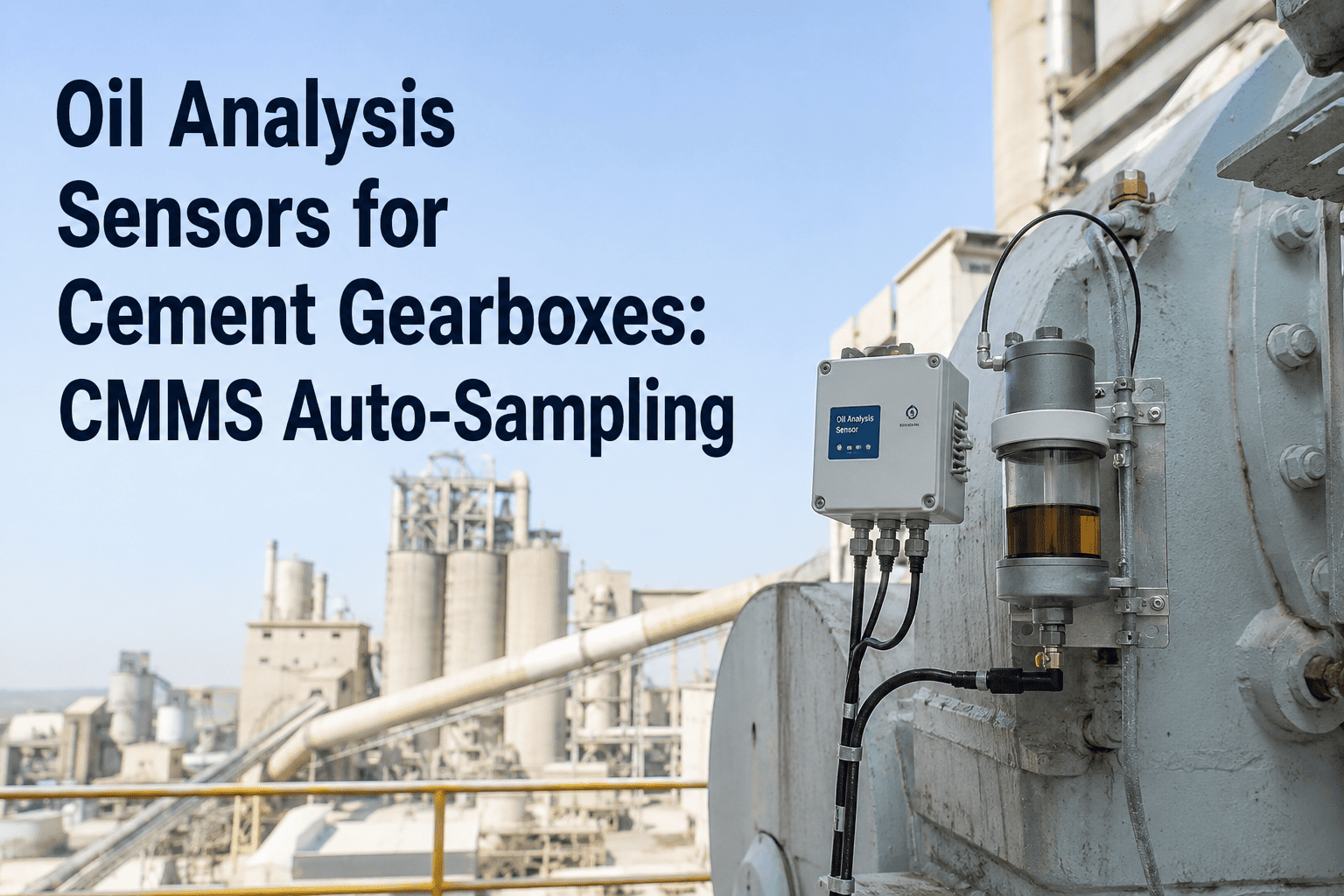
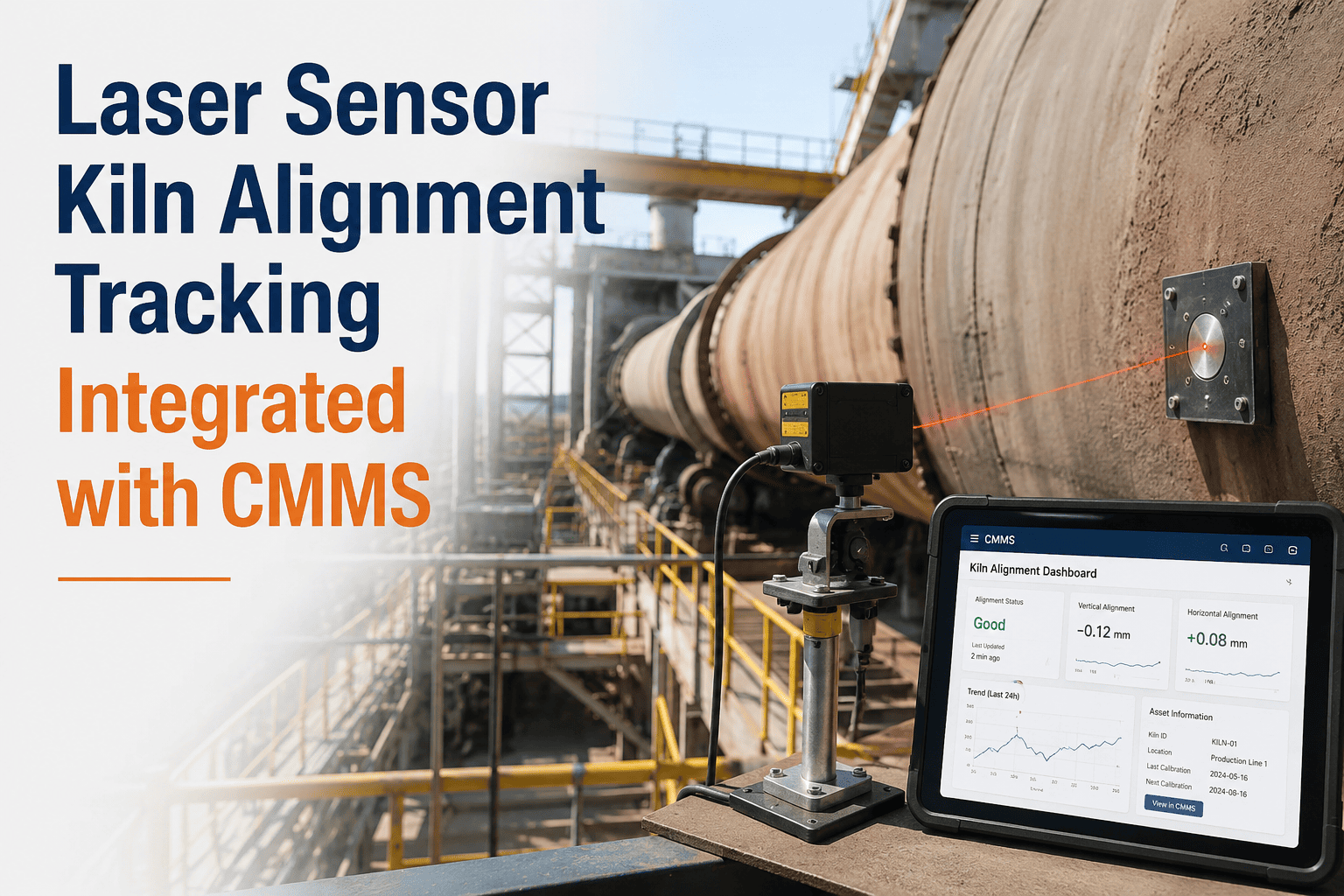
A single VRM gearbox seizure at a 5,000 TPD cement plant costs between $800,000 and $2.5 million in emergency parts, labour, and lost production — and in most documented cases, the failure was preventable. Wear metal particles, moisture contamination, and viscosity breakdown all appear in the oil weeks before a gearbox approaches catastrophic failure, but traditional quarterly lab sampling creates a 90-day blind window where damage accumulates undetected. Online oil analysis sensors installed directly on VRM gearboxes and kiln drive lubrication systems close that window permanently — monitoring lubricant health in real time and triggering work orders automatically in a predictive CMMS like OxMaint the moment contamination crosses alarm thresholds.
Cement Plant Maintenance · Oil Analysis · Predictive Lubrication
Oil Analysis Sensors for Cement Gearboxes: Real-Time Lubrication Monitoring with CMMS Auto-Sampling
VRM gearboxes and kiln drive systems run under massive continuous loads. When lubricant quality degrades — through wear metal accumulation, moisture ingress, or viscosity breakdown — the first sign is in the oil, weeks before vibration or temperature alarms fire. Online oil sensors detect it instantly. OxMaint acts on it automatically.
90 days
Blind window between quarterly lab samples where gearbox damage accumulates undetected
3–6 wk
Advance warning from online oil sensors before gearbox failure reaches destructive stage
38%
Extension of oil drain intervals achievable through condition-based rather than calendar-based changes
The Case for Online Oil Monitoring
Why Quarterly Lab Sampling Is No Longer Enough for Cement Gearboxes
Traditional oil analysis sends samples to a lab every 90 days. In between, your gearbox runs blind. For VRM planetary drives, kiln main gear units, and ball mill trunnion lubrication systems operating under continuous high-torque loads, 90 days is time enough for a contamination event to progress from detectable to catastrophic.
Day 0
Clean Oil Baseline
Quarterly sample taken. Oil particle count within limits. Lab report filed. Gearbox declared healthy.
Day 14
Wear Particle Spike — Undetected
Metallic particle count begins rising. Gear tooth contact pattern changes due to micro-pitting. Online sensor would detect this. Quarterly schedule sees nothing.
Day 35
Moisture Ingress — Undetected
Water contamination from a failed seal begins acid-accelerating gear tooth wear. Particle count doubles. Viscosity drops 12%. Still 55 days until next sample. Vibration unchanged.
Day 60
Accelerated Gear Wear — Undetected
Wear rate has increased 4× from Day 0. Gear tooth surface fatigue is now progressing rapidly. Vibration shows minor elevation — not enough to alarm. 30 days until next lab sample.
Day 82
Catastrophic Seizure — Unplanned Shutdown
Gear tooth spalling generates large metallic debris. Debris circulates through bearings. Gearbox seizes. Production line stops. Emergency repair cost: $1.2M. All detectable on Day 14 with online sensors.
Sensor Technology Guide
Four Online Oil Analysis Parameters That Predict Cement Gearbox Failure
Online oil analysis sensors measure four lubricant parameters in real time. Each parameter detects a different failure mechanism — and together they give a complete picture of gearbox health that no single sensor or lab report can match.
Wear Particle Count
ISO 4406 Cleanliness Code
What it measures
Number and size distribution of solid particles per millilitre of oil — distinguishing ferrous wear debris from external contamination
Failure modes detected
Gear tooth micro-pitting, bearing race fatigue, abrasive wear from external dust ingress
Lead time before failure
3–6 weeks for VRM planetary drives; 2–4 weeks for kiln drive pinion
CMMS Action: Generate inspection work order when ISO code rises 2 levels from baseline in a 7-day window
Moisture / Water Content
Parts Per Million (PPM)
What it measures
Water concentration in the lubricant — distinguishing dissolved moisture from free water that accelerates corrosion and additive depletion
Failure modes detected
Seal failure, condensation from thermal cycling, cooling water cross-contamination in kiln drive systems
Lead time before failure
4–8 weeks before accelerated corrosion causes bearing raceway damage
CMMS Action: Trigger urgent seal inspection work order when water content exceeds 500 PPM and is trending upward
Viscosity Index
cSt at 40°C and 100°C
What it measures
Lubricant film-forming capacity at operating temperature — the property that keeps gear teeth separated under load
Failure modes detected
Thermal degradation, fuel dilution from nearby equipment, additive shear breakdown in high-pressure gear systems
Lead time before failure
Viscosity loss below 15% of specification begins reducing gear tooth film thickness toward boundary lubrication
CMMS Action: Schedule accelerated oil analysis and oil change work order when viscosity deviates more than 15% from ISO grade specification
Ferrous Debris Density
Magnetic Inductive Index
What it measures
Mass of ferrous (iron) particles in suspension — specifically identifying wear originating from steel gears and bearing races versus non-ferrous seal debris
Failure modes detected
Active gear tooth wear, bearing spalling, case hardening fatigue in planetary carriers under high radial loads
Lead time before failure
Ferrous index doubling in 72 hours indicates acute wear event — immediate action required to prevent seizure
CMMS Action: Immediate shutdown recommendation work order when ferrous index doubles in any 72-hour period
OxMaint Predictive AI · Oil Analysis Integration
Stop Waiting 90 Days for Lab Results. Get Real-Time Oil Health Data — With Automatic Work Orders.
OxMaint connects directly to online oil analysis sensors on your VRM gearboxes and kiln drive systems. When any parameter — particle count, moisture, viscosity, or ferrous debris — crosses your defined alarm threshold, a corrective work order is generated automatically with the fault type, affected gearbox, and recommended action. No manual monitoring. No lab turnaround delays.
Asset Priority Map
Which Cement Plant Gearboxes Need Online Oil Sensors First — and Why
Not every gearbox in a cement plant justifies the same monitoring investment. This priority map ranks the five most critical gearbox applications by failure consequence and the specific oil parameter most likely to give early warning.
| Gearbox / Asset |
Failure Consequence |
Primary Oil Alarm Parameter |
Recommended Sampling |
OxMaint Action |
| VRM Planetary Gearbox |
Entire raw or finish grinding circuit halts. 2–6 week lead time for planetary carrier replacement |
Wear particle count (ISO 4406) + ferrous debris index |
Continuous online sensor |
Auto work order on ISO code +2 rise in 7 days |
| Kiln Main Drive Gearbox |
Full plant shutdown. Kiln refractory damage from uncontrolled cooling. $1.5M+ replacement cost |
Ferrous debris density + moisture PPM |
Continuous online sensor |
Emergency work order on ferrous index doubling in 72hr |
| Ball Mill Trunnion Lube System |
Trunnion bearing seizure. 3–8 week repair involving bearing replacement and shaft alignment |
Viscosity + wear particle count |
Continuous or weekly auto-sampling |
Scheduled oil change WO when viscosity deviation exceeds 15% |
| Coal Mill Gearbox |
Coal circuit outage affecting kiln fuel supply. Risk of coal dust ignition if gearbox casing overheats |
Moisture PPM + particle count |
Continuous online sensor (safety-critical) |
Immediate inspection WO — combined moisture and particle threshold breach |
| Clinker Cooler Fan Gearbox |
Cooler efficiency drop affecting clinker quality and kiln back-pressure control |
Wear particle count + viscosity |
Monthly auto-sampling or continuous on critical units |
Predictive maintenance WO scheduled at next planned opportunity on any threshold trend |
CMMS Auto-Sampling Workflow
How OxMaint Turns Oil Sensor Data Into Maintenance Actions — Automatically
1
Continuous Sensor Data Ingestion
Online oil sensors transmit particle count, moisture, viscosity, and ferrous debris readings to OxMaint in real time via Modbus, OPC-UA, or wireless IoT gateway. Readings are logged to the gearbox asset record continuously — not just at sample events.
2
Baseline and Trend Analysis
OxMaint establishes a running baseline for each parameter at each gearbox — accounting for seasonal temperature variation, load fluctuations, and post-oil-change stabilisation. Alarms fire on rate of change, not just absolute value, eliminating false positives from normal operating variation.
3
Multi-Parameter Correlation
OxMaint cross-references oil sensor data with vibration and temperature readings on the same gearbox. A particle count spike combined with a concurrent vibration increase at bearing defect frequencies triggers a higher urgency response than either alarm in isolation.
4
Automatic Work Order Generation
When any configured threshold or trend condition is met, OxMaint generates a corrective work order automatically — with the specific parameter that triggered it, the current reading versus baseline, recommended immediate action, and assigned technician. Zero manual intervention for standard alarm events.
5
Lab Sample Request Auto-Trigger
When online sensors detect an anomaly, OxMaint automatically generates a physical lab sample request work order in addition to the corrective action work order. The lab sample provides detailed elemental spectroscopy that confirms the failure mode and guides the repair scope — without waiting for the next scheduled quarterly sample.
6
Post-Intervention Verification
After an oil change or gearbox repair, OxMaint monitors the rate of particle count reduction and viscosity stabilisation post-intervention — confirming the corrective action resolved the root cause and resetting the trend baseline for ongoing monitoring.
Common Questions
Oil Analysis Sensors for Cement Gearboxes — FAQs
Can online oil sensors replace laboratory oil analysis entirely for cement gearboxes?
Online sensors and lab analysis are complementary, not interchangeable. Online sensors provide continuous real-time trend data on particle count, moisture, viscosity, and ferrous debris. Lab analysis adds elemental spectroscopy, acid number, and detailed particle morphology that identify specific failing components. The best approach is online sensors triggering lab samples automatically when anomalies appear, rather than fixed quarterly lab schedules.
Discuss the combined monitoring approach with our team.
How do online oil sensors connect to OxMaint CMMS?
OxMaint integrates with oil analysis sensors via Modbus TCP, OPC-UA, and REST API. For wireless sensor installations, OxMaint supports MQTT over IoT gateways. Sensor readings map directly to the gearbox asset record in OxMaint, with threshold configuration done per-asset to account for different gearbox sizes, oil grades, and criticality levels.
How often does a VRM gearbox actually need oil changes based on condition monitoring data?
Most cement plants running VRM gearboxes on fixed annual or 6-month oil change schedules find that condition monitoring data justifies extending intervals by 30–40% on gearboxes with clean operating histories — and mandates early changes on 15–20% of units showing accelerated degradation. The result is fewer oil changes overall with significantly better gearbox protection.
Start tracking your gearbox oil condition in OxMaint.
What is the recommended particle count alarm threshold for a VRM planetary gearbox?
ISO 14/12/9 is the typical cleanliness target for a VRM planetary gearbox. Alert thresholds are generally set at ISO 16/14/11 — two codes above baseline — with an urgent work order triggered at ISO 17/15/12. OxMaint allows per-asset threshold configuration so you can apply manufacturer-recommended limits for each specific gearbox rather than a plant-wide blanket setting.
Can OxMaint's oil analysis integration also track manual lab sample results alongside sensor data?
Yes. OxMaint provides a unified oil health record per gearbox that combines continuous sensor readings with manually entered or imported lab report data. Technicians can enter lab results directly in the mobile app, and the system overlays them on the sensor trend chart so you see both data sources in one view for each gearbox.
Book a demo to see the unified oil health dashboard.
OxMaint Predictive Maintenance · Oil Analysis · Cement Gearboxes
Your VRM Gearbox Is Telling You It Is About to Fail. The Signal Is in the Oil. Are You Listening?
OxMaint connects to online oil analysis sensors on your most critical cement gearboxes — VRM planetary drives, kiln main gear units, and ball mill trunnion systems — monitoring particle count, moisture, viscosity, and ferrous debris in real time. When any parameter signals trouble, OxMaint generates a corrective work order automatically. No 90-day lab turnaround. No missed contamination events. No unplanned gearbox seizures.