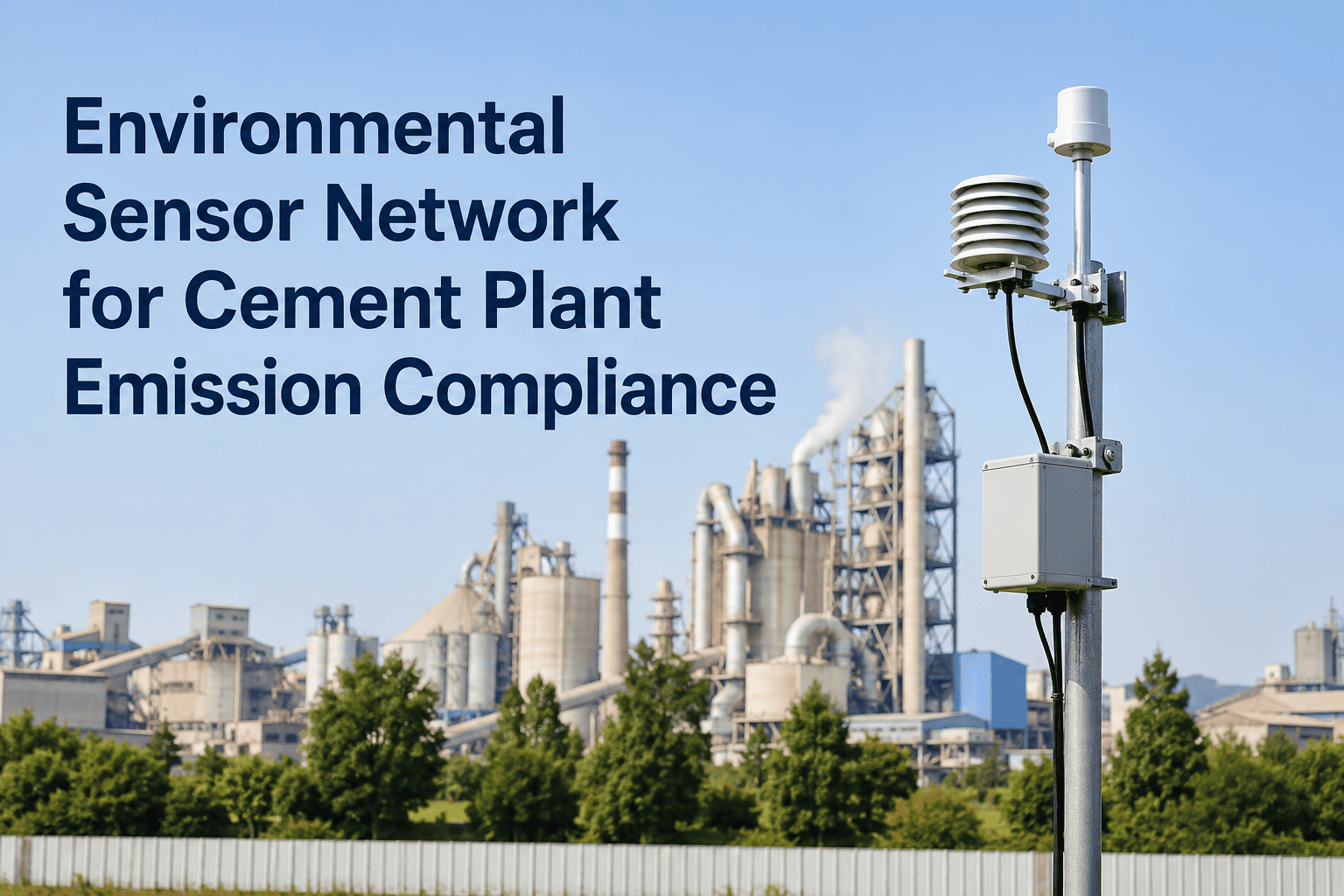
Cement kilns operate at 1,400°C and emit a cocktail of regulated pollutants — NOx, SO2, particulate matter, mercury, CO, and dioxins — from every stage of production. Environmental regulators across the US, EU, India, and China now mandate continuous real-time monitoring of these emissions, with penalties ranging from $10,000 to $100,000+ per day of violation. Yet the most dangerous compliance gap is not a missing sensor — it's the gap between a sensor reading and the maintenance action it should trigger. That gap is where CMMS integration closes the loop: when emission readings drift toward permit limits, your CMMS should automatically schedule baghouse inspections, SNCR reagent checks, and burner cleanings before the exceedance occurs. Start a free trial with Oxmaint CMMS to build your environmental compliance program on a framework built for cement operations, or book a 30-minute session with our cement industry specialists to map your emission sources to CMMS maintenance triggers.
Why 73.7% of Cement Plants Still Fail NOx Compliance
Across a study of over 1,400 cement plants globally, 90% achieved compliance for particulate matter and SO2 — but only 26.3% met ultra-low NOx emission standards. The sensors exist. The regulations are clear. The failure point is the maintenance program behind the control equipment: SNCR nozzles clogging, reagent feed lines drifting, and burner settings decaying between manual inspections. A continuous emission sensor network connected to CMMS maintenance triggers is the operational link that the other 73.7% are missing.
Where Sensors Must Be Deployed Across the Cement Plant
A cement plant is not a single emission point — it is a distributed network of emission sources, each with different pollutant profiles, regulatory limits, and maintenance dependencies. Mapping every source to its sensor requirement and its CMMS trigger is the foundation of a functional environmental compliance program.
Connect Every Emission Reading to a Maintenance Action
Oxmaint CMMS maps your CEMS sensor readings to automatic maintenance triggers — scheduling baghouse inspections, SNCR checks, and burner cleanings before readings breach permit thresholds.
How Continuous Emission Sensors Drive Automatic CMMS Maintenance Triggers
The compliance value of a CEMS network is not the sensor data — it is what happens when that data trends toward a limit. A sensor that logs a rising NOx reading with no corresponding maintenance action is a compliance liability, not an asset. Here is the four-stage workflow that converts raw sensor output into scheduled, documented, preventive maintenance.
CEMS analyzers measure NOx, SO2, particulate, CO, mercury, and opacity at each emission point — typically every 1 to 15 minutes depending on the pollutant and regulatory requirement. Triboelectric dust monitors and LIDAR-based opacity sensors feed readings directly into the plant's data acquisition system (DAHS).
Each pollutant is assigned two thresholds: a warning threshold at 80–85% of permit limit, and an action threshold at 90–95% of permit limit. Warning thresholds generate a scheduled work order. Action thresholds generate an urgent work order with same-shift response requirements — all automatically, without manual dashboard review.
When a reading crosses a configured threshold, CMMS generates a work order assigned to the responsible technician with the specific inspection task, asset ID, the pollutant reading that triggered it, and the permit limit for reference. No manual intervention is required to initiate the maintenance response.
Work order completion is recorded in CMMS with technician sign-off, corrective action taken, and post-maintenance emission reading. This creates an auditable compliance trail demonstrating to regulators that an exceedance was identified and corrected. Without this documentation, even a correctly executed corrective action provides no compliance protection at audit.
Five Pollutants, Five Sensor Technologies, Five Maintenance Triggers
Each pollutant measured by a cement plant CEMS has a specific sensor technology and a specific set of control equipment whose maintenance directly determines whether emissions stay within permit limits. Understanding this link turns environmental monitoring from a compliance checkbox into a predictive maintenance tool.
| Pollutant | Sensor Technology | Typical Permit Limit | Control Equipment | CMMS Maintenance Trigger |
|---|---|---|---|---|
| NOx | Chemiluminescence or NDIR analyzer | 200–500 mg/Nm³ (EU); 1.5–3.0 lb/ton clinker (US) | SNCR/SCR system, combustion optimization | SNCR nozzle inspection, reagent flow rate verification, burner tuning work order |
| SO₂ | UV fluorescence or NDIR analyzer | 400 mg/Nm³ (EU); varies by US state permit | Dry sorbent injection (DSI), raw material feed control | DSI dosing system inspection, sorbent feed rate calibration check |
| Particulate Matter | Triboelectric or optical forward scatter | 10–20 mg/Nm³ (EU); 0.04 gr/dscf (NESHAP) | Baghouse filters, ESP | Baghouse differential pressure check, bag row inspection, pulse valve cycle test |
| Mercury (Hg) | Cold vapor atomic fluorescence (CVAF) | 0–5 µg/Nm³ (NESHAP Subpart LLL) | Activated carbon injection (ACI) | ACI dosing rate verification, raw material Hg testing, activated carbon silo level check |
| CO / O₂ | Electrochemical or paramagnetic sensor | CO: 1,000–3,000 mg/Nm³; O₂: varies by permit | Combustion air control, burner management | Burner combustion air ratio adjustment, kiln draft fan inspection |
Maintaining the CEMS Analyzers Themselves: Your Other Compliance Obligation
A CEMS that is not properly maintained becomes a compliance liability faster than an unmonitored emission point. Title V permit conditions in the US require a minimum 90% CEMS data availability rate — a single four-hour data gap can trigger an excess emission report. CMMS tracking of the sensor maintenance program is as critical as tracking the control equipment the sensors monitor.
CEMS Integration with CMMS: Common Questions
Stop Reacting to Exceedances — Start Preventing Them
Oxmaint CMMS connects your emission sensor network to automatic maintenance triggers. Every rising NOx reading becomes a scheduled baghouse inspection. Every permit limit approached becomes a preventive work order, not a penalty notice.