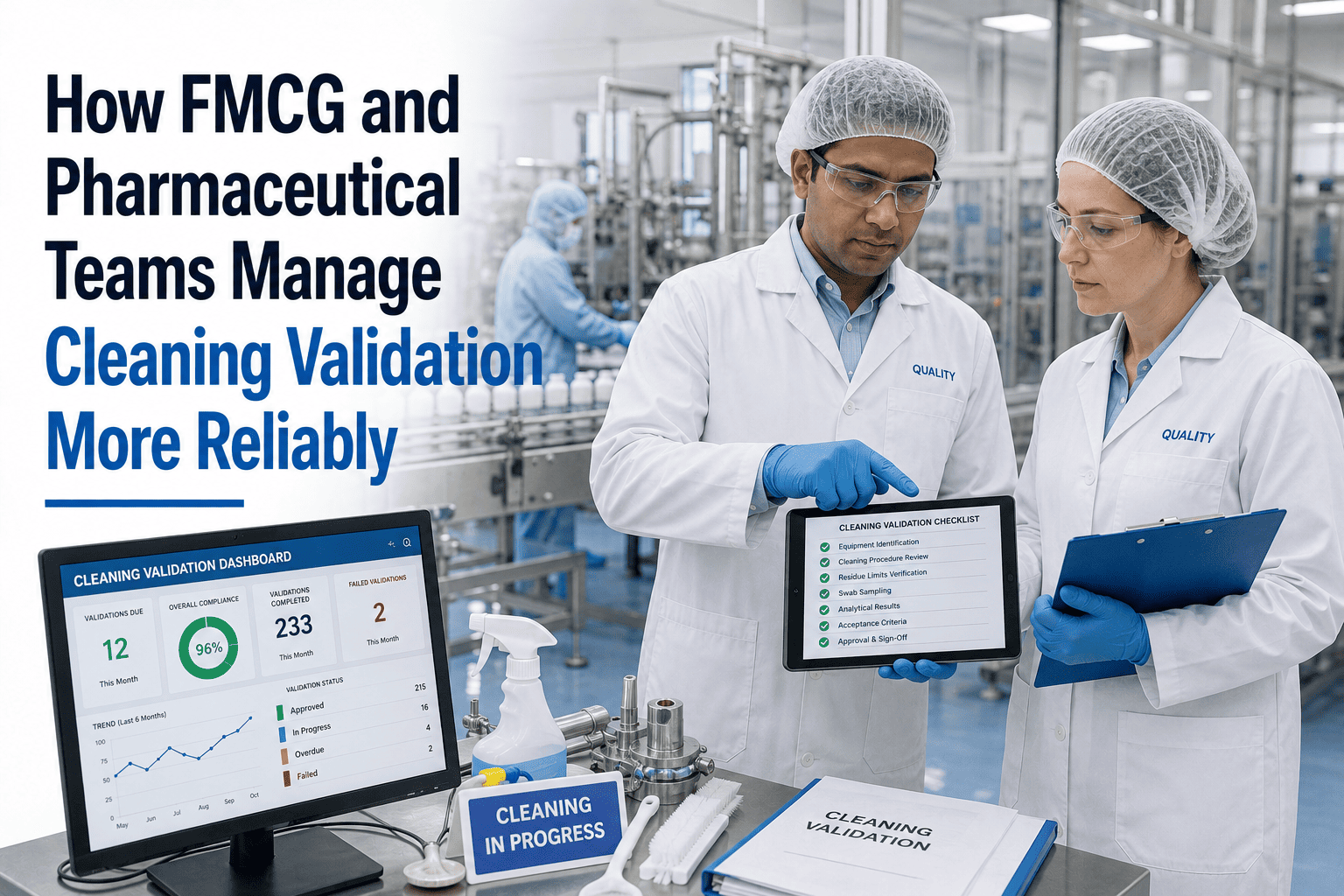
In FMCG and pharmaceutical manufacturing, the cost of one failed cleaning validation event dwarfs the entire annual cleaning budget. A single residue carryover incident in a pharma tablet line triggers an FDA Form 483, a Plan of Correction, and a regulatory hold that can paralyse production for weeks. A failed allergen changeover in an FMCG line creates a labelling crisis and a recall in seven figures of direct cost before legal exposure. Cleaning validation is not a sanitation activity — it is a structured five-stage process (Clean → Verify → Document → Approve → Release) that must complete in sequence, with electronic evidence at each stage, before product manufacturing can resume. Plants running paper-based cleaning validation routinely lose 10-15% of available production time to validation rework, cycle restarts, and disputed records. The plants that move to Oxmaint Inspection Management with Safety & Compliance and Smart Document Management consistently recover that time and produce audit-grade evidence for FDA, MHRA, EMA, ANVISA, and TGA inspections. Book a demo to see the validation cycle mapped on your lines.
COMPRESS VALIDATION CYCLE BY 40-60%
Oxmaint structures Clean → Verify → Document → Approve → Release as one digital workflow.
Cleaning Validation Reality
Four Numbers That Define Validation Outcomes
10-15%
production time lost to validation rework on paper-based plants
$10M+
average cost of a single allergen or pharma residue recall event
60-80%
of microbial contamination events traced to inadequate CIP validation
-45%
validation cycle time reduction typical inside 12 months
DEFINITION
What Cleaning Validation Actually Means
Cleaning validation is the formal, regulator-recognized process of proving that a cleaning procedure consistently removes product residues, cleaning agents, and microbial contamination below pre-defined acceptance criteria. For FMCG, this means allergen carryover under 5ppm; for pharma, residue limits calculated on patient dose carryover and toxicology. The validation event is structured into five sequential stages and each stage must produce timestamped electronic evidence to satisfy FDA 21 CFR Part 211, EU GMP Annex 15, and ICH Q7.
Oxmaint structures the five stages into one digital workflow with required measurement gates and electronic signatures at each step. Start a free trial, or book a demo.
The 6-Stage Cleaning Validation Cycle
Every validation event flows through six gated stages around a single central record. Oxmaint requires evidence at each gate before the next stage can begin.
VALIDATION
CYCLE
21 CFR Part 11
01
Clean
CIP/SIP cycle executed per validated SOP. Temperature, time, concentration, and flow logged via PLC integration.
02
Verify
Visual inspection, swab samples, rinse-water TOC, conductivity, and microbial counts recorded with photo evidence.
03
Document
Every reading, observation, and deviation timestamped in Oxmaint with operator electronic signature.
04
Approve
QA reviews the validation record digitally and applies approval signature. Out-of-spec results block release automatically.
05
Release
Line release recorded with timestamp and QA approval ID. Production system unlocks for next campaign.
06
Audit Trail
Full electronic audit trail retained for FDA, MHRA, EMA, ANVISA, TGA inspections. Exportable in minutes.
A failed CIP swab discovered before release costs Rs.5,000. The same residue discovered post-release costs Rs.10 crore.
Pain Points That Compromise Validation Reliability
Six recurring failures every paper-validation plant carries — most invisible until an audit, deviation, or recall surfaces the gap.
01
EXECUTION
CIP Steps Skipped Under Pressure
A skipped pre-rinse or shortened hold time happens under production pressure. Oxmaint Inspection Management gates each step.
02
VERIFY
Swab Results Mismatched to Locations
Paper swab logs lose track of which result came from which location. Oxmaint links every swab to a specific asset location.
03
DOCUMENT
Handwritten Records Illegible
A faded entry at the end of a 12-hour validation shift is a Form 483 finding. Oxmaint captures structured digital data.
04
APPROVE
QA Approval Delays Restart
A QA approver away from the floor delays line restart 2-6 hours. Oxmaint mobile approval lets QA sign off remotely.
05
RELEASE
Out-of-Spec Result Misses Hold
A failed swab not caught by QA review releases an unvalidated line. Oxmaint blocks release on out-of-spec results.
06
AUDIT
Audit Trail Reconstruction
Reconstructing 12 months of paper validation records for an FDA audit takes days. Oxmaint exports the full audit pack in minutes.
These six failures compound into the validation cycle time and regulatory risk gap — start a free trial or book a demo.
How Oxmaint Structures Every Validation Event
Six Oxmaint modules combine to convert paper-based validation into a structured, gated, regulator-ready workflow.
01
Every CIP/SIP cycle is a digital procedure with required temperature, time, concentration, and flow checkpoints.
02
Electronic signatures with operator authentication, timestamps, and tamper-proof audit logs satisfying FDA 21 CFR Part 11.
03
Swab and rinse TOC, conductivity, and microbial counts trended on SPC charts. Out-of-spec results auto-flag a deviation WO.
04
12-24 months of validation evidence exportable as a structured audit pack for FDA, MHRA, EMA, ANVISA, TGA inspections.
05
CIP skid PLC feeds live temperature, time, conductivity, and flow data into the validation record continuously.
06
Out-of-spec results auto-create a corrective WO. QA cannot release line until WO is closed with root cause and CAPA.
FDA 21 CFR Part 11 is non-negotiable for pharma — Oxmaint produces compliant electronic records from day one.
Paper Validation vs. Oxmaint Digital Validation
The cycle time and compliance gap is structured workflow captured in one platform every operator and QA approver uses.
| Operational Dimension | Paper Validation Plant | Oxmaint Digital Validation |
|---|
| CIP Step Compliance | Paper SOP, skip-prone | Digital gating per step |
| Swab Result Traceability | Manual reconciliation | Linked to asset location |
| QA Approval Time | 2-6 hours typical | Under 15 minutes mobile |
| Validation Cycle Time | Baseline + 10-15% rework | Baseline, near-zero rework |
| Audit Trail Format | Paper binders | Digital, exportable |
| 21 CFR Part 11 Compliance | Gap-prone, paper sigs | Full electronic signature |
| Out-of-Spec Hold | Manual, error-prone | Automatic system lock |
| Audit Prep Time | 2-5 days reconstruction | Export pack in minutes |
ROI & Outcomes From Oxmaint Validation Deployment
These are the measurable outcomes FMCG and pharma plants reach within 12 months of unified Oxmaint deployment.
validation cycle time
Through gated digital workflow and mobile QA approval
21 CFR Part 11 compliance
Electronic signatures replace paper sigs from day one
audit prep time
From 2-5 days reconstruction to minutes-long export
deviation events
Gated workflow eliminates skipped CIP steps
production time recovered
From 10-15% lost to validation rework down to 1-3%
typical payback
On single-line Oxmaint validation deployment
These outcomes are what QA Directors and Plant Managers bring to leadership — start a free trial on one line first, or book a demo for the multi-site rollup.
FMCG & Pharma Cleaning Validation FAQ
Does Oxmaint satisfy FDA 21 CFR Part 11 for pharma cleaning validation
Yes. Oxmaint captures operator authentication, electronic signatures, timestamps, and tamper-proof audit logs that satisfy FDA 21 CFR Part 11, also recognized by MHRA, EMA, and TGA inspections.
Can Oxmaint integrate with CIP skid PLCs and SCADA
Yes. Oxmaint PLC Sensor Integration connects to CIP skid PLCs and plant SCADA so temperature, time, concentration, and conductivity data flow live into the validation record — eliminating manual transcription.
How does Oxmaint handle out-of-spec swab results
Out-of-spec swab or rinse results auto-trigger a deviation WO and lock the line release in Oxmaint. QA must approve a corrective action and CAPA before the line can return to production.
How long does Oxmaint deployment take for an FMCG or pharma plant
A single FMCG or pharma plant is typically live in 10-14 working days using Oxmaint pre-built validation templates. First digital validation event captured inside week one, with full team adoption inside 30 days.
Decision Point
Stop Losing Production Time to Validation Rework
Turn every cleaning validation event into a structured, gated, audit-ready workflow with Oxmaint. Used by FMCG and pharma teams managing 10,000+ assets. Live in days, not months.
21 CFR Part 11 compliant
Mobile QA approval
Multi-site portfolio rollup
No heavy implementation. Multi-site FMCG and pharma portfolios. Measurable results in 30 days.