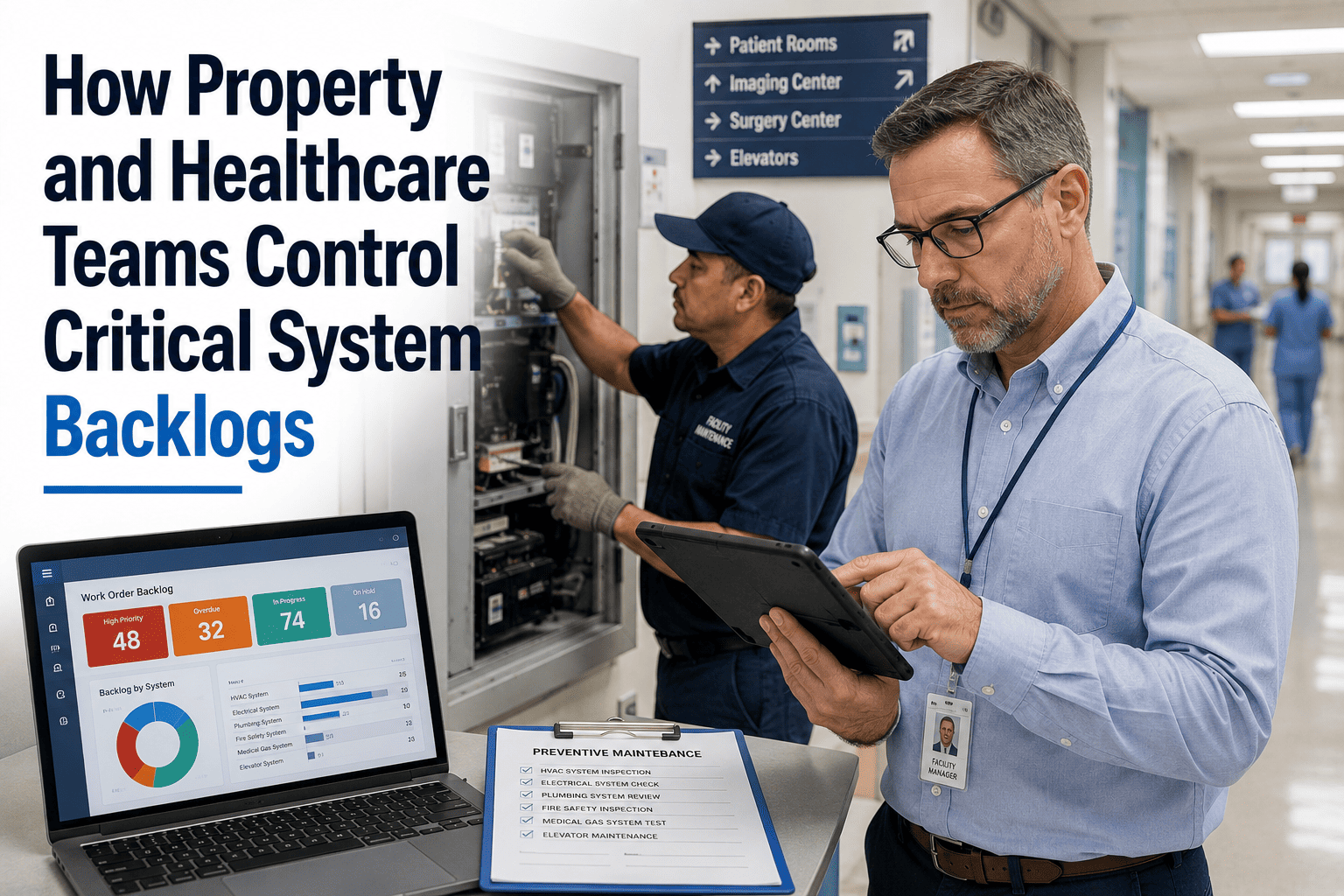
The work order backlog in a property or healthcare facility is the single most accurate predictor of asset failure risk in the next 90 days. Most facilities carry a backlog of 200-1,500 open work orders at any time — and the difference between a well-run portfolio and a struggling one is not the size of the backlog but the structure of how it is triaged. A 600-WO backlog with every order tagged by criticality, asset risk, and compliance impact is manageable. A 200-WO backlog without triage is operationally invisible — and an investigation waiting to happen when a sentinel event occurs in a hospital corridor or a property loses certification. Top-quartile facilities run a daily triage routine that ranks every open WO against four dimensions: life-safety risk, regulatory deadline, asset criticality, and SLA-to-occupant. Oxmaint encodes this triage into a single dashboard that surfaces what to do first, second, and third — across Maintenance Management, Work Order Management, Inspection Management, and Safety & Compliance. Book a demo to see your backlog ranked in real time.
PRIORITY 1 BACKLOG
Get your backlog ranked in 30 minutes
Oxmaint surfaces the 5% of open work orders that drive 80% of operational and compliance risk.
BACKLOG DASHBOARD — OPERATIONAL REALITY
Four Numbers Every Facility Director Knows
200-1500
typical open work orders at any time in a mid-sized facility portfolio
80/20
5% of backlog WOs drive 80% of operational and compliance risk
4.8X
cost of emergency repair vs. planned repair on the same asset
62%
of facilities operate without a structured WO triage system
What Critical System Backlog Control Actually Means
Backlog control is the discipline of taking every open work order in a facility portfolio and ranking it daily against four risk dimensions — life-safety exposure, regulatory deadline, asset criticality, and SLA to occupant — then dispatching technicians against the ranked list rather than against age or random sequence. The output is a daily prioritized worklist where the highest-risk items are addressed first, deferred PMs do not slip below safety thresholds, and compliance deadlines never sneak up on the team.
Oxmaint encodes the triage logic into the platform: every WO is tagged on creation, scored on dimensions, and surfaced to the dispatcher in a ranked list. To see your facility backlog ranked, start a free trial, or book a demo.
The Backlog Triage Matrix: 6 Priority Tiers
Every open work order in Oxmaint sits in one of six priority tiers. The top three tiers represent the 5% of WOs that drive 80% of facility risk.
CRITERIA
Fire alarm panel fault, medical gas system failure, elevator entrapment risk, emergency generator failure, fall hazard in occupied corridor.
ACTION
Same-shift response, ILSM activation, technician dispatched within 30 minutes.
CRITERIA
TJC EC deadline, ASHRAE compliance, OSHA citation correction, Building Safety Act deadline, food-safety audit prep.
ACTION
Closed before regulatory deadline. Oxmaint Safety & Compliance tracks deadlines per WO and escalates overdue.
CRITERIA
Chiller compressor anomaly, switchgear fault, boiler leak, hospital HVAC zone failure, primary backup pump fault.
ACTION
Same-day response, parts confirmed in stock. Oxmaint Parts & Inventory checks availability at WO creation.
CRITERIA
Patient room temperature out of range, tenant common-area lighting outage, plumbing leak in non-clinical space.
ACTION
Closed within SLA window (typically 4-24 hours). Oxmaint tracks SLA per WO with auto-escalation.
CRITERIA
Quarterly fire damper inspection, annual chiller PM, monthly fire extinguisher walk, semiannual generator load test.
ACTION
Closed within scheduled PM window. Oxmaint surfaces overdue PMs in dispatch view.
CRITERIA
Aesthetic repairs, non-critical paint, planned upgrades, cosmetic fixture replacement, energy-efficiency improvements.
ACTION
Closed in scheduled maintenance window or quarterly batch. Oxmaint groups P6 by location for batch dispatch.
A 600-WO backlog is fine. A 200-WO backlog without triage is dangerous — Oxmaint surfaces the 5% that matter most.
Pain Points That Quietly Grow Backlog Risk
Six recurring failures every reactive facility carries — most invisible until a sentinel event surfaces the gap.
!
No Triage on Open Work Orders
WOs queued by submission date, not risk. A P1 life-safety item can sit behind a P6 paint job. Oxmaint scores every WO automatically.
!
Regulatory Deadlines Sneak Up
TJC, OSHA, and Building Safety Act deadlines pass unnoticed until an inspector arrives. Oxmaint tracks deadlines per WO.
!
Aging Backlog Hides Asset Risk
A WO open 180 days on a chiller compressor is a predictive failure indicator nobody sees. Oxmaint surfaces aging WOs by criticality.
!
Parts Out-of-Stock at Dispatch
Technicians arrive at the asset to find the part is not on shelf. Oxmaint Parts & Inventory checks stock at WO creation.
!
SLA Breach Discovered After Complaint
A tenant or patient complaint surfaces an SLA breach that was avoidable. Oxmaint auto-escalates WOs approaching SLA deadline.
!
No Portfolio View Across Sites
A VP Facilities cannot see backlog status across 12 properties from one dashboard. Oxmaint Enterprise rolls up backlog by site.
These pain points stack into the operational and compliance gap — start a free trial or book a demo.
How Oxmaint Triages Every Open Work Order
Six Oxmaint modules combine to convert undifferentiated backlog into a ranked, daily, dispatch-ready worklist.
01
Every WO is scored on life-safety, regulatory, asset criticality, and SLA dimensions at creation.
02
TJC, OSHA, Building Safety Act, and customer-audit deadlines tracked per WO. Auto-escalation as deadline approaches.
03
WO creation checks parts availability against the asset's typical spare needs. Stock-out warnings before dispatch.
04
Deferred and overdue PMs surface in the daily dispatch view with carry-forward priority.
05
Real-time dashboard of open WOs by tier, age, location, and assigned technician. Sentinel-risk WOs flagged for VP review.
06
Portfolio dashboards roll up backlog metrics across every facility — VP Facilities sees hotspots before they become incidents.
A daily 10-minute triage routine on Oxmaint prevents 80% of the sentinel events that come from unmanaged backlog.
Unmanaged Backlog vs. Oxmaint-Triaged Backlog
The operational gap is structured ranking captured in one dispatch-ready system every shift uses.
| Operational Dimension |
Unmanaged Backlog |
Oxmaint-Triaged Backlog |
| WO Sequencing | Date-of-submission | Risk-scored ranking |
| Life-Safety WO Response | Variable, ad-hoc | Same-shift, alerted |
| Regulatory Deadline Tracking | Calendar reminders, missed | Per-WO tracking, auto-escalation |
| Parts Availability at Dispatch | Discovered at asset | Checked at WO creation |
| SLA Breach Detection | After tenant complaint | Auto-escalation before breach |
| Backlog Aging Visibility | Manual reporting, lagged | Real-time per asset and tier |
| Multi-Site View | Spreadsheet aggregation | Portfolio dashboard |
| Sentinel Event Risk | High — undetected aging WOs | Low — flagged in dashboard |
ROI & Outcomes From Oxmaint Backlog Triage
These are the measurable outcomes property and healthcare teams reach within 12 months of unified Oxmaint deployment.
-42%
aging WOs over 90 days
Through structured daily triage and dispatch
100%
regulatory deadline tracking
TJC, OSHA, Building Safety Act tracked per WO
-58%
SLA breaches
Auto-escalation prevents breach before it occurs
-38%
emergency repair spend
As reactive cost ratios shift to planned
3.6X
technician dispatch efficiency
Through parts-at-creation and ranked queue
60 days
typical payback
On a single-property Oxmaint backlog deployment
These outcomes are what VP Facilities bring to leadership to justify portfolio rollout — start a free trial on one site first, or book a demo for the multi-site rollup.
Property & Healthcare Backlog FAQ
How does Oxmaint score each work order
Oxmaint assigns a combined risk score on creation based on four dimensions — life-safety exposure (highest weight), regulatory deadline proximity, asset criticality rating, and SLA-to-occupant. WOs surface in ranked order in the dispatcher view.
Can Oxmaint integrate with our existing ticketing or service-request portal
Yes. Oxmaint integrates with tenant portals, patient-experience platforms, and internal service-request systems via API. Inbound service requests become Oxmaint WOs with the source data captured.
How does Oxmaint help with TJC and Building Safety Act audits
Oxmaint Safety & Compliance tracks regulatory deadlines per WO, surfaces overdue items, and produces audit-ready evidence packs showing complete WO history, technician sign-off, and corrective action chains.
How long does Oxmaint deployment take for a property or healthcare facility
A single facility is typically live in 7-14 working days using Oxmaint pre-built property and healthcare asset templates. First triaged dispatch happens inside week one, with full team adoption inside 30 days.
Decision Point
Stop Losing Compliance and SLA to Unranked Backlog
Turn every open work order into a ranked, dispatchable item with Oxmaint. Used by facility teams managing 10,000+ assets. Live in days, not months.
Risk-scored WO triage
Regulatory deadline tracking
Multi-site portfolio rollup
No heavy implementation. Works across multi-site property and healthcare portfolios. Measurable results in 30 days.