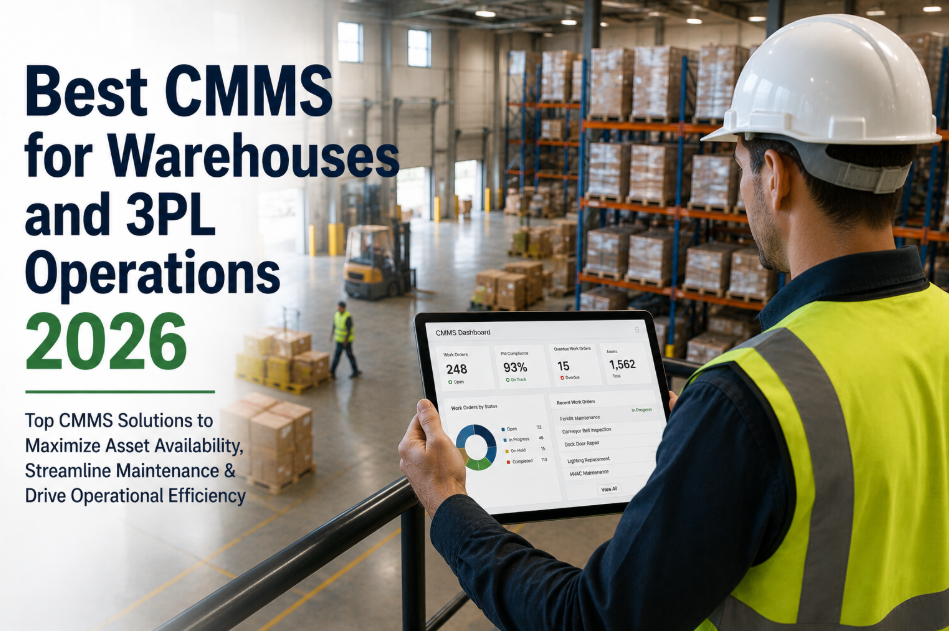
Warehouse maintenance is not facility management with higher ceilings — it is a throughput-protection discipline where a single conveyor failure halts 2,000 orders per hour, where a dock leveler malfunction backs up inbound trucks for an entire shift, where forklift downtime cascades into missed SLA windows that trigger six-figure penalty clauses from retail clients, and where the maintenance team is expected to keep material handling equipment, sortation systems, racking infrastructure, dock equipment, HVAC for temperature-sensitive storage, and fire suppression systems running 20-24 hours per day across peak season surges that double normal volume. A mid-size distribution center manages 3,500+ maintainable assets across conveyors, sortation, MHE fleets of 40-80 forklifts, dock doors and levelers, racking systems, HVAC and refrigeration, fire suppression, and building infrastructure — each with different failure modes, PM frequencies, and direct throughput impact. Warehouses and 3PL operations using structured CMMS platforms report 44% reduction in unplanned conveyor downtime, 37% improvement in MHE fleet availability, and elimination of the reactive maintenance culture that currently costs the average distribution center $180,000-$320,000 annually in emergency repairs and missed shipment penalties. The platforms ranked here are evaluated on warehouse-specific criteria — conveyor and sortation system PM automation, MHE fleet management, dock equipment tracking, OSHA compliance documentation, and whether a maintenance technician working the overnight shift can complete work orders from a mobile device in a 500,000 sq ft facility without walking back to the maintenance office for a computer.
Best CMMS for Warehouses and 3PL Operations 2026
Top warehouse and distribution center maintenance platforms ranked on conveyor PM automation, MHE fleet management, dock equipment tracking, OSHA compliance, and real-world adoption by operations teams protecting throughput 24/7.
See How OxMaint Handles Warehouse and DC Maintenance
Conveyor PM templates, MHE fleet tracking, dock equipment management, and multi-site dashboards — deployed across your distribution network in weeks.
Why Warehouse Maintenance Demands Its Own CMMS Approach
Warehouse and distribution center maintenance operates on a fundamentally different value equation than commercial property maintenance. In an office building, a broken escalator is an inconvenience. In a distribution center, a broken conveyor segment halts an entire pick line — and every order on that line misses its ship window. The financial consequence is not a tenant complaint; it is a retailer penalty clause, a 3PL client SLA breach, or a direct-to-consumer shipping promise broken at scale. The maintenance team does not have the luxury of next-business-day response windows — they need sub-60-minute repair initiation on throughput-critical systems during live operations.
3PL operations compound this complexity with multi-client warehousing where each client's SLA carries different penalty structures, different inventory sensitivity requirements, and different peak season timing. A 3PL managing 4 clients in one DC needs to understand which conveyor lines serve which clients so maintenance prioritization reflects revenue risk rather than simple first-reported-first-fixed sequencing. A warehouse CMMS must deliver this operational intelligence alongside standard PM and work order management. Discover how OxMaint handles this for warehouse operations — start a free trial or book a demo to walk through DC-specific configurations.
The Real Pain Points of Warehouse Maintenance Operations
These are not theoretical inefficiencies — they are the daily throughput killers that cost distribution centers hundreds of thousands in lost productivity, missed SLAs, and emergency repair premiums.
Without PM tracking on belt tension, motor bearings, sensor alignment, and roller condition, conveyors fail during the exact periods when throughput demand is highest. 68% of major conveyor failures occur during peak operational windows — when the system is under maximum stress and PM was deferred.
A 60-unit forklift fleet without structured PM loses 8-12 units to unplanned downtime daily. Each unavailable forklift reduces pick capacity by 80-120 units per hour. Operators work around dead machines instead of flagging issues early because there is no simple reporting mechanism.
A failed dock leveler means an inbound trailer cannot unload. With 15-minute truck scheduling windows and detention charges starting at $75/hour, a single dock malfunction cascades into $500-$1,500 in detention costs per incident plus receiving delays that ripple into putaway and pick operations.
OSHA requires documented pre-shift forklift inspections, racking inspection records, fire suppression maintenance logs, and lockout/tagout compliance documentation. DCs without CMMS-based compliance tracking face citations averaging $15,625 per serious violation — and repeat violations multiply penalties 10x.
VP of Operations managing 5-15 distribution centers cannot compare equipment failure rates, PM compliance, maintenance cost per square foot, or MHE fleet performance across sites. Each DC runs its own disconnected system, making network-wide operational intelligence impossible.
A conveyor motor burns out and the replacement part is not in stock — turning a 2-hour repair into a 2-day throughput reduction while expedited shipping brings the part. 42% of extended downtime events in DCs are caused by spare parts unavailability, not repair complexity.
Evaluation Criteria for Warehouse and 3PL CMMS
A warehouse CMMS must serve overnight maintenance techs, MHE fleet managers, dock supervisors, and network-level operations leaders simultaneously. These six weighted criteria reflect what determines platform success in high-throughput distribution environments.
Pre-configured PM templates for belt conveyors, roller conveyors, sortation systems, motors, sensors, and controls — with runtime-based or calendar-based scheduling across all lines?
Does the platform track individual forklifts and powered equipment with pre-shift inspection logging, hour-based PM scheduling, operator assignment, and fleet availability dashboards?
Can it manage critical spare parts inventory with min/max levels, auto-reorder triggers, parts-to-asset linkage, and vendor procurement tracking for warehouse-specific components?
Does the platform support 3-15 distribution centers with network-level dashboards, site-level operational independence, and cross-DC performance comparison reporting?
Built-in documentation for pre-shift inspections, racking inspections, lockout/tagout, fire suppression, and fall protection — generating audit-ready records from daily work order data?
Can techs complete work orders from mobile devices across 500,000+ sq ft facilities with offline capability for areas with limited connectivity — without returning to the maintenance crib?
Top Warehouse and 3PL CMMS Platforms — 2026 Rankings
Ranked specifically for warehouse and distribution center operations — conveyor and MHE management, throughput protection, multi-DC networks, and the 24/7 operational reality of high-volume fulfillment environments.
OxMaint leads the 2026 warehouse CMMS ranking because it combines pre-configured warehouse vertical templates with the multi-site network architecture that distribution operations demand. The platform ships with industry-standard MHE asset libraries covering every major forklift, reach truck, order picker, and tugger manufacturer — plus conveyor system PM templates for belt, roller, sortation, and spiral conveyors covering motor inspections, belt tension, sensor calibration, and bearing lubrication schedules. MHE fleet management tracks individual units with hour-based PM scheduling, pre-shift digital inspection checklists that replace paper OSHA logs, operator assignment history, and fleet availability dashboards showing real-time unit status across the entire fleet. The spare parts module manages critical component inventory with min/max auto-reorder, parts-to-asset linkage so technicians know exactly which belt or motor fits which conveyor, and vendor procurement tracking that eliminates the stockout events causing 42% of extended downtime. Multi-DC network architecture gives VP-level operations leaders dashboard visibility into PM compliance, equipment failure trends, maintenance cost per square foot, and MHE availability across every DC — while each site maintenance manager sees only their facility. OSHA compliance documentation — pre-shift inspections, racking inspections, lockout/tagout records, fire suppression maintenance — generates automatically from daily work order data. Unlimited user pricing means every maintenance tech, MHE operator, dock supervisor, and regional director has full access without per-seat cost that escalates with 24/7 shift coverage requirements.
Fiix benefits from Rockwell Automation's deep industrial equipment expertise, making it a natural fit for distribution centers with heavy automation — automated storage and retrieval systems (AS/RS), robotic sortation, and PLC-controlled conveyor networks. The platform integrates with Rockwell's industrial IoT and SCADA infrastructure, enabling condition-based maintenance triggers from equipment sensors. Asset management depth is strong with detailed component-level tracking. The limitation is that Fiix's industrial heritage means warehouse-specific workflows — dock equipment, MHE fleet management, and 3PL client SLA tracking — require more configuration than warehouse-native platforms. Per-user pricing and enterprise implementation timelines of 3-6 months position Fiix for larger automated DCs rather than standard warehouse operations.
UpKeep's mobile-first architecture serves warehouse maintenance teams that are constantly on the move across large floor areas. Work order creation, photo documentation, and PM task completion are strong on mobile — and the interface drives high technician adoption with minimal training. Basic PM scheduling, asset tracking, and parts management handle core warehouse maintenance needs. The platform was not designed for warehouse-specific operations — conveyor system specialization, MHE fleet dashboards, dock equipment tracking, and multi-DC network architecture require workarounds. Per-user pricing at higher tiers limits scalability for operations with 20+ maintenance staff across multiple shifts.
Limble provides clean, intuitive PM and work order management that small-to-mid-size warehouses — under 250,000 sq ft with 5-15 maintenance staff — can deploy rapidly. QR code asset identification works well for labeling conveyor sections, dock doors, and MHE units. The mobile app drives strong adoption. Warehouse-specific features — conveyor PM templates, fleet availability dashboards, spare parts auto-reorder, and multi-DC architecture — are not available natively and require manual setup. Per-user pricing limits scalability for larger operations or 24/7 shift coverage.
MaintainX's strength in digital procedures and checklists makes it practical for warehouse operations that rely heavily on standardized inspection routines — pre-shift MHE inspections, daily conveyor walk-throughs, dock door safety checks. The communication features support shift handoffs effectively. Asset management depth and spare parts inventory management are lighter than maintenance-heritage platforms. Multi-DC network dashboards and conveyor-specific PM automation require manual configuration that warehouse-native platforms provide out of the box.
Platforms 6-8: Additional Warehouse Options
Enterprise-grade EAM for the largest distribution networks — Amazon-scale operations with 50+ DCs and complex automation infrastructure. Implementation investment of $500K-$2M+ and 12-18 month timelines restrict Maximo to the largest logistics operators with dedicated IT project teams. Not practical for standard warehouse budgets.
Solid general-purpose CMMS with good PM scheduling and reporting capabilities. Some warehouse operations adopt eMaint for core maintenance management. Warehouse-specific templates and MHE fleet management require configuration. Better for single-site operations than multi-DC networks. Moderate implementation timeline of 2-4 months.
Asset tracking platform with basic maintenance features used by some smaller warehouses for MHE fleet tracking and tool management. Work order management and PM scheduling capabilities are less developed than dedicated CMMS platforms. Better as an asset tracking complement than a standalone maintenance management system.
General-purpose CMMS with decent PM and work order management. Some logistics companies use Brightly for building infrastructure maintenance at DCs. Conveyor, sortation, and MHE fleet management require extensive customization. Stronger in education and government facilities than industrial warehouse environments.
Feature Comparison: Top 5 Warehouse CMMS Platforms
This comparison focuses on the warehouse-specific capabilities that determine whether a CMMS protects throughput and MHE availability or just digitizes work orders.
| Warehouse Capability | OxMaint | Fiix | UpKeep | Limble | MaintainX |
|---|---|---|---|---|---|
| Conveyor and Sortation PM | Pre-configured templates | Configurable with IoT | Manual setup | Manual setup | Checklist-based |
| MHE Fleet Management | Fleet dashboard with inspections | Asset-level tracking | Basic asset tracking | QR-based tracking | Limited |
| Spare Parts Inventory | Auto-reorder with parts-to-asset | Full MRO management | Basic parts tracking | Basic parts | Limited |
| Multi-DC Network Dashboard | Full network roll-up | Multi-site capable | Limited multi-site | Basic multi-site | Limited |
| OSHA Compliance Documentation | Auto-generated from WOs | Configurable | Manual setup | Manual | Digital procedures |
| Mobile for Large Facilities | Offline-capable | Standard mobile | Excellent mobile | Good mobile | Good mobile |
| Pricing Model | Unlimited users | Per user | Per user | Per user | Per user |
Reactive vs. Preventive: Warehouse Maintenance Economics
The financial impact of shifting DC operations from reactive break-fix to structured preventive maintenance is measurable in throughput protection, SLA compliance, and direct cost reduction.
| Metric | Reactive / No CMMS | CMMS-Driven Preventive |
|---|---|---|
| Conveyor Downtime Events Per Month | 6-12 unplanned stoppages | 1-3 with PM-driven prevention |
| MHE Fleet Availability | 72-78% of fleet operational | 92-96% with structured PM |
| Emergency Repair Vendor Costs | $180K-$320K annually per DC | $60K-$110K with preventive focus |
| Spare Parts Stockout Events | 8-15 extended downtime events annually | Under 2 with auto-reorder |
| OSHA Inspection Readiness | Paper records assembled under pressure | Digital records on demand |
| Average Repair Response Time | 90-180 minutes to initiate | Under 30 minutes with mobile dispatch |
Distribution centers that structure maintenance operations around a CMMS consistently report 35-50% reduction in total maintenance spend while simultaneously improving equipment availability and throughput protection. The ROI is measurable within the first quarter of deployment for most warehouse operations. See how OxMaint delivers these results for distribution centers — start a free trial or book a demo to see warehouse-specific configurations with conveyor PM and MHE fleet management live.
How OxMaint Solves Warehouse and 3PL Maintenance
Six capabilities designed for the way distribution centers actually operate — built for throughput protection, not adapted from commercial property maintenance.
Pre-configured PM templates for belt tension, motor bearings, sensor alignment, roller condition, and control system checks. Runtime-based or calendar-based scheduling. Deploy across all conveyor lines simultaneously.
Individual unit tracking with hour-based PM, digital pre-shift inspections replacing paper OSHA logs, operator assignment history, and real-time fleet availability showing exactly how many units are operational right now.
Critical component inventory with min/max auto-reorder, parts-to-asset linkage, vendor procurement tracking, and cost analysis. Technicians see which parts fit which assets before they walk to the parts crib.
VP of Operations sees PM compliance, failure trends, and cost per square foot across 5-15 DCs. Site managers see their facility only. Cross-DC performance comparison identifies best practices and underperforming sites.
Pre-shift inspections, racking inspection records, lockout/tagout documentation, fire suppression logs — all generated automatically from daily operations. OSHA walks in and records are ready in minutes.
Offline-capable mobile app for 500,000+ sq ft facilities. Complete work orders, log inspections, capture equipment photos, and update PM status without walking back to the maintenance crib for a computer.
Matching CMMS to Your Warehouse Type
The right warehouse CMMS depends on your operation type, automation level, network size, and whether your primary challenge is conveyor uptime, MHE availability, or multi-site visibility.
3PL operations serving multiple clients need equipment-to-client SLA linkage, multi-DC dashboards, and unlimited user pricing for 24/7 shift teams. OxMaint's network architecture and unlimited user model serve the complexity of 3PL operations without per-user cost scaling across shifts.
DCs with AS/RS, robotic sortation, and PLC-controlled conveyors need deep automation integration alongside standard PM management. OxMaint handles conveyor PM and MHE fleet natively. Fiix adds Rockwell IoT integration for sensor-driven condition monitoring.
Standard fulfillment operations with conveyor systems, 20-40 unit MHE fleets, and basic dock infrastructure need rapid deployment without enterprise complexity. OxMaint deploys in 2-3 weeks with warehouse templates. Limble works for smaller single-site operations with simple PM needs.
Refrigeration system maintenance, temperature monitoring integration, and compliance documentation for FDA food safety requirements demand specialized PM templates and environmental monitoring capabilities. OxMaint handles cold chain infrastructure alongside standard warehouse equipment management.
Frequently Asked Questions
How does conveyor PM scheduling work in OxMaint?
Can OxMaint replace our paper-based OSHA forklift inspection process?
How does the spare parts auto-reorder system prevent stockouts?
What does deployment look like for a 5-DC distribution network?
Every Minute of Downtime Costs You Throughput
Every conveyor failure, every dead forklift, every dock leveler malfunction is throughput lost — orders missed, SLAs breached, and emergency vendor costs that eat operating margin. OxMaint gives warehouse and 3PL operations the conveyor PM automation, MHE fleet management, spare parts control, and multi-DC visibility that transforms maintenance from a reactive cost center into a throughput protection system. Most distribution centers are running live PM schedules with MHE fleet tracking within 2 weeks of signup.