School and university maintenance is not commercial property management with smaller budgets — it is a public-trust operational discipline where a broken HVAC system means 800 students in a 95-degree classroom, where a failed boiler in January shuts down an entire campus, where deferred maintenance on roofing and plumbing creates mold exposure lawsuits, and where the maintenance team is expected to keep aging buildings operational on budgets that haven't kept pace with inflation since 2008. A mid-size school district manages 12,000+ maintainable assets across 15-40 buildings — HVAC systems averaging 22 years old, roofing with 30% past useful life, plumbing infrastructure from the 1970s, fire safety systems requiring annual inspection documentation, and athletic facilities with specialized turf, pool, and lighting maintenance demands. K-12 districts and universities using structured CMMS platforms report 39% reduction in emergency repair spending, 67% faster work order completion for classroom-impacting issues, and the elimination of the deferred maintenance backlog growth that currently averages 6-8% annually across US public school facilities. The platforms ranked here are evaluated on education-specific criteria — multi-campus architecture, regulatory compliance documentation, summer maintenance planning capability, budget cycle alignment, and whether a custodian or building engineer can actually submit and track work orders from a mobile device without training that costs more than the software itself.
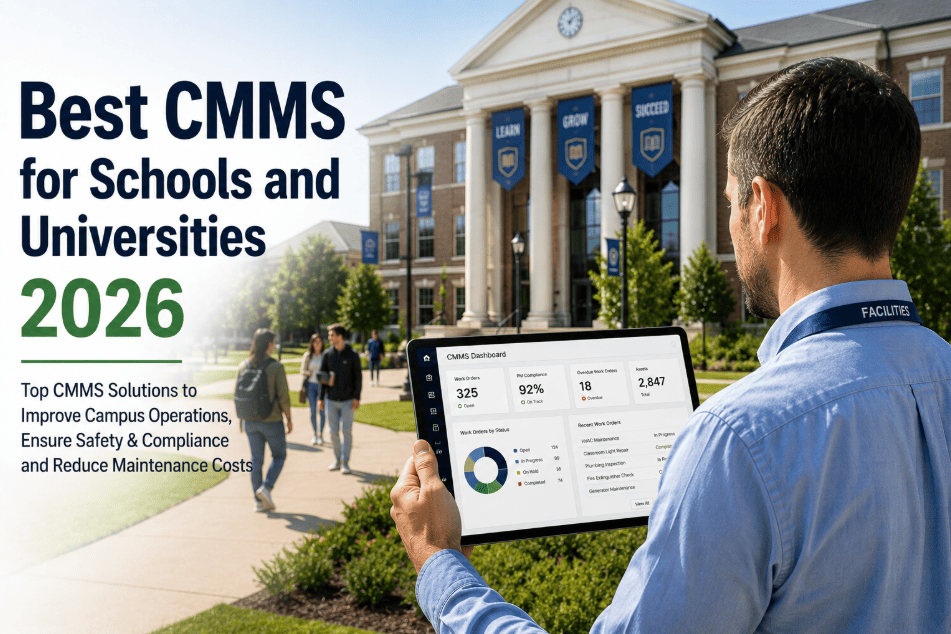
Best CMMS for Schools and Universities 2026
Top education facility maintenance platforms ranked on multi-campus management, regulatory compliance, deferred maintenance tracking, budget planning, and real-world adoption by K-12 and higher education maintenance teams protecting student environments.
See How OxMaint Handles Campus and District-Wide Maintenance
Multi-campus dashboards, deferred maintenance tracking, summer PM planning, and compliance documentation — deployed across your district or university in weeks.
Why Education Facility Maintenance Is a Unique Challenge
Education maintenance teams operate under constraints that no other sector combines simultaneously — aging buildings that average 44 years old in US public schools, annual budgets approved 6-12 months before spending occurs, regulatory compliance for fire safety and indoor air quality that directly affects student health, and a 10-week summer window where 70% of major maintenance must be completed while buildings sit empty. A broken classroom HVAC unit is not just a comfort issue — it triggers parent complaints, potential school closure on extreme temperature days, and indoor air quality liability exposure. A failed elevator in a university building creates ADA compliance violations within hours.
Districts managing 20-40 buildings need centralized visibility into which buildings consume disproportionate maintenance budgets, which HVAC systems are approaching end-of-life, and which fire safety inspections are overdue — while each building's head custodian needs simple work order tools that do not require a computer science degree. Universities face the same multi-building complexity compounded by research lab equipment, residence hall plumbing at 10x the residential density, and athletic facility specialization that commercial CMMS platforms were never designed to handle. Discover how OxMaint handles this complexity for education — start a free trial or book a demo to see campus-level configurations.
The Real Pain Points of K-12 and University Maintenance Teams
These are the operational failures that cost districts bond referendum credibility, create unsafe learning environments, and accelerate the deferred maintenance crisis that now totals $85 billion nationally across US K-12 facilities.
Without asset condition data, districts cannot prioritize limited capital dollars. The average K-12 deferred maintenance backlog grows 6-8% annually — $4.5M per district — because nobody has documented evidence of which systems need replacement first.
Teachers report broken fixtures, leaking ceilings, and HVAC failures to the office. The office writes it on a list. The list gets lost. 34% of classroom maintenance requests take more than 5 days to resolve — because the communication channel fails, not the repair itself.
Fire marshal inspections require documented maintenance records for alarm systems, sprinklers, extinguishers, emergency lighting, and exit hardware. Districts without CMMS-based compliance tracking face violations and remediation orders 2.5x more frequently.
The 10-week summer break is the only window for major maintenance without disrupting instruction. Without advance PM planning tools, districts waste 2-3 weeks just organizing what work needs to happen — reducing the productive window by 25%.
School boards requesting $40M bond measures need facility condition data that taxpayers and rating agencies trust. Without documented asset condition scores, remaining useful life projections, and maintenance cost history, bond requests lack the credibility to pass voter approval.
HVAC system failures in aging schools create mold growth conditions within 48-72 hours. Districts face $500K-$2M remediation costs per incident plus legal exposure. Preventive HVAC maintenance documented through a CMMS is the primary defense against IAQ litigation.
Evaluation Criteria for Education CMMS
A school CMMS must serve custodians, maintenance technicians, principals, facilities directors, and school board members — each with different needs from the same platform. These six weighted criteria reflect what determines real success in education maintenance.
Can you manage 15-40 school buildings from one login with district-level dashboards and building-level drill-down for principals and custodians?
Does it track asset condition scores to build rolling 5-10 year capital plans that support bond referendums and budget requests with real data?
Fire safety, elevator, playground, ADA, and indoor air quality — does the platform generate inspection-ready compliance records automatically from work order data?
Can teachers, office staff, and custodians submit and track maintenance requests from a phone or tablet without training sessions and IT support?
Can the platform schedule, sequence, and track the concentrated summer maintenance window — coordinating vendor schedules, material procurement, and staff assignments?
Can a public school district deploy the platform without per-user fees that exceed tight operational budgets — and without multi-year contract commitments?
Top Education CMMS Platforms — 2026 Rankings
Ranked specifically for K-12 school districts and university campus operations — multi-building management, deferred maintenance tracking, compliance documentation, and the budget reality of public education facilities.
OxMaint earns the top education ranking for 2026 because it delivers the multi-campus architecture, deferred maintenance tracking, and CapEx planning that education facilities demand — without the enterprise pricing that puts most purpose-built platforms out of reach for public school budgets. The portfolio hierarchy — District, Building, System, Asset, Component — gives a facilities director visibility into HVAC condition scores, fire safety compliance, and maintenance spend across 30 buildings while each building custodian sees only their school's work orders and PM schedules. Deferred maintenance tracking ties directly to asset condition scoring, producing rolling 5-10 year capital plans that facilities directors present to school boards and voters during bond referendum cycles with investor-grade credibility. Fire safety, elevator, playground, and ADA compliance documentation is generated automatically from daily work order completion data — meaning inspections are met with ready documentation rather than the 40-60 hour scramble most districts endure. The summer PM planning module allows facilities teams to schedule the entire summer maintenance window months in advance, sequencing vendor commitments, material procurement, and staff assignments to maximize productive work days. Teachers and office staff submit maintenance requests from a simple mobile interface — no training, no login complexity, no IT involvement. Unlimited user pricing is critical for education — a 25-school district with 80+ custodians, technicians, principals, and facilities staff cannot afford per-seat licensing.
Brightly — formerly known as SchoolDude and now part of Siemens — has been the dominant education CMMS brand for over a decade. The platform understands K-12 and higher education workflows natively, with strong work order management, PM scheduling, and energy management modules. The brand recognition in education procurement is unmatched. The limitations are modernization pace and pricing — the platform's interface feels dated compared to newer competitors, per-user pricing has increased significantly under Siemens ownership, and the legacy technology stack makes mobile experience and API integration less fluid than cloud-native alternatives. Still a strong choice for districts already invested in the ecosystem.
FMX has gained strong traction in the K-12 and higher education market with a clean, modern interface that drives high adoption among non-technical staff. Work request submission by teachers and office personnel is genuinely simple — FMX is often the platform that finally gets staff to stop calling the maintenance office and start submitting digital requests. PM scheduling, scheduling calendars for shared spaces, and basic reporting serve mid-size districts well. The limitation is depth — advanced asset lifecycle tracking, CapEx forecasting, and deferred maintenance analytics are less developed than platforms with deeper asset management heritage.
Limble provides solid PM and work order management that smaller school districts — 5-10 buildings — can deploy rapidly with minimal training. The mobile app drives strong technician adoption, and the QR code-based asset identification system works well for building equipment. Education-specific features — district-wide compliance reporting, summer PM planning, deferred maintenance analytics, and bond referendum documentation — require manual configuration that education-specific platforms provide out of the box.
UpKeep's mobile-first design serves campus maintenance teams that spend their day moving between buildings. Work order management, PM scheduling, and photo documentation are strong on mobile. The platform was not designed for education operations specifically — district-level compliance, deferred maintenance tracking, summer planning tools, and multi-campus budget reporting require workarounds. Per-user pricing limits adoption for districts with large custodial and maintenance staffs.
Platforms 6-8: Additional Education Options
Facility condition assessment platform with CMMS capabilities designed for education and government. Strong FCA workflow integrates with maintenance management. The assessment-first approach helps districts build facility condition index (FCI) scores that support capital planning. CMMS operational depth is lighter than maintenance-heritage platforms. Best as a complement to operational CMMS for capital planning.
Solid general-purpose CMMS with good asset management depth. Some larger university systems adopt Fiix for engineering-depth maintenance management. Education-specific features — teacher request portals, summer planning, compliance documentation — require custom configuration. Better for university physical plant operations than K-12 district management.
Mobile-friendly with strong procedure and checklist features useful for custodial workflows and building inspection routines. Some small districts use MaintainX for basic work order management. Multi-campus architecture, deferred maintenance tracking, and compliance documentation not built for education scale.
Enterprise-grade asset management for the largest university systems with complex multi-campus operations and research facility requirements. Implementation investment of $500K-$1M+ and 12-18 month timelines restrict Maximo to major research universities with dedicated IT project teams. Not practical for K-12 budgets.
Feature Comparison: Top 5 Education CMMS Platforms
This comparison focuses on the education-specific capabilities that determine whether a CMMS protects student environments and supports district capital planning or just digitizes paper work orders.
| Education Capability | OxMaint | Brightly | FMX | Limble | UpKeep |
|---|---|---|---|---|---|
| Multi-Campus District Dashboard | Full portfolio roll-up | Established | Moderate | Basic multi-site | Limited |
| Deferred Maintenance Tracking | Condition-based with CapEx | Basic tracking | Not included | Not included | Not included |
| Fire Safety and Compliance Docs | Auto-generated from WOs | Built-in templates | Basic | Manual configuration | Manual |
| Teacher/Staff Work Requests | Simple mobile portal | Established | Best-in-class simplicity | Standard request form | Standard |
| Summer PM Planning Tools | Scheduling module | Calendar-based | Calendar | Not specialized | Not specialized |
| CapEx and Bond Referendum Data | 5-10 year condition-based | Basic reporting | Not included | Not included | Not included |
| Pricing Model | Unlimited users | Per user | Per user | Per user | Per user |
Before vs. After: School District Maintenance Operations
The transformation when a school district moves from paper-based reactive maintenance to a structured CMMS is measurable in response time, compliance readiness, and capital planning credibility.
| Metric | Before CMMS | With CMMS |
|---|---|---|
| Classroom Issue Response Time | 3-7 days average | Under 24 hours for priority issues |
| PM Completion Rate | 30-45% of scheduled PMs completed | 85%+ with automated tracking |
| Fire Safety Inspection Prep | 40-60 hours of manual record assembly | Reports generated on demand |
| Deferred Maintenance Visibility | Unknown until failure occurs | Tracked with condition scoring per asset |
| Bond Referendum Data Quality | Estimates and guesswork | Condition-based 5-10 year capital plans |
| Summer PM Utilization | 25% of summer lost to planning | Pre-scheduled with vendor coordination |
School districts that structure their facilities operations around a CMMS protect student learning environments more effectively while building the documented evidence base needed for capital investment decisions. The data pattern holds across every district size from rural single-campus to large urban systems. See how OxMaint delivers these results for education facilities — start a free trial or book a demo to walk through district-level configurations.
How OxMaint Solves Education Facility Maintenance
Six capabilities designed for the way school districts and universities actually operate — built for public education budgets, aging infrastructure realities, and the teams responsible for keeping students safe in buildings that average 44 years old.
District, Building, System, Asset hierarchy. Facilities directors see maintenance spend, PM completion, and equipment condition across 30 buildings. Principals and custodians see only their school. No information overload.
Asset condition scoring identifies which systems are approaching failure. Rolling 5-10 year CapEx plans show the true cost of deferred maintenance and prioritize limited capital dollars by urgency and impact.
Fire safety, elevator, playground, ADA compliance records generated automatically from completed work orders. Fire marshal walks in — documentation is ready in minutes, not assembled over 60 staff hours.
Teachers submit maintenance requests from their phone — leaking ceiling, broken outlet, HVAC not working — with one tap and a photo. Auto-routing sends the request to the right person. No phone calls, no paper forms.
Schedule the entire 10-week summer maintenance window months in advance. Sequence vendor commitments, material procurement, and staff assignments. No more losing 2-3 weeks to planning that should have happened in April.
Every custodian, technician, principal, and facilities director gets full access without per-seat cost escalation. Designed for public education budgets — no heavy implementation fees, no multi-year lock-in contracts.
Matching CMMS to Your Education Facility Type
The right education CMMS depends on your institution type, number of buildings, infrastructure age, and whether your primary challenge is daily operations, capital planning, or both.
Large districts need district-wide dashboards, deferred maintenance tracking, bond referendum data, and unlimited user pricing for 60-100+ staff. OxMaint delivers this at public-budget pricing. Brightly has deep education market presence with proven K-12 workflows.
Smaller districts need rapid deployment, simple teacher request portals, and core PM scheduling. OxMaint scales from 3 to 50 buildings without pricing complexity. FMX excels at non-technical staff adoption. Limble works for the smallest operations.
Universities managing academic buildings, residence halls, athletic facilities, and research labs need deep asset management with campus-wide visibility. OxMaint's component-level tracking handles the equipment diversity. Brightly has established presence in higher education with energy management modules.
Smaller campuses with specialized lab and shop equipment need flexible asset management with simple deployment. OxMaint handles technical equipment PM alongside building systems. FMX provides excellent user adoption for mixed staff teams.
Frequently Asked Questions
How does a CMMS help with school bond referendums?
Can teachers really submit maintenance requests without training?
How does summer PM planning actually work?
What does deployment look like for a 25-school district?
Students Deserve Buildings That Work
Every deferred maintenance dollar is a classroom that gets colder in winter, hotter in summer, and closer to the failure that costs ten times more than prevention. OxMaint gives school districts and universities the multi-campus visibility, deferred maintenance tracking, compliance documentation, and summer planning tools that transform facilities management from reactive crisis response into structured asset stewardship — on budgets that public education can actually afford. Most districts are running district-wide operations within 3-4 weeks of signup.