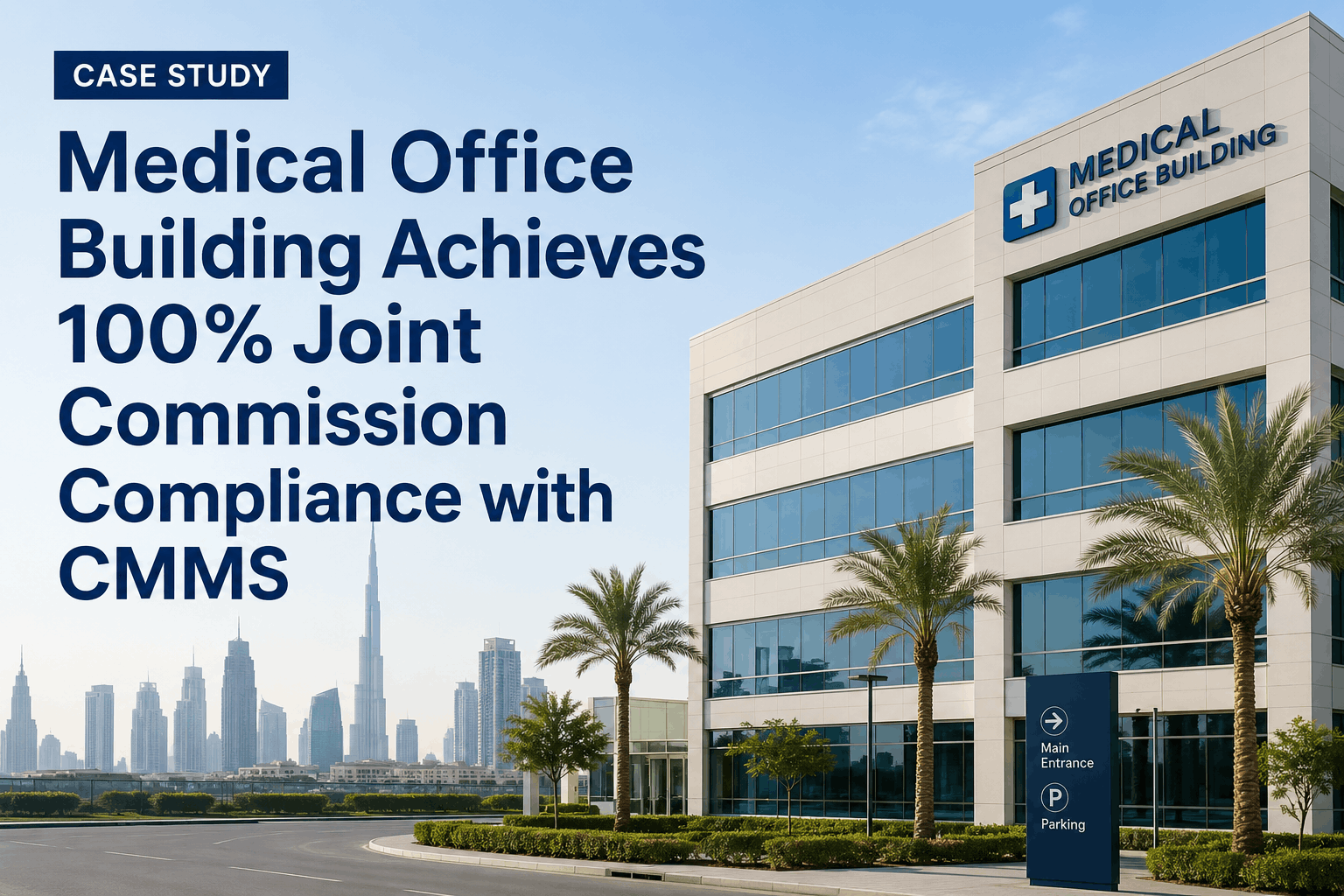
A 120,000-square-foot medical office building serving 45+ physicians and housing 85+ medical equipment assets faced a critical regulatory reality: non-compliance with Joint Commission standards could result in fines up to $75,000 per day, loss of Medicare/Medicaid funding, and loss of insurance company reimbursement for patient care. The facilities team was managing fire alarm testing, emergency generator load tests, medical gas manifold pressure checks, life safety system certifications, and medical equipment maintenance across multiple independent schedules. When state surveyors arrived, documentation was scattered across paper files, email chains, and disconnected spreadsheets. The organization could not quickly prove which equipment was serviced, by whom, or whether certifications were current. Within 6 months of implementing a healthcare-specific CMMS, the medical building achieved 100% Joint Commission compliance, reduced audit preparation time from 80 hours to 3 hours, and eliminated the risk of compliance citations. Start your free trial or schedule a compliance consultation to see how your medical facility can achieve audit-ready compliance.
Medical Facility Joint Commission Compliance — 2026
From Scattered Documentation to 100% Audit-Ready Compliance in 6 Months
100%
Joint Commission compliance achieved
Zero deficiency findings in survey cycle; all Environment of Care standards met with complete documentation trail
80→3
Audit prep hours reduced 97%
From 80 hours of manual record assembly before survey to 3 hours of one-click documentation export
85+
Medical equipment assets tracked
Defibrillators, ventilators, imaging equipment, HVAC systems, fire suppression, emergency power — all with compliance schedules and service history
$75k
Risk per deficiency citation eliminated
Joint Commission deficiency findings carry fines up to $75,000 per day; proactive compliance eliminates this exposure entirely
The Challenge: Joint Commission Compliance in a Complex Medical Facility
Healthcare facilities operate under the most demanding regulatory framework of any built environment. The Joint Commission's Environment of Care (EC) and Life Safety (LS) standards — consolidated into the Physical Environment (PE) framework in 2026 — establish rigorous requirements for medical equipment management, fire safety system testing, emergency power readiness, and medical gas safety. A 120,000-square-foot medical office building housing 45+ independent practices and 85+ medical assets must maintain an integrated compliance infrastructure that addresses five simultaneous regulatory jurisdictions: The Joint Commission (accreditation and patient safety), CMS Conditions of Participation (Medicare/Medicaid funding eligibility), OSHA (workplace safety and bloodborne pathogen protection), state health department (facility licensing and device oversight), and NFPA standards (fire alarm, sprinkler, medical gas, emergency power). Failure in any one jurisdiction creates consequences that extend beyond fines. A missed fire alarm test triggers a deficiency finding. An untracked medical equipment service creates audit exposure. A generator load test performed by an uncertified contractor invalidates the testing record. The facilities team at this medical building was drowning in administrative burden. Fire alarm panels required weekly visual checks, monthly signal tests, and annual certifications. Sprinkler systems demanded annual inspections and compliance documentation. Emergency generators needed monthly visual inspections, monthly exercise runs, and annual full-load tests. Medical gas manifolds required quarterly pressure checks and annual certification tests. HVAC systems serving surgical suites needed continuous temperature/humidity monitoring and documented calibrations. Defibrillators, ventilators, imaging equipment, and other life-support devices required individual maintenance schedules and service documentation. Without a centralized tracking system, the facilities team relied on paper checklists maintained by individual technicians, spreadsheets updated sporadically, and contractor reports filed in physical cabinets. When a Joint Commission surveyor asked "Show me the documentation of all fire alarm tests completed in the past 24 months," the facility manager faced an hour-long filing cabinet search to assemble an answer. Some records were complete. Others were missing signatures. Some contractor certifications had expired. The surveyor's findings noted "incomplete equipment maintenance records and inconsistent documentation practices" — a deficiency finding that escalated license risk and triggered corrective action demands. The organization understood that compliance was not a technology problem — it was a visibility problem. The facilities director could not see in real time which systems were due for inspection, which inspections had been completed with proper documentation, and which records were missing. Every survey was a stressful audit preparatio that consumed weeks of staff time.
01
Multiple Regulatory Jurisdictions Creating Conflicting Documentation Requirements
A fire alarm system must satisfy Joint Commission PE standards, NFPA 72 codes, state fire marshal requirements, and local building department regulations — sometimes with conflicting documentation formats. Without a centralized system, facilities managers cannot ensure that work performed under one standard automatically satisfies another. Surveyors find documentation gaps not because work was not performed, but because the facility cannot produce evidence in the format that regulators expect.
02
Contractor Credential Verification at Time of Audit
Joint Commission surveyors increasingly ask "Who performed this elevator test? Show me their license." When medical facility managers must hunt through contractor files to find a three-year-old license copy, auditors note this as a documentation failure. If a contractor's license had expired at the time of the work, the entire test is invalid — requiring re-testing and corrective action. Facilities need a system that links contractor credentials to every work order, proving that only licensed professionals performed critical testing.
03
Medical Equipment Inventory Gaps at Survey Time
CMS surveys require a complete inventory of all medical equipment with PM schedule, last service date, and next due date visible. If a defibrillator was recently acquired but not added to the facility's equipment registry, or if a ventilator's maintenance schedule is not documented, these gaps trigger direct deficiency findings. Paper-based or spreadsheet-based equipment tracking cannot keep pace with the rate of equipment additions, removals, and service date changes across a multi-department medical facility.
04
Unannounced Surveys With No Advance Notice to Assemble Documentation
Joint Commission surveys can arrive with minimal notice. Facilities have no time to locate paper records, compile contractor documentation, or assemble proof of equipment testing. If the facility is not operationally compliant on a daily basis — with documentation current and searchable — an unannounced survey becomes a crisis event. Facilities that must spend 80+ hours assembling audit documentation are not operationally compliant; they are exposed to whatever gaps exist in their paper filing system.
Joint Commission Physical Environment Standards: The Five Compliance Pillars
The Joint Commission's Physical Environment (PE) standards, effective January 1, 2026, consolidated previous Environment of Care and Life Safety standards into a unified framework. While the consolidation simplified the organizational structure, the actual compliance work remained the same. Healthcare facilities must operationalize compliance across five distinct pillars, each with independent documentation and testing requirements.
PE
Medical Equipment Management & Inventory
Complete asset registry with PM and service history
Every medical device must be inventoried with acquisition date, PM schedule, last service date, next due date, and service history visible in a centralized registry. Risk-classified equipment (life-supporting devices like ventilators and defibrillators) require more frequent PM. High-risk devices serviced beyond their due dates trigger direct deficiency findings. Oxmaint maintains this registry in real-time, with automatic PM due date calculation and escalation alerts when maintenance is overdue.
PE
Life Safety System Testing & Certification
Fire alarm, sprinkler, emergency power — all with complete audit trails
Fire alarm panels require weekly visual, monthly signal tests, and annual certifications. Sprinkler systems require annual inspections and 5-year internal bracing tests. Emergency generators require monthly exercises, monthly load tests, and annual full-load tests. Each system is independently scheduled; a missed test date on any system triggers compliance exposure. Oxmaint auto-generates work orders for each test type on its independent schedule, with contractor credential verification and completion documentation captured digitally.
PE
Utility System Reliability & Monitoring
Medical gas, emergency power, HVAC temperature control
Medical gas manifolds must have quarterly pressure checks and annual certification. Emergency power must be continuously available with monthly exercise verification. Surgical suite HVAC must maintain 15 air changes per hour with documented temperature and humidity monitoring. Water systems must be tested for Legionella periodically. These utilities underpin patient safety; failures create both clinical and regulatory consequences. Oxmaint schedules and tracks all utility maintenance with automated alerts before any deadline is missed.
PE
Infrastructure & Safety System Maintenance
Building systems serving patient care spaces
Electrical distribution panels, fire suppression heads, emergency lighting, hand-washing stations, patient call systems, and other infrastructure must be maintained on established schedules. Each component has a compliance deadline; missing any deadline creates regulatory exposure. Oxmaint creates a unified schedule across all infrastructure components, ensuring nothing falls through the cracks.
PE
Audit-Ready Compliance Documentation & Evidence Trail
Every work order captured with full regulatory audit trail
Every medical device service, every fire alarm test, every generator load test, and every utility check is documented with technician identity, timestamp, asset details, findings, corrective actions, and digital signature. The moment a technician completes work, the record is time-stamped and archived. When a surveyor asks for all equipment maintenance records from the past 24 months, one button export produces a compliance report organized by asset, date, or technician — exactly the format regulators expect.
100% Compliance Without Constant Crisis
Stop Scrambling for Records. Start Operating Continuously Audit-Ready.
Oxmaint's healthcare CMMS is built specifically for Joint Commission, CMS, and OSHA compliance. Medical equipment inventory management, life safety system testing, emergency power readiness, utility monitoring, and one-click audit documentation — all integrated into daily maintenance workflows. Your medical facility can achieve perfect compliance and reduce audit preparation time from weeks to hours.
Medical Facility Compliance Transformation: Before and After Metrics
| Compliance metric | Before CMMS (paper + spreadsheet) | After CMMS (6 months) | Regulatory Impact |
| Joint Commission survey compliance score |
84% (deficiency findings noted) |
100% (zero findings) |
Eliminated deficiency risk, maintained accreditation, preserved Medicare/Medicaid funding eligibility |
| Time to prepare for unannounced survey |
80+ hours of manual record assembly |
3 hours — one-click documentation export |
Facility is continuously audit-ready; unannounced surveys become routine validation instead of crisis events |
| Medical equipment PM completion rate |
72% — multiple overdue services at any time |
100% — automated alerts ensure no deadline is missed |
All medical equipment maintained on schedule; zero equipment-related deficiency findings |
| Fire alarm testing documentation completion |
Inconsistent — some weeks missing tests |
100% — automatic work order generation ensures every test is scheduled and documented |
Zero fire safety deficiency findings; complete audit trail of weekly, monthly, and annual testing |
| Contractor credential verification capability |
Manual search through paper files — 30+ minutes per question |
Instant — credentials linked to every work order and electronically searchable |
Surveyors verify contractor qualifications without delays; facility proves only certified professionals performed critical work |
| Emergency generator test documentation |
Monthly and annual tests inconsistently recorded |
Every monthly exercise and annual load test documented with kilowatt output, transfer time, and runtime |
Continuous proof of emergency power readiness; zero life safety deficiency exposure from generator failures |
| Medical equipment inventory accuracy |
85% — some equipment missing from registry; PM schedules out of date |
100% — real-time equipment registry with current PM schedules and service dates |
CMS audits find no equipment management gaps; facility maintains complete risk-classified inventory of all devices |
Customer Testimonial: Facilities Director, Multi-Specialty Medical Office Building
"Joint Commission compliance was consuming our lives. Before each survey, we would spend 80+ hours pulling paper files, verifying contractor credentials, and assembling proof that equipment was serviced on time. The stress was enormous because we were never sure if we had everything. One missed documentation detail and the survey would flag a deficiency. With Oxmaint, all of that anxiety is gone. Every medical device is in the system with its PM schedule. Every fire alarm test is automatically scheduled and documented. When a surveyor arrives, I can export a complete compliance report in minutes — everything organized, time-stamped, and signed. We achieved 100% compliance and cut our audit prep time from 80 hours to 3 hours. The system pays for itself in reduced administrative burden and zero exposure to compliance fines."
Facilities Director, 120,000 Sq Ft Multi-Specialty Medical Office, USA
Healthcare CMMS Features: Purpose-Built for Joint Commission Compliance
01
Pre-Loaded Joint Commission PE Code Templates
Every work order is linked to applicable Joint Commission Physical Environment codes (PE.01 through PE.06 as of 2026 standards). When maintenance is completed, the system automatically tags the record with relevant regulatory codes. Survey documentation exports are organized by PE code, showing surveyors exactly which standards were met through which maintenance activities.
Automatic regulatory coding eliminates documentation mapping errors
02
Medical Equipment Risk Classification & PM Prioritization
Equipment is classified as life-supporting (critical - most frequent PM), life-sustaining (high priority), or non-life-sustaining. The system adjusts PM schedules accordingly, ensuring life-supporting equipment like ventilators receive more frequent preventive maintenance than administrative devices. CMS surveys verify that risk classification matches actual PM completion rates.
Risk-based maintenance priorities aligned with regulatory expectations
03
Contractor Credential Verification & License Tracking
Store contractor licenses, certifications, insurance details, and expiration dates in a centralized database. Link credentials directly to work orders so auditors can instantly verify that only qualified contractors performed critical medical equipment testing. Automatic alerts notify you when contractor certifications are approaching expiration so you can schedule renewal before the deadline.
Complete audit trail proving only qualified labor performed critical work
04
Emergency Power Testing Documentation with Load Parameters
Emergency generator testing requires documentation of monthly visual inspections, monthly exercise runs, and annual full-load tests. Oxmaint captures every test with load parameters (kilowatt output, transfer time, runtime duration, fuel consumption). NFPA 110 compliance requirements are automatically verified against test records, ensuring generators remain certified for patient care applications.
Complete emergency power readiness documentation for any regulator
05
One-Click Audit Documentation Export by PE Code
When a surveyor requests documentation of equipment maintenance compliance, one button export generates a complete audit report organized by Physical Environment code, asset type, date, or technician. The report includes every work order, finding, corrective action, and supporting documentation in the format that regulators expect. Audit response changes from days of manual assembly to minutes of export.
Reduce audit response time from 80+ hours to 3 hours
06
Multi-Site Facility Compliance Dashboard (If Multi-Location)
For healthcare organizations operating multiple medical office buildings or clinic locations, a single dashboard provides real-time compliance status across all facilities. Compare PE code compliance rates across buildings. Identify facilities with compliance gaps. Allocate resources to sites that need them most. Corporate compliance officers have visibility without requiring manual status reports.
Network-wide compliance visibility for organizations with multiple locations
Frequently Asked Questions: Healthcare CMMS & Joint Commission Compliance
What happens if a surveyor arrives unexpectedly before we are fully live on Oxmaint?+
Oxmaint operates alongside existing systems during transition. You can start with critical medical equipment and life safety systems while paper processes run parallel. Most facilities achieve 100% critical-asset compliance within 4–6 weeks, well before typical survey timing. Your facilities director can request survey deferral if timing is tight.
Will we lose historical compliance records during the transition to Oxmaint?+
No. Oxmaint imports existing maintenance history from spreadsheets, contractor reports, and paper records. Historical documentation is scanned and archived in the system for audit reference. Future records are created natively in Oxmaint with full audit trail capability and Joint Commission coding.
How does Oxmaint handle different contractor vendors who perform equipment testing?+
Oxmaint maintains a contractor database with credentials for each vendor. When a vendor performs work, you verify their current credentials in the system before approving the work order. The work order links directly to the vendor's credentials, so surveyors can instantly verify that only licensed contractors performed critical tests.
What if we have medical equipment that is leased vs. owned — do we track both the same way?+
Yes. Oxmaint tracks all equipment the same way — owned, leased, or shared assets all appear in the inventory registry with identical PM schedules. You can tag equipment as "leased" so the system alerts you when lease-end date approaches. For leased equipment with vendor-provided maintenance, you can link contractor reports directly to the asset record.
Does Oxmaint automatically generate updated reports for CMS and OSHA compliance?+
Yes. Oxmaint generates compliance reports formatted for Joint Commission PE codes, CMS K-tags, and OSHA workplace safety requirements. Reports are exportable by asset type, date range, or facility. You can customize reports to match specific surveyor requests without manual reassembly of documentation.
How does Oxmaint handle life-safety system tests that occur during off-hours or weekends?+
Emergency maintenance and after-hours testing are fully supported. Mobile work orders allow technicians to document emergency repairs and tests from the field at any time. Time-stamps capture exact work completion time, ensuring off-hours work is documented with full audit trail just like regular business-hour work.
If we discover a missed deadline before the surveyor finds it, how does Oxmaint help us respond?+
Oxmaint alerts you 14 days before any deadline is missed, so you rarely discover problems just before survey. If you do discover a gap, the system documents when you identified it, what corrective action was taken, and proof of completion. This responsive documentation demonstrates good faith compliance efforts — surveyors view self-identified and corrected gaps more favorably than items found during their inspection.
Medical Facility Compliance — Oxmaint
From 84% Compliance to 100% Joint Commission Audit Success.
Medical equipment inventory management, life safety system testing, emergency power readiness, contractor credential verification, and one-click audit documentation — all integrated into daily maintenance workflows. This medical office building achieved perfect compliance, eliminated deficiency risk, and reduced audit preparation time from 80+ hours to 3 hours. Your facility can achieve the same results with a CMMS built for healthcare regulators.
100%
Joint Commission compliance
97%
Audit prep time reduction
4–6 wk
Implementation timeline