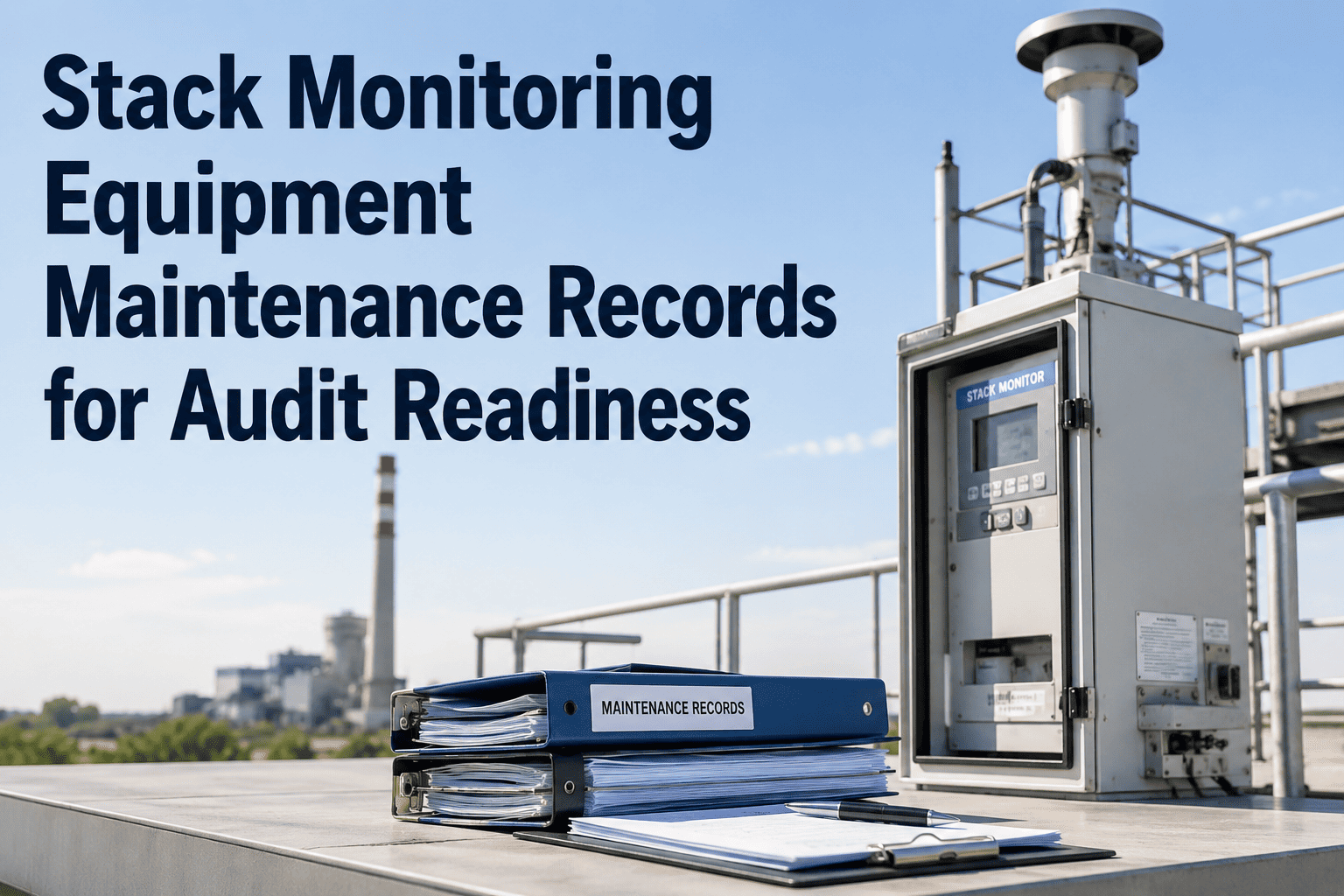
Every power plant that operates a Continuous Emissions Monitoring System (CEMS) faces the same regulatory reality: emissions data must be captured, calibrated, and documented at near-perfect completeness, or the EPA fills your gaps with worst-case substitution values that can cost six figures in penalty exposure before a single inspector visits. Under 40 CFR Part 75, plants must achieve at least 95% valid data availability per quarter — and slipping below that threshold triggers mandatory data substitution that overstates your actual emissions on the official record. The problem most compliance teams face is not that the equipment is failing; it is that the maintenance records, calibration logs, and RATA certificates are scattered across binders, spreadsheets, and email threads that cannot be assembled into an audit package in under a week. OxMaint structures your stack monitoring assets as a living compliance program, not a documentation cleanup project you run the week before an inspector arrives. Start a free trial and build your first CEMS maintenance workflow today.
95%
Minimum CEMS data availability required under 40 CFR Part 75
$37.5K
Maximum daily EPA penalty per violation day under CAA
4 hrs
CEMS data gap threshold before an excess emissions report is triggered
<15 min
Time to compile a full audit package with structured CMMS records
The compliance gap
Why plants with compliant equipment still fail audits
An EPA inspector reviewing a Title V permit audit does not care that your CEMS analyst ran the quarterly RATA last month. They care whether the certificate is filed under the correct asset record, whether calibration drift logs show zero unexplained gaps, and whether the corrective work order for the February probe replacement was closed in time to preserve your data availability calculation. Most plants perform the work. Almost none of them have the records organized in a way that survives a structured audit review. The failure is a documentation and workflow failure, not a technical one.
The paper-and-spreadsheet reality
RATA certificates stored in analyst email, not asset records
Calibration drift logs split across three technician notebooks
Data substitution periods undocumented or reconstructed retroactively
QA/QC plan references outdated analyzer models replaced two years ago
Corrective maintenance time stamps unavailable for data gap defense
What structured CMMS records look like
RATA results attached to the CEMS asset record on completion day
Calibration drift values logged per analyzer per shift, searchable
Every data gap has a timestamped corrective work order as evidence
QA/QC plan linked to current analyzer model and firmware version
Full maintenance history exportable by asset, date range, or permit condition
What auditors actually check
The five stack monitoring records that determine your audit outcome
A Title V compliance audit and a 40 CFR Part 75 CEMS audit share a common structure: inspectors work through a defined checklist of required records, and gaps in any one of them create findings even when the underlying equipment performed correctly. Understanding exactly which records are requested — and making them instantly retrievable — is the maintenance team's single highest-leverage compliance action.
01
CEMS calibration error and drift logs
Daily zero and span checks must be documented with pass/fail status, corrective action taken, and the time window any corrective work order was open. A gap in this log creates a presumptive data substitution period.
Daily logging required
02
Relative Accuracy Test Audit (RATA) certificates
Quarterly RATA results must be filed against the specific analyzer serial number, the test date, and the reference method used. Missing or mismatched certificates are one of the top five findings in Part 75 audits.
Quarterly per analyzer
03
Data availability calculation records
The quarterly 95% data availability calculation must be supported by operating hours logs, planned downtime records, and unplanned outage documentation. The calculation itself is not sufficient without the source evidence.
Quarterly per monitoring system
04
Startup, shutdown, and malfunction (SSM) records
Every SSM event affecting CEMS operation requires a documented record showing the event cause, duration, corrective action, and whether the data gap qualified for SSM-period treatment under the applicable standard.
Per occurrence, retained 5 years
05
QA/QC plan with current equipment inventory
The facility QA/QC plan must match actual installed equipment — analyzer models, probe configurations, data acquisition system version. An outdated plan referencing replaced equipment triggers an automatic finding regardless of actual performance.
Annual review minimum
Audit-ready from day one
Your CEMS records should survive an inspector visit without a weekend of prep work
OxMaint structures every calibration log, RATA certificate, and SSM record against the specific CEMS asset and permit condition it belongs to. When an auditor arrives, your compliance package is exportable in under 15 minutes.
PM schedule framework
Stack monitoring PM intervals that protect your data availability rate
The 95% quarterly data availability requirement translates directly into a hard limit on unplanned CEMS downtime: a plant running 2,160 hours per quarter can absorb no more than 108 hours of unplanned or undocumented downtime before entering substitution territory. A structured PM program that keeps analyzers, probes, and sample conditioning systems maintained on schedule is the only reliable way to protect that margin.
| Component |
PM Task |
Interval |
Compliance Tie |
| SOx / NOx analyzer |
Zero and span calibration check |
Daily |
40 CFR Part 75, App A |
| Sample conditioning system |
Filter, coalescer, and pump inspection |
Weekly |
Manufacturer and QA/QC plan |
| Flow monitor |
3-point calibration and blockage check |
Monthly |
40 CFR Part 75, App D |
| Stack probe and sample line |
Heat trace, seal, and probe integrity inspection |
Monthly |
QA/QC plan |
| Data acquisition system |
Data gap audit and backup verification |
Monthly |
40 CFR Part 75, §75.59 |
| All CEMS analyzers |
Relative Accuracy Test Audit (RATA) |
Quarterly |
40 CFR Part 75, App B |
| Mercury CEMS (MATS) |
Sorbent trap or CEM performance evaluation |
Quarterly |
40 CFR Part 63, MATS |
| Full CEMS system |
QA/QC plan review and equipment reconciliation |
Annual |
40 CFR Part 75, §75.53 |
How OxMaint closes the gap
Three things a CMMS does that a spreadsheet never can
A spreadsheet can record that a calibration happened. It cannot trigger a corrective work order when a drift value exceeds permit limits, attach the RATA certificate to the correct asset record automatically, or generate a data availability report formatted for ECMPS submission. These are the gaps that separate a documentation program that looks compliant from one that actually is.
Auto-triggered corrective WOs
When a calibration drift value crosses its threshold — SOx span drift above 2.5%, for example — OxMaint auto-generates a corrective work order before the data gap is recorded. The technician's repair is timestamped as the documented response.
Asset-linked compliance records
Every RATA certificate, calibration log, and SSM event record is attached directly to the CEMS asset it belongs to — not to a folder on a shared drive. Auditors and your team can pull the complete history for any analyzer in seconds.
Data availability reporting
OxMaint tracks CEMS operating hours, planned downtime, and unplanned outages against your quarterly availability calculation automatically. The quarterly report is generated from live data, not reconstructed from memory at submission time.
Common questions
Frequently asked questions from compliance and maintenance teams
Can OxMaint generate the quarterly 40 CFR Part 75 CEMS data availability report automatically?
Yes. OxMaint tracks planned and unplanned CEMS downtime against your quarterly operating hours, calculates data availability as a percentage, and exports the supporting records in a format ready for ECMPS submission. The calculation is live, not assembled at quarter-end.
Start a free trial to configure your CEMS asset register and availability tracking.
How does the system handle RATA certificates from a third-party testing firm?
RATA certificates from external reference method testers are uploaded directly to the CEMS asset record in OxMaint with the test date, analyzer serial number, and reference method documented. The record is linked to the next RATA due date, which triggers a scheduling work order 60 days in advance.
What happens when a CEMS goes down unexpectedly and we need to document the SSM event?
The technician opens a corrective work order from the mobile app at the CEMS asset, enters the event cause and initial response, and the system timestamps the record from the moment the work order is created. The SSM documentation — cause, duration, and corrective action — is built automatically from the closed work order with no retroactive reconstruction needed.
Does OxMaint support MATS compliance records for mercury monitoring in addition to Part 75 CEMS?
Yes. Mercury CEMS and sorbent trap monitoring systems are configured as separate asset types with their own PM schedules aligned to 40 CFR Part 63 MATS requirements. Performance evaluations, sorbent injection system maintenance records, and semiannual compliance data all file against the mercury control asset record.
Book a demo to see the MATS compliance workflow in detail.
How long does it take to migrate existing CEMS maintenance records into OxMaint from spreadsheets?
Most plants complete the CEMS asset register migration and PM schedule configuration in under two weeks with the OxMaint onboarding team. Historical calibration records and RATA certificates are uploaded as attachments to each asset record. Current-state compliance documentation is live and audit-ready before the end of the first month.
Stop reconstructing. Start retrieving.
Your next EPA audit should take 15 minutes to prepare for, not 15 days
The difference between a plant that passes a CEMS audit and one that generates findings is almost never the equipment. It is whether the calibration logs, RATA certificates, and SSM records are structured, current, and retrievable in real time. OxMaint turns your stack monitoring assets into a continuously documented compliance program that survives any inspector visit without emergency prep work.