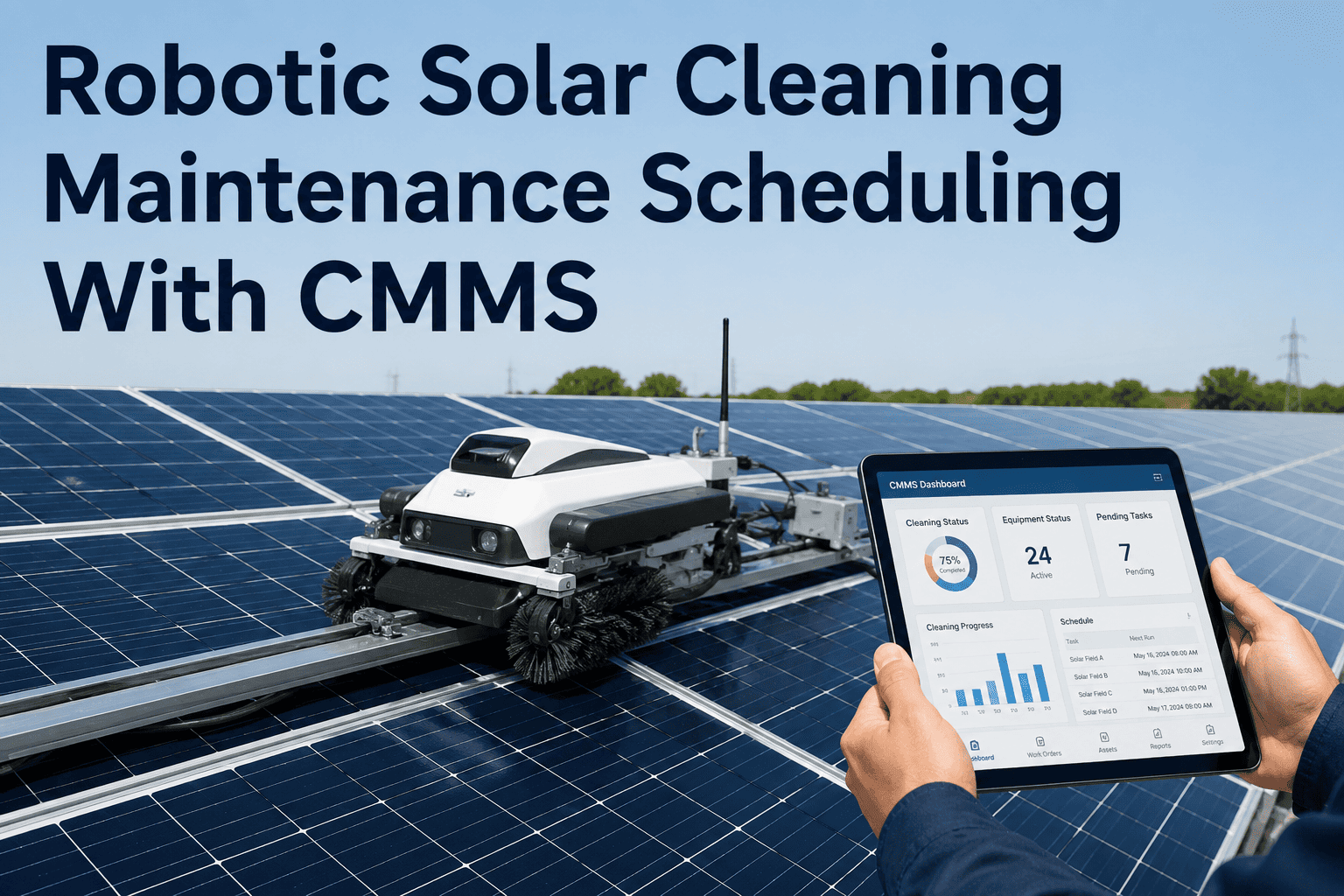
Solar PV modules lose between 4% and 35% of their annual energy output — not from equipment failure, not from weather — but from dust, pollen, bird fouling, and mineral deposits accumulating on glass surfaces faster than most O&M programs address them. On a 100 MW plant, a 6% soiling loss translates to roughly 6,000 MWh of generation per year that simply never reaches the grid. Structured cleaning programs tied to soiling station data, robotic cleaner schedules, and CMMS-tracked records are how leading solar operators close that gap — and OxMaint gives O&M teams the platform to run cleaning programs that are triggered by data, documented by default, and optimised across every cleaning cycle. If you want to see how condition-based solar cleaning scheduling works in practice, book a 30-minute walkthrough with an OxMaint product expert.
OxMaint · Solar PV Module Cleaning & Soiling Management
Your Panels Are Losing Revenue
Every Day They Stay Dirty.
Soiling is the #1 controllable performance loss in solar PV — and most plants are still cleaning on a calendar, not on data.
4–7%
Average global annual energy loss from soiling (IEA-PVPS)
35%
Energy loss in desert/arid environments without regular cleaning
$1.41B
Global solar panel cleaning market size in 2025
13.2%
CAGR of robotic cleaning market through 2034
The Soiling Problem
What Is Solar PV Soiling — And Why It Compounds Faster Than You Think
Soiling is the accumulation of dust, sand, pollen, bird droppings, industrial pollution, and biological debris on PV module glass. After irradiance, it is the single most influential factor on system yield. It does not trigger alarms. It does not stop inverters. It simply reduces the light reaching solar cells — silently, every day, until someone acts.
Dust & Sand
0.03–0.5% loss per day
Dominant in arid and semi-arid regions. Wind-deposited fine particles fill microscopic surface textures, creating diffuse shading across the entire module face.
Bird Fouling
Creates localised hot spots
Dense opaque deposits block 100% of irradiance in the affected cell area, causing localised current mismatch, hot spot formation, and in severe cases, cell cracking.
Industrial Pollution
Bonds to glass — requires water
Cement dust, fly ash, and industrial aerosols cement to module surfaces when wetted by rain or dew. Cannot be removed by dry brushing alone; requires scheduled wet cleaning.
Pollen & Biological
Seasonal peak: 3–8% loss
Pollen, algae, and lichen colonise module surfaces in temperate and humid climates. Seasonal surges require forecast-triggered cleaning rather than fixed-interval schedules.
Revenue Impact
What Soiling Actually Costs: A 100 MW Plant Reality Check
Annual Energy Output Lost to Soiling — 100 MW Plant
Temperate climate (low soiling)
~5,200 MWh/yr
Sub-tropical / semi-arid
~15,600 MWh/yr
Desert region (arid)
~32,500 MWh/yr
Extreme dusty arid (no cleaning)
~45,500 MWh/yr
Assumes 130,000 MWh/yr baseline generation at $50/MWh tariff
$260K
Annual revenue loss — 4% soiling, 100 MW plant
$1.6M
Annual revenue loss — 12% soiling, sub-tropical plant
$2.3M+
Annual revenue loss — 35% soiling, unmanaged desert plant
<1%
Residual soiling loss achievable with CMMS-tracked robotic programs
Stop cleaning on a calendar. Start cleaning on data.
OxMaint triggers cleaning work orders when soiling station data crosses your yield-loss threshold — not because it's Tuesday.
Cleaning Methods
Manual, Waterless Robotic, and Wet Robotic: Which Cleaning Method for Which Site
There is no single correct cleaning method for every solar PV site. The right approach depends on soiling type, water availability, array size, tilt angle, site geography, and O&M budget. Here is how the three principal methods compare — and what the data says about each.
| Factor |
Manual (Crew + Water) |
Waterless Robotic |
Wet Robotic |
| Water requirement per MW/clean |
~40,000 litres |
Zero |
~4,000 litres (90% saving) |
| Labour per cleaning cycle |
High — crew mobilisation each time |
Minimal — autonomous overnight |
Low — operator-supervised |
| Cleaning effectiveness |
High for bonded soils |
High for dry dust; limited for bird fouling |
Highest — all soiling types |
| Suitable for arid / water-scarce sites |
No — unsustainable cost |
Yes — primary solution |
Partial — requires water source |
| Annual O&M cost per MW |
~$40,000 |
~$4,000 |
~$8,000–$15,000 |
| CMMS integration |
Manual work orders |
API — auto-logs each cycle |
API — auto-logs each cycle |
| Panel safety |
Risk of micro-cracks from pressure |
Under 50g/cm² contact pressure |
Controlled low-pressure delivery |
Robotic Cleaning Programs
How Waterless Robotic Cleaner Programs Work at Utility Scale
Waterless cleaning robots use soft microfiber or polymer brushes with pressure-limited heads to sweep accumulated dust from module surfaces without water, chemicals, or crew mobilisation. At scale — 50 MW and above — they represent the most cost-effective cleaning solution available. But hardware alone is not a cleaning program.
01
Soiling Station Triggers the Threshold
Soiling stations compare cleaned vs unclean reference modules in real time. When irradiance-corrected yield delta crosses the configured threshold — typically 1 to 2% — OxMaint auto-generates a cleaning work order for the affected array zone.
02
Robot Dispatched — Work Order Active
The robotic unit receives its row assignment and begins its overnight cleaning cycle. OxMaint tracks the cleaning work order as active, with the assigned robot as the responsible asset — every cleaning cycle is a logged maintenance event, not an undocumented activity.
03
Cycle Complete — Pre/Post Yield Logged
On cycle completion, the robot API posts the cleaning record to OxMaint. Pre-clean and post-clean soiling ratio data is attached to the work order — creating a per-zone performance record that quantifies the yield recovery achieved from each cleaning event.
04
Robot PM Scheduled — Fleet Health Maintained
Each cleaning robot is registered as an asset in OxMaint with its own PM schedule — brush replacement every 500 to 2,000 hours, wheel and track inspection, battery health checks, and sensor calibration. The robots that clean your panels are maintained by the same system that tracks the panels themselves.
05
Data Builds — Thresholds Optimised
After multiple cleaning cycles, OxMaint's cleaning history reveals zone-specific soiling rates, seasonal patterns, and which areas recover the most yield per cleaning event. Thresholds are tuned to maximise ROI — cleaning more where it matters, less where it does not.
Soiling Stations
Soiling Stations: The Data Infrastructure Behind Condition-Based Cleaning
What They Measure
A soiling station pairs two identical reference modules — one cleaned daily, one left to accumulate — and continuously measures the output ratio between them. The soiling ratio indicates the current yield loss at that point in the array, updated in real time.
IEC 61724-1 Class A Compliance
Utility-scale plants targeting IEC 61724-1 Class A performance monitoring status are required to deploy soiling stations per the standard's sensor placement recommendations. OxMaint records soiling station readings as measurement assets with their own inspection and calibration PM schedules.
Placement Strategy
Soiling is not uniform across a large array. Wind direction, topography, proximity to roads or agricultural land, and row position all affect soiling rate. Stations should be placed in representative high-soiling and low-soiling zones — not just in one central location.
Trigger Logic in OxMaint
OxMaint allows configurable soiling thresholds per zone. When the station reading in a zone drops below the configured ratio — typically 1 to 2% yield delta — a cleaning PM work order is automatically created and assigned to the relevant cleaning method (manual crew or robot dispatch) for that zone.
CMMS Cleaning Records
Why Cleaning Records in a CMMS Are Not Optional
Warranty protection. Most module manufacturers require documented cleaning records to honour degradation warranties. An undocumented cleaning program is legally the same as no cleaning program when a warranty claim is disputed.
Performance audit evidence. Investors, lenders, and off-takers increasingly require documented soiling management as part of O&M audit packages. A CMMS export covering all cleaning events, pre/post yield data, and soiling station readings satisfies audit requirements without manual compilation.
Cleaning ROI verification. Without before-and-after yield data linked to each cleaning work order, it is impossible to calculate the actual revenue recovered per cleaning event — or to justify cleaning frequency and method selection to asset owners.
Multi-site programme management. Solar portfolios across different climate zones need different cleaning frequencies. OxMaint allows different soiling thresholds and cleaning schedules per site — all managed from a single platform with portfolio-level reporting across every asset.
OxMaint Cleaning Work Order — Sample Record
Asset ZoneBlock C — Rows 41–80
TriggerSoiling Station C3 — 1.8% yield delta
Cleaning MethodWaterless Robot — Unit R-04
Cycle Completed02:14 — 4h 22min duration
Pre-Clean Soiling Ratio0.982 (1.8% loss)
Post-Clean Soiling Ratio0.998 (0.2% residual)
Yield Recovered+1.6% — est. $3,200 revenue/cycle
Robot PM StatusBrush hours: 1,340 / 2,000 — Next PM: 47 days
Closed ByAuto-closed on robot cycle confirmation
Frequently Asked Questions
How often should solar PV modules be cleaned?
Cleaning frequency depends on site-specific soiling rate, not a fixed calendar. Industry best practice is to trigger cleaning when soiling station data shows a 1 to 2% yield delta from the clean reference. In arid desert climates this may mean monthly or even bi-weekly cycles; in temperate high-rainfall regions, quarterly may be sufficient.
OxMaint supports soiling-triggered PM configuration so work orders are dispatched when data warrants it, not on an arbitrary date.
Do waterless robotic cleaners work on all soiling types?
Waterless robots are highly effective for dry dust and sand — the dominant soiling type in arid zones — and can maintain soiling losses below 1% when deployed on data-triggered schedules. They are less effective on bonded soils such as bird fouling, hardened mineral deposits, and cement dust, which require periodic wet cleaning to remove. Most utility-scale programs combine waterless robotic cycles for daily dust management with scheduled wet cleaning for bonded soiling removal.
Does robotic cleaning damage solar panels?
Purpose-built solar cleaning robots apply under 50g per cm² of contact force, well within the mechanical load limits of standard PV modules. Major module manufacturers including tier-1 OEMs permit robotic cleaning under their warranties. OxMaint maintains robot asset records including contact pressure parameters, brush condition, and maintenance history — providing the documented evidence needed to demonstrate warranty-compliant cleaning practices.
What is a soiling station and does every plant need one?
A soiling station is a pair of reference PV modules — one cleaned daily, one left to accumulate soiling — whose output ratio quantifies the current soiling loss at that location. They are required for IEC 61724-1 Class A performance monitoring compliance and are considered best practice for any utility-scale or commercial plant above 500 kW where soiling is a measurable performance driver. OxMaint treats soiling stations as monitored assets with calibration PM schedules,
and our team can walk you through configuration options on a demo call.
Can OxMaint manage cleaning records across a multi-site solar portfolio?
Yes. OxMaint supports multi-site portfolio management with site-specific soiling thresholds, cleaning method assignments, and robot asset registries for each location. Portfolio managers see a consolidated view of cleaning program status, overdue work orders, and soiling loss trends across all sites — without logging into separate systems per site. Each site can have independently configured cleaning triggers appropriate to its local soiling rate and climate.
OxMaint · Solar PV Cleaning Program Management
Every Day Without a Cleaning Program
Is Revenue You Cannot Recover.
OxMaint connects soiling station data, robotic cleaner schedules, and cleaning work order records into one platform — so your O&M team cleans when it pays, documents every cycle, and builds the data record that protects module warranties and satisfies investor audits.