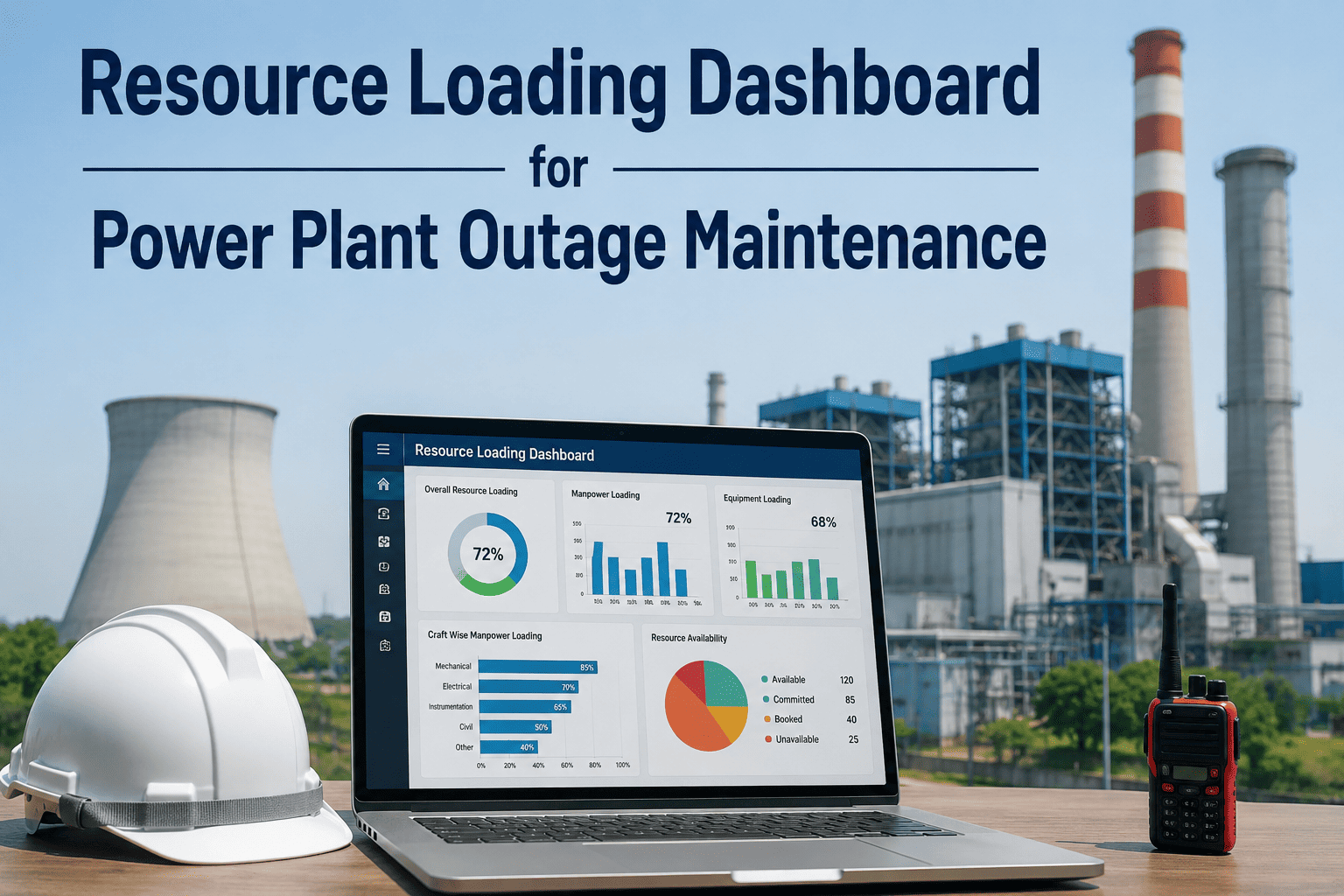
Resource Loading Dashboard for Power Plant Outage Maintenance
By Johnson on June 16, 2026
Every power plant outage has the same enemy: unproductive contractor time. Crew members standing by while a permit isn't cleared, a critical part hasn't been staged, or the next work package hasn't been handed off. Contractor costs represent 40–60% of total outage expenditure in thermal power plants — and most of the waste isn't the work itself, it's the gaps between the work. A resource loading dashboard makes those gaps visible before the outage starts: who is assigned to which package, which tasks have float versus which are on the critical path, and which crew is falling behind in real time. For a 500 MW combined-cycle plant losing approximately $850,000 per day in every overrun, that visibility is the difference between an on-schedule outage and a week of unplanned generation loss. To see how OxMaint's outage planning module manages resource loading for power plant shutdowns, start a free trial or book a 30-minute outage management walkthrough with a power plant specialist.
Outage Planning · Outage Management · Power Plant CMMS
Resource Loading Dashboard for Power Plant Outage Maintenance
See every crew, every work package, and every critical path task — in real time, across your entire outage. Stop discovering schedule overruns 24 hours after they start.
$850K
Per day — revenue lost on every overrun day at a 500 MW plant
40–60%
Of outage cost is contractor labour — idle time is the biggest driver of overrun
25–35%
Reduction in overhaul duration from structured resource loading and critical path visibility
97%
Work package documentation completion — vs 61% on paper-managed outages
Post-outage analysis from power generation operators consistently points to the same root causes — and none of them are caused by the scope of the work.
43%
Materials Not Ready
Critical path tasks where parts weren't confirmed as staged before the shutdown window began. The work crew arrives, the part isn't there, and the outage clock runs.
34%
Crew Access Delays
Permits not pre-approved, scaffolding not staged, isolation not confirmed — contractor crews stand by while the next task's access isn't ready. Idle time compounds hourly.
23%
Scope Changes Off Critical Path
Scope additions approved without assessing their impact on the critical path. Some additions can be absorbed; others extend the outage if sequenced incorrectly — and planners couldn't tell the difference in real time.
What the OxMaint Resource Loading Dashboard Shows
Six panels. One screen. Everything the outage manager needs to stay ahead of the schedule instead of chasing it.
Critical Path Status
GT Combustion Liner Removal
Complete
Hot Gas Path Inspection
In Progress
Turbine Blade Replacement
Pending
Rotor Realignment — CRITICAL
Parts Risk
Crew Utilization
Turbine Team A
92%
E&I Crew
74%
Welding Crew
38%
Civil Works
81%
Work Package Progress
84Closed
31Active
8At Risk
Parts Readiness
Combustion liner set — Staged
Transition pieces (×4) — Staged
Rotor bearing kit — ETA Day 4
Flex coupling — Procurement Gap
Resource Loading: The 5-Phase Outage Workflow
Effective resource loading starts 6–12 months before the outage window. Here is how OxMaint structures the full lifecycle — from scope development to post-outage learning.
Phase 1
Scope Development
6–12 months out
Review condition monitoring data, inspection history, and OEM service bulletins. Every work package entered with asset ID, estimated duration, craft type, and hold point classification. Scope locked before resource planning begins.
Phase 2
Resource Loading
3–6 months out
Work packages resource-loaded with craft type and headcount per task. Contractor scope packages issued. Long-lead materials ordered. Critical path established from task dependencies. Cross-unit crew conflicts flagged and resolved.
Phase 3
Pre-Outage Readiness
30 days out
Work packages whose readiness gate is not cleared — parts not delivered, permits not ready, briefings not conducted — are flagged and escalated 48 hours before the outage window. Scaffolding staged. Isolation pre-approved. Every unresolved pre-shutdown item is a schedule delay that has already happened.
Phase 4
Live Outage Execution
Active window
Live dashboard updates in real time as crews close work orders from mobile. Scope additions assessed against critical path before approval. Crew productivity tracked at work order level — not daily report level. Every deviation logged instantly.
Phase 5
Post-Outage Learning
Within 30 days
Cost vs budget, schedule variance, and scope findings fed back into the next outage plan. Continuous improvement loop closed. Duration reduction achieved within first two outage cycles — driven primarily by critical path visibility and pre-positioning of materials.
Stop Running Outages on Whiteboards and Morning Reports
OxMaint's live outage dashboard gives every outage manager, planner, and crew supervisor full work package visibility across all active contractors — updated continuously as field crews close tasks on mobile.
Resource Loading Dashboard vs Traditional Outage Control
Outage Management Task
Paper / Whiteboard Control
OxMaint Resource Dashboard
Critical path visibility
Updated once per day in morning meeting
Real-time, continuous as tasks close
Contractor idle time detection
Visible in retrospect via daily reports
Flagged within hours via utilization drops
Parts readiness confirmation
Manual checklist, phone calls to storeroom
Auto-check against storeroom inventory per WO
Scope change impact assessment
Scheduler estimates from memory
Critical path model updated instantly
Documentation completion
~61% average on paper-managed outages
97%+ — enforced at work order closure
Daily report compilation time
60–90 minutes per outage manager
Zero — auto-generated from WO status
Post-outage cost vs budget
Assembled weeks after completion
Live cost tracking against outage budget
Frequently Asked Questions
How does OxMaint's resource loading dashboard handle scope additions during an active outage?
When an inspection finding or protection trip triggers a scope addition during the outage, OxMaint assesses it against the current critical path model before the outage manager approves it. Additions that can be absorbed into available float are flagged as low risk; additions that would extend the critical path are escalated immediately. Start a free trial to see scope change control live.
What is the biggest driver of contractor idle time in power plant outages?
The most common causes are access delays — permits not pre-approved, scaffolding not staged, isolation not confirmed — and parts not staged for critical path tasks before the outage starts. Structured CMMS resource loading eliminates both: readiness gates are enforced 48 hours before the outage window, and parts availability is checked against every work package automatically. Book a demo to see pre-outage readiness checks in practice.
Can OxMaint integrate with Primavera P6 or MS Project for outage scheduling?
Yes. For plants using existing scheduling tools for outage planning, OxMaint can import the schedule structure and export progress updates — so planners keep their existing scheduling workflow while gaining live work order execution tracking and mobile field crew updates in real time. No data re-entry, no duplicate systems for the field crew.
How does a resource loading dashboard reduce outage duration?
Three mechanisms drive the documented 25–35% duration reduction: pre-outage preparation ensures zero delays on Day 1 with parts verified and permits pre-approved; parallel task scheduling identifies where tasks can run concurrently rather than sequentially; and digital closeout captures inspection findings on mobile during execution rather than reconstructing paperwork after the outage ends.
How quickly can OxMaint be set up for an upcoming planned outage?
Work package templates for standard outage types — combustion inspection, hot gas path, major overhaul — can be configured within the first site deployment, which takes one to three days. Templates auto-generate the full work order set per outage type, pre-loaded with tasks, parts lists, and resource estimates. Start a free trial and have your next outage scope structured before the week ends.
Your Next Outage Doesn't Have to Overrun. Give Your Team the Dashboard That Prevents It.
Resource loading, critical path tracking, real-time crew utilization, parts readiness, and live scope change control — all in one outage management platform built for power generation operators. Deploy OxMaint before your next planned shutdown and run the tightest outage your team has ever executed.