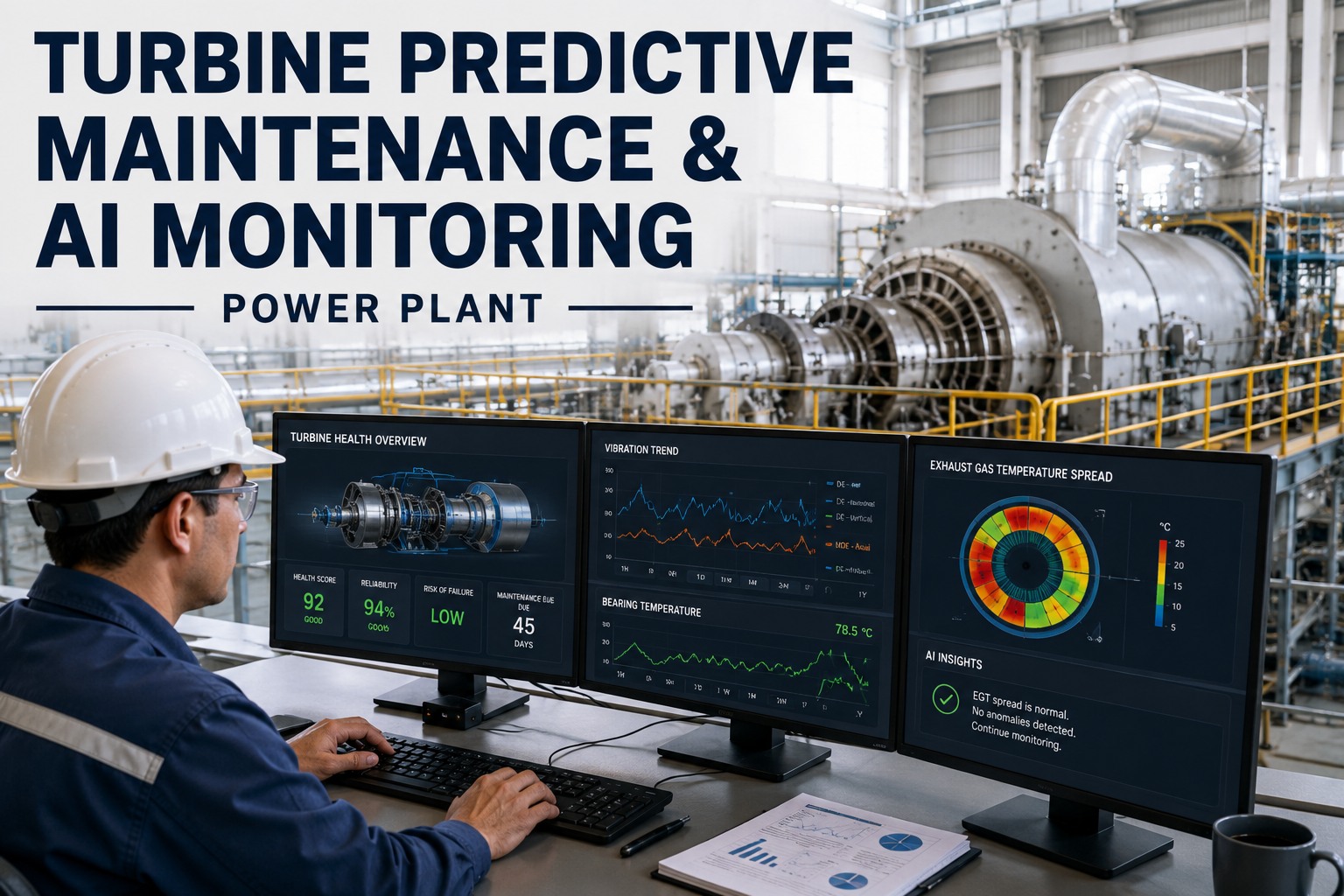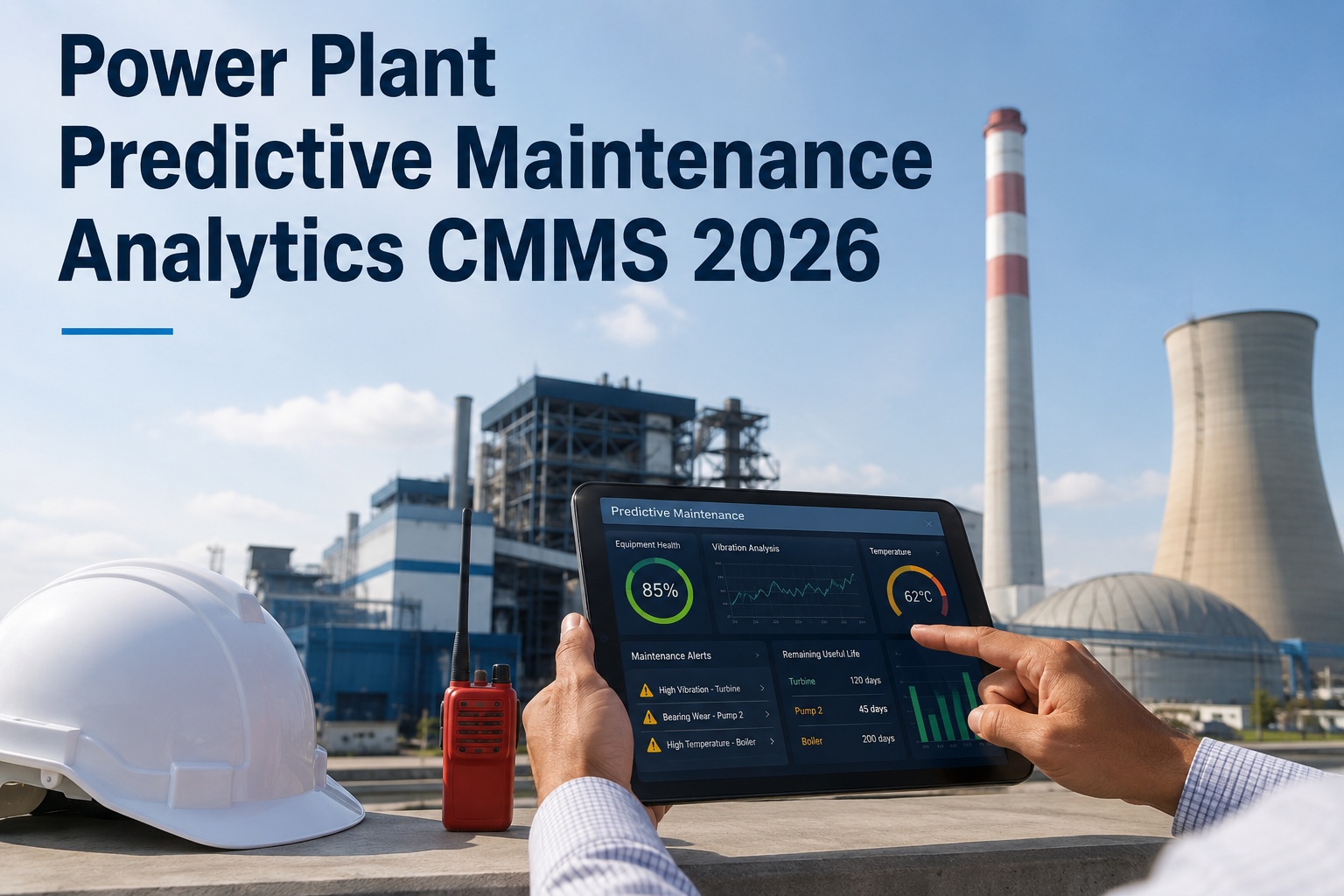
Power plant predictive maintenance has shifted from a competitive advantage to an operational necessity in 2026, as generation fleets face rising forced-outage costs, aging asset bases, and tightening reliability standards. By applying predictive analytics to power plant equipment—turbines, HRSGs, transformers, and boilers—maintenance teams can detect degradation weeks before failure, cutting unplanned downtime by 30–50% and reducing maintenance spend by 15–25%. This guide breaks down the analytics models, failure signatures, and CMMS workflows that make predictive plant maintenance work, and shows how OxMaint turns that data into automated work orders. Ready to see it on your assets? Start Free Trial or read on for the full framework.
Power Plant Predictive Maintenance Analytics
Can your plant predict the next forced outage before it costs you $300K?
A single unplanned gas-turbine trip can exceed $300K in lost generation and repairs. AI-driven predictive maintenance analytics changes that equation—detecting bearing degradation, HRSG tube leaks, and transformer insulation faults weeks before they escalate. See how OxMaint makes it actionable.
Predictive Analytics Models
Turbine predictive maintenance: degradation models that catch failures early
Gas and steam turbines account for over 60% of unplanned generation losses in thermal plants. Turbine predictive maintenance uses vibration spectrum analysis, oil debris monitoring, and thermal performance baselining to model bearing wear, blade fouling, and rotor degradation trajectories. The most effective programs combine ISO 10816 vibration limits with machine-learning anomaly detection—flagging deviations from the asset's own historical baseline rather than generic thresholds.
| Turbine Component | Failure Mode | Predictive Signal | Early-Warning Window |
|---|---|---|---|
| Journal bearing | Babbitt fatigue / wipe | 1X vibration amplitude trend + oil temp rise | 10–21 days |
| Blade path | Fouling / deposit buildup | Exhaust temp spread + compressor efficiency drop | 21–45 days |
| Rotor | Thermal bow / unbalance | Polar plot orbit shift + phase angle change | 7–14 days |
| Seals | Tip clearance erosion | Stage pressure ratio deviation + flow capacity loss | 30–60 days |
| Oil system | Lube degradation / contamination | Particle count trend + dielectric constant shift | 14–30 days |
A 2025 benchmark study across 40 combined-cycle plants found that turbine predictive analytics deployed through an integrated CMMS reduced bearing-related forced outages by 42% and cut average repair costs by $180K per event—because parts were staged and planned during a scheduled window rather than expedited mid-failure.
Critical Asset Health
HRSG failure prediction and transformer health AI: beyond vibration
Heat Recovery Steam Generators (HRSGs) and power transformers present different predictive challenges. HRSG failure prediction focuses on creep and fatigue in superheater tubes, flow-accelerated corrosion in economizer inlet headers, and drum-level instability—all detectable through dissolved oxygen trends, blowdown chemistry drift, and tube-wall temperature differentials. Transformer health AI leverages dissolved gas analysis (DGA), partial discharge sensors, and thermal imaging to model insulation aging per IEEE C57.104, giving reliability engineers a probability-of-failure score rather than a simple alarm.
HRSG tube leak detection
Acoustic emission sensors + feedwater makeup rate trend detect micro-leaks 5–12 days before catastrophic rupture, preventing casing damage that averages $1.2M per event.
Transformer DGA trend analysis
Duval triangle and key-gas ratios computed automatically from oil samples, with AI cross-referencing load history to flag incipient tap-changer faults before they cascade.
Boiler tube failure prediction
Fireside corrosion and fly-ash erosion modeled from fuel quality logs, soot-blower cycle counts, and tube-wall thermocouple arrays—reducing waterwall failures by up to 35%.
Generator winding health
Stator end-winding vibration and partial discharge trending per IEEE 1434, with automatic alerts when dielectric loss angle exceeds baseline by more than 15%.
ROI & Cost Justification
Predictive maintenance ROI for power plants: the cost of waiting
The business case for power plant predictive maintenance is driven by three variables: avoided forced-outage revenue loss, reduced repair severity, and deferred capital replacement. Most 500 MW+ generation assets lose $50K–$120K per day of unplanned unavailability; a single caught failure typically pays for an entire year of CMMS software licensing and sensor investment.
A 320 MW combined-cycle plant with 180 tracked assets
Before predictive analytics: 4.1% forced-outage rate, $1.8M annual unplanned maintenance spend, 2 catastrophic bearing failures per year averaging $420K each. After deploying CMMS-integrated predictive models: forced-outage rate drops to 1.3%, unplanned spend falls to $1.1M, and zero catastrophic failures in 12 months. Net annual savings: $890K, payback in under 5 months.
| Cost Category | Reactive (Annual) | Predictive (Annual) | Savings |
|---|---|---|---|
| Lost generation revenue | $2.4M | $780K | $1.62M |
| Expedited parts & labor | $610K | $180K | $430K |
| Catastrophic repair events | $840K | $95K | $745K |
| Overtime & contractor callouts | $310K | $120K | $190K |
| Total | $4.16M | $1.175M | $2.985M |
Implementation Timeline
How to deploy predictive analytics in a power plant CMMS in 90 days
Most generation predictive maintenance programs stall not because the analytics are wrong, but because the data never reaches the work-order workflow. A structured 90-day rollout—asset hierarchy first, sensor integration second, model tuning third—ensures predictions become actual completed work orders.
Asset hierarchy & criticality ranking
Build the full asset tree in OxMaint—from turbine major components to BOP pumps—tagged by criticality (ABC analysis) and mapped to failure modes. Import existing PM schedules, spare parts, and historical work-order data.
Sensor & historian integration
Connect DCS/SCADA tags, vibration sensors, DGA results, and oil analysis feeds into OxMaint. Establish baselines for each critical asset; configure alert thresholds using ISO 10816, IEEE C57.104, and your own historical norms.
Model tuning & automated work-order generation
Refine AI anomaly-detection models against the first 30 days of data. Configure automatic work-order creation when predictive alerts fire—pre-filled with the right spare parts, procedures, and priority—so predictions never die in a dashboard.
OxMaint Platform
How OxMaint delivers predictive power plant maintenance that actually converts to action
Most predictive analytics tools stop at the alert. OxMaint closes the loop—turning every anomaly, threshold breach, and degradation trend into a tracked, assigned, and completed work order inside a full CMMS and EAM environment built for generation fleets.
AI-driven failure prediction
Machine-learning models on vibration, thermal, and oil data predict turbine bearing and HRSG tube failures 7–21 days in advance—cutting unplanned downtime 30–50%.
Automated work-order generation
Every predictive alert auto-creates a work order with the correct parts, procedure, and priority—eliminating the gap between detection and action that causes 40% of missed predictions.
Real-time asset health dashboard
A single live view of every turbine, transformer, and boiler—color-coded by health score, with degradation trends and remaining-useful-life estimates per ISO 55000 alignment.
Spare-parts inventory linkage
Predictive alerts check stock levels automatically—if the bearing or tube section isn't in inventory, a purchase requisition fires before the work order is due, preventing parts-related delays.
Maintenance Leaders
What reliability teams say after switching to predictive CMMS
"OxMaint's predictive alerts caught a bearing degradation on our Unit 2 gas turbine 11 days before it would have tripped. We scheduled the repair during a planned outage window and saved an estimated $340K in lost generation and expedited repair costs."
"We moved from Excel-based PM tracking to OxMaint's predictive CMMS in under two months. Forced-outage hours dropped 38% in the first year, and our NERC compliance audit was the cleanest we've ever had—every work order, sensor alert, and part was traceable."
See Predictive Maintenance on Your Assets
Book a 30-minute demo and watch OxMaint predict your next failure
Bring your asset list and recent outage data. We'll show you exactly how OxMaint's AI models, automated work orders, and inventory linkage would have changed the outcome—live on your equipment.
Frequently Asked Questions
Power plant predictive maintenance: your questions answered
What is predictive maintenance in a power plant?
Predictive maintenance in a power plant uses sensor data—vibration, temperature, oil chemistry, dissolved gases—and AI models to detect asset degradation before failure. Unlike time-based preventive maintenance, it triggers work orders only when the asset's condition warrants, reducing unnecessary downtime and parts consumption by 15–25% while cutting unplanned outages by 30–50%.
How does a predictive CMMS differ from a standard CMMS?
A standard CMMS schedules preventive maintenance on fixed time or usage intervals. A predictive CMMS like OxMaint ingests real-time condition data, runs AI anomaly-detection models, and automatically generates work orders when a degradation threshold is crossed—so you fix assets before they fail, not because a calendar says so. You can Start Free Trial to see the difference on your assets.
What sensors are needed for turbine predictive maintenance?
Core sensors include accelerometers on bearing housings (per ISO 10816), proximity probes for shaft vibration, oil debris monitors, exhaust-temperature thermocouples, and lube-oil temperature and pressure transmitters. Most modern turbines already have these installed—OxMaint integrates the existing historian or DCS tags rather than requiring new hardware.
How long does it take to implement predictive maintenance analytics?
A structured rollout with OxMaint typically takes 60–90 days: 30 days for asset hierarchy and data import, 30 days for sensor and historian integration, and 30 days for model tuning and automated work-order configuration. Plants with existing SCADA and vibration data can see first predictive alerts within 45 days.
What is the ROI of predictive maintenance for power generation?
Most 500 MW+ plants see $800K–$3M in annual savings from reduced forced outages, lower repair severity, and deferred capital replacement. A single avoided turbine trip typically pays for the entire CMMS and analytics investment for the year. To get a custom ROI estimate based on your fleet, Book a Demo with our team.
Start Predicting, Stop Reacting
Your next forced outage is already developing—see it before it happens
Join the generation fleets using OxMaint to predict failures, automate work orders, and keep the lights on. Start your free trial today or book a demo and we'll show you predictive maintenance on your real asset data.
Free 14-day trial · No credit card