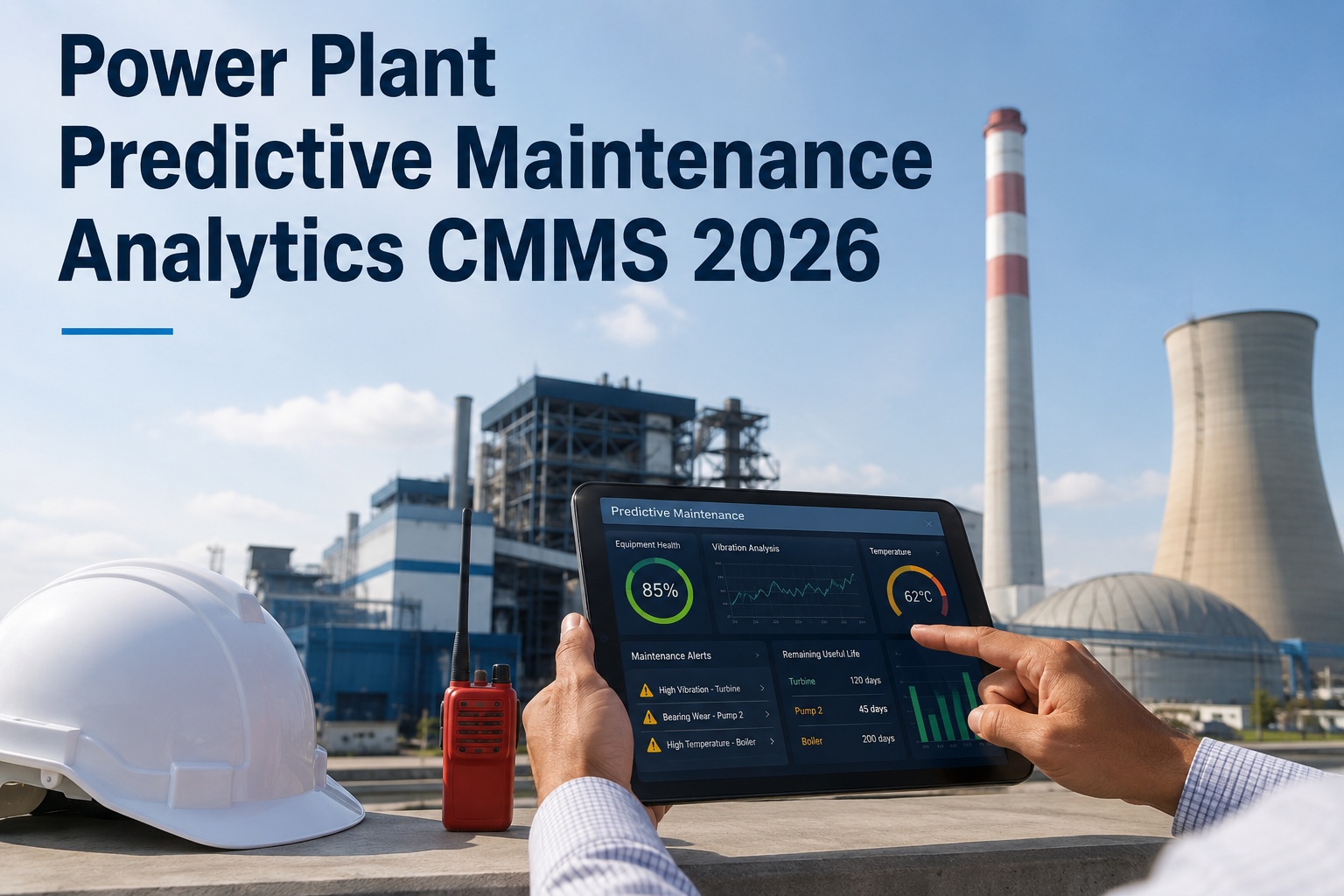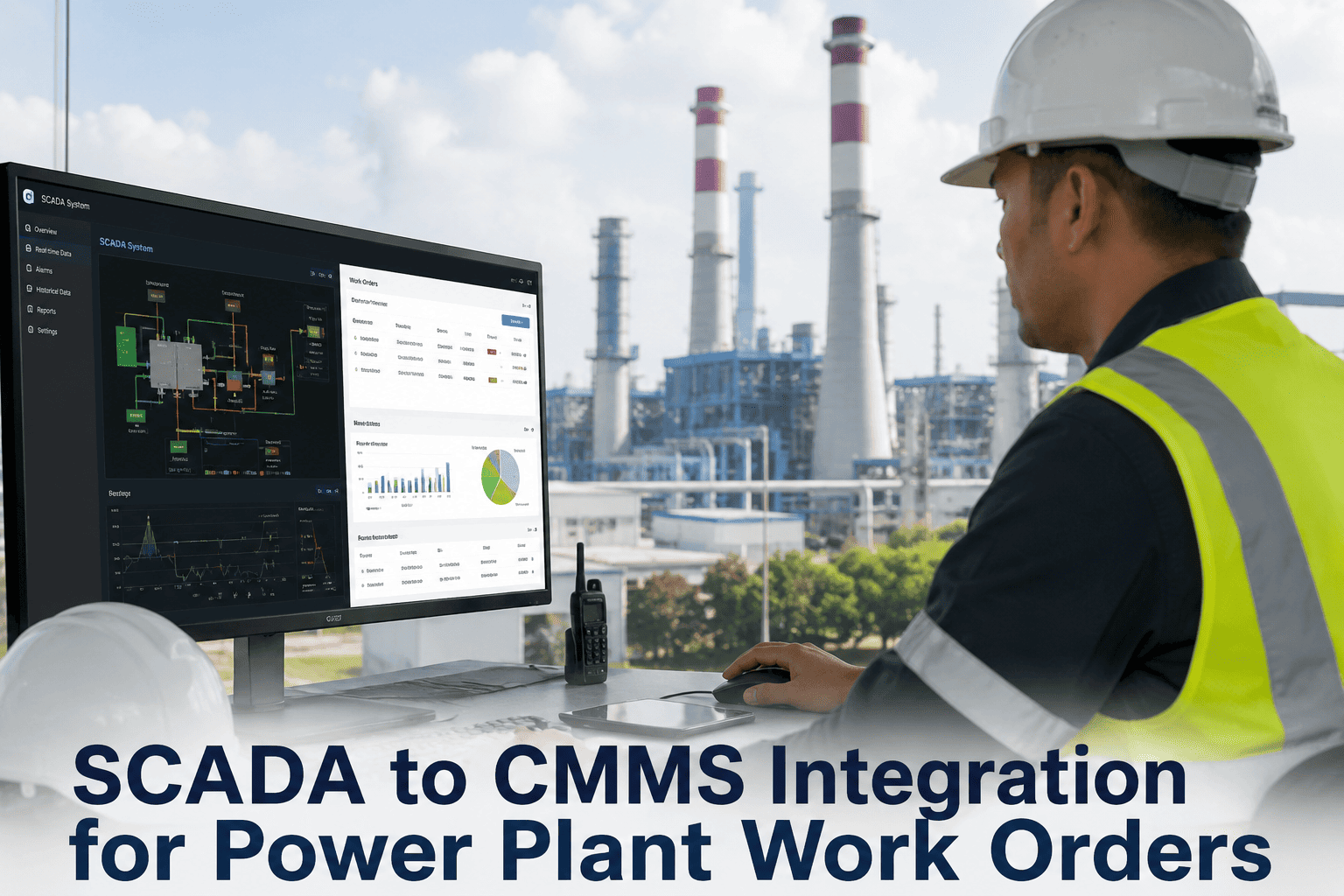
SCADA CMMS integration for power plants connects real-time supervisory control and data acquisition systems with maintenance management software so that vibration, temperature and pressure trends automatically trigger work orders before equipment fails. For a modern power generation facility — whether gas, steam, wind or hydro — linking the PI System or plant historian directly to a CMMS turns raw process tags into predictive maintenance actions, cutting unplanned downtime by 25–45% and reducing O&M spend by millions annually across a fleet. This guide walks through process tag mapping, SCADA alarm-to-work-order automation and historian-driven analytics, and shows how OxMaint makes the entire integration fast enough to Start Free Trial in under an afternoon.
SCADA + CMMS = Predictive Power
Your SCADA already sees the failure coming — is your CMMS acting on it?
Most power plants collect millions of process tags per hour but still run maintenance on paper, spreadsheets or a disconnected CMMS. Closing that gap — so every SCADA alarm or historian threshold auto-generates a prioritized work order — typically cuts unplanned downtime 30–50% and slashes emergency repair costs.
Why Integrate
Why SCADA predictive power maintenance demands CMMS integration
A typical 500-MW combined-cycle plant logs over 50,000 process tags per second through its SCADA layer and PI System historian. Yet reliability teams in many of these plants still discover bearing failures, tube leaks and valve degradation during scheduled rounds or — worse — after a trip. The root cause is not a lack of data; it is the absence of an automated bridge between process data and maintenance execution.
When SCADA and CMMS operate in silos, a bearing temperature may breach its warning threshold at 2 a.m. Tuesday, but the work order is not created until a technician reads the alarm log Wednesday morning — if they read it at all. Integrating the two systems collapses that lag to seconds, automatically generating a work order with the correct asset hierarchy, failure code, priority and spare-part list attached. OxMaint was built specifically to close this execution gap for power plant reliability teams.
Integration Architecture
How power plant SCADA integration maps process tags to work orders
Effective CMMS SCADA integration is not a single cable — it is a layered data flow that moves information from the control system to the maintenance backlog in four stages. Each stage can be implemented incrementally, starting with a critical-asset subset and expanding fleet-wide.
Data Acquisition — SCADA & PI System Historian
Process tags for vibration, temperature, pressure, flow and current are polled from PLCs and RTUs at 1-second intervals. The PI System (or equivalent historian) stores time-series data and provides the API layer — PI Web API, OData or OPC UA — that OxMaint subscribes to for real-time values and historical baselines.
Process Tag Mapping — Asset Hierarchy Alignment
Each SCADA tag is mapped to a specific asset in the CMMS equipment hierarchy (e.g., Tag TIC-2103-A maps to Boiler Feed Pump A, Discharge Bearing). OxMaint imports your existing tag register or auto-matches tags to assets using naming conventions, so a single integration can cover thousands of measurement points without manual line-by-line configuration.
Threshold & Predictive Analytics Engine
OxMaint applies rule-based thresholds (high-high, rate-of-change, deviation-from-baseline) and AI-driven anomaly detection to incoming tag streams. When a value crosses a configured limit or the model flags an abnormal pattern, the engine evaluates severity, asset criticality and spare-parts availability before deciding whether to auto-create or queue a work order.
Alarm-to-Work-Order Automation
A qualified SCADA alarm generates a complete work order in OxMaint — pre-filled with asset ID, failure mode, priority, task checklist, required parts and assigned technician. The work order flows through approval, execution and completion, and the CMMS writes status back so operators see maintenance in progress on their SCADA HMI.
SCADA Alarm to Work Order
SCADA alarm CMMS automation: from threshold breach to dispatched technician
Consider a 180-asset coal-fired unit spending roughly $42K per year on emergency pump and fan repairs. A boiler feed pump discharge bearing temperature trends upward over six days — from a baseline of 68°C to 89°C. Without SCADA CMMS integration, the bearing seizes on day seven, the pump trips, the unit derates 40 MW for 11 hours, and emergency repair costs hit $28K. With integration, OxMaint detects the deviation on day two, auto-creates a priority-2 work order, and a technician replaces the bearing during the next low-load window for $3,400 — a 12:1 cost avoidance.
Downtime Cost Avoided Formula
Avoided Cost = (Derated MW × Hours × Margin $/MWh) + (Emergency Repair $ − Planned Repair $)
Example: (40 MW × 11 hrs × $35/MWh) + ($28K − $3.4K) = $15,400 + $24,600 = $40,000 saved per event
The same automation applies to vibration velocity on ID fans, stator winding temperature on generators, lube-oil pressure on turbines and stack-emission excursions. OxMaint lets reliability engineers configure multi-condition rules — for instance, auto-create a work order only when bearing temperature exceeds 85°C AND vibration RMS exceeds 7.1 mm/s for 30 consecutive minutes — which dramatically reduces false alarms and alarm fatigue compared to simple single-threshold SCADA logic.
Comparison
Integrated SCADA analytics CMMS vs. standalone monitoring: the real gap
| Capability | Standalone SCADA / Historian | Standalone CMMS (Manual) | OxMaint SCADA + CMMS Integrated |
|---|---|---|---|
| Alarm-to-work-order lag | Hours to days (manual review) | 4–8 hrs average | < 60 seconds, fully automated |
| Predictive lead time | Visible but unactioned | None — reactive only | 7–14 days pre-failure |
| Asset context on alarm | Tag ID only | Manual lookup required | Full hierarchy, history, parts |
| False-alarm filtering | Single-threshold only | N/A | Multi-condition + AI anomaly |
| Maintenance feedback to operators | None | Radio / phone call | Work-order status on HMI |
| Audit trail for NERC / ISO 55000 | Partial — alarm logs | Separate work-order records | End-to-end linked trail |
OxMaint Solutions
How OxMaint bridges SCADA, PI System and maintenance execution
OxMaint is an AI-powered CMMS and EAM platform purpose-built to ingest plant historian data and convert it into prioritized, actionable maintenance. Four capabilities deliver measurable ROI within the first quarter of deployment:
PI System & Historian Connector
Native PI Web API, OPC UA and OData connectors pull time-series data from any plant historian — no custom middleware or per-tag licensing fees. Map 10,000+ tags to assets in a single import.
Outcome: 90% faster integration vs. custom codingAI Predictive Analytics Engine
Machine-learning models learn each asset's normal operating envelope across load, ambient and seasonal conditions — then flag deviations 7–14 days before traditional threshold alarms would fire.
Outcome: 30–50% fewer unplanned tripsAutomated Work-Order Generation
Qualified SCADA alarms auto-create work orders with asset context, failure code, task checklist, required spare parts and technician assignment — routed by skill, shift and priority in under 60 seconds.
Outcome: 8-hr lag reduced to secondsMaintenance Analytics & KPI Dashboard
Real-time OEE, MTBF, MTTR and maintenance-cost-per-MWh dashboards blend SCADA production data with CMMS work-order history — giving plant managers a single source of truth for reliability reporting.
Outcome: ISO 55000 & NERC audit-ready in one clickReal-World Impact
What power plant data integration delivers in the first 12 months
"We integrated OxMaint with our PI System across three gas turbines and two HRSGs. In the first six months the AI caught a bearing degradation on our CT-2 generator 11 days before it would have tripped. That single event paid for the entire platform."
"Before OxMaint our operators would call in a SCADA alarm and a tech would grab a clipboard. Now the work order is waiting before the phone rings. We cut emergency overtime by 35% in one quarter and our NERC compliance audit was the cleanest we have ever had."
See OxMaint on your assets — book a 30-min demo
Watch a SCADA alarm auto-generate a work order on your own tag names and asset hierarchy. Bring your top 5 critical-asset failure modes and we will map the integration live.
FAQ
SCADA CMMS integration for power plants — frequently asked questions
What is SCADA CMMS integration and why does it matter for power plants?
SCADA CMMS integration connects your plant's real-time control and data acquisition system directly to your maintenance management software, so process-tag alarms and historian trends automatically generate work orders. For power plants it matters because it eliminates the manual lag between detecting a problem and acting on it — turning hours or days of delay into seconds and cutting unplanned downtime by 25–45%.
How does OxMaint connect to the PI System or plant historian?
OxMaint uses native PI Web API, OPC UA and OData connectors to subscribe to time-series data from the PI System or any compatible plant historian — no custom middleware required. Tags are mapped to assets via an automated import or naming-convention matcher, and you can Start Free Trial to test the connector on a 20-asset pilot before scaling fleet-wide.
Can SCADA alarms automatically create work orders without false positives?
Yes. OxMaint supports multi-condition rules — for example, triggering a work order only when temperature exceeds 85°C AND vibration exceeds 7.1 mm/s for 30 minutes — plus AI anomaly detection that learns each asset's normal operating envelope. This filters out transient spikes and process load changes, typically reducing false alarms by 60–80% compared to single-threshold SCADA logic.
How long does it take to implement CMMS SCADA integration in a power plant?
A focused pilot on 20–50 critical assets with an existing PI System can be live in 2–4 weeks, including tag mapping, threshold configuration and technician training. Full fleet deployment across hundreds of assets typically takes 8–12 weeks. OxMaint's guided onboarding and automated tag-mapping tools compress this timeline significantly compared to custom-coded integrations.
What ROI can a power plant expect from SCADA predictive maintenance integration?
Most plants see a 25–45% reduction in unplanned downtime, a 20–30% cut in emergency repair spend and a 10–15% decrease in maintenance labor overtime within the first 12 months. A 200-MW unit typically avoids $800K–$1.2M annually. You can see a personalized ROI projection on your own asset register when you Book a Demo with the OxMaint team.
Stop reading SCADA alarms your CMMS cannot act on
Deploy OxMaint in days, connect your PI System, and let every process-tag breach auto-generate a prioritized work order — with parts, checklists and technician assignment built in.
Free 14-day trial · No credit card