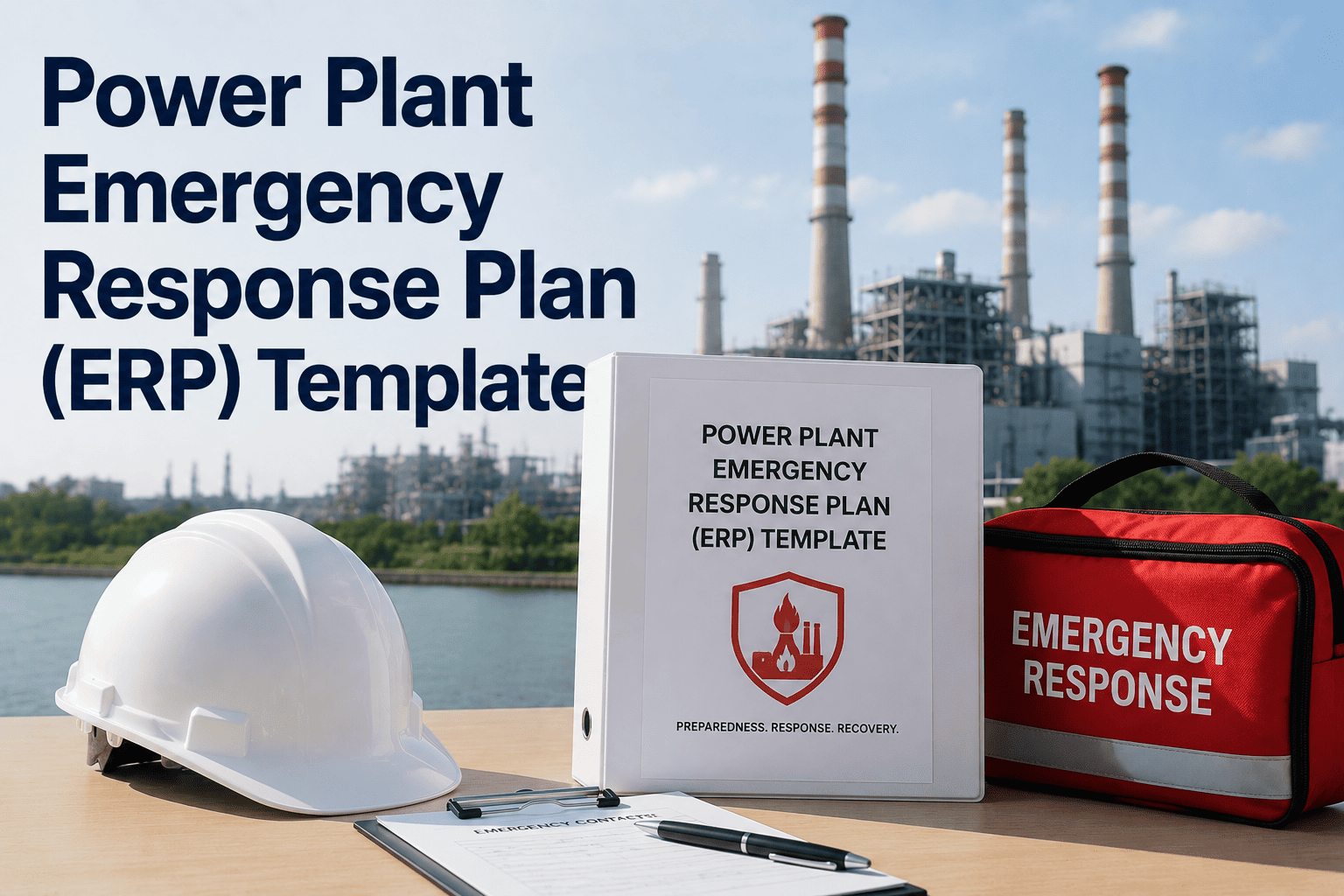
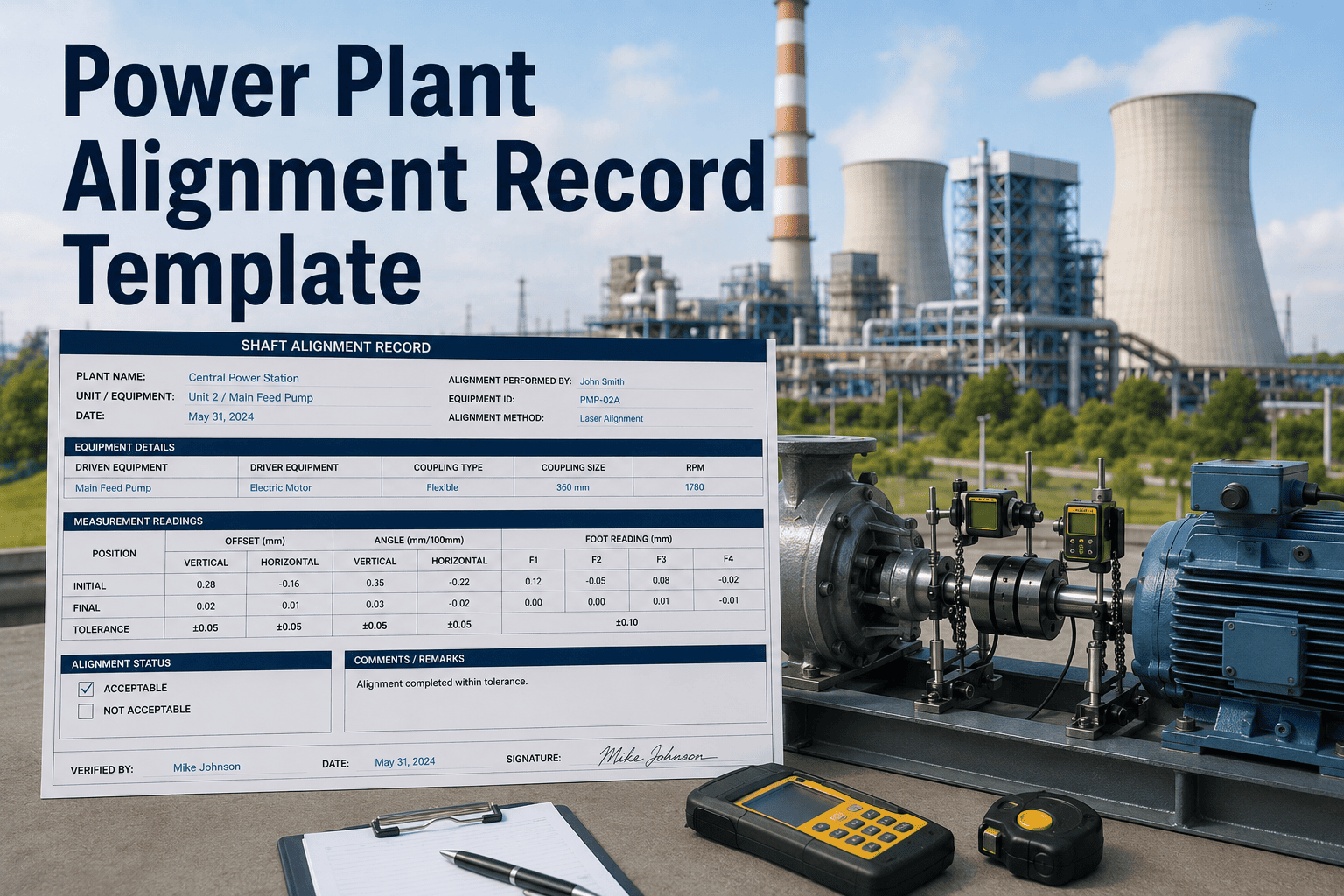
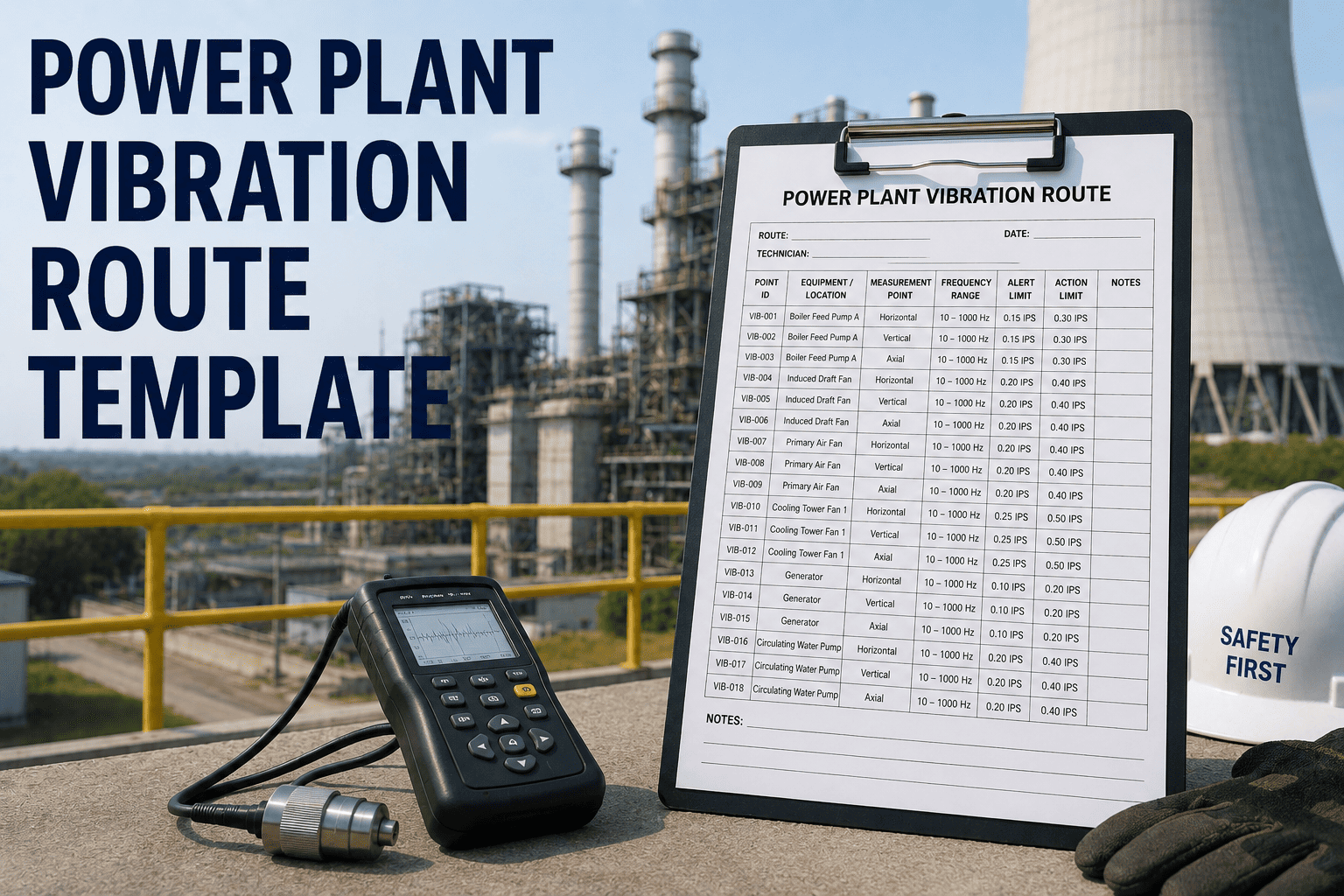
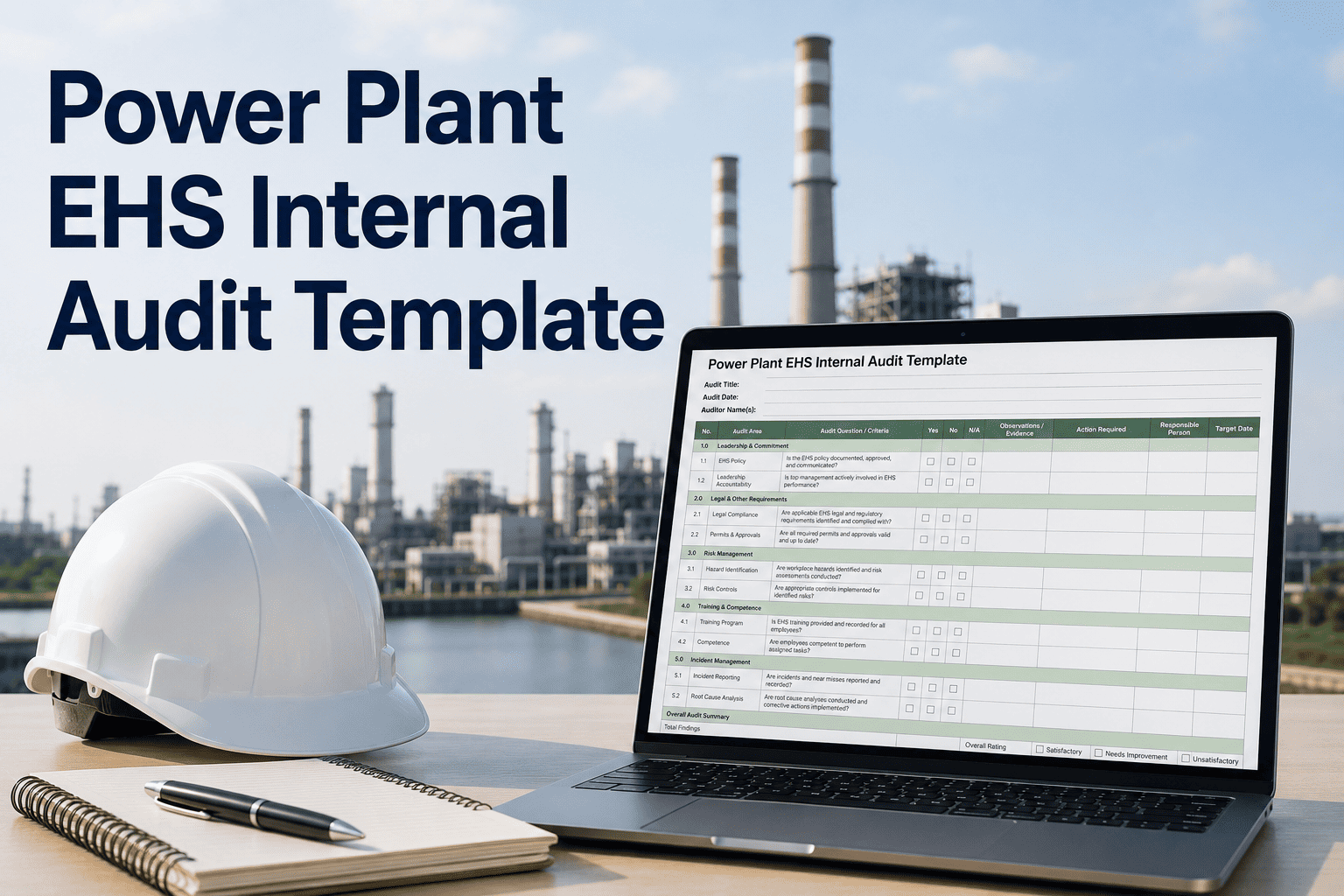
A power plant emergency response plan is the document that determines whether a fire, gas release, transformer failure, or dam breach unfolds as a managed event or an uncontrolled crisis. Most plants have an ERP — but most ERPs are static documents that live in a binder, were last updated three years ago, and have never been tested as a complete drill sequence with CMMS-routed response tasks assigned to specific roles. The difference between a functional ERP and a compliant-on-paper ERP is whether your operations team can execute it under pressure without reading it. The template below is a complete, editable framework covering five major emergency scenarios — fire, gas release, transformer fire, dam breach, and personnel injury — structured for immediate use and designed to integrate with OxMaint's CMMS for drill scheduling, task routing, and audit-ready records. If your plant's ERP is due for a structured rebuild or CMMS integration, explore OxMaint's emergency response management tools or book a 30-minute session with a power plant safety specialist to walk through an ERP build for your specific facility type.
ERP Template · Power Plant Safety · CMMS-Routed Drills
Power Plant Emergency Response Plan (ERP) Template — Fire, Gas Release, Transformer Fire, Dam Breach, and CMMS-Routed Drills
A complete editable framework for power plant emergency response. Five scenarios, structured activation protocols, CMMS drill integration, and audit-ready documentation.
Fire
Gas Release
Transformer Fire
Dam Breach
Personnel Injury
ERP Structure: The Five Required Components Every Power Plant Plan Must Include
A defensible power plant ERP is not a narrative document. It is a structured operational protocol with clear activation triggers, defined roles, step-by-step response sequences, resource inventories, and drill records. Regulators — FERC, NRC, OSHA, and state environmental agencies — look for all five components during compliance reviews.
1
Hazard Inventory and Risk Assessment
A facility-specific list of credible emergency scenarios with probability and consequence ratings. Drives which response plans receive priority investment and which require immediate notification to external agencies.
2
Roles, Responsibilities, and Command Structure
Named roles (Emergency Director, Incident Commander, Safety Officer, Communications Lead) with defined authority and succession. Every role has a backup, and every person knows their activation trigger without being told.
3
Scenario-Specific Response Protocols
Step-by-step response sequences for each credible scenario — what to do in the first 5 minutes, first 30 minutes, and first 4 hours. Includes isolation steps, evacuation routes, agency notification requirements, and contractor mobilisation triggers.
4
Resource and Equipment Inventory
Locations of all emergency equipment (fire suppression, gas detection, spill response, first aid) with monthly inspection requirements and CMMS-tracked maintenance records. Equipment that fails an inspection is flagged before an emergency, not during one.
5
Drill Schedule and Post-Drill Records
Annual and semi-annual drill requirements for each scenario type, with CMMS-generated drill work orders, attendance records, deficiency logs, and corrective action tracking. Drill records are the primary evidence auditors request.
Scenario 1: Fire Response Protocol Template
Fire is the highest-frequency emergency scenario at thermal power plants. The response protocol must be fast enough to prevent a small fire from becoming a structural loss, and structured enough to prevent responders from creating additional hazards during suppression. The template below covers the first 60 minutes of response.
0–2 min
Detection and Initial Alert
Automatic fire detection system activates. Control room operator verifies alarm, confirms location, and initiates PA announcement. Shift supervisor notified immediately. Fire brigade paged via CMMS-triggered alert or plant PA.
2–5 min
Fire Brigade Response and Initial Assessment
Fire brigade arrives with Class appropriate extinguishers. Incident Commander assumes control. Initial assessment: fire size (incipient vs structural), fuel type, and spread risk. Personnel accountability check initiated for affected zone.
5–10 min
Isolation and Suppression Decision
Control room isolates fuel, electrical, and ventilation systems serving the fire zone per isolation procedure. Incident Commander decides: internal suppression with brigade, or evacuate and call external fire services. External call made if structural involvement confirmed or hazardous materials at risk.
10–30 min
External Agency Notification and Evacuation Management
Fire department notified at or before 10-minute mark regardless of suppression status. Full evacuation of non-essential personnel from affected building. Muster at designated assembly point. Emergency Director assumes overall site command and manages media/regulatory communication.
30–60 min
Regulatory Notification and Post-Incident Transition
State environmental agency, OSHA, and plant owner notified per regulatory timelines. Scene preserved for investigation. CMMS incident report opened with cause classification, affected equipment list, and corrective action work orders generated automatically.
Scenario Templates: Response Sequences for All Five Emergency Types
Each scenario has a distinct activation trigger, hazard profile, isolation sequence, and regulatory notification requirement. The table below summarises the critical response parameters for each of the five template scenarios — the elements that must be defined before an emergency, not improvised during one.
| Scenario |
Primary Hazard |
First 5-Minute Action |
Isolation Requirement |
External Notification |
| Fire |
Structural loss, personnel injury, equipment damage |
Personnel accountability check, fire brigade response, fuel and electrical isolation |
Fuel supply, ventilation, electrical feeds to fire zone |
Fire department, OSHA (if injury), state regulator |
| Gas Release |
Explosion, asphyxiation, toxicity (H2S, NH3, SF6) |
Evacuate zone, isolate gas source, atmospheric monitoring deployment |
All gas isolation valves serving affected zone, ventilation shutdown |
Fire department, PHMSA (if pipeline), EPA (if toxic release threshold exceeded) |
| Transformer Fire |
PCB oil release, electrical hazards, fire spread to adjacent equipment |
De-energise transformer, activate fixed suppression system, 50-metre exclusion zone |
High-voltage feeds both sides of transformer, oil containment berm check |
Fire department, EPA (PCB spill), state environmental agency, grid operator |
| Dam Breach |
Downstream flooding, ash pond release, structural collapse |
Downstream community notification, dam emergency action plan activation, evacuation of dam area |
Upstream inflow control, spillway gate operation, downstream isolation barriers |
State dam safety authority, downstream municipalities, FERC (if FERC-licensed), EPA |
| Personnel Injury |
Fatality, serious injury, lost-time incident |
Secure scene, summon first aid and EMS, do not move victim unless in immediate danger |
Energy isolation of equipment involved in incident, preserve scene for investigation |
OSHA within 8 hours (hospitalisation), OSHA within 24 hours (amputation/loss of eye) |
Your ERP Is Only as Good as the Drills That Test It
OxMaint routes drill work orders to the right personnel automatically, records attendance and deficiency findings, and tracks corrective actions to closure — giving you the audit-ready drill record that regulators require and static binder documents cannot produce.
CMMS Integration: How OxMaint Manages ERP Drills and Emergency Equipment
An ERP that is never tested is a liability document, not a safety program. CMMS-managed drills and emergency equipment maintenance close the gap between a written plan and an executable one — and produce the records that prove the program works.
D
Drill Scheduling and Routing
CMMS auto-schedules annual full-scale drills, semi-annual tabletop exercises, and monthly notification tree tests per scenario type. Drill work orders route to all required participants with pre-drill briefing documents attached.
R
Drill Record and Deficiency Log
Drill completion is recorded in the CMMS with attendance confirmation, scenario outcomes, and deficiencies identified. Each deficiency generates a corrective action work order with an assigned responsible person and deadline.
E
Emergency Equipment PM Tracking
All emergency equipment — fire suppression systems, gas detection units, first aid stations, spill response kits, emergency lighting — is registered as assets in CMMS with monthly PM work orders. Failed inspections are flagged to the safety manager before the next drill or emergency.
A
Audit Package Generation
CMMS generates an ERP compliance report covering: drill history, equipment PM completion rates, corrective action close-out rates, and ERP document revision history. Audit response time drops from days to hours when all records are asset-linked and searchable.
ERP Document Maintenance: How Often Each Component Must Be Reviewed
An ERP that was accurate when written becomes a liability as the facility changes. Staff turnover, equipment modifications, regulatory updates, and process changes can all invalidate response protocols without anyone noticing — until an emergency exposes the gap. The review schedule below is the minimum required for a defensible ERP program.
Monthly
Emergency contact list verification
Emergency equipment inspection records
Notification tree test (call-down exercise)
Quarterly
Role assignments updated for staff changes
Chemical inventory and hazard list reviewed
Isolation procedure cross-check with current P&IDs
Annual
Full ERP document review and revision
Full-scale drill for at least two scenario types
Regulatory notification requirements updated
External agency coordination review
Event-Triggered
After any actual emergency or near-miss
After any major equipment modification
After regulatory citation or NOV
After key personnel changes in named roles
Frequently Asked Questions
What regulations require a power plant to have a formal Emergency Response Plan?
OSHA's Process Safety Management (29 CFR 1910.119) and Emergency Action Plan (29 CFR 1910.38) standards require formal written ERPs for facilities with covered chemicals above threshold quantities. FERC, NRC, EPA's Risk Management Program (40 CFR Part 68), and state environmental agencies add facility-specific requirements.
OxMaint's ERP module maps required plan elements to the relevant regulation so nothing is missed.
How does a CMMS improve ERP drill quality compared to manual scheduling?
Manual drill scheduling relies on a safety manager remembering to schedule and document each drill. CMMS auto-schedules drills, sends advance notifications to participants, routes scenario-specific briefing documents, records attendance and completion, and logs deficiencies as corrective action work orders. The audit trail is created automatically, not reconstructed after an audit request arrives.
Book a demo to see the drill workflow in detail.
Can this ERP template be used for both gas turbine and coal or nuclear facilities?
The core structure and five scenario protocols apply across all thermal plant types. Facility-specific elements — chemical inventory, isolation procedures, regulatory notification thresholds, and dam applicability — will differ by fuel type and licensing regime. The template is designed to be edited with facility-specific data rather than used verbatim. Nuclear facilities have additional NRC-required Emergency Plan elements that go beyond this template's scope.
What happens to drill deficiency findings if they are not tracked to closure?
Open drill deficiencies that are not corrected and documented are the most common finding in ERP compliance audits. They indicate that the drill process identified a gap and the organisation failed to close it — which regulators treat as a more serious finding than the original deficiency. OxMaint's corrective action module assigns each deficiency a responsible person, deadline, and escalation path to prevent closure gaps.
How does OxMaint manage ERP document version control and revision history?
OxMaint stores ERP document versions with revision date, responsible author, and summary of changes. Auditors can see when each section was last reviewed and who approved it.
Start a free trial to explore the document management workflow with your own ERP structure.
A Static Binder Is Not an Emergency Response Program. Build One That Works.
OxMaint gives power plant safety teams CMMS-routed drills, emergency equipment PM tracking, deficiency-to-corrective-action workflows, and audit packages that take minutes to generate — not days of document hunting.