A single transformer fire at Fermi National Accelerator Laboratory in 2024 caused $3.5 million in losses — representing 81% of the entire DOE's fire losses for that year. Across power generation facilities, fire incidents consistently follow the same pattern: detection systems that were overdue for testing, suppression agents that had degraded beyond effective concentration, and inspection records that could not confirm when any component had last been verified. The failure is almost never the hardware — it is the maintenance program. Fire suppression systems that are tested, calibrated, and documented on schedule suppress fires. Those that are not are expensive decoration. Sign up free on OxMaint to automate every inspection schedule, calibration deadline, and compliance document your fire protection systems require — before the next audit or the next incident reveals what your records cannot prove.
Fire Protection Systems That Are Not Maintained Do Not Work When You Need Them
Fire sprinkler failure is most commonly caused by improper or insufficient maintenance — not faulty design or installation. The 2025 NFPA 25 updates now require immediate corrective actions for any deficiency found during inspection. A deferred fix is a compliance violation.
The Fire Protection Systems a Power Plant Must Maintain — and How Often
Power plants operate multiple fire protection systems simultaneously, each governed by a different NFPA standard and each requiring its own inspection, testing, and maintenance schedule. Tracking these obligations manually creates the exact gaps that fire marshals and insurance auditors find most often: overdue tests, missing signatures, and detector calibrations that expired months before anyone noticed. Talk to an OxMaint specialist about automating your fire system maintenance schedule.
Smoke detectors, heat detectors, flame detectors, manual pull stations, notification appliances, and fire alarm control panels all require structured testing cycles. NFPA 72 (2025 edition) now includes enhanced wireless mesh network monitoring requirements — missed testing creates both life-safety gaps and compliance violations.
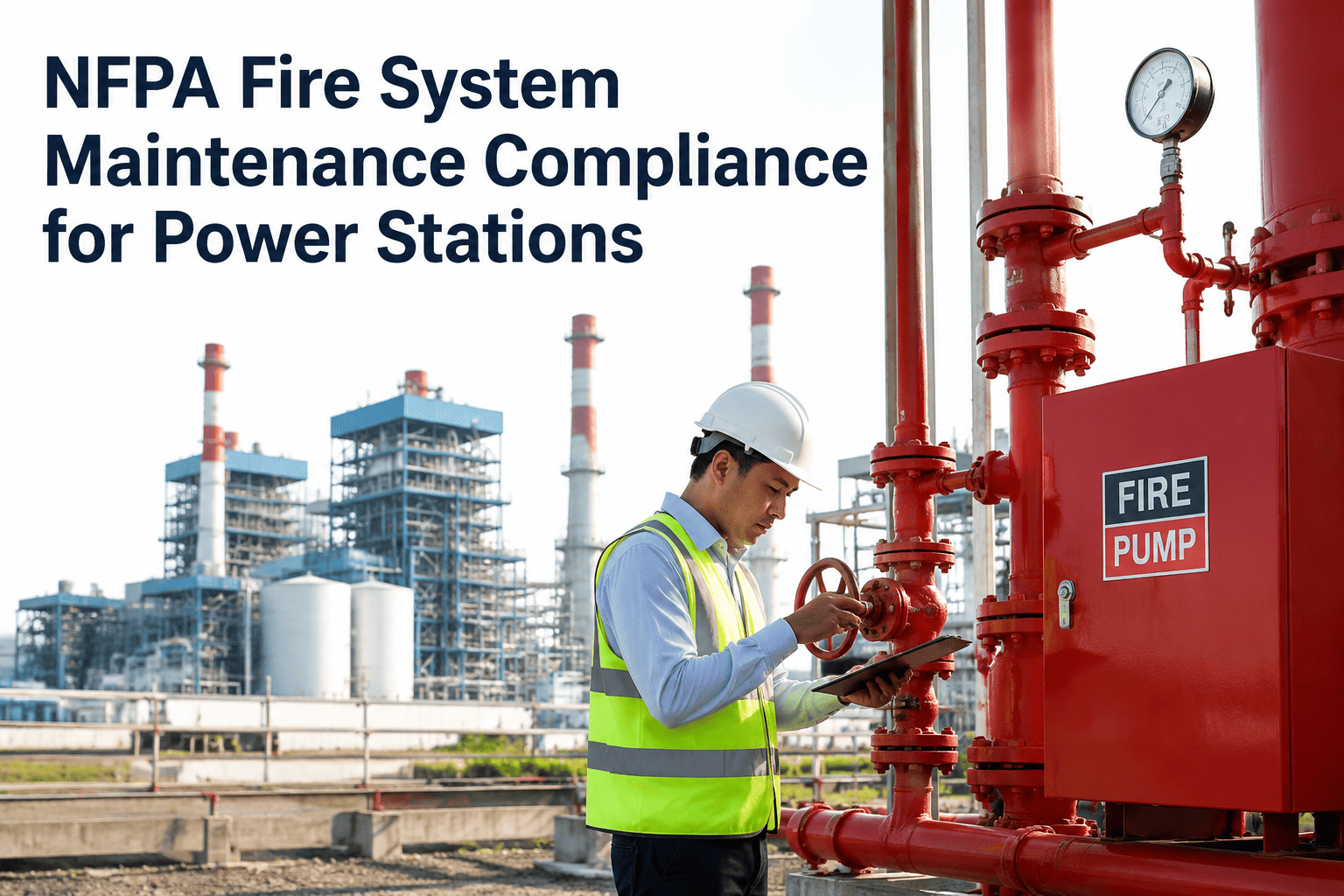
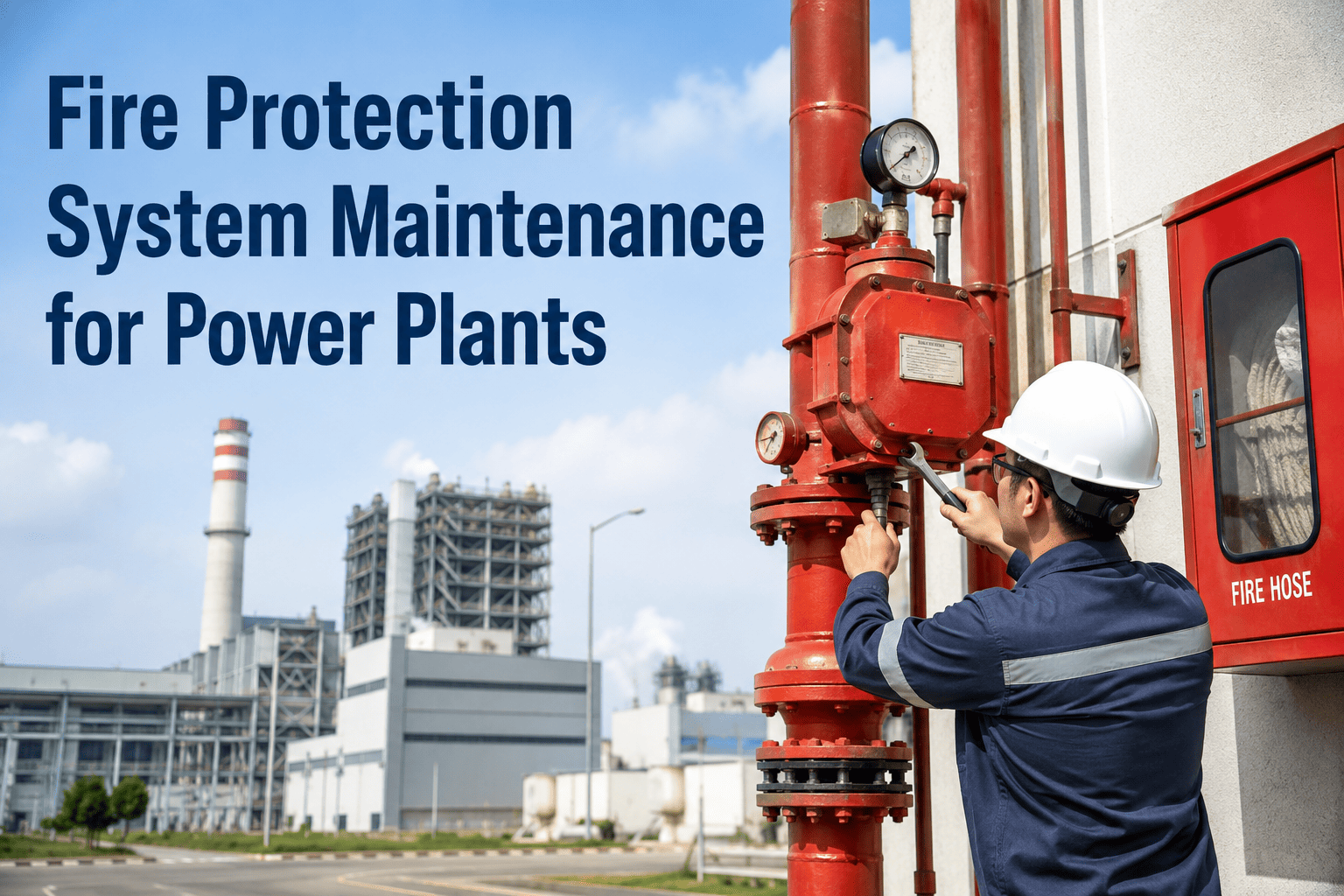
Wet pipe and dry pipe sprinkler systems, deluge systems, standpipes, and fire pumps. The 2025 NFPA 25 updates mandate immediate corrective action for deficiencies found during inspection — not deferred repairs. Frozen or obstructed sprinklers are the leading cause of suppression failure at the critical moment.
FM-200, Novec 1230, and CO₂ systems protect control rooms, cable spreading rooms, and electrical equipment vaults where water suppression would cause catastrophic collateral damage. Agent concentration, container pressure, and discharge nozzle integrity must all be verified — a depleted agent cylinder discovered post-fire is not a usable suppression system.
Transformer bays, fuel oil storage areas, and turbine lube oil systems use foam suppression to combat Class B flammable liquid fires. Foam concentrate degrades over time — manufacturers typically specify annual sampling and 3-year full foam quality testing. Degraded concentrate does not achieve design suppression density when discharged.
How OxMaint Automates Fire System Maintenance Compliance
Fire protection maintenance fails when schedules live in spreadsheets, inspection records exist on paper, and no one is accountable for a detector test that quietly became six months overdue. OxMaint structures fire system maintenance as a continuous automated workflow — from scheduled work order generation through technician execution, documentation capture, and compliance reporting. Sign up free to see how automated scheduling eliminates the gaps that auditors and fire marshals find most often.
An Overdue Detector Test Is a Compliance Violation Waiting to Be Found
OxMaint keeps every fire alarm, suppression system, foam system, and clean agent system in your power plant on an automated maintenance schedule — with work orders, documentation requirements, deficiency tracking, and audit reports built in. Stop relying on spreadsheets to manage systems that protect everything else.
NFPA Compliance Requirements at a Glance
Each fire protection system in your plant operates under a specific NFPA standard with defined inspection frequencies and documentation requirements. The table below maps the key standards to what inspectors look for and what OxMaint generates automatically to meet each requirement.
| NFPA Standard | System Type | Minimum Inspection Frequency | Documentation Required | Key 2025 Update |
|---|---|---|---|---|
| NFPA 72 (2025) | Fire alarm, smoke & heat detectors, notification devices | Weekly visual → semi-annual functional → annual full test | Signed test records, device-level pass/fail, deficiency log — retained 1 year minimum | Expanded wireless mesh network monitoring; enhanced power outage resilience requirements |
| NFPA 25 (2025) | Sprinklers, standpipes, fire pumps, deluge valves | Weekly gauges → quarterly flow → annual heads → 5-year internal | Inspection, testing, and maintenance records per system type — immediate corrective action documentation | Immediate corrective action now required for any deficiency found during ITM — no deferred repairs |
| NFPA 2001 | Clean agent systems (FM-200, Novec 1230, CO₂) | Monthly cylinder check → semi-annual panel test → annual full inspection | Cylinder weight/pressure records, enclosure integrity tests, agent quality certificates | New provisions for low-GWP agent alternatives and system compatibility documentation |
| NFPA 11 | Foam suppression (transformer bays, fuel storage) | Quarterly concentrate check → annual sample → 3-year quality test | Foam concentrate quality test reports, proportioner calibration records, discharge test documentation | Updated guidance on AFFF phase-out and PFAS-free concentrate transition requirements |
| NFPA 850 | Electric generating plant fire protection (all systems) | Per applicable referenced standards (NFPA 72, 25, 2001, 11) | Plant-specific fire protection program documentation, AHJ approval records, annual program review | Reference standard for all power plant fire protection — drives compliance with all listed standards above |
Frequently Asked Questions
Every Missed Fire System Inspection Is a Gap Your Next Audit Will Find
Power plant fire protection systems are only as reliable as their maintenance records prove them to be. OxMaint automates the inspection schedules, deficiency tracking, corrective action workflows, and compliance documentation that keep your fire systems audit-ready, insurance-compliant, and ready to work when they actually matter.