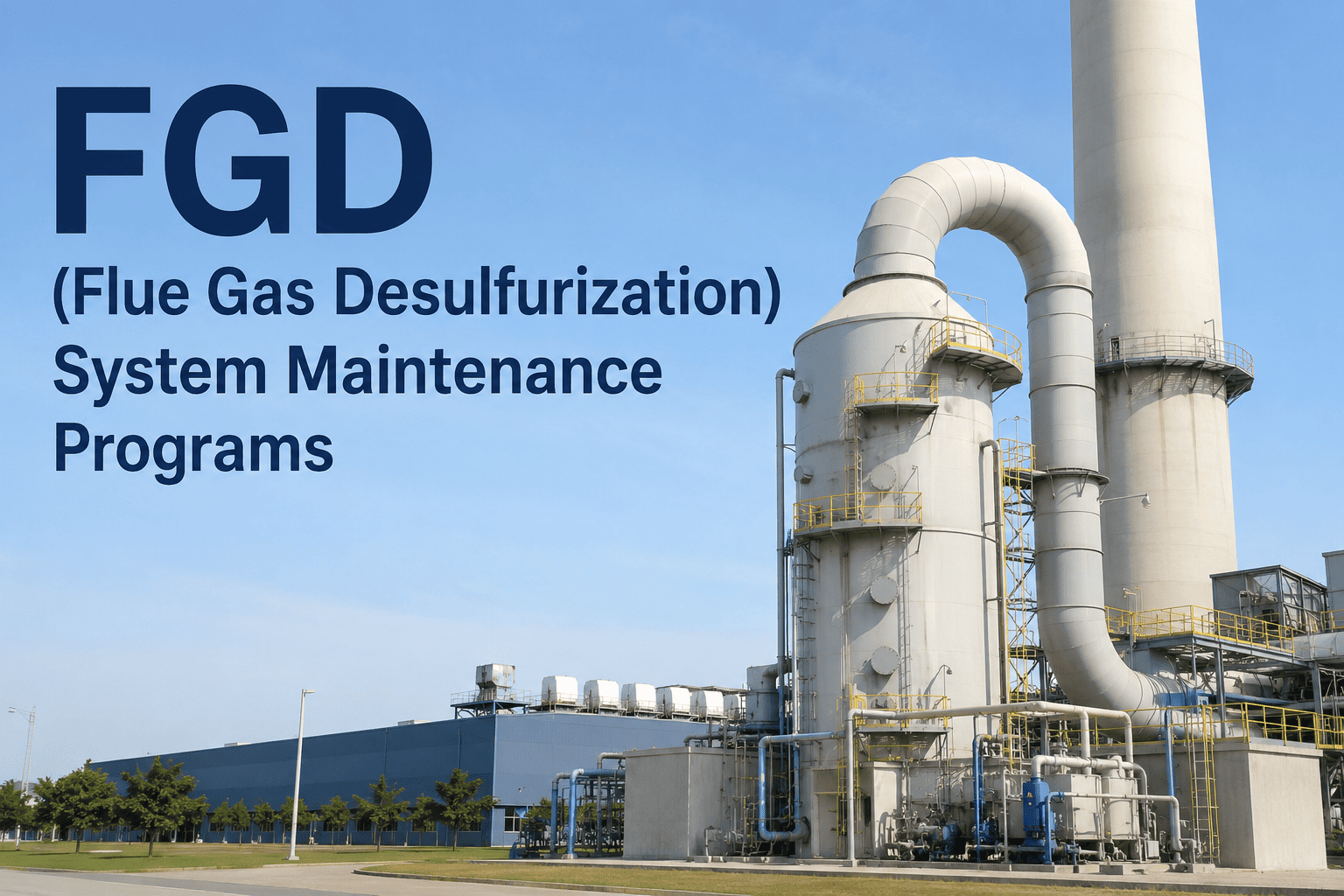
Wet limestone FGD systems are among the most chemically aggressive and mechanically demanding assets in a power plant — operating continuously in abrasive, highly corrosive slurry environments with zero tolerance for unplanned downtime during high-SO2 load periods. Sign Up Free on OxMaint to build a structured CMMS program for your FGD absorbers, slurry pumps, mist eliminators, and recycle lines — with full PM scheduling, work order tracking, and compliance documentation in one platform.
FGD System Overview: What You Are Actually Maintaining
A wet limestone forced oxidation (WLFO) FGD system removes SO2 from flue gas through a continuous chemical reaction — limestone slurry absorbs SO2, is oxidized to calcium sulfate (gypsum), and is dewatered for disposal or sale. Every component in this reaction chain is subject to abrasion, corrosion, scaling, or plugging failure modes that maintenance must actively manage.
The Five High-Failure-Rate FGD Components
Industry reliability data from wet FGD systems consistently identifies the same five subsystems as responsible for the majority of forced outage hours and performance degradation events. A maintenance program that applies rigorous PM and predictive monitoring to these five areas captures most of the achievable reliability improvement.
Large centrifugal pumps (typically 5,000–30,000 GPM) circulating limestone slurry from the absorber sump to spray headers. Failure modes: rubber liner erosion, impeller wear from abrasive gypsum solids, seal failures from crystallization. Most significant source of forced FGD outage hours in most plants.
Chevron or mesh-pad demisters remove entrained slurry droplets from the outlet gas stream. Scaling (gypsum or calcium carbonate) and plugging are the dominant failure modes — causing carryover of slurry into downstream ducting, reheaters, and ID fans with severe corrosive damage potential. Wash system maintenance is as important as ME inspection.
Spray headers distribute slurry across the absorber cross-section to maximize SO2 contact area. Nozzle plugging reduces liquid-to-gas (L/G) ratio and SO2 removal efficiency — a direct compliance risk. Internal header corrosion and erosion at elbow bends shorten header replacement intervals.
Forced oxidation blowers inject air into the absorber sump to convert calcium sulfite to gypsum — a key product quality and dewatering performance driver. Blower trip, sparger plugging, or air distribution failure causes sump chemistry shift toward bisulfite, reducing SO2 removal rate and gypsum quality simultaneously.
The absorber sump maintains slurry in suspension and provides the reaction volume for SO2 absorption. Agitator seal and blade wear allows solids settling, causing pump suction starvation and localized scaling. Internal sump lining condition determines long-term absorber structural integrity.
Slurry Pump Maintenance: Liner and Impeller Life Management
FGD recycle pump maintenance is almost entirely a wear life management problem. Rubber-lined centrifugal pumps in gypsum slurry service experience predictable liner and impeller wear that can be tracked and acted on before pump failure occurs. The key is establishing wear rate data from successive inspections and using it to predict replacement timing.
| Component | Normal Life Range | Failure Mode | Inspection Method | Replace Threshold |
|---|---|---|---|---|
| Rubber casing liner | 18–36 months | Erosion thinning, blistering from pH excursions | UT thickness at wear zones quarterly | Below 50% of original thickness |
| Impeller (rubber-coated) | 12–24 months | Vane edge erosion, balance shift → vibration increase | Visual at inspection; vibration trending | Vane edge loss visible or vibration velocity >7 mm/s |
| Mechanical seal / packing | 6–18 months | Crystalline scale plugging seal faces; slurry abrasion | Monthly leakage check; annual seal face inspection | Any visible slurry leak past primary seal |
| Bearing assembly | 24–48 months | Contamination from seal failure; overloading from impeller wear imbalance | Monthly vibration analysis (overall + spectrum) | ISO 10816 Zone D or bearing temperature >90°C |
| Inlet/outlet pipe flanges | 36–60 months | Erosion at elbow and reducer sections; gasket chemical attack | UT thickness at elbows annually | Below 60% of original wall thickness |
Mist Eliminator Maintenance and Wash System Management
Mist eliminator performance directly affects what goes downstream of the absorber — slurry carryover damages reheaters, causes corrosion in ID fan blades, and in extreme cases deposits gypsum scale in outlet ductwork that requires expensive manual removal. The wash system is the primary maintenance lever for mist eliminator longevity.
Measure differential pressure across the mist eliminator daily during operation. Trend DP against gas velocity and slurry pH. A rising DP trend at constant load indicates accumulating scale or plugging — triggering a wash frequency increase before DP reaches the point where slurry breakthrough risk elevates. Target operating DP: 0.5–1.5 in. W.C. for chevron-type ME sections.
ME wash nozzles plug with gypsum crystals over time — particularly when wash water quality is poor or wash cycles are insufficiently frequent. Inspect all wash nozzles quarterly for plugging, spray pattern deviation, and nozzle body erosion. A single blocked nozzle creates a dry zone on the ME surface that rapidly accumulates scale into a structural plug that cannot be cleared by washing alone.
At every planned outage, physically enter the absorber above the ME (permit required) and inspect chevron blade condition, support frame corrosion, and any areas of gypsum buildup exceeding 6 mm. Photograph findings against a consistent reference grid for trend comparison. Replace any chevron blade sections with visible cracking or deformation — fractured ME sections fall onto spray headers below.
CMMS Records Required for FGD Compliance Programs
| Record Category | Required Fields | Retention |
|---|---|---|
| Slurry pump inspection WO | Component, liner UT readings, impeller condition, vibration baseline, date, technician | Equipment life |
| Mist eliminator inspection WO | Section ID, DP reading, visual findings, photos, wash nozzle status, date | Equipment life |
| SO2 removal performance log | Date, inlet SO2, outlet SO2, removal efficiency, L/G ratio, slurry density, pH | 5 years minimum |
| Slurry chemistry log | Date, pH, specific gravity, chloride content, gypsum crystallization index | 3 years minimum |
| Reagent system maintenance WO | Ball mill liner condition, silo outlet, feeder calibration, date | Equipment life |
Expert Review
The mist eliminator is the most maintenance-neglected component in most FGD systems I have audited, and it causes the most expensive secondary failures. When a plant tells me their ID fan impeller needed replacement after only 3 years, my first question is always about ME wash system maintenance history. In almost every case, the wash nozzles were blocked and the ME was allowing slurry carryover that sandblasted the fan. The CMMS work order cost for quarterly nozzle inspection is about 2% of one ID fan impeller replacement.
Recycle pump liner life varies enormously between plants running nominally identical FGD systems — I have seen 12-month liner life at one plant and 30-month at another with the same equipment. The differentiating factor is almost always slurry chemistry control. Plants that allow chloride buildup above 20,000 ppm, or that run pH below 5.0 during load transients, see accelerated liner chemical attack superimposed on abrasive wear. Chemistry logs and pump inspection records must be analyzed together — one without the other gives you an incomplete picture of what is actually driving your wear rates.