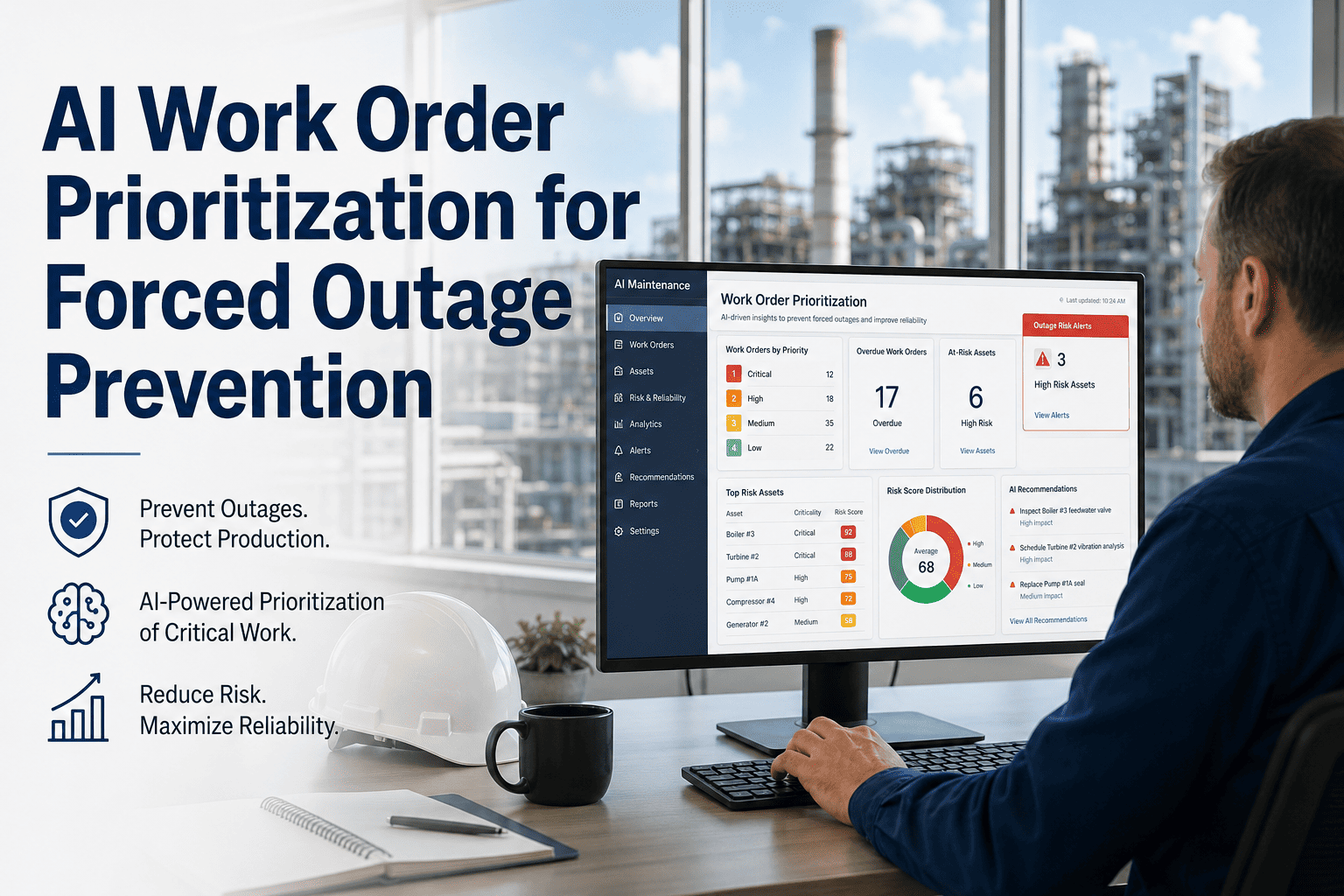
A forced outage at a 500 MW thermal unit costs between INR 1.2 crore and INR 4 crore per day in lost generation revenue — before fuel and restart costs are counted. The technical cause of the forced outage is almost always investigated thoroughly; the operational cause, which is frequently a collapse in work order prioritization during the first two hours of the event, rarely is. When a unit trips unexpectedly, 8 to 20 competing repair activities are identified within the first hour, and without a structured prioritization framework, the maintenance team works in order of loudness rather than order of criticality to return-to-service. Oxmaint's Work Order Management gives the maintenance supervisor a real-time prioritization view of every open outage task, sequenced by critical path impact on unit restoration, with parts availability and crew assignment visible on a single dashboard.
Forced Outage Response
Work Order Management
Power Plant CMMS
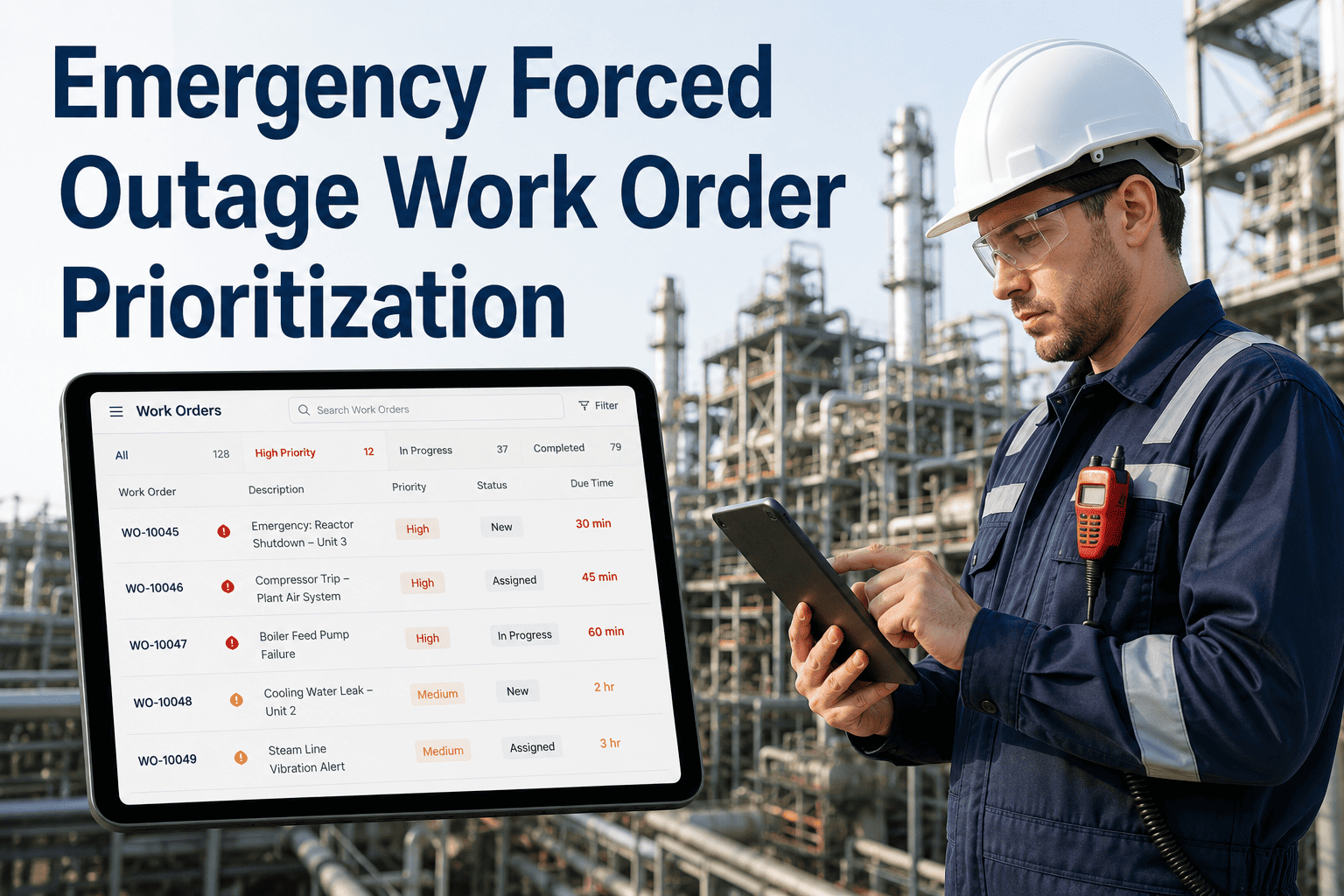
Emergency Forced Outage Work Order Prioritization
When a unit trips, every hour offline costs lakhs. Oxmaint sequences your outage work orders by critical path to restoration — so your crew works on what matters first, not what's loudest.
INR 1.2–4Cr
Lost generation revenue per day of forced outage at a 500 MW unit
2 hrs
Critical window for work order prioritization — decisions made here determine total outage duration
38%
Of forced outage duration attributed to crew coordination and task sequencing failures, not repair time
4.5 hrs
Average reduction in forced outage duration with structured CMMS work order prioritization
The Priority Problem
Why Forced Outage Repairs Run Longer Than They Should
Industry data from CERC and POSOCO performance reports consistently shows that mechanical and electrical availability of Indian thermal units is not the primary driver of extended forced outage duration — coordination and task management are. Three patterns explain most of the excess time.
!
Parallel Work Without Sequencing
Maintenance crews begin work in parallel on all identified defects — including secondary defects that were caused by the primary failure and will resolve themselves once the root cause is repaired. Labor is wasted on repairs that are not on the critical path to unit restoration.
?
Parts Availability Unknown at Job Start
Work orders are assigned without checking whether required parts are in stock. The technician travels to the storeroom, finds the part is not available, and the job stalls while procurement is contacted. In a forced outage, every storeroom trip that could have been predicted adds 30 to 90 minutes to the timeline.
X
Supervisor Visibility Lost Under Pressure
During a forced outage, the maintenance supervisor is typically on the phone, not at a dashboard. Status updates arrive verbally, by radio, or by text — creating a fragmented, delayed picture of what is actually done, in progress, or blocked. Priority shifts happen on gut feel rather than data.
Prioritization Framework
The Four-Layer Forced Outage Work Order Prioritization Logic
Oxmaint applies a structured prioritization model to every work order generated during a forced outage event. Supervisors see a ranked task list, not an undifferentiated queue — with the reason for each ranking visible, not just the priority number.
Layer 1
Return-to-Service Criticality
Is this work order on the critical path to unit synchronization? Work orders are tagged as critical-path, enabling, or parallel. Critical-path tasks — the primary fault repair and any prerequisites — are ranked first regardless of other factors. Enabling tasks, those that must be complete before the critical-path repair can begin, are ranked second. Parallel tasks that can be deferred to the next planned outage window are ranked last.
Highest weight in ranking
Layer 2
Parts Availability at Job Start
Before a work order reaches the technician's mobile device, Oxmaint checks parts availability against the asset BOM in inventory. Work orders where parts are confirmed available are ranked above structurally equivalent work orders where parts must be sourced — because parts-delayed work orders will stall regardless of crew readiness, while ready-to-execute work orders can proceed immediately.
High weight — prevents stall points
Layer 3
Crew and Skill Availability
Work orders are matched to available crew by skill requirement and current assignment status. Oxmaint shows the supervisor which technicians are available, which are mid-task, and which are idle. When a work order requires a specialist — a winder, an instrument tech, a rotating equipment specialist — the work order is only promoted in the ranking when that specialist is available, preventing assignment bottlenecks.
Prevents bottleneck assignment
Layer 4
Safety and Permit Requirements
Work orders requiring permits-to-work, LOTO isolation, or hot work permits are sequenced to account for permit approval time. Oxmaint flags permit requirements on work order creation and tracks permit status in the outage dashboard — so the supervisor can see which work orders are waiting on permit approval and chase the right person, rather than discovering the blockage when the crew arrives at the job.
Safety — non-negotiable sequencing
Outage Duration Data
Forced Outage Duration vs. Prioritization Method — Benchmark Data
Plants using structured CMMS-based work order prioritization during forced outages consistently show shorter restoration timelines compared to plants relying on verbal coordination or unstructured work order queues. The data below draws on operational benchmarks from Indian thermal and combined-cycle plants.
| Outage Scenario |
Without CMMS Prioritization |
With Oxmaint Prioritization |
Time Saved |
Revenue Impact at INR 25L/day |
| Boiler tube leak — single pass |
22–32 hours |
14–20 hours |
6–12 hours |
INR 6–12L saved per event |
| HP Turbine trip — governing valve |
8–16 hours |
5–10 hours |
3–6 hours |
INR 3–6L saved per event |
| Auxiliary transformer failure |
36–72 hours |
28–52 hours |
8–20 hours |
INR 8–20L saved per event |
| FD/ID fan bearing failure |
12–20 hours |
8–14 hours |
4–6 hours |
INR 4–6L saved per event |
| BFP mechanical seal failure |
10–18 hours |
7–12 hours |
3–6 hours |
INR 3–6L saved per event |
Every hour of forced outage has a price. Prioritize with precision.
Oxmaint's forced outage work order dashboard sequences every repair task by critical path impact, parts availability, and crew readiness — so your team restores generation in the minimum possible time.
Expert Review
What Plant Operations Directors Say About Outage Prioritization
In 20 years of managing thermal plant maintenance, the single most damaging thing I have seen during forced outages is not the fault itself — it is the 90 minutes that gets burned while the maintenance supervisor tries to figure out what to do first. By the time the team has decided, parts have been fetched from the wrong storeroom, three technicians are working on non-critical repairs, and the critical-path job is waiting on a permit that nobody has started. A CMMS that can show the prioritized task sequence, parts status, and crew assignment in a single view at the start of the outage changes the entire dynamic. Plants that deploy this capability consistently recover 4 to 8 hours per forced outage event compared to teams coordinating by phone and whiteboard.
Power Plant Operations Director
25+ years in Indian thermal power generation | 1,200 MW multi-unit plant operations
4–8 hrs
Average forced outage duration reduction with CMMS-based work order prioritization vs. verbal coordination
38%
Of forced outage excess duration attributed to task coordination failures, not repair time (EPRI Operations Study)
INR 10–25L
Estimated revenue recovered per event at a 500 MW plant from 4–8 hour restoration time improvement
FAQ
Frequently Asked Questions
How does Oxmaint identify which work orders are on the critical path during a forced outage?
Critical path identification in Oxmaint is based on two inputs: the maintenance supervisor's confirmation of the primary fault at outage declaration, and the equipment hierarchy dependencies pre-configured in the asset register. When an outage event is opened in Oxmaint, the supervisor confirms the primary fault cause, and the system automatically identifies upstream enabling tasks and downstream secondary faults based on the equipment dependency map. The supervisor can manually adjust critical-path flags if the fault diagnosis evolves during the outage.
Book a demo to see the outage event creation workflow and critical-path assignment in a live environment.
Can Oxmaint work order prioritization integrate with the plant's existing ERP or planning system?
Yes. Oxmaint integrates with SAP PM, Oracle, Maximo, and spreadsheet-based planning systems via REST API, CSV export/import, and direct database connectors where available. For plants with an existing ERP, Oxmaint can operate as the mobile field execution layer — receiving work orders from the ERP, capturing field data, and returning completion status — rather than replacing the planning system entirely. This preserves existing ERP investment while adding the real-time prioritization and mobile execution capability that desktop-only ERP systems cannot provide in a forced outage context.
Explore integration options in the Oxmaint platform.
How does Oxmaint handle spare parts availability checking during a forced outage when the storeroom may not be digitized?
Oxmaint's inventory module supports three levels of integration depending on the plant's storeroom digitization maturity. For fully digitized storerooms, parts availability is checked in real time against the Oxmaint inventory register. For partially digitized storerooms, critical spare parts can be pre-tagged in Oxmaint's BOM module, and storeroom staff can confirm availability via mobile before the technician travels. For plants with no digital storeroom system, Oxmaint generates a parts list from the work order BOM that the storeroom team can cross-check manually — still faster than the technician discovering a stockout at the storeroom counter.
Book a demo to see which inventory integration level fits your current storeroom setup.
Does Oxmaint support regulatory reporting requirements for forced outage events under CERC or state SLDC reporting?
Oxmaint captures the data required for CERC Appendix III and state-level SLDC forced outage reporting: event start time, unit affected, fault cause code, work orders completed, return-to-service time, and sequence of events log. This data is available as a structured report export immediately after outage closure — typically reducing the time to prepare a regulatory submission from 2 to 3 days to under 4 hours. Custom report templates for specific state utility formats are available on request.
Start free and configure your regulatory report template in the reporting module.
What happens to work orders that were in progress before the forced outage — are they paused automatically?
When a forced outage event is declared in Oxmaint, the supervisor has the option to place all non-outage-related in-progress work orders into a "suspended" status automatically. Suspended work orders retain all their progress data and can be resumed after unit restoration. This prevents outage-period work order status from being confused with normal operations work orders and ensures the outage dashboard shows only outage-relevant tasks. The forced outage event is tracked as a separate event container in Oxmaint's maintenance history, linked to all work orders completed during the event.
Book a demo to see the forced outage event management workflow.
Restore generation faster. Prioritize every outage task with data, not gut feel.
Oxmaint sequences forced outage work orders by critical path to restoration, parts availability, and crew readiness — giving your maintenance supervisor a clear action list in the first 10 minutes of every forced outage event.