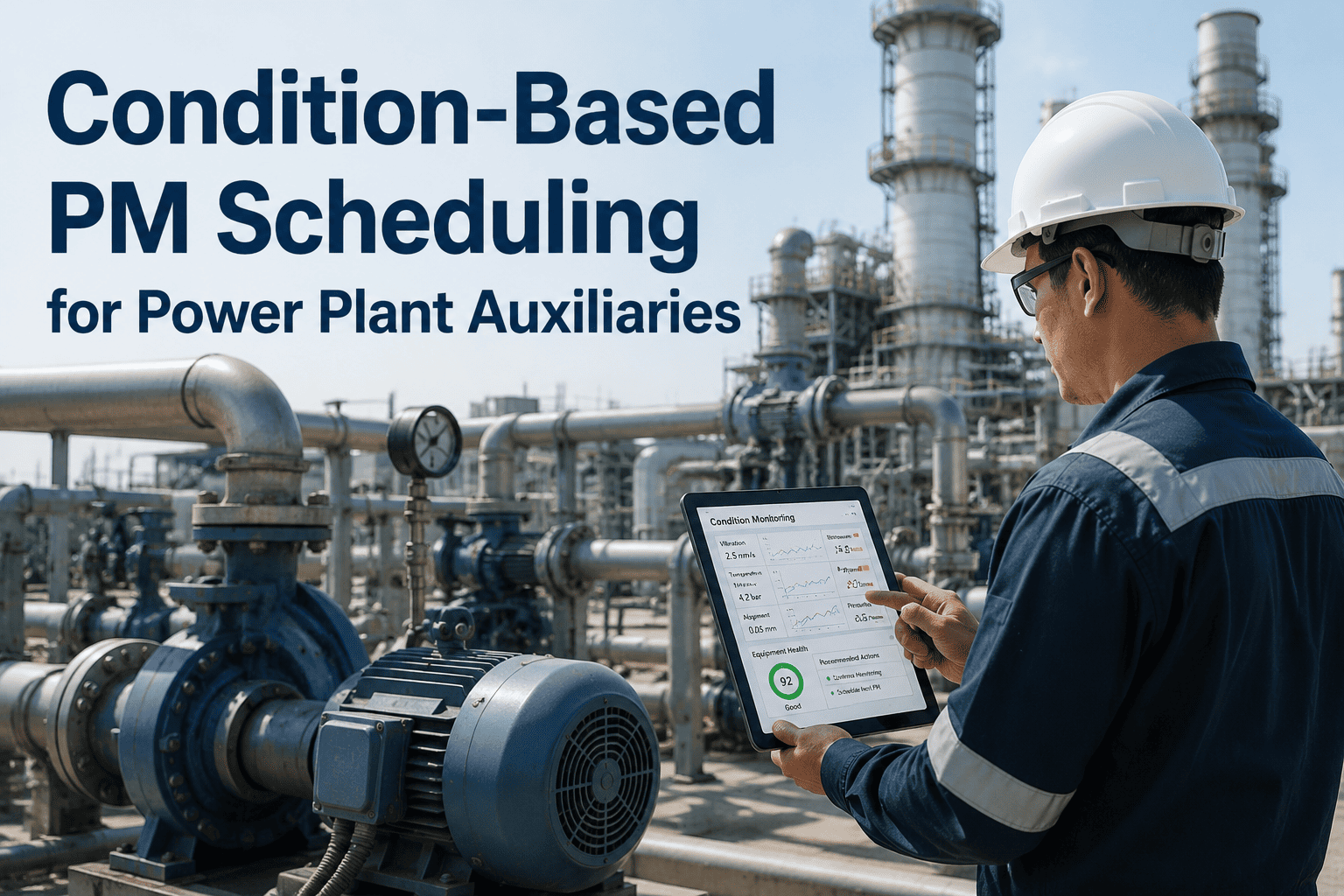
Pumps, fans, compressors, and gearboxes rarely fail on a fixed schedule — yet most plants still service them on one, replacing bearings that have years of life left while a vibrating motor two bays over runs straight to failure undetected. Condition-based PM scheduling flips that logic: maintenance is triggered by what the equipment is actually telling you — vibration, temperature, current draw — not by a calendar that treats every auxiliary the same. The result is fewer unnecessary teardowns and far fewer surprise failures on the assets that matter most. Sign up free on OxMaint to start scheduling PM by condition instead of the calendar.
PREVENTIVE MAINTENANCE · PM OPTIMIZATION · POWER PLANT AUXILIARIES
Condition-Based PM Scheduling for Power Plant Auxiliaries
Trigger maintenance from real sensor readings — vibration, temperature, current draw — instead of fixed calendar intervals that waste labor on healthy equipment and miss failing equipment in between.
30-40%
reduction in unnecessary PM labor when auxiliaries move from time-based to condition-based scheduling
2-3x
more advance warning on bearing and seal failures compared to fixed-interval inspection alone
70%
of rotating equipment failures show a detectable condition signal weeks before breakdown
Where Condition-Based PM Sits on the Maintenance Spectrum
Most plants run a mix of all three strategies — the goal isn't to eliminate time-based PM everywhere, it's to apply condition-based triggers to the auxiliaries where unplanned failure carries the highest cost.
Reactive
Run to failure
No scheduled intervention. Repair happens after breakdown — highest cost, no warning.
Time-Based
Fixed calendar interval
Service every 30, 60, or 90 days regardless of actual equipment condition.
Condition-Based
Triggered by sensor data
Work order generated when vibration, temperature, or current crosses a defined threshold.
How a Condition-Based Trigger Works
The logic is simple, but the value comes from acting on it consistently — every reading checked against a threshold, every threshold breach turned into a work order automatically.
1
Sensor or manual reading logged against the asset
→
2
Reading compared to warning and critical thresholds
→
3
Threshold breach auto-generates a prioritized work order
SENSOR-TRIGGERED WORK ORDERS · CONDITION MONITORING · CMMS
Let Equipment Condition Set the PM Schedule
OxMaint logs condition readings against every auxiliary asset and auto-generates work orders the moment a threshold is crossed — no manual review, no missed warning signs.
Auxiliary Equipment Best Suited to Condition-Based PM
Not every asset needs a sensor program. These auxiliaries see the highest return because their failure modes show clear, measurable warning signs before breakdown.
Pumps
Vibration, seal temperature, flow rate
Fans & Blowers
Bearing vibration, motor current, airflow
Compressors
Discharge temperature, vibration, oil analysis
Gearboxes
Oil condition, vibration, operating temperature
Motors
Current draw, winding temperature, vibration
Cooling Tower Fans
Vibration, belt tension, bearing temperature
Cost Impact by Maintenance Strategy
The cost gap between strategies widens fast once a failure escalates from a flagged condition to an unplanned outage.
Expert Perspective
RV
R. Velez — Reliability Engineering Manager
14 years, condition monitoring programs for rotating auxiliary equipment
The mistake most plants make is trying to put every pump and fan on a full sensor program at once. Start with the auxiliaries where failure actually hurts — the ones feeding critical loads or with long lead-time spare parts — and prove the threshold logic there before expanding.
SH
S. Huang — Maintenance Strategy Consultant
PM optimization and CMMS threshold configuration
Condition-based PM only works if the threshold breach actually creates a work order automatically. I have seen plants collect vibration data for years that nobody acted on because the alert lived in a spreadsheet instead of the maintenance system. The data has to trigger action, not just sit in a report.
Frequently Asked Questions
What's the difference between condition-based and predictive maintenance?
Condition-based PM triggers a work order once a reading crosses a defined threshold — it reacts to a current state. Predictive maintenance goes further, using trend data to forecast when a threshold will be crossed in the future. Most plants start with condition-based triggers before adding predictive trending.
Sign up free on OxMaint to set up threshold-based work orders first.
Do we need IoT sensors to run a condition-based PM program?
No. Many plants start with manual readings — handheld vibration meters or temperature guns logged during rounds — checked against the same thresholds an automated sensor would use. Continuous sensors add speed and consistency later, but the work order logic works the same either way.
How do we decide which auxiliaries should move to condition-based scheduling first?
Prioritize equipment where unplanned failure has the highest consequence — critical-load pumps, long lead-time gearboxes, or assets with a history of repeat failures. Lower-criticality auxiliaries can often stay on time-based PM without much added risk.
Can condition-based thresholds be set differently for each piece of equipment?
Yes, and they should be. A threshold appropriate for a small cooling fan motor will be too sensitive or too loose for a large feedwater pump. Thresholds should be set per asset class based on manufacturer specs and historical failure data.
Book a demo to see how OxMaint configures asset-specific thresholds.
CONDITION-BASED PM · THRESHOLD ALERTS · POWER PLANT AUXILIARIES
Move Your Auxiliaries to Condition-Based Scheduling
Set thresholds once, log readings from the field or sensors, and let OxMaint generate the right work order at the right time — before a reading turns into a failure.