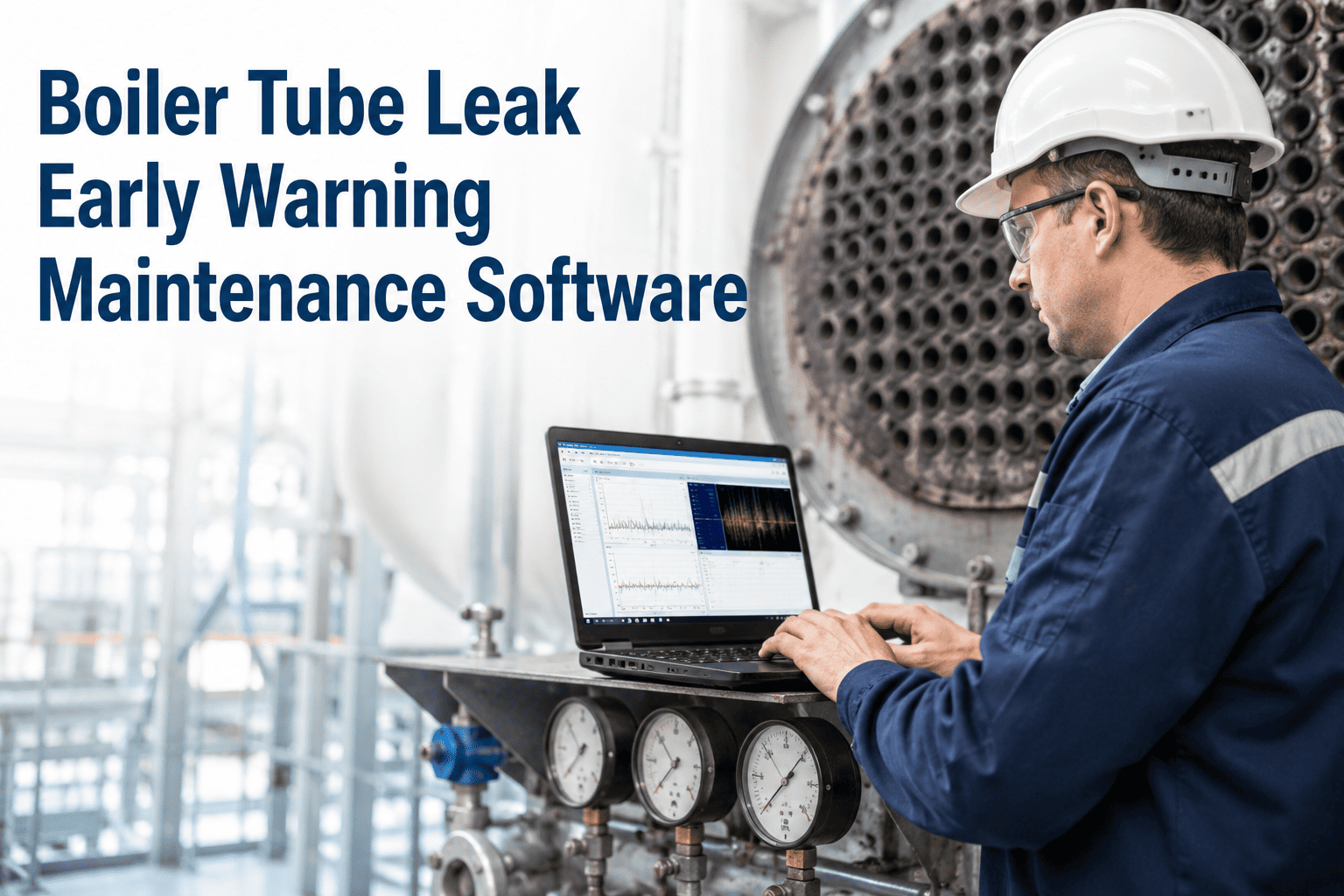
Boiler Tube Leak Early Warning Maintenance Software

By Johnson on June 18, 2026

boiler-tube-leak-early-warning-maintenance-software

Boiler tube failures are the single largest cause of forced outages at thermal power plants — and the damage they cause escalates dramatically with every hour a leak goes undetected. An undetected tube leak causes hydrogen embrittlement in adjacent tubes, progressive tube cracking, damage to neighboring circuits, and in severe cases complete asset failure requiring weeks of repair and millions in replacement costs. The challenge is that tube leaks in their early stage are invisible to plant operators: no audible steam, no pressure alarm, no SCADA indication — only subtle shifts in feedwater flow, flue gas chemistry, and acoustic emission signatures that only AI-connected monitoring can detect. OxMaint's predictive maintenance software integrates with boiler tube monitoring systems to convert early-stage leak signals into structured, assigned maintenance work orders — ensuring that what the sensors detect today becomes the inspection your team performs tomorrow, not the emergency shutdown your plant suffers next week. Book a demo to see how OxMaint connects your boiler monitoring data to a complete maintenance response workflow.

Boiler Reliability · Predictive Maintenance · Early Warning

Boiler Tube Leak Early Warning Maintenance Software

From acoustic emission signal to closed maintenance work order — OxMaint connects your tube leak monitoring to a maintenance response that happens in hours, not days.

Why Early Detection Matters

Acoustic systems detect leaks within minutes — vs. 72+ hours for traditional makeup water monitoring

Boiler tube failures are the leading cause of downtime for steam power plants globally (MISTRAS)

27% of predictive maintenance adopters recover full system cost within one year through prevented outages
Failure Mechanisms

6 Boiler Tube Failure Mechanisms and Their Early Signatures

Each failure mode produces detectable signals before the tube perforates. OxMaint's monitoring integration catches these signals and generates a maintenance response before visible damage occurs.

01
Long-Term Overheating
Early signal: flue gas temperature deviation, steam temperature trending above design
OxMaint alert: Thermal performance drop flag + inspection work order
02
Short-Term Overheating
Early signal: Sudden tube temperature spike correlated with flow restriction event
OxMaint alert: Rate-of-change alert + emergency inspection trigger
03
Corrosion (Water-Side)
Early signal: Water chemistry excursion — pH deviation, oxygen content, iron levels
OxMaint alert: Chemistry trending alert linked to tube inspection schedule
04
Erosion (Gas-Side)
Early signal: Wall thickness reduction on ultrasonic spot checks at high-velocity zones
OxMaint alert: UT reading below minimum threshold triggers replacement planning
05
Hydrogen Damage
Early signal: Feed chemistry upset combined with acoustic emission on waterwall zone
OxMaint alert: Correlated chemistry + acoustic alert with escalation to senior engineer
06
Fatigue Cracking
Early signal: Acoustic emission at tube bends and weld locations during load cycling
OxMaint alert: AE threshold breach + NDT inspection work order at flagged location
Detection Methods

Early Warning Technology Comparison: Which Method Detects What

Detection Method What It Detects Lead Time Accuracy OxMaint Integration
Acoustic Emission (AE) Active leaks, crack propagation, hydrogen damage Minutes from initiation High — detects perforations measured in thousandths of an inch Real-time API / OPC-UA alert to work order
Ultrasonic Thickness (UT) Wall thinning from erosion and corrosion Weeks to months Very high — measures remaining wall to 0.1 mm UT readings imported to OxMaint asset record; trending alert on minimum wall approach
Water Chemistry Monitoring Corrosion precursors, dissolved oxygen excursions, pH drift Days to weeks ahead of tube damage Medium — correlated with tube location data for actionable insight Chemistry parameter trending; excursion alert triggers inspection work order
Thermal Imaging (IR) Hot spots, flow blockage, scale deposits on tube surface Hours to days High for surface defects; limited for internal wall condition IR scan results logged in OxMaint inspection records; anomalies trigger follow-up UT
Makewater Flow Trending Active leaks of measurable volume 72+ hours after leak initiation Low — detects only established leaks, not incipient ones SCADA flow data ingested; baseline deviation triggers AE verification workflow
OxMaint Boiler Monitoring

Connect Your Boiler Monitoring to Automated Maintenance Response

Book a 30-minute demo and we will show you how OxMaint converts AE alerts, UT readings, and chemistry excursions into structured work orders — with zero manual steps between the sensor and the technician.

BTFR Program

Boiler Tube Failure Reduction (BTFR) Program: OxMaint Framework

The best-performing utilities reduce tube failure frequency by combining detection technology with root cause analysis and aggressive tube circuit tracking. OxMaint supports all four pillars of a BTFR program.

01
Continuous Monitoring Integration
AE, UT, water chemistry, and flue gas sensors all connected to OxMaint. Every signal produces a traceable asset event — not just a notification that expires unread in a shared inbox.
02
Root Cause Documentation
Every tube repair work order requires a failure mode classification before closure. OxMaint accumulates a failure database per circuit and boiler zone — identifying repeat failure locations automatically.
03
Tube Circuit Risk Register
OxMaint maintains a risk score per tube circuit based on failure history, current UT readings, and operating hours since last inspection — enabling risk-ranked inspection scheduling across your boiler inventory.
04
Outage Scope Planning
Circuits reaching minimum UT thresholds or repeat failure trigger an outage planning flag — ensuring tube replacement scope is built into the upcoming outage work package before the outage window opens.
Expert Review

What Boiler Maintenance Engineers Say


The most preventable boiler tube failures I encounter are not ones where the monitoring system missed anything — they are cases where the monitoring system alerted correctly and nothing happened. The alert went to a general alarm screen, the operator acknowledged it and moved on, and four hours later the tube perforated. Early warning technology only prevents outages when it is connected to a maintenance response process. When an AE alert automatically creates a work order with location data, inspection scope, and assigned technician, the response happens consistently regardless of shift, staffing level, or operator attention load. That is the fundamental value of connecting boiler monitoring to a CMMS. Water chemistry excursions deserve equal attention: connecting chemistry monitoring to your maintenance system — so that a pH excursion or oxygen spike triggers an inspection recommendation the same day — creates an earlier warning layer than any physical sensor alone can provide.

Senior Boiler Reliability Engineer
19 years in thermal power plant maintenance, boiler tube failure analysis, and BTFR program development at coal, gas, and combined-cycle generating facilities
FAQs

Frequently Asked Questions

Which boiler tube monitoring systems does OxMaint integrate with?
OxMaint integrates with MISTRAS AE monitoring systems, Vaisala water chemistry monitors, OSIsoft PI and similar plant historians for flue gas and thermal data, and any monitoring platform that provides an OPC-UA or REST API output. Ultrasonic thickness measurements from periodic NDT inspections can be imported via structured CSV or entered directly by field technicians through the OxMaint mobile app. All readings are stored in the tube circuit asset record with full trend history. Confirm integration compatibility for your specific monitoring hardware in a live demo.
How does OxMaint handle the high volume of acoustic emission alerts, including false positives during soot blower operation?
OxMaint's alert processing includes configurable suppression windows for known high-noise events — including soot blower operation cycles and load change transients — so the platform does not generate work orders during periods when acoustic background levels are elevated by routine plant operations. Alert thresholds are set per tube circuit zone rather than plant-wide, enabling different sensitivity levels for high-risk zones like superheaters and high-velocity erosion areas. Work orders are only generated when anomalous signals are detected outside suppression windows and above zone-specific thresholds. Configure zone-specific alert thresholds in a free trial environment.
Can OxMaint track tube circuit replacement history and flag circuits with repeat failures?
Yes — OxMaint maintains a complete repair and replacement history for each tube circuit, indexed by boiler zone, circuit designation, and tube row. When a circuit records two or more failures within 24 months, OxMaint automatically generates a chronic failure flag and creates a root cause investigation work order. This prevents the common pattern of repeatedly patching the same circuit without addressing the underlying failure mechanism — whether that is flow restriction, chemistry excursion, or local overheating. See the tube circuit history and chronic failure detection in a 30-minute demo.
How does OxMaint support boiler tube outage scope planning before a shutdown window opens?
OxMaint's outage planning module displays all boiler tube circuits that have breached UT minimum thresholds, exceeded repair frequency limits, or have open alert-triggered work orders — presenting them as a pre-built inspection and replacement scope for the upcoming outage. Maintenance planners can review the list, attach the relevant tube specifications and procurement requirements, and convert the risk list into a fully resourced outage work package before the shutdown window opens. This eliminates scope discovery during disassembly, which is the primary driver of unplanned outage extensions. Explore the outage planning module in a free trial.
Is OxMaint suitable for HRSG boilers in combined-cycle plants as well as traditional fired boilers?
Yes — OxMaint supports both fired boiler and HRSG configurations. HRSG-specific monitoring includes HP, IP, and LP circuit tracking, duct burner temperature trending, stack bypass monitoring, and flow-accelerated corrosion risk tracking at high-velocity bends and transition zones. The platform's asset register supports multi-pressure-level HRSG configurations, and all monitoring integrations work identically for gas-fired HRSGs as for coal and biomass boilers. Discuss your specific HRSG or fired boiler configuration in a live demo.
Boiler Tube Early Warning · OxMaint · Predictive Maintenance

Detect Leaks in Minutes — Not After the Forced Outage

OxMaint connects your boiler tube monitoring to a structured maintenance response — so every early warning signal becomes a planned inspection, and every repeat failure location gets investigated rather than patched again.



Share This Story, Choose Your Platform!