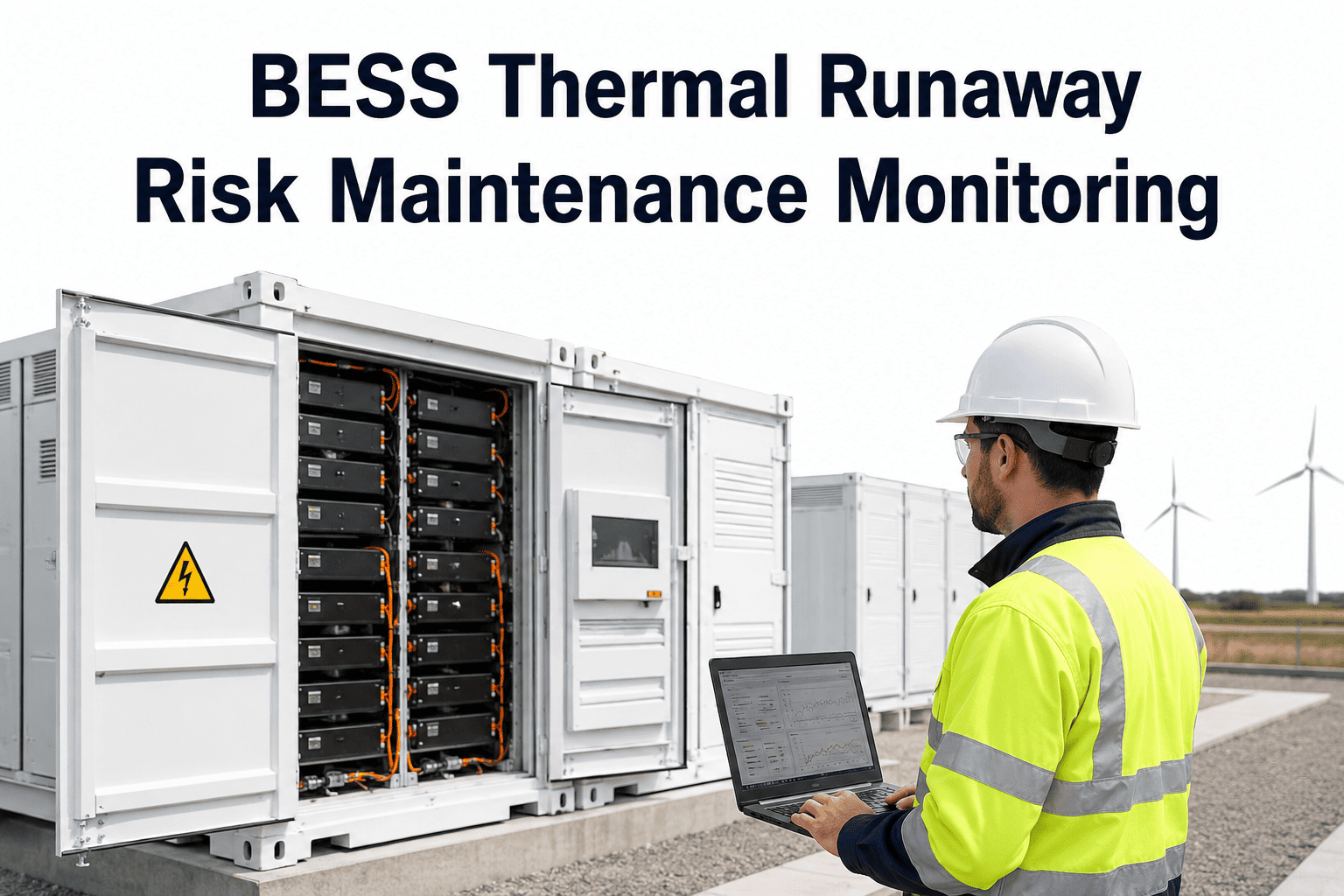
Between 2018 and 2023, more than 60 large-scale battery storage fires occurred worldwide, causing over $300 million in damage. The January 2025 Moss Landing incident — where a thermal runaway event forced the evacuation of 1,500 residents and the fire was left to burn out due to explosion risk — made clear that thermal runaway in battery energy storage systems is not a theoretical concern: it is an operational and community safety risk at every utility-scale BESS facility. A 2025 industry survey found that 54% of businesses had already experienced a lithium-ion battery incident including overheating, smoke, or fire. The gap between a safe system and a catastrophic one is almost always a monitoring gap — not a design gap. Start free on OxMaint to configure continuous thermal and electrical monitoring on your BESS assets, or book a demo to see how condition-based work orders are structured for battery storage facilities.
PREDICTIVE MAINTENANCE · BATTERY STORAGE
BESS Thermal Runaway Risk Maintenance Monitoring
Thermal runaway does not start as a catastrophe. It starts as a data point no one was watching. Here is the monitoring framework that changes that.
60+
Large-scale BESS fires globally between 2018–2023
$300M+
Total damage from battery storage fires in that period
54%
Businesses that experienced a lithium-ion incident in 2025 survey
THE MECHANISM
How Thermal Runaway Develops — and Where It Can Be Stopped
Thermal runaway is a self-accelerating chain reaction. Once initiated, the process is nearly impossible to arrest without dedicated suppression systems. But the conditions that trigger it — cell overheating, electrical abuse, separator degradation — develop slowly and generate measurable signals well before the chain reaction begins. Every stage before ignition is a monitoring and intervention opportunity.
1
Thermal Stress
Cell temperature rises above safe operating range — from overcharge, high ambient temperature, or cooling system degradation. Heat dissipation can no longer keep pace with generation.
→
2
Separator Failure
The porous membrane separating anode and cathode degrades. Internal short circuits begin. Exothermic reactions accelerate, generating both heat and flammable gas.
→
3
Gas Venting
Combustible gases including hydrogen, methane, and CO vent from the cell. In enclosed battery enclosures, gas concentration can quickly reach the lower flammability limit — creating explosion risk.
→
4
Propagation
The thermal runaway event spreads to adjacent cells. A single failing cell can cascade through a rack, a module, and an entire enclosure — triggering the fire or explosion scenario that suppression systems are designed to address.
Monitor the Warning Signs Before the Chain Reaction Starts
OxMaint tracks cell temperature, state of charge deviation, and BMS fault history as continuous condition indicators — and converts anomalies into work orders before Stage 1 becomes Stage 4.
MONITORING PARAMETERS
Key Signals for BESS Thermal Risk — What to Track and Why
| Parameter |
Risk Indicated |
Threshold Alert |
Maintenance Response |
| Cell / Module Temperature |
Thermal stress initiation, cooling failure |
Above 45°C at module level |
Inspect cooling system, reduce charge rate |
| Cell Voltage Deviation |
Internal imbalance, early short circuit |
Delta > 50 mV within a string |
Isolation and cell-level inspection |
| State of Charge Drift |
BMS calibration error, capacity fade |
Consistent overestimation trend |
BMS recalibration, capacity retest |
| Combustible Gas Detection |
Early venting, separator compromise |
Any positive reading |
Immediate isolation, ventilation, inspection |
| HVAC / Cooling Performance |
Ambient control degradation |
Enclosure delta-T rising trend |
Filter cleaning, compressor inspection |
| BMS Fault Frequency |
Cumulative stress on control electronics |
Increasing fault rate week-on-week |
BMS firmware check, hardware inspection |
REACTIVE VS PROACTIVE
What Changes When BESS Monitoring Is Continuous and Condition-Based
Without Continuous Monitoring
Thermal anomalies are only discovered during scheduled inspections — weeks or months after they begin
BMS fault logs are reviewed reactively after a trip or alarm, not as a leading indicator
Cell voltage imbalance accumulates unchecked between manual battery health checks
A cooling system degrading at 10% efficiency per month goes undetected until failure
With OxMaint Condition Monitoring
Temperature and voltage anomalies trigger work orders within hours of threshold breach
BMS fault frequency is trended as a leading indicator — increasing fault rate generates an alert before a trip occurs
Cell voltage deviations above configured limits are flagged at the module level with isolation recommendations
Cooling efficiency trends surface weeks before the system fails to maintain safe enclosure temperature
EXPERT REVIEW
James Okafor
BESS Safety & Reliability Engineer — Grid Storage, 14 Years
Moss Landing changed the conversation in this industry. Operators who were managing BESS purely through BMS alarms and annual inspections suddenly had to explain their monitoring approach to regulators, insurers, and local communities. The answer most of them had was not good enough. What we know from the incidents that have been studied is that thermal runaway is almost never a surprise to the data — it is a surprise to the team, because no one had a system that connected the cell-level temperature trend to a maintenance action before the chain reaction began. That is the gap continuous condition monitoring closes.
FREQUENTLY ASKED
BESS Thermal Runaway Monitoring — Common Questions
How does OxMaint connect BESS sensor data to a maintenance work order?
When any configured parameter — cell temperature, voltage deviation, BMS fault rate, or gas sensor reading — crosses a set threshold, OxMaint generates a work order with the signal context attached. Technicians receive the alert with the affected asset, the parameter in breach, and the recommended response scope — without needing to manually review BMS dashboards.
Start free to configure your first BESS threshold alert.
Can OxMaint monitor multiple BESS enclosures across a grid-scale storage facility?
Yes. OxMaint supports multi-asset and multi-site configurations, so a facility operating dozens of containerized BESS units can monitor all of them in a single asset health view. Alerts from any enclosure roll up to a portfolio-level dashboard, and maintenance teams can see which units are trending toward a threshold breach across the entire site at a glance.
Book a demo to scope your facility configuration.
What role does BMS fault history play in predictive maintenance for BESS?
BMS fault logs are one of the strongest leading indicators for thermal risk. A cell that faults once and recovers may be within normal operating tolerance. A cell with an increasing fault frequency over weeks is telling you something different. OxMaint trends BMS fault rate per unit over time, flagging the pattern of increasing faults as a maintenance trigger long before the fault severity escalates.
Start free to begin trending your BMS data.
How does this approach complement the fire suppression systems already in place?
Fire suppression is a last-resort response to thermal runaway that has already begun. OxMaint operates in the layer before that — tracking the conditions that precede thermal runaway so intervention happens before suppression is needed. The two systems address different parts of the risk: suppression handles the event; continuous condition monitoring is designed to prevent the event from initiating.
Book a demo to understand how the layers work together.
How quickly can BESS assets be onboarded into OxMaint for condition tracking?
Most BESS facilities can complete initial asset setup within the first week, importing enclosure details, BMS data feeds, and existing inspection records. Monitoring thresholds are configured per battery chemistry — LFP, NMC, or NCA — because safe temperature limits and fault tolerances vary by cell type.
Start free to create your first BESS asset record.
OXMAINT · BATTERY STORAGE SAFETY
Thermal Runaway Has a Warning Period. Use It.
OxMaint converts BESS sensor data into condition-based work orders at Stage 1 — so your team intervenes before the chain reaction begins, not after it is already underway.