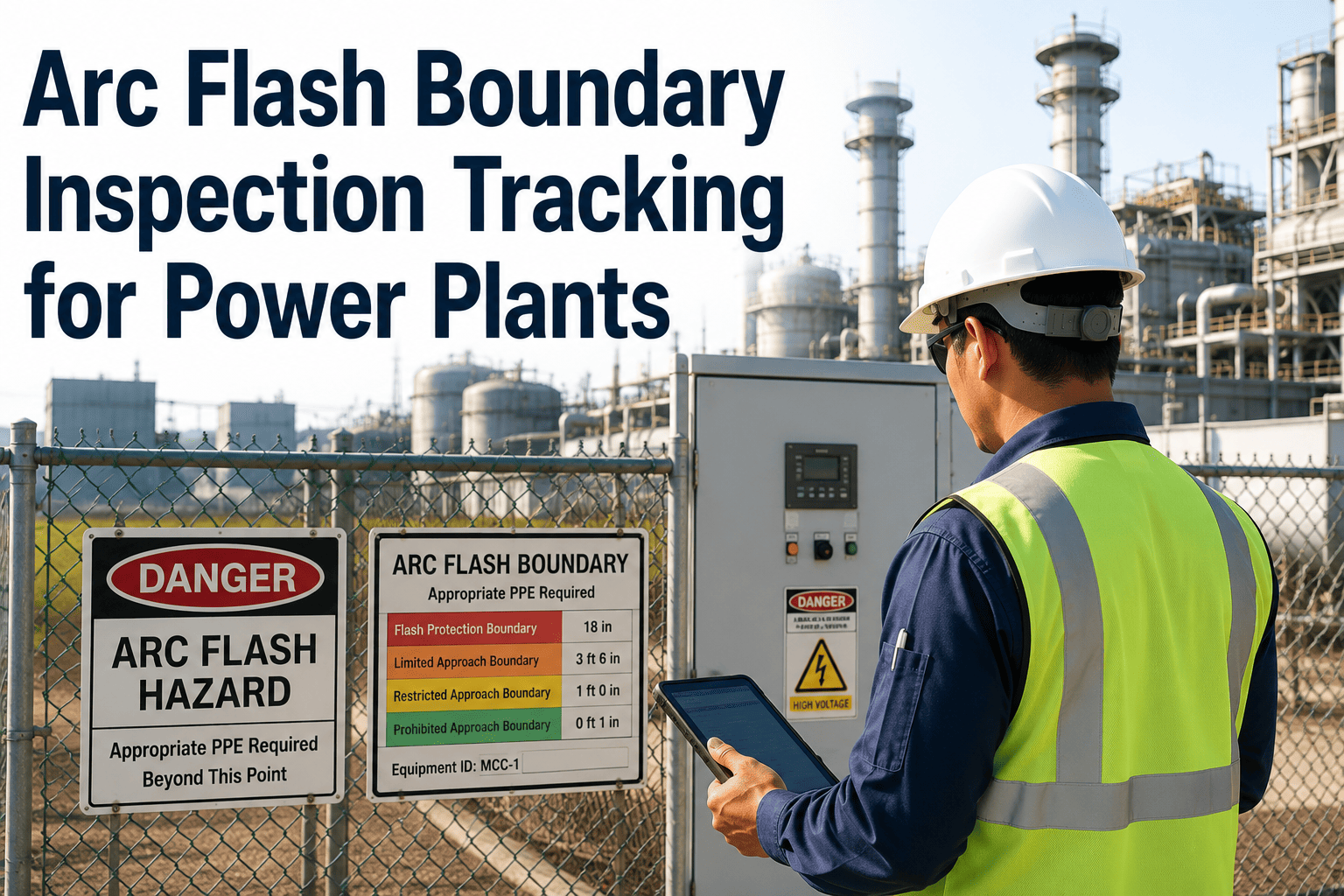
Arc flash events in power plant electrical systems release energy measured in calories per square centimetre — at the boundary where a worker stands, the difference between a correctly identified 1.2 cal/cm² incident energy and a miscalculated 8 cal/cm² exposure is the difference between standard FR clothing and a Category 3 PPE suit. When arc flash hazard labels are missing, outdated, or unenforced, that miscalculation happens in the field. Electrical workers have died in power plant arc flash incidents that would have been survivable with correct boundary enforcement and PPE selection. OxMaint's Inspection Management module digitises arc flash boundary inspection tracking — ensuring every electrical panel, switchgear bay, and MCC is labelled, that labels match the current arc flash study, and that inspections are scheduled, completed, and documented on a defensible cycle. Learn how structured inspection management closes the gap between your arc flash study and your workers' daily PPE decisions in the field.
Electrical Safety · Inspection Management
Arc Flash Boundary Inspection Tracking for Power Plants
Digitise your arc flash boundary inspection program — scheduled label verification inspections, boundary measurement confirmations, PPE compliance checks, and study update tracking — all connected to work orders and documented for NFPA 70E and OSHA 1910.269 audit evidence.
Arc Flash in Power Generation — The Numbers
5–10
arc flash incidents per day in US electrical workplaces (ESFI)
2,000°C
plasma temperature at an arc fault — 4× the surface temperature of the sun
40%
of electrical fatalities involve arc flash rather than direct electrical contact
NFPA 70E
requires documented arc flash risk assessment for every energised electrical work task
What Arc Flash Boundary Inspection Actually Covers
Arc flash boundary inspection is not a single check — it is a structured program that verifies multiple interdependent elements across every energised electrical asset in the plant. Missing any element creates a gap between the arc flash study on paper and the protection that workers receive in the field.
Label Integrity Inspections
Arc flash label present and legible on every panel, MCC, and switchgear bay per NFPA 70E 130.5(H)
Label incident energy value matches current arc flash study — study date and revision on label confirmed
Label PPE category matches incident energy per current NFPA 70E Table 130.5(G)
Restricted approach boundary and limited approach boundary values displayed on label
Boundary Enforcement Verification
Physical boundary markings — floor markings, rope barriers, or permanent demarcation — present and undamaged
Warning signs posted at entry points to areas containing equipment with incident energy greater than 40 cal/cm²
Locked or access-controlled entry to high-energy zones (above 40 cal/cm²) confirmed functional
Approach boundary calculation verified against current single-line diagram and fault current values
System Change Compliance
Upstream protective device settings verified against assumptions used in arc flash study calculations
New equipment additions since last study identified and flagged for study update requirement
Breaker coordination changes or protective relay updates that affect incident energy levels recorded
Utility fault current level updates confirmed — utility impedance changes directly affect calculated incident energy
How OxMaint Structures Arc Flash Inspection Workflows
OxMaint translates the NFPA 70E and OSHA 1910.269 arc flash inspection requirements into structured, schedulable, documented inspection workflows — linked to specific assets, generating compliance evidence automatically from normal inspection workflow completion.
1
Asset Registry with Arc Flash Data Fields
Every electrical asset in OxMaint carries dedicated arc flash data fields — incident energy (cal/cm²), PPE category, restricted approach boundary, limited approach boundary, working distance, arc flash study date and revision, and label condition. These fields are inspectable, updateable from work orders, and reportable. When your arc flash study is revised, the updated values are distributed across all affected asset records in OxMaint — eliminating the label-data gap.
2
Scheduled Inspection Work Orders by Asset Class
OxMaint generates inspection work orders on a defined schedule for each electrical asset class — quarterly label integrity checks for MCCs, annual boundary verification for high-voltage switchgear, post-modification inspections whenever a protective device setting changes. Schedules are configured once and run automatically, ensuring no inspection cycle is missed due to planning oversight.
3
Digital Inspection Checklists with Pass/Fail Capture
Each arc flash inspection work order in OxMaint includes a digital checklist aligned to NFPA 70E requirements — label present, label legible, incident energy matches study, boundary markings intact, PPE category current. Technicians complete the checklist on mobile, with photo attachment capability for label condition documentation. Pass/fail data is structured and queryable — not buried in PDF attachments or free-text notes.
4
Deficiency Work Order Generation
When an inspection identifies a deficiency — missing label, damaged boundary marking, incident energy mismatch — OxMaint automatically generates a corrective work order linked to the inspection finding. The deficiency work order includes the specific finding, the asset and location, the required correction, and a target completion date based on severity. Electrical safety deficiencies are never left as inspection notes — they become tracked, assigned work orders until resolved.
5
Compliance Evidence Package for Audits
OxMaint generates exportable arc flash inspection compliance reports — all inspection work orders completed in a date range, pass/fail results per asset, deficiencies found and corrective work orders closed, and outstanding items with current status. This package is the documentary evidence that demonstrates a systematic arc flash inspection program to OSHA, state regulatory inspectors, and insurance auditors. It is generated in minutes, not assembled over days from scattered records.
Build an Arc Flash Inspection Program That Satisfies NFPA 70E and OSHA Auditors
OxMaint structures arc flash boundary inspections as scheduled, digital, documented workflows — with automatic deficiency tracking and compliance report generation. Stop relying on paper logbooks to demonstrate electrical safety compliance.
Arc Flash Inspection Frequency by Equipment Class
NFPA 70E does not mandate a single inspection frequency for arc flash labels and boundaries — it requires inspections to be performed "at intervals not to exceed five years" for the arc flash study itself, with label inspections tied to normal equipment maintenance cycles. Best practice in power generation establishes equipment-class-specific frequencies based on operational exposure and incident energy levels.
Scroll right on mobile to view full table
| Equipment Class |
Typical Incident Energy Range |
Recommended Label Inspection Frequency |
Boundary Verification Trigger |
Study Update Requirement |
| Generator Step-Up & Unit Transformers |
40–100+ cal/cm² |
Annual |
Any protective relay setting change or utility fault current update |
Every 5 years or after system modification |
| High-Voltage Switchgear (13.8 kV–115 kV) |
20–80 cal/cm² |
Annual |
After breaker maintenance, relay coordination review, or bus tie configuration change |
Every 5 years or after feeder addition/deletion |
| Medium-Voltage MCC / Bus (4.16 kV–6.9 kV) |
8–40 cal/cm² |
Semi-annual |
After motor or load additions to bus section |
Every 5 years or after load reconfiguration |
| Low-Voltage Switchgear (480V–600V) |
1.2–20 cal/cm² |
Quarterly (high-traffic panels), Semi-annual (others) |
After breaker replacement or upstream setting change |
Every 5 years |
| Motor Control Centres (LV) |
1.2–8 cal/cm² |
Quarterly |
After bucket replacement or MCC reconfiguration |
Every 5 years |
| DC Systems & Battery Chargers |
1.2–5 cal/cm² |
Semi-annual |
After battery bank replacement or charger upgrade |
Every 5 years or after significant capacity change |
Frequently Asked Questions
Does OxMaint include the arc flash incident energy calculation — or does it only track the inspection of existing labels?
OxMaint tracks and manages arc flash inspection data — it is not an arc flash calculation software. The incident energy values and boundary distances that feed into OxMaint are generated by a dedicated arc flash study tool (such as ETAP, SKM, or EasyPower) by a qualified electrical engineer. OxMaint then stores those study-derived values against each asset, schedules and documents the label and boundary inspections, and tracks the study date for renewal reminders. When the study is revised, OxMaint is updated with the new values — ensuring the inspection program reflects the current study rather than a superseded one.
Sign in to configure your arc flash asset data fields.
How does OxMaint handle arc flash inspection requirements after a major electrical system modification?
When a modification work order in OxMaint affects electrical equipment — such as a breaker replacement, protective relay upgrade, or load addition to a bus section — the work order can trigger a post-modification arc flash inspection requirement against affected assets. The modification work order links to the inspection requirement, creating a documented chain: modification performed, arc flash study review required, label inspection completed, new values updated. This chain is the evidence that demonstrates your arc flash program responds appropriately to system changes, which is a specific NFPA 70E requirement.
Book a demo to see how modification-triggered inspections work.
Can OxMaint track arc flash PPE compliance at the work order level — verifying that workers selected the correct PPE before starting energised work?
Yes — OxMaint work orders for energised electrical tasks can include a pre-task PPE verification checklist that the technician completes before beginning work. The checklist specifies the required PPE category for the specific asset (pulled from the asset's arc flash data fields), and the technician confirms selection of each required item — arc-rated clothing, face shield rating, gloves, footwear. This pre-task record is timestamped against the work order and retained as evidence that PPE requirements were communicated and acknowledged before the work began — which is a specific OSHA 1910.269 and NFPA 70E documentation requirement for energised electrical work.
How does OxMaint differentiate between arc flash inspections that can be done with equipment energised versus those requiring shutdown?
Arc flash label integrity inspections — visual verification that labels are present, legible, and current — are typically performed with equipment energised during normal operation. OxMaint classifies these as energised inspection tasks, which include the appropriate PPE requirements and boundary observance notes in the work order. Physical boundary verification inspections that require approach to or entry into restricted approach boundaries are classified as restricted access tasks requiring an energised electrical work permit. OxMaint's permit-to-work integration ensures that inspection work orders crossing boundary thresholds trigger the appropriate permit workflow before the technician begins.
Sign in to configure energised work classifications in OxMaint.
What documentation does OxMaint generate to satisfy OSHA 1910.269 arc flash requirements during an OSHA inspection?
OSHA 1910.269 requires employers to perform an arc flash risk assessment and implement exposure controls. During an OSHA inspection, the compliance officer typically asks to see: the arc flash study and its currency, evidence that labels are maintained and current, records of energised electrical work performed and PPE used, and evidence that workers received arc flash safety training. OxMaint contributes to each of these areas — inspection records demonstrate label maintenance, work order PPE checklists demonstrate field PPE compliance, and the asset data fields show study date and revision. Combined with your arc flash study document, OxMaint's records constitute a defensible OSHA compliance package.
Book a demo to review OxMaint's compliance documentation output.
Every Arc Flash Boundary. Every Inspection. Every Deficiency. Tracked and Documented.
OxMaint converts your arc flash inspection program from a paper checklist exercise into a structured, scheduled, auditable digital workflow — with automatic deficiency work orders, PPE pre-task verification, and NFPA 70E compliance report generation on demand. Protect your workers. Satisfy your auditors.