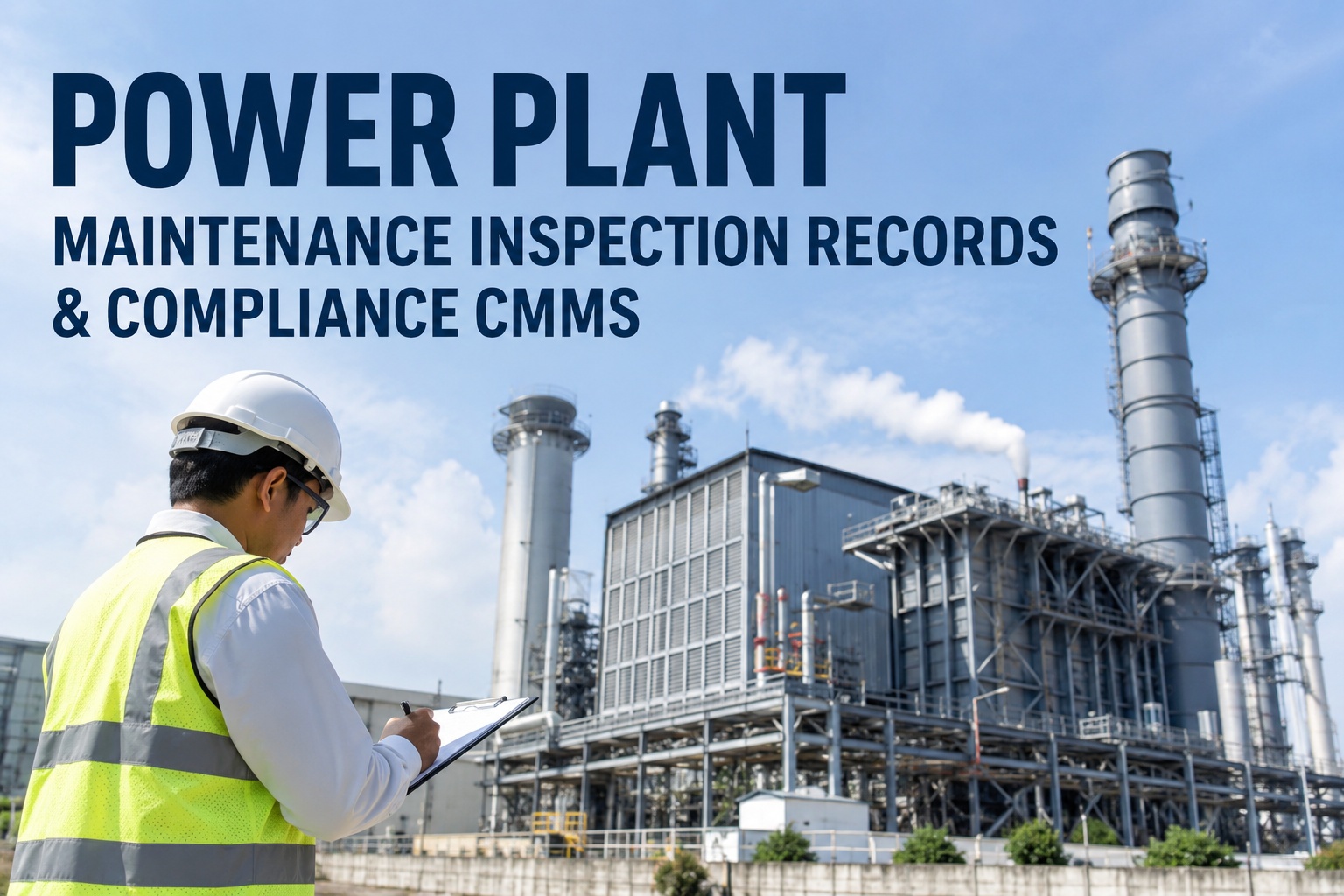
FERC audits do not fail power plant operators because their equipment failed — they fail because their documentation did. When Federal Energy Regulatory Commission auditors request maintenance records, work order histories, and technician sign-off logs, utilities and independent generators without a structured CMMS face weeks of manual record reconstruction, incomplete asset histories, and the real risk of corrective action orders carrying six-figure daily penalties. Start building your FERC-ready audit trail with OxMaint today or book a demo to see how timestamped work orders and electronic signatures satisfy FERC documentation requirements from day one of deployment.
OxMaint · FERC Compliance & Power Plant CMMS
FERC Doesn't Audit Your Equipment.
It Audits Your Records.
Timestamped work orders, electronic technician signatures, and complete asset maintenance histories — built to satisfy FERC audit requirements without manual preparation.
$1M+
Daily penalty exposure for FERC reliability violations
72 hrs
Typical FERC data request response window
63%
Of NERC violations involve incomplete maintenance records
100%
Audit trail coverage OxMaint delivers from first work order
What FERC Auditors Actually Request: The 6 Documentation Categories
FERC and NERC compliance audits for power generators follow a structured information request process. Understanding exactly what auditors look for — and mapping your CMMS outputs to each category — is the difference between a smooth audit and a corrective action order.
01
Maintenance Work Order Records
Complete work order history for all transmission and generation assets — including planned, corrective, and emergency maintenance. Each record must show asset identification, work description, completion date, and assigned personnel.
OxMaint output: Auto-generated, timestamped work orders with full audit trail per asset
02
Technician Sign-Off Documentation
Evidence that maintenance tasks were performed by qualified personnel and reviewed by authorised supervisors. FERC requires verifiable technician identification — not just handwritten sign-off sheets that can be reconstructed.
OxMaint output: Electronic signatures with user ID, timestamp, and role verification on every task
03
Asset Maintenance History
Full lifecycle maintenance record for each critical asset — transformers, breakers, generators, protection relays. Auditors look for evidence of interval compliance with NERC FAC and PRC standards and OEM maintenance requirements.
OxMaint output: Asset-level history reports exportable by asset class, date range, and maintenance type
04
Preventive Maintenance Scheduling Evidence
Proof that PM programmes exist and are followed — not just that maintenance happened reactively. Auditors request PM schedules, completion rates against schedule, and explanation of any deferrals beyond the allowed tolerance window.
OxMaint output: PM schedule compliance reports with deferral tracking and authorisation records
05
Corrective Action Documentation
When deficiencies are found during inspection or testing, FERC requires documentation of the finding, the corrective action taken, the timeline to resolution, and verification of effectiveness. Unresolved findings without documented follow-up are a primary violation trigger.
OxMaint output: Deficiency-to-resolution workflow with linked work orders and status tracking
06
Calibration & Testing Records
Protection relay testing, instrument calibration, and trip testing records under NERC PRC standards. Test results must show actual measured values, pass/fail determinations, and technician certification of the testing procedure used.
OxMaint output: Test record templates with mandatory fields, calibration due-date tracking, and certificate attachment
The Documentation Gap: What Most Power Plants Are Missing
The majority of FERC and NERC compliance violations at power generation facilities are not caused by failure to perform maintenance — they are caused by failure to document it in a verifiable, auditor-readable format. The gap between what actually happened and what can be proven happened is where penalties originate.
Without Structured CMMS
Work orders in paper binders or spreadsheets — not searchable, not timestamped by system
Technician sign-offs as handwritten initials — no user identity verification or role confirmation
PM history reconstructed from maintenance logs — gaps appear when staff turn over or logs are lost
Deficiency tracking in emails and punch-lists — no audit trail from finding to resolution
Calibration records in equipment binders — no automatic due-date alerts, high risk of missed intervals
Audit preparation takes 2–6 weeks of manual record compilation per audit cycle
With OxMaint CMMS
Every work order system-timestamped at creation, assignment, start, and completion — immutable log
Electronic signatures with user account identity, role verification, and timestamp on every task
Asset maintenance history built automatically from every completed work order — never reconstructed
Deficiency-to-resolution workflow creates linked audit trail from finding to verified close-out
Calibration due dates auto-scheduled — overdue alerts prevent missed intervals before audits reveal them
Audit package generated in hours — pre-formatted reports by asset, standard, or date range
OxMaint Audit Trail: How Every Work Order Becomes a Compliance Record
A FERC-compliant audit trail is not a report generated before an audit — it is a record built automatically at the moment maintenance activity occurs. OxMaint embeds compliance documentation into the normal workflow so that technicians, supervisors, and planners create the audit record as a byproduct of doing their jobs.
Step 1
Work Order Created
System timestamp, creator identity, asset ID, standard reference (NERC FAC/PRC), and priority classification recorded automatically. Work order number becomes the permanent compliance reference for this maintenance event.
→
Step 2
Assigned & Accepted
Technician assignment logged with user ID. Acceptance timestamp recorded when technician acknowledges the work order. Qualification verification check against asset-required certification level completed automatically.
→
Step 3
Task Execution Recorded
Each checklist item completed with timestamp, measured values entered against acceptance criteria, and photos or attachments linked to the record. Technician electronic signature applied to each completed step.
→
Step 4
Supervisor Review & Sign-Off
Supervisor electronic signature with role-based authorisation recorded at work order close. Any findings or deviations from procedure flagged and linked to corrective action work order automatically.
→
Step 5
Immutable Record Stored
Completed work order locked in version-controlled audit log. Asset history updated automatically. Record available for audit export immediately — searchable by asset, date, standard, technician, or work type.
Every record in OxMaint is immutable once closed — no editing, no deletion, no reconstruction. The record that existed at the time of work is the record auditors see.
NERC Reliability Standards: What OxMaint Documents for Each
FERC enforces compliance with NERC reliability standards that directly govern maintenance activities at bulk power system facilities. OxMaint's work order templates and asset classification system is structured around these standards — so every maintenance record maps to the standard it satisfies.
FAC-001 / 002
Transmission facilities, generation interconnection
Facility ratings, maintenance records supporting rated capability
Full Coverage
PRC-005
Protection systems — relays, trip coils, batteries, CTs/VTs
Maintenance intervals, test results with measured values, technician ID
Full Coverage
MOD-025
Verification of generator capability
Generator testing records, maintenance supporting verified output
Full Coverage
TOP-002
Operations planning, outage coordination
Planned outage records, equipment availability documentation
Full Coverage
EOP-005
Emergency operations equipment
Black start capability maintenance, periodic testing records
Full Coverage
CIP-007
Cyber assets associated with control systems
Patch management, port and service management, security event logs
Partial — physical asset records
FERC audit preparation should take hours, not weeks. OxMaint makes that possible.
Every work order your team completes today becomes part of an audit-ready record that can be exported, sorted, and submitted — without any manual reconstruction.
FERC Penalty Reality: What Documentation Failures Actually Cost
FERC's penalty authority under the Energy Policy Act of 2005 authorises civil penalties up to $1 million per violation per day. The penalty matrix below reflects actual FERC enforcement actions where documentation failures — not equipment failures — drove the violation finding.
$10M+
NERC PRC-005 Violations
Multiple utilities have faced penalties exceeding $10M for failure to maintain and document protection system maintenance at required intervals. The violation is not that relays failed — it is that interval compliance could not be demonstrated with auditor-acceptable records.
$3.5M
FAC-002 Facility Rating Failures
Penalties for inability to produce maintenance records supporting facility ratings claimed in system studies. Auditors found maintenance history did not support the rated capability being reported to the regional transmission organisation.
$2.1M
Corrective Action Tracking Gaps
Penalties issued where deficiencies identified in prior audits had no documented corrective action trail. The absence of a verifiable finding-to-resolution record was treated as failure to implement corrective actions, not merely failure to document them.
$900K
Technician Qualification Records
Penalties where utilities could not demonstrate that personnel performing maintenance on protected assets held the required qualifications at the time of the work. Work order records without verified technician identity created this exposure.
The pattern is consistent across enforcement actions: the documentation system failed, not the maintenance programme. OxMaint eliminates the documentation risk by making compliant record-keeping the default, not the exception.
Electronic Signatures That Satisfy FERC: What Qualifies and What Doesn't
Not all electronic signatures are equal in FERC audit contexts. The key requirement is non-repudiation — the ability to prove, without ambiguity, that a specific identified individual with a specific role performed or authorised a specific action at a specific recorded time. OxMaint's signature system is built to meet this standard.
Requirement
Basic Digital Sign-Off
OxMaint Electronic Signature
User identity tied to corporate credentials
Not guaranteed — shared logins possible
Individual account authentication required
Timestamp is system-generated, not user-entered
Often user-entered or editable
System UTC timestamp — immutable
Role verification at time of signature
No role check — any user can sign anything
Role-based permission gates what each user can sign
Post-completion editing locked
Often editable after sign-off
Record locked on supervisor sign-off — immutable
Exportable for audit submission
Manual export with risk of data loss
One-click audit package export with signature manifest
Chain of custody for multi-step approvals
No linked approval workflow
Sequential approval chain with each step time-stamped
Frequently Asked Questions
Does OxMaint generate reports formatted for NERC violation self-reporting?
OxMaint generates structured maintenance history reports, PM completion rate summaries, and work order audit packages that can be used directly in NERC violation self-report preparation and corrective action plan documentation. The reports include all fields typically requested in FERC data requests — asset identification, work type, completion date, technician identity, and supervisory approval — in a format designed for regulatory submission without reformatting.
How long does OxMaint retain maintenance records for audit purposes?
OxMaint retains all work order records, electronic signatures, and asset maintenance history indefinitely in the platform's version-controlled audit log. NERC standards require retention of maintenance records for a minimum of one or two maintenance intervals depending on the applicable standard — OxMaint exceeds this requirement as a default. Records are never deleted through normal system operation, and the full history is available for any audit regardless of how long ago the work was performed.
Can OxMaint track PM interval compliance for NERC PRC-005 protection system maintenance?
Yes. OxMaint supports configurable PM interval scheduling for protection system assets — relays, trip coils, station batteries, CTs, and VTs — with the specific interval categories defined in NERC PRC-005 (monthly, quarterly, 6-year, and 12-year intervals depending on asset type). The system tracks completion against due dates, flags overdue items before the interval expires, and generates interval compliance reports that directly map to the PRC-005 audit evidence requirement format.
How does OxMaint handle situations where maintenance was deferred beyond its scheduled interval?
When a PM is deferred in OxMaint, the system requires an authorised supervisor to document the deferral reason, the new target date, and any compensating measures implemented during the deferral period. This creates a defensible deferral record that satisfies the NERC requirement for documented justification of interval deviations — which is a far better position than simply missing an interval with no record at all. The deferral record and subsequent completion are both included in audit package exports.
OxMaint · FERC Compliance & Power Plant CMMS
The Next FERC Audit Will Ask for Records
You Are Building Right Now.
Every work order your team completes in OxMaint is a compliance record — timestamped, signed, and audit-ready. Start building your FERC-defensible maintenance history before the data request arrives.