-for-manufacturing-plants-a-2026-guide.png)
Reliability-Centered Maintenance (RCM) is the most rigorous and technically disciplined methodology available to modern manufacturing plants for ensuring that physical assets continue to do what their users want them to do in their present operating context. In 2026, as industrial environments integrate complex AI-driven robotics and high-speed autonomous systems, the traditional "one-size-fits-all" preventive maintenance approach has become obsolete and cost-prohibitive. RCM provides a structured framework for identifying the failure modes that matter and selecting the most cost-effective maintenance tasks to mitigate them. Sign up for Oxmaint to digitize your RCM analysis and transform your maintenance strategy from a cost center into a reliability engine.
Stop Guessing Your Maintenance Strategy
Oxmaint gives reliability engineers the tools to document failure modes, conduct FMEA, and execute RCM-driven maintenance tasks with mobile-first precision across the entire plant floor.
The 7 Pillars of Reliability-Centered Maintenance: SAE JA1011 Standards
To be considered a true RCM process according to international standards (SAE JA1011), a maintenance program must answer seven fundamental questions about each asset. These questions move beyond simple "repair or replace" logic and force a deep understanding of functional performance and failure consequences. Failing to answer even one of these questions compromises the technical integrity of the entire reliability program.
What are the desired functions and performance standards?
Define exactly what the asset must do (e.g., "Pump 500 liters of glycol per minute at 60 PSI"). Without clear performance standards, "failure" cannot be objectively defined.
In what ways can the asset fail to fulfill its functions?
Identify functional failures. A pump that produces zero flow has failed, but so has a pump that produces only 300 liters per minute when 500 are required.
What causes each functional failure?
This is the core of FMEA. Is the failure caused by bearing wear, seal rupture, electrical fault, or operator error? Every mode requires a specific strategy.
What happens when each failure occurs?
Document the physical effects of the failure: noise, heat, smoke, system shutdown, or secondary damage to upstream/downstream equipment.
In what way does each failure matter?
Assess the failure consequence: Hidden, Safety, Environmental, or Operational. This determines the urgency and the level of maintenance spend required.
What can be done to predict or prevent each failure?
Select technically feasible proactive tasks — like condition monitoring or scheduled restoration — based on the failure mode's predictability.
What if a suitable proactive task cannot be found?
Define default actions: Failure-finding tasks for hidden failures, one-off redesigns for safety/environmental risks, or conscious run-to-failure decisions.
The RCM Process: A Step-by-Step Guide for Manufacturing Leaders
Implementing RCM is a strategic investment in technical transparency. The following five-step process is designed to help reliability teams move from a pilot program to a plant-wide reliability standard, ensuring that every maintenance dollar spent is tied directly to a documented failure risk.
System Selection & Criticality Ranking
Do not attempt RCM on every asset at once. Use a Pareto analysis to identify the 20% of systems causing 80% of your downtime or maintenance costs. Focus your RCM resources where the ROI is highest — typically on bottlenecks or high-safety-risk systems. Book a Demo to see how Oxmaint ranks asset criticality automatically.
Functional Block Diagramming & Boundary Definition
Clearly define the "in-scope" and "out-of-scope" components. A common mistake is analyzing a pump but forgetting the inlet valves or the VFD controlling the motor. Boundary definitions ensure that no critical failure mode is missed during the analysis phase.
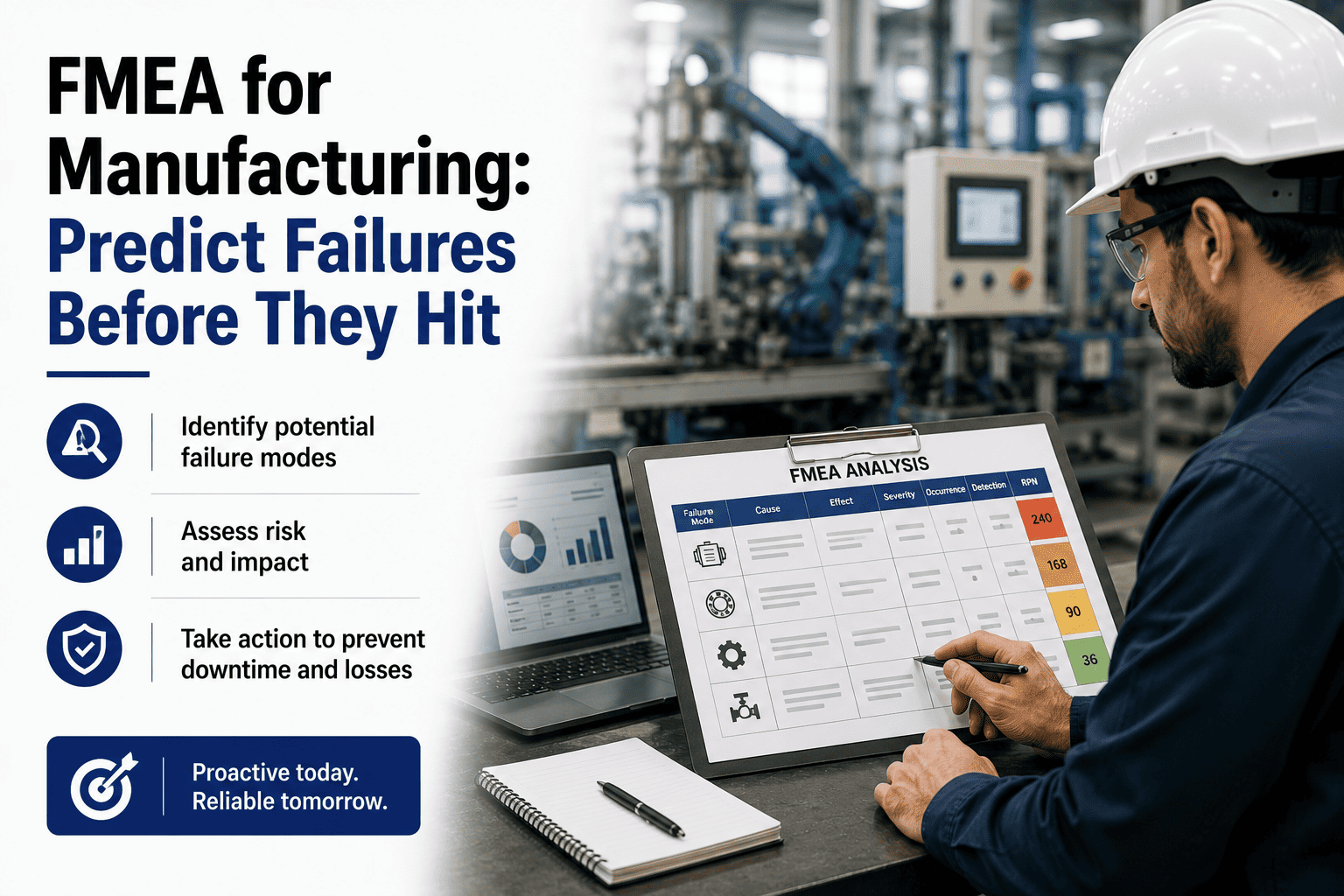
Conduct a Failure Mode and Effects Analysis (FMEA)
For every functional failure, identify every credible failure mode. A "credible" mode is one that has happened before, is currently being prevented by a task, or is highly likely in this operating context. Document the "Failure Consequence" — is it Hidden, Safety, Environmental, or Operational?
Task Selection Logic & Decision Tree Analysis
Use an RCM decision tree to select the most appropriate task. Prioritize "On-Condition" (Predictive) tasks first. If no predictive task is technically feasible, move to "Scheduled Discard" or "Scheduled Restoration." If the failure is "Hidden," a "Failure-Finding" task is mandatory.
Continuous Review & Strategy Optimization
RCM is not a "one-and-done" exercise. As assets age or operating contexts change (e.g., moving from 2 shifts to 3 shifts), the failure modes and consequences evolve. Use real-time work order data in Oxmaint to validate that your RCM-selected tasks are actually preventing the targeted failures.
RCM Task Selection: How to Choose the Right Maintenance Type
The goal of RCM is to move away from "calendar-based" maintenance toward "condition-based" and "consequence-based" maintenance. This matrix provides the framework for ranking and selecting tasks based on technical feasibility and cost-effectiveness.
| Task Category | Applicability Criteria | Objective | 2026 Tech Integration |
|---|---|---|---|
| On-Condition | Failure has a measurable lead-in phase (P-F Interval) | Detect failure before it becomes functional | IoT Vibration & Ultrasound sensors |
| Scheduled Task | Failure is wear-related and predictable by age | Renew or replace components before wear-out | Runtime/Meter tracking via CMMS |
| Failure-Finding | Hidden failures in standby/protection systems | Verify that the system will work when needed | Automated self-test sequences |
| No Scheduled Maint | Failure consequence is low cost and non-critical | Run-to-failure (Conscious decision) | Mobile-first defect reporting |
Why Reliability-Centered Maintenance is Non-Negotiable in 2026
Plants that successfully implement RCM outperform their competitors in three critical areas. By focusing only on the maintenance that matters, these plants reduce the "Total Cost of Ownership" for their most critical capital assets while simultaneously improving safety compliance.
40% Maintenance Cost Reduction
RCM systematically identifies and eliminates "over-maintenance" — tasks that provide zero reliability benefit. Most plants find that 30-50% of their legacy PM tasks can be safely deleted or replaced with more efficient predictive tasks.
Zero Critical Safety Failures
By prioritizing "Failure-Finding" tasks for safety interlocks and standby systems, RCM ensures that your protection systems are 100% functional, eliminating the risk of catastrophic "double failures" during emergencies.
Enhanced Asset Life Cycle
Condition-based maintenance prevents "infant mortality" caused by invasive intrusive maintenance on healthy equipment. Only repairing what is actually failing extends the usable life of major components by years.
Digitize Your RCM Strategy Today
Move your FMEA records out of static spreadsheets and into a dynamic, mobile-first platform. Oxmaint connects your reliability analysis directly to the technicians executing the work.
Reliability-Centered Maintenance — Common Questions from Reliability Engineers
Stop Reacting to Failures. Start Engineering Reliability with Oxmaint.
Oxmaint provides the digital backbone for your RCM program — from asset criticality and FMEA documentation to mobile-first task execution and real-time reliability analytics. Join the next generation of manufacturing leaders who have moved beyond legacy PMs to a truly reliability-centered operation.
-in-manufacturing.png)