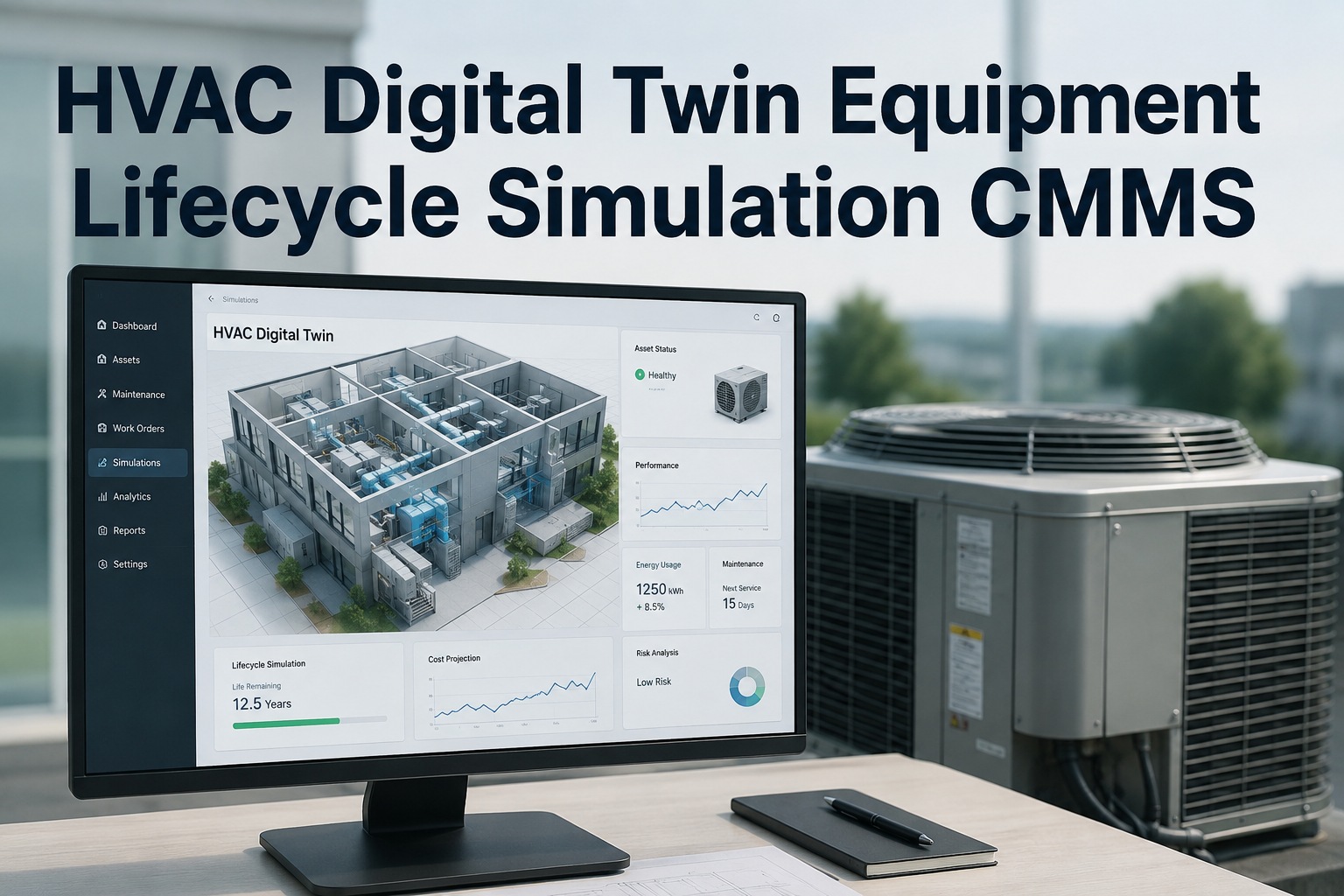
An HVAC digital twin lifecycle simulation models the physical degradation of chillers, compressors and heat exchangers over time so reliability teams can forecast capital replacements, prevent unplanned downtime and extend asset useful life. An HVAC digital twin CMMS fuses those physics-based degradation models with live work-order, meter and condition data, turning the abstract concept of a twin into a daily decision-making tool. This lifecycle simulation guide explains how to build and operationalize a digital twin degradation model for HVAC equipment, what data inputs matter, and how to translate the outputs into defensible capital replacement forecasts. To see the twin simulation running on your own asset register, you can Start Free Trial or read on for the full framework.
What if you could $180K in avoidable chiller failures before they happened — one simulation cycle ahead?
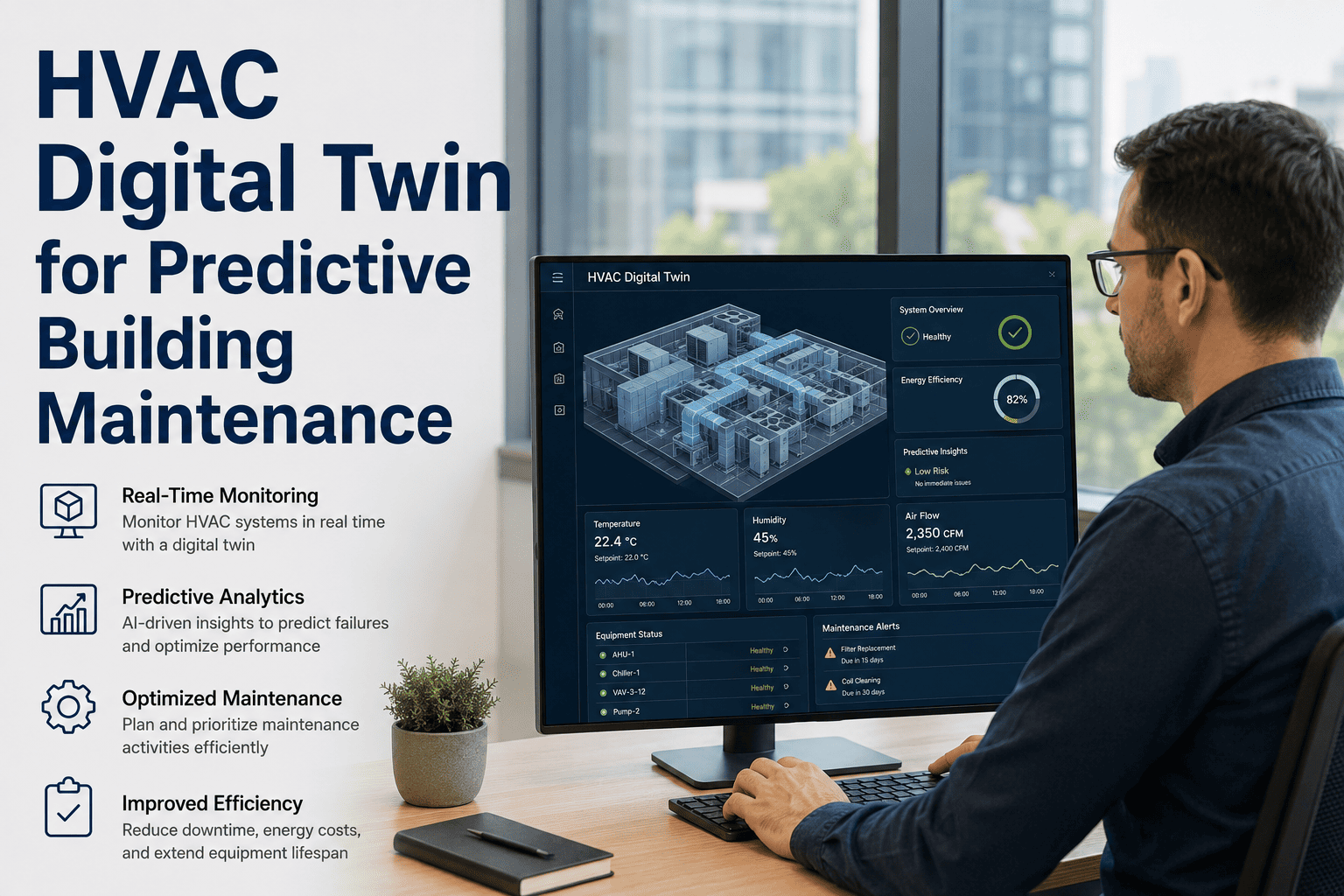
A digital twin equipment HVAC strategy pairs real-time sensor data with physics-based degradation models to simulate asset lifecycle year-by-year. OxMaint's CMMS digital twin lifecycle module turns that simulation into work orders, capital forecasts and PM triggers — so you replace equipment on your schedule, not the failure's.
From static asset register to living lifecycle twin
An HVAC digital twin is a dynamic, physics-grounded virtual model of a physical asset — a chiller, AHU, cooling tower or boiler — that updates continuously as operating data flows in. Unlike a 3D CAD model that shows geometry, an equipment simulation HVAC twin captures thermodynamic performance, wear rates and failure probabilities over the asset's entire lifecycle.
Physical model layer
Captures manufacturer specs, rated capacity, design efficiency (kW/ton) and component geometry — the baseline against which real-time performance is compared to detect degradation drift.
Live data layer
BAS/BMS telemetry — supply and return temps, flow rates, compressor amps, vibration, oil pressure — feeds the twin every 60 seconds so the model reflects actual operating conditions, not nameplate assumptions.
Degradation logic
Algorithms track efficiency decay curves (e.g., fouling factor increase in heat exchangers, isentropic efficiency loss in compressors) and project remaining useful life (RUL) months before functional failure.
CMMS action layer
When the twin predicts a threshold breach — say, heat exchanger efficiency dropping below 80% — it auto-generates a work order or flags a capital replacement in the OxMaint forecast dashboard.
How an HVAC digital twin degradation model works
The core of an HVAC twin lifecycle guide is the degradation model — the mathematical relationship between operating hours, stress factors and performance loss. Below are the two most common models that an HVAC digital twin CMMS like OxMaint calibrates automatically.
Exponential fouling-factor growth
Rf(t) = Rf0 × e(k·t)
Where Rf is thermal resistance at time t, Rf0 is initial fouling resistance, and k is the fouling rate constant derived from water quality and flow velocity. When Rf exceeds 0.00015 m²·K/W, the twin flags tube cleaning.
Isentropic efficiency decay
ηi(N) = ηi0 − α·Nβ
Where ηi is isentropic efficiency at cycle count N, ηi0 is rated efficiency, and α, β are wear coefficients fitted to vibration trend and oil analysis data. A drop below 75% rated efficiency triggers a rebuild-or-replace evaluation.
A 180-asset commercial campus spending $42K/yr on reactive HVAC repairs
By loading 5 years of work-order history and BAS meter data into OxMaint's twin simulation, the reliability team built degradation curves for 12 critical chillers and 34 AHUs. The twin predicted that Chiller #4's heat exchanger would cross the fouling threshold in Month 9 — not the next scheduled PM in Month 14. Acting early, the team cleaned tubes during a planned window, avoided an estimated $28K in emergency labor and downtime, and extended the chiller's useful life by 3 years. The capital replacement forecast also shifted: two units moved from "replace Year 2" to "replace Year 5," freeing $310K in capex.
How to deploy an HVAC digital twin CMMS in 4 phases
A phased rollout de-risks adoption. Most mid-size facilities (100–500 HVAC assets) complete Phases 1–3 in 30–45 days using OxMaint's onboarding toolkit.
Asset hierarchy & data ingestion
Import the asset register, manufacturer specs, nameplate data and historical work orders into OxMaint. Map BAS/BMS data points (Modbus, BACnet, OPC UA) to each asset record so live telemetry begins flowing.
Baseline & degradation calibration
OxMaint's AI establishes a performance baseline for each asset using 30–90 days of clean data, then fits degradation curves (fouling, wear, drift) to historical failure patterns and current condition data.
Simulation & forecast generation
Run lifecycle simulations projecting 1–10 years out. The CMMS twin simulation outputs RUL estimates, recommended PM intervals, and a capital replacement forecast ranked by risk and cost-avoidance value.
Closed-loop optimization
Every completed work order, meter reading and inspection updates the twin automatically. The degradation model self-corrects, forecasts tighten, and the CMMS continuously re-prioritizes work based on real asset condition.
How OxMaint's CMMS digital twin lifecycle drives ROI
OxMaint converts the digital twin's predictions into actions your team can execute today — work orders, PM schedule adjustments and capex justifications — all in one platform. No spreadsheets, no disconnected analytics tools.
Predictive work-order auto-generation
When the twin detects a degradation threshold breach, OxMaint auto-generates a prioritized work order with the likely failure mode, recommended fix and parts list — cutting unplanned downtime 30–50%.
30–50% less unplanned downtimeCapital replacement forecasting
The twin's RUL projections feed a year-by-year capital plan dashboard, so you can justify budget requests with data — not gut feel — and defer replacements that the model shows are premature.
$200K–$500K capex re-prioritizedDynamic PM optimization
Instead of fixed-interval PMs, OxMaint adjusts preventive maintenance schedules based on actual asset condition from the twin — eliminating over-maintenance and freeing technician hours for higher-value work.
20–25% PM labor savedAudit-ready compliance trail
Every twin-triggered action, work order and asset condition record is timestamped and stored — giving you a defensible, ISO 55000-aligned audit trail for insurance, finance and regulatory reviews.
100% audit-ready recordsReactive maintenance vs CMMS digital twin simulation
The gap between a facility running spreadsheet-driven reactive maintenance and one powered by an HVAC digital twin CMMS is measurable — in dollars, hours and risk exposure.
| Dimension | Reactive / Spreadsheet | OxMaint Digital Twin CMMS |
|---|---|---|
| Failure prediction | After failure — mean time to detect is hours to days | 2–6 months ahead via degradation model RUL forecast |
| PM scheduling | Fixed calendar intervals regardless of condition | Condition-based; auto-adjusted by twin simulation output |
| Capital planning | Age-based replacement; gut-feel budget requests | Data-driven RUL + risk-ranked replacement forecast |
| Downtime cost / yr | $60K–$120K typical for a 200-asset facility | $18K–$42K — 50–65% reduction after Year 1 |
| Data source | Paper logs, disconnected spreadsheets, tribal knowledge | Unified platform: BAS telemetry + work orders + asset history |
| Audit readiness | Manual compilation; gaps and missing records common | Automatic, timestamped, ISO 55000-aligned trail |
See your HVAC assets' future — before the failure happens
Book a 30-minute demo and we'll load a sample asset register, run a twin simulation, and show you exactly where OxMaint would have predicted your last HVAC failure — and what it would have saved.
HVAC digital twin lifecycle — common questions
What is an HVAC digital twin lifecycle simulation?
It is a physics-based virtual model of HVAC equipment that simulates how components like chillers, compressors and heat exchangers degrade over their useful life. By ingesting real-time sensor data and historical work-order patterns, the twin projects remaining useful life, optimal maintenance intervals and capital replacement timing — typically 2–6 months before functional failure.
How does a CMMS digital twin lifecycle differ from a standard CMMS?
A standard CMMS tracks work orders, PM schedules and asset history reactively. A CMMS digital twin lifecycle layer adds predictive degradation modeling — it uses live telemetry and physics-based algorithms to forecast failures, auto-generate condition-based work orders and produce data-driven capital replacement plans. You can see it in action when you Start Free Trial of OxMaint.
What data do I need to build an HVAC degradation model?
At minimum you need an asset hierarchy with manufacturer specs, 6–12 months of BAS/BMS telemetry (temperatures, flow, pressure, vibration, power draw) and 1–2 years of historical work-order data. OxMaint's onboarding team helps map these data sources during the first 2 weeks of implementation, regardless of whether your BAS uses BACnet, Modbus or OPC UA.
How accurate is digital twin capital replacement forecasting?
After 60–90 days of calibration, a well-tuned HVAC twin lifecycle typically predicts RUL within ±10–15% for critical assets like centrifugal chillers and large AHUs. Accuracy improves continuously as the model self-corrects with each completed work order and new condition data point — reaching ±5–8% by Year 2 for most equipment classes.
Is a digital twin worth it for a small or mid-size facility?
Yes — facilities with as few as 50–100 critical HVAC assets see ROI within 6–9 months. A typical 180-asset commercial campus avoids $30K–$60K/yr in unplanned downtime and re-prioritizes $200K+ in deferred capex. To get a facility-specific estimate, Book a Demo and we'll model your numbers live.
Stop reacting to HVAC failures. Start simulating them away.
Join the reliability teams using OxMaint's AI-powered CMMS to predict equipment degradation, optimize PMs and justify capital with data — not guesswork.
Free 14-day trial · No credit card