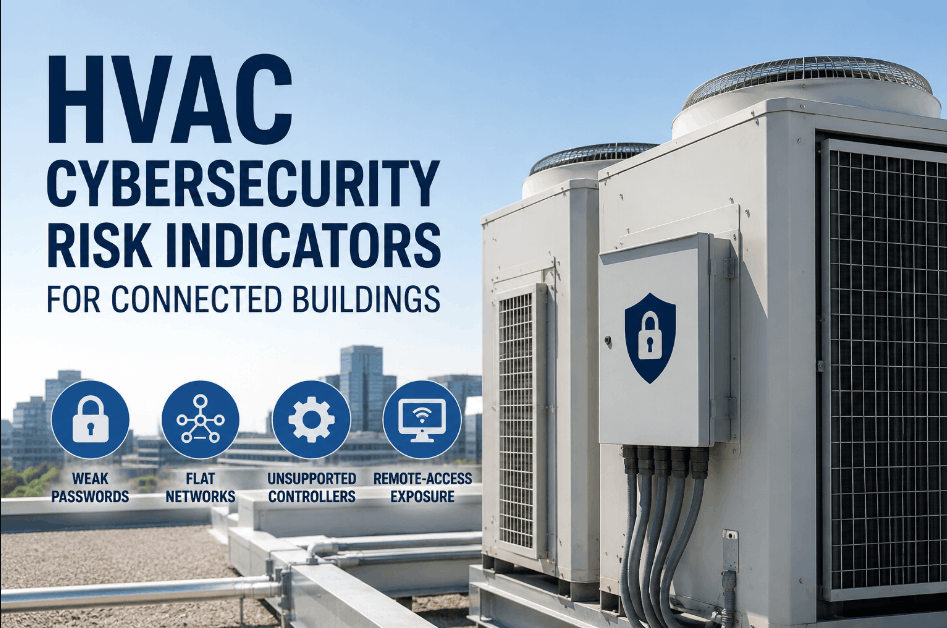
HVAC controllers have quietly become some of the most connected devices in a building, and that connectivity carries risk indicators most maintenance teams were never trained to watch — weak or default passwords, flat networks with no segmentation, unsupported end-of-life controllers, and remote-access paths nobody remembers opening. Treating these as IT's problem alone leaves a gap, because the maintenance team is the one with eyes on the controller hardware itself. Sign Up Free on Oxmaint to add controller model and firmware data to your asset records, or Book a Demo to see how tracked work orders turn cybersecurity hygiene into a documented maintenance routine.
Why Connected HVAC Controllers Carry Unmanaged Cyber Risk
Most HVAC cybersecurity exposure isn't the result of a sophisticated attack — it's the accumulation of small maintenance gaps left unaddressed for years. Book a Demo to see how Oxmaint helps surface which controllers in your asset register need a closer security review.
Four Risk Indicators Maintenance Teams Should Track
These indicators don't require deep network security expertise to spot — they require consistent asset documentation. Sign Up Free to start logging these indicators against each controller in your Oxmaint asset register.
Weak or Default Credentials
Controllers still running factory-set or shared logins are among the easiest entry points to close, but only if maintenance and IT both know which units haven't been updated.
Flat Network Segmentation
HVAC controllers sharing a network segment with general office or guest traffic widen the blast radius of any single compromised device.
Unsupported or End-of-Life Controllers
Controllers past their vendor support window no longer receive security patches, turning routine equipment age into an open vulnerability.
Unmonitored Remote-Access Paths
Vendor or contractor remote access set up for a past project and never closed out is one of the most common overlooked exposure points in building systems.
HVAC Controller Risk Profile by Type
Exposure level and remediation urgency vary significantly depending on the type of controller and how it connects to the rest of the building. Book a Demo to see how Oxmaint segments remediation priority by controller type across a connected facility.
| Controller Type | Primary Exposure | Patch Availability | Remediation Urgency | Oxmaint Management Lever |
|---|---|---|---|---|
| Legacy BMS Controllers | End-of-life firmware | Limited or none | High — plan replacement | Asset record flags end-of-support status |
| IoT Thermostats & Sensors | Default credentials | Vendor-dependent | Medium | Credential review tracked as recurring task |
| Cloud-Connected Rooftop Units | Remote-access exposure | Generally available | Medium-High | Work order tracks access review and closure |
| Third-Party Vendor Gateways | Unclear ownership of patching | Inconsistent | High — clarify accountability | Vendor record linked to gateway asset |
| Retrofit Edge Devices | Undocumented network placement | Varies by manufacturer | Medium | Asset record captures network segment and install date |
What Unmanaged HVAC Cyber Risk Costs Maintenance Teams
Cybersecurity gaps in building systems rarely show up as a single dramatic incident — they accumulate as compliance and accountability problems first. Sign Up Free to turn remediation actions into tracked work orders before they become audit findings.
Running a Controller Risk Tracking Program with Oxmaint
Add Controller Model and Firmware Version to Asset Records
Capture model, firmware version, and install date for every connected HVAC controller in Oxmaint's asset register as a baseline for risk review.
Flag End-of-Life Controllers for Replacement Review
Use asset age and vendor support status in Oxmaint to identify which controllers should move into a replacement planning cycle.
Convert Remediation Actions Into Tracked Work Orders
Turn credential resets, firmware updates, and access reviews into Oxmaint work orders so each action has an owner and a closure record.
Schedule Recurring Credential & Access Review Tasks
Set a recurring preventive task in Oxmaint to confirm credentials and remote-access paths are still valid and still needed.
Maintain Audit Trail for IT/OT Compliance Reporting
Keep every remediation action and firmware update documented in Oxmaint so IT and facility teams can produce a shared compliance record on request.
Frequently Asked Questions: HVAC Cybersecurity Risk Indicators
What is the most common HVAC cybersecurity risk indicator?
Default or rarely-changed credentials on connected controllers remain one of the most common and easiest-to-close exposure points in building systems.
Why does network segmentation matter for HVAC controllers?
Controllers sharing a flat network with general IT traffic widen the impact of any single compromised device beyond just the building system itself.
Does Oxmaint monitor networks or detect cyber threats?
Oxmaint tracks the asset, firmware, and remediation data maintenance teams need to manage controller risk — it works alongside IT/OT security tools, not in place of them.
How should remediation responsibility be assigned between IT and maintenance?
Tracking each remediation action as a work order with a named owner, whether IT, facilities, or a vendor, prevents tasks from stalling on unclear accountability.
How often should controller risk indicators be reviewed?
A quarterly review of credentials, remote-access paths, and firmware status catches most drift before it becomes a larger exposure.