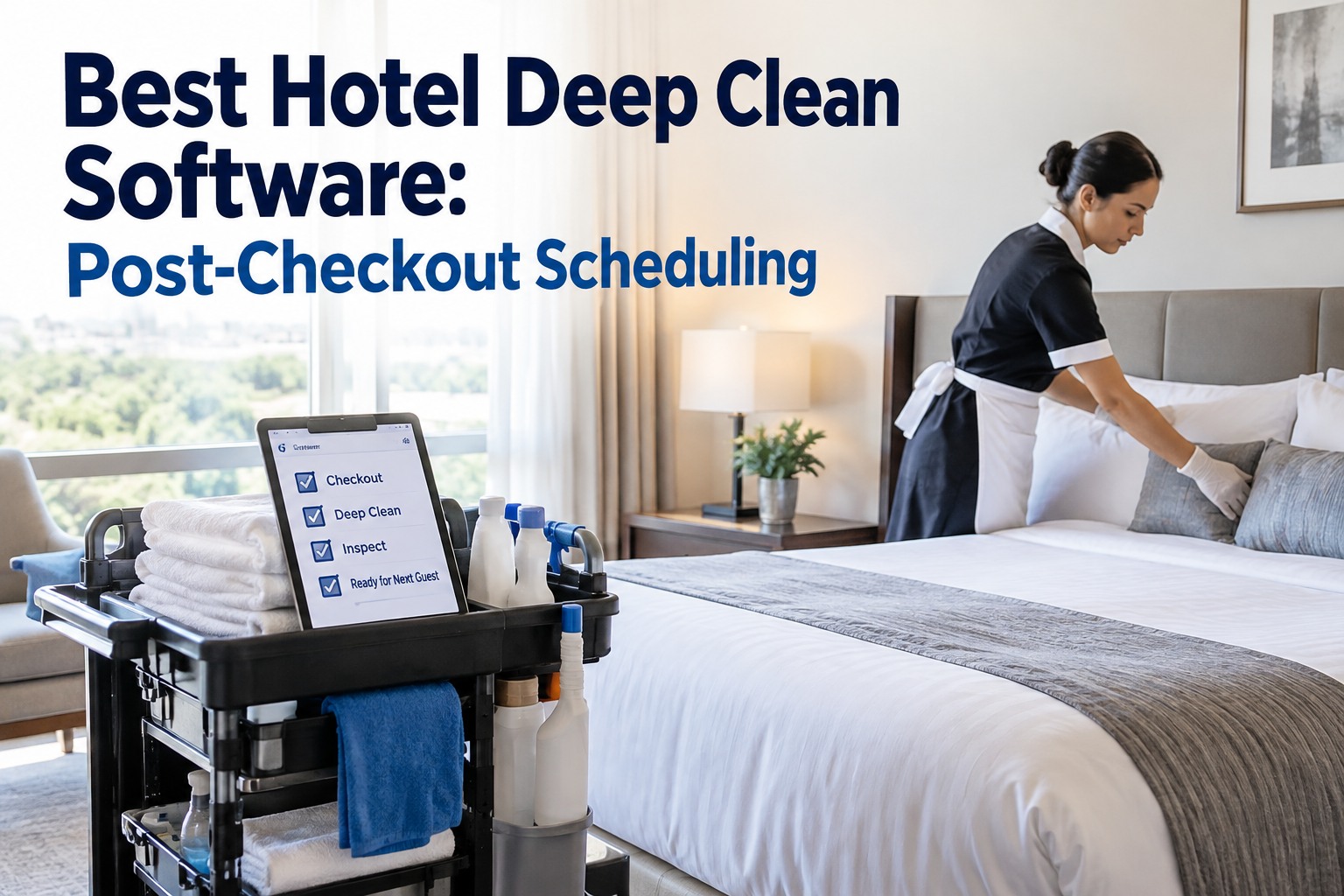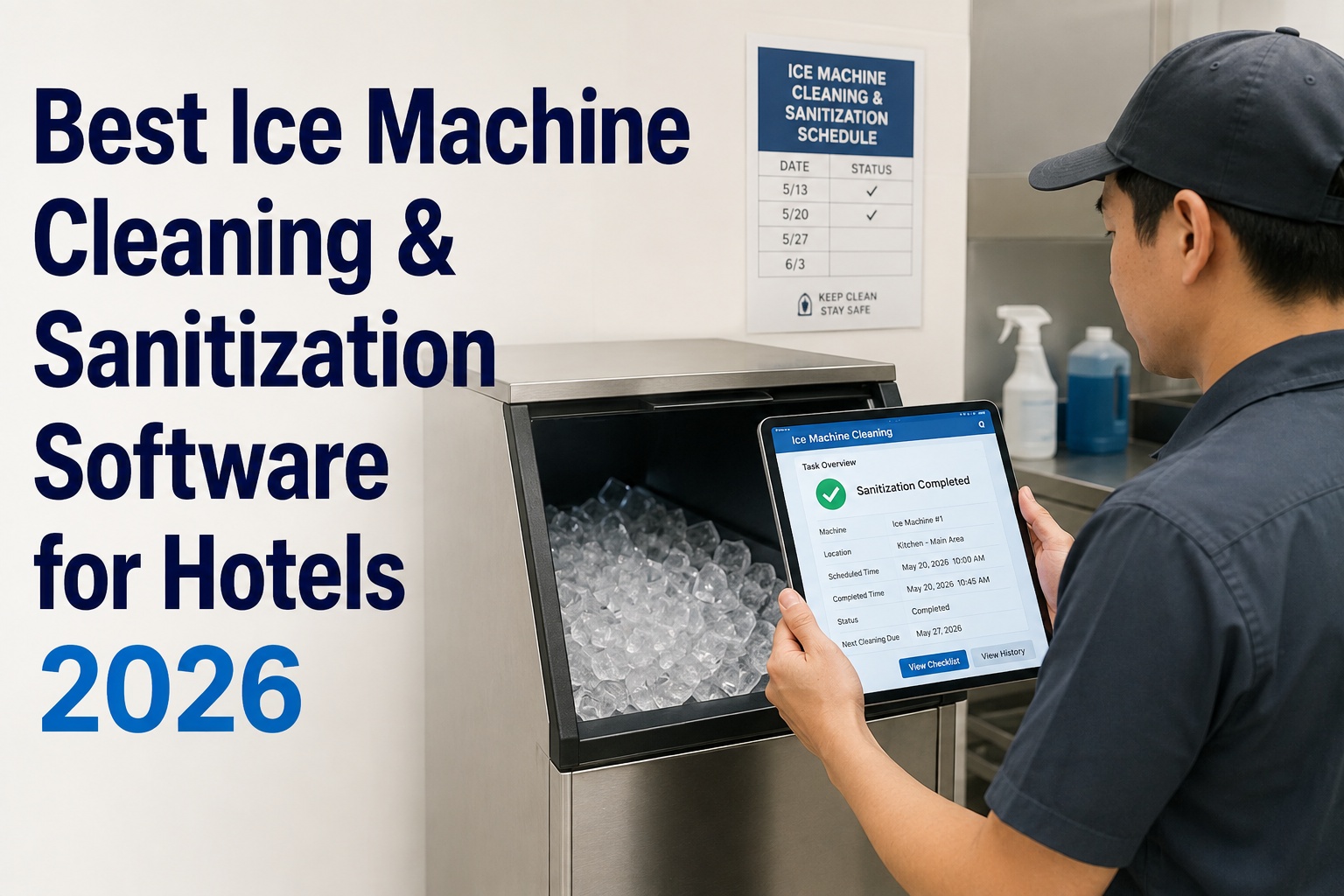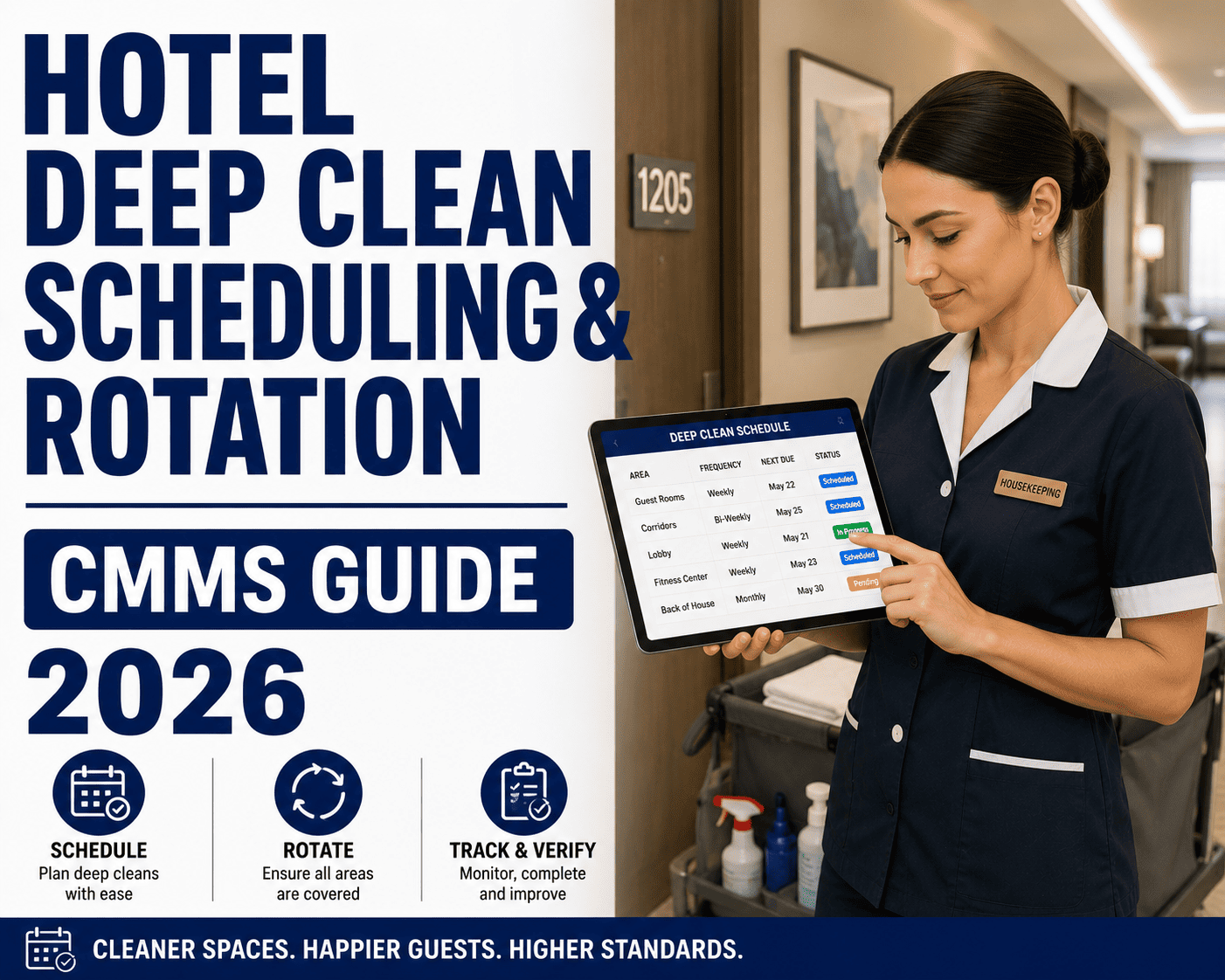
Hotel deep clean scheduling and rotation is the difference between rooms that stay fresh year after year and rooms that visibly age faster than they should — and in 2026, the properties winning that fight have moved off spreadsheets onto a CMMS that automates the entire deep clean cycle. Carpet shampooing, drapery cleaning, mattress deep clean rotation, and upholstery care each have different ideal intervals, and without a centralized system the first thing that gets dropped during peak occupancy is exactly the preventive rotation that protects your asset value. A modern rotation CMMS for hotels schedules every deep clean task by room type, ties it to live occupancy data, and auto-generates work orders so nothing slips. This guide breaks down the intervals, the rotation workflow, capacity planning, and how a platform like OxMaint turns deep clean scheduling from a constant fire drill into a hands-off automated cycle — you can Start Free Trial or read on to see the full framework.
Is your hotel's deep clean rotation the first thing that gets dropped when occupancy spikes?
A 200-room property running carpet, drapery, and mattress deep cleans on memory and sticky notes will miss 30–40% of its scheduled rotations each year — accelerating carpet replacement by 2–3 years and dragging down guest review scores. A CMMS-based deep clean cycle closes that gap permanently.
Hotel deep clean scheduling intervals by room type and surface
Not every surface ages at the same rate. Hotel deep clean scheduling only works when intervals are set by surface material, room traffic class, and guest turnover volume. Below are the industry-benchmarked deep clean intervals that a hotel CMMS should enforce automatically.
| Surface / Asset | Standard Room | High-Traffic / Suite | Trigger Logic in a CMMS |
|---|---|---|---|
| Carpet shampoo | Every 6 months | Every 3–4 months | Calendar-based + turnover count threshold |
| Drapery / curtains | Every 12 months | Every 6–8 months | Calendar-based, seasonal anchor |
| Mattress deep clean | Every 6 months | Every 4 months | Calendar + inspection flag from housekeeping |
| Upholstered furniture | Every 6 months | Every 4 months | Calendar-based, grouped by room type |
| Hard floor deep scrub | Every 3 months | Monthly | Calendar + post-event trigger |
| AC coil & vent sanitize | Every 12 months | Every 6 months | Calendar-based, tied to PM schedule |
A CMMS for hotel deep clean scheduling holds these intervals as asset-level preventive maintenance (PM) rules — so every carpet, drape, and mattress has its own automated rotation timeline that survives staff turnover and seasonal chaos.
How a CMMS deep clean rotation cycle actually works
A hotel deep clean rotation isn't a checklist — it's a closed-loop workflow that links room availability, housekeeping capacity, and maintenance scheduling in real time. Here is the five-step cycle that OxMaint automates end to end.
Inventory & tag every asset
Every carpet, drape set, mattress, and upholstery piece is tagged in the CMMS with a QR code, room location, install date, and deep clean interval. A 200-room hotel typically tracks 800–1,200 cleanable assets.
Auto-generate work orders
When a deep clean interval triggers — say, a mattress hits its 6-month mark — the CMMS auto-generates a work order with checklists, chemical requirements, estimated time, and assigned technician. No manual scheduling required.
Cross-check live occupancy
The system checks PMS / occupancy data and only releases the work order for a room that has a 24–48 hour vacancy window. If the room is booked, the CMMS holds the task and re-slots it into the next available gap.
Execute & close with photo proof
Technicians complete the work order on mobile, attach before/after photos, log chemicals used, and close the ticket. The asset's next deep clean date is automatically reset based on its interval rule.
Audit trail & analytics
Every deep clean is logged with timestamp, technician, cost, and completion status. Maintenance managers get a live dashboard showing compliance rate, overdue rotations, and cost-per-room trends.
How to plan deep clean capacity without overloading housekeeping
The number-one reason hotel deep clean schedules collapse is capacity math that doesn't account for peak occupancy. A rotation CMMS calculates labor hours needed against available housekeeping hours — so deep cleans are distributed across low-occupancy windows rather than dumped on already-stretched teams.
Example: A 180-room hotel with 12 housekeeping staff at 8 hours each has 96 total labor hours per day. Daily turnover consumes ~64 hours. That leaves 32 hours for deep clean work — enough for 4–6 carpet shampoos or 8–10 mattress deep cleans per day. The CMMS automatically fills those 32 hours with the highest-priority overdue rotations and never overbooks beyond capacity.
A 180-room hotel was missing 40% of its mattress deep clean rotations
A boutique hotel group in the Southeast was scheduling mattress deep cleans, carpet shampooing, and drapery cleaning on a shared Google Calendar managed by the Head Housekeeper. During peak season (March–August), deep clean tasks were routinely pushed to "next week" — and next week never came.
- 40% of mattress deep cleans skipped or delayed beyond 9 months
- Carpet replacement cycle shortened from 7 years to 4.5 years
- Guest complaints about "musty" rooms up 22% year-over-year
- $31K spent on emergency carpet replacement in one property
- Zero audit trail for brand compliance inspections
- 94% deep clean compliance rate within 90 days of rollout
- Automated work orders triggered by interval + occupancy window
- Photo proof and timestamp on every deep clean task
- Carpet replacement cycle projected back to 7-year baseline
- $27K redirected from emergency replacement to preventive schedule
How OxMaint automates hotel deep clean scheduling and rotation
OxMaint is an AI-powered CMMS and EAM platform built to eliminate the spreadsheet chaos that breaks deep clean rotation. Here is how four specific OxMaint capabilities map directly to the hotel deep clean problem — each with a measurable outcome.
Automated deep clean work orders
OxMaint generates work orders automatically when a carpet shampoo, drapery cleaning, or mattress deep clean interval hits its trigger date — complete with checklists, chemical lists, and assigned technician. No manual scheduling, no sticky notes.
Outcome: 85%+ deep clean compliance rate within 60 daysAsset-level tracking & history
Every carpet, drape set, mattress, and furniture piece is tracked as an individual asset with install date, deep clean history, cost, and next-due date. QR codes let staff scan and pull full lifecycle history on the spot during inspections.
Outcome: Extend FF&E asset life 2–3 years with full audit trailMobile execution with photo proof
Technicians receive work orders on their phone, complete checklists on-site, attach before/after photos, log time and materials, and close the ticket — all offline-capable. Managers see real-time completion status across every room and floor.
Outcome: Eliminate paper work orders and 100% visual compliance proofPredictive scheduling & analytics
OxMaint's AI analyzes turnover patterns, occupancy forecasts, and historical deep clean completion data to predict the optimal low-impact windows for each rotation — and flags assets at risk of missing their interval before it happens.
Outcome: Cut overdue deep clean rotations by 70% in first quarterSee OxMaint automate your hotel's deep clean cycle — book a 30-min demo
We'll show you exactly how OxMaint would schedule carpet shampooing, drapery cleaning, and mattress rotations for your property — with live occupancy-aware work order generation, photo proof, and a full audit trail for brand inspections.
Hotel deep clean scheduling & rotation CMMS — frequently asked questions
How often should hotels deep clean carpets, drapes, and mattresses?
Standard rooms should have carpets shampooed every 6 months, drapes cleaned every 12 months, and mattresses deep cleaned every 6 months. High-traffic rooms and suites need more frequent rotation — carpets every 3–4 months, drapes every 6–8 months, and mattresses every 4 months. A CMMS enforces these intervals automatically and adjusts based on room type and turnover volume.
What is a deep clean rotation CMMS for hotels?
A deep clean rotation CMMS is a maintenance management system that automatically schedules, generates work orders for, and tracks deep clean tasks (carpet shampooing, drapery cleaning, mattress care) across every room and surface in a hotel. It replaces spreadsheets and shared calendars by tying each cleanable asset to a preventive maintenance rule with a fixed interval, then auto-generating work orders when that interval triggers. You can see it in action — book a demo and we'll walk through your property's setup.
How does a CMMS prevent deep cleans from being skipped during peak occupancy?
A hotel CMMS cross-references deep clean schedules with live occupancy and PMS data, then automatically slots deep clean work orders into rooms with upcoming 24–48 hour vacancy windows. If a room is booked, the system holds the task and re-schedules it into the next available gap — so the rotation is never lost, just re-sequenced. This eliminates the manual "push to next week" loop that causes 30–40% of deep cleans to be skipped.
How much does a hotel deep clean CMMS cost compared to manual scheduling?
A CMMS like OxMaint typically costs $30–$75 per user per month — for a 10-person housekeeping and maintenance team that's $300–$750 monthly. The savings come from extended carpet and FF&E life (2–3 extra years), reduced emergency replacement spending ($18K–$35K annually for a mid-size hotel), and higher guest review scores. Most properties see positive ROI within the first 90 days. Start Free Trial to calculate your specific payback.
Can a deep clean CMMS integrate with our hotel PMS and housekeeping software?
Yes — OxMaint integrates with major hotel PMS platforms to pull live occupancy and room status data, ensuring deep clean work orders are only released for rooms with confirmed vacancy windows. The system also exports completion reports and audit trails for brand compliance inspections, so you have timestamped photo proof that every carpet, drape, and mattress was cleaned on schedule.
Stop skipping deep cleans. Start automating the rotation.
OxMaint turns hotel deep clean scheduling from a manual fire drill into a fully automated, occupancy-aware rotation cycle — with photo proof, audit trails, and predictive scheduling that keeps every room fresh year after year.
Free 14-day trial · No credit card