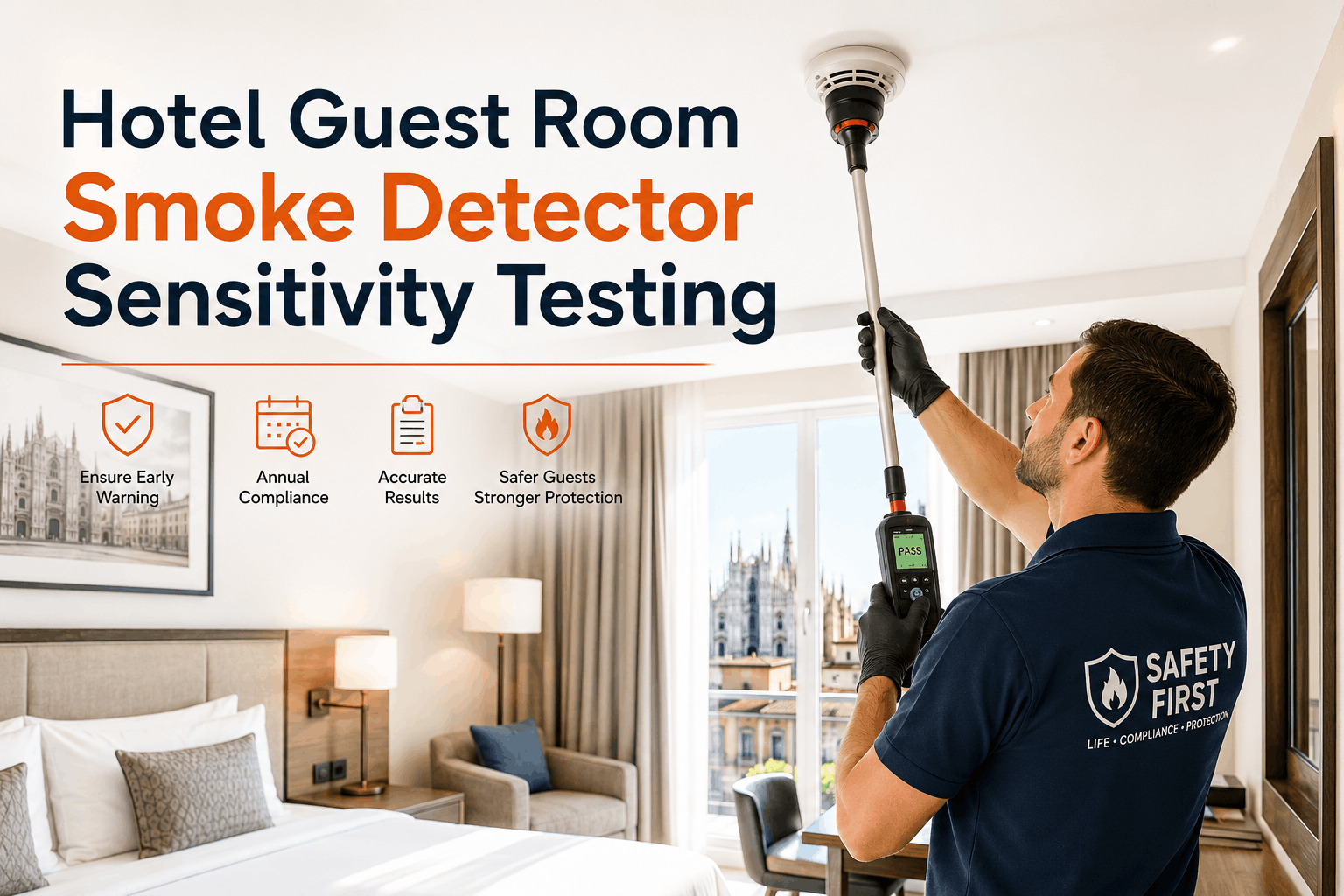
Guest room smoke detectors are your first line of defense against fire spread and occupant injury in hotel properties. Unlike fire suppression systems that require activation by humans, smoke detectors operate automatically—they detect smoke presence within seconds and trigger alarms that wake sleeping guests, alert staff, and notify emergency services. However, smoke detectors drift out of calibration over time as dust accumulates on optical sensors and electronic components age. NFPA 72 National Fire Alarm and Signaling Code requires sensitivity testing within one year of installation, then biennially (every two years) thereafter for commercial hotel fire alarm systems. Hotels that skip sensitivity testing or wait for complaints to discover failed detectors face liability exposure, insurance penalties, and guest safety risk. Implementing a structured sensitivity testing program with Oxmaint tracking ensures every guest room detector is verified within its listed sensitivity range annually, documentation is audit-ready for fire marshals, and no unit deteriorates silently into failure.
Smoke Detector Sensitivity Testing: NFPA 72 Requirements and Hotel Compliance Obligations
Fire alarm systems in hotels are life safety devices that must operate with extreme reliability. Smoke detectors are the sensing elements of these systems—they must respond to smoke within a specific sensitivity window defined by Underwriters Laboratories (UL) listing standards. NFPA 72 Section 14.4.3.2 requires commercial smoke detectors to be tested within one year of installation to verify they respond within their listed and marked sensitivity range (typically 0.5-2.5% obscuration, depending on detector type). After the first successful test, sensitivity testing is required biennially—once every two years—at minimum. However, if two consecutive biennial tests pass within the specified range, the interval may be extended to five years maximum, provided documented procedures are followed and approval from the Authority Having Jurisdiction (AHJ) is obtained. Many hotel properties test annually anyway to maintain safer margins and reduce risk of undetected drift. Hotels that fail to perform sensitivity testing on schedule or that maintain inadequate documentation face fire code violations, insurance coverage gaps, and liability if a fire occurs where guests report that detectors failed to alarm.
Smoke Detector Sensitivity Testing Methods: Smoke Generators, Sensitivity Verification, and Cleaning Procedures
Sensitivity testing measures how reliably a smoke detector responds to smoke at varying density levels. Modern commercial systems use one of three testing approaches: (1) field testing with calibrated smoke aerosol generators that produce ISO-standard smoke at specified obscuration levels; (2) detector/panel monitoring systems that measure and log each detector's internal sensitivity electronically—these system automatically alert if sensitivity drifts outside range and do not require physical testing; (3) manual field verification using canned smoke or aerosol testers. Hotels typically use field testing with smoke generators, as these are portable, require no permanent equipment modifications, and provide immediate pass/fail verification. If a detector tests outside its sensitivity range (too sensitive or too insensitive), two remediation options exist: (1) clean the optical chamber using compressed air and alcohol-based lens cleaner—many detectors recover within range after cleaning—or (2) replace the unit with a new detector of the same model and set. Testing each guest room detector takes 3-5 minutes; coordinating across 150-300 rooms requires structured scheduling to avoid guest disruptions, which is why many hotels use Oxmaint to schedule tests during housekeeping cycles or low-occupancy periods.
Dust, insect debris, and environmental contaminants accumulate on detector optical sensors over time, reducing sensitivity. A detector passing test in year 3 may fail in year 5. Annual testing catches this degradation before guests notice false alarms or complete failure.
Smoke generators require regular calibration and battery replacement. Hotels must verify test equipment is certified to generate standardized smoke density before testing—outdated or uncalibrated generators produce unreliable results.
Many hotels perform tests but store records in fragmented paper logs, spreadsheets, or contractor invoices. Fire marshals demand continuous, timestamped, traceable records of every test, every location, and every result—gaps create liability and invite violations.
Over-sensitive detectors trigger nuisance alarms from cooking, steam, or dust, leading to occupant complaint escalation and "alarm fatigue" where guests disable or remove detectors. Sensitivity testing identifies and removes these problem units.
Many guest rooms use stand-alone battery-powered smoke alarms (not connected to the building fire alarm system). These require individual testing, battery replacement per manufacturer schedule, and separate tracking by room number—a logistical challenge without CMMS support.
Testing requires brief room access during low-occupancy periods. Coordinating testing schedules across 200+ occupied guest rooms without disrupting service requires disciplined planning and real-time availability tracking that manual schedules cannot provide.
Annual Sensitivity Testing Procedure: NFPA 72 Testing Schedule, Equipment Setup, and Pass/Fail Criteria
The standard NFPA 72 sensitivity test procedure involves four steps: (1) equipment preparation and calibration verification, (2) smoke introduction at standardized density, (3) detector response observation and timing measurement, (4) documentation and determination of pass/fail status. Hotels that establish a disciplined testing cycle—typically in off-season or low-occupancy months—can test 50-100 guest rooms per week with minimal operational disruption. Testing during spring (post-winter housekeeping cycle) or fall (before peak winter occupancy) is common practice. Each test is logged with room number, detector model/serial number, test date, technician name, pass/fail result, and any follow-up actions (cleaning or replacement).
| Test Phase | Equipment & Setup | Procedure Steps | Documentation Required | Pass Criteria |
|---|---|---|---|---|
| Pre-Test Verification | Calibrated smoke aerosol generator or smoke canister, detection response chart per detector model, notification system documentation | Verify detector is mounted per design (center of room, away from HVAC vents, 4-12 inches from ceiling). Confirm fire alarm control panel shows detector as active/monitored. Document baseline status in CMMS. | Detector location verified, model/serial number confirmed, last test date and result, fire panel status at time of test | Detector installed and communicating with fire alarm panel; no previous failures or maintenance flags |
| Smoke Aerosol Introduction | Calibrated smoke generator set to produce 0.5–2.5% obscuration (per UL Listed range), aerosol dispenser, fan or diffuser to distribute smoke evenly | Introduce smoke from generator in slow, even stream toward detector. Watch for LED blink or audio alert. Start timer when smoke enters. Do not block smoke dispersion with hand or body. | Time from smoke introduction to first alarm indication, aerosol type and batch number, ambient temperature and humidity at time of test | Detector responds with LED indicator or audible/visual alarm within 30-60 seconds of smoke introduction (per manufacturer specification) |
| Sensitivity Assessment | Response timing chart, sensitivity classification reference (slow, medium, fast respond), cleaning materials (compressed air, isopropyl alcohol, lint-free cloth) | If detector responds within specification, mark as PASS. If response is delayed (over 90 seconds) or absent, assess for visible dust on lens. If contamination visible, proceed to cleaning. If no visible contamination but response fails, mark for replacement. | Response time measured in seconds, sensitivity classification (fast/medium/slow), visual condition of optical lens (clean/dusty/damaged), recommended action (pass/clean/replace) | Alarm indication within UL Listed response window for detector model (typically 0.5-2.5% obscuration, 30-90 second response time) |
| Cleaning Procedure (if needed) | Compressed air canister, isopropyl alcohol 90%+ (non-flammable type preferred), soft-bristle brush, lint-free cloth, replacement battery (if battery-backed unit) | Turn off detector at panel (if hardwired) or remove battery (if standalone). Use compressed air in short bursts to dislodge dust from optical chamber. Dampen cloth with isopropyl alcohol and gently wipe optical lens surfaces. Allow to air dry 2-3 minutes. Reinstall battery or restore power. Retest with smoke aerosol. | Pre-cleaning response time, cleaning date/time, cleaning materials used, post-cleaning response time, battery replacement date (if applicable) | Detector responds within UL Listed range after cleaning. If still fails, proceed to replacement. |
| Replacement Procedure (if needed) | Replacement detector of same model, fire panel programming tools (if hardwired), new battery (if battery-powered), proper disposal of failed unit | At fire panel, delete old detector device address and factory-reset address if hardwired. Install new detector in same mounting bracket using same hardware. If battery-backed, install fresh battery. Restore power and verify fire panel shows new detector as active. Test with smoke aerosol to confirm operation. | Failed detector model/serial number, replacement detector model/serial number, installation date, test result post-installation, reason for replacement (failed sensitivity test) | New detector responds within specification on first test. Fire panel shows new detector as active with no faults. |
| CMMS Documentation & Final Sign-Off | Oxmaint mobile work order (or paper log), supervisor review, compliance manager sign-off | In Oxmaint, log room number, detector model/serial, test date/time, technician name, response time (sec), pass/fail, action taken (none/cleaned/replaced). Attach test report PDF. Route to supervisor for review. Compliance manager confirms all required rooms tested and eligible for next interval extension. | Complete test record with all required fields, technician signature/digital sign-off, supervisor approval, compliance manager review, chain of custody maintained | Test documentation complete and audit-ready. All guest rooms with detectors accounted for. Next test due date auto-calculated and scheduled in CMMS. |
Building a Compliance Program: NFPA 72 Testing Intervals, Documentation Requirements, and Fire Marshal Audits
NFPA 72 Chapter 14 establishes the testing framework, but local Authority Having Jurisdiction (AHJ)—typically your local fire marshal's office—enforces compliance and audit expectations. Many hotels implement annual testing schedules (more frequent than the biennial NFPA 72 minimum) to maintain safety margins and demonstrate diligence to insurance carriers and fire marshals. The critical success factor is documentation discipline: every test, every result, every room, and every corrective action must be timestamped, attributed to a technician, and retrievable. Hotels without digital CMMS tracking often maintain scattered records that fail audit scrutiny, even if actual testing was performed. Oxmaint creates a permanent, searchable, tamper-proof testing history that satisfies the most rigorous fire marshal audits and insurance carrier requirements.
- Walk all guest room corridors and guest suites; document detector location (room number, ceiling position), model number, serial number, install date, and baseline status in Oxmaint as named assets
- Identify standalone battery-powered units versus hardwired units connected to fire panel
- Establish annual testing window (e.g., "March-May, low occupancy period") or rolling schedule (test 15-20 rooms per week year-round)
- Obtain calibrated smoke aerosol generator from fire safety equipment supplier; verify calibration certificate and expiration
- Ensure your fire alarm contractor or in-house technicians are trained in NFPA 72 sensitivity testing and can explain test results to fire marshals
- Gather cleaning supplies: compressed air, isopropyl alcohol (90%+), lint-free cloth, replacement batteries for any battery-powered standalone units
- Develop one-page quick-reference testing procedure for technicians, including detector response time thresholds and pass/fail criteria
- In Oxmaint, create recurring annual work orders for smoke detector sensitivity testing; assign to technician; set due date 30 days before interval deadline
- Technician accesses mobile work order at guest room, performs test, documents room number, detector model, response time, pass/fail status, and any cleaning or replacement actions completed
- Failed detectors trigger automatic follow-up work orders for cleaning or replacement; supervisor must confirm completion before marking detector as compliant
- All records timestamped, attributed to technician, and linked to detector asset for complete history
- Monthly: run Oxmaint compliance report showing testing completion percentage, failed detectors requiring remediation, and any overdue tests
- Quarterly: review with security/life safety team; escalate any detectors with repeated failures (consider replacement if cleaning consistently fails to restore sensitivity)
- Before fire marshal visits: export complete testing history (last 5 years minimum) from Oxmaint, organized by room number; include all test reports, cleaning records, and replacement documentation
- Document any false alarms or guest complaints related to detectors; investigate and correct root cause (sensor too sensitive, location issues, cooking smoke proximity)
Fire Safety Metrics: Detector Failure Rates, Testing Compliance, and Guest Confidence
Hotels that measure smoke detector program performance connect testing discipline to guest safety outcomes and insurance liability reduction. Oxmaint's analytics dashboard shows compliance rates, failure trends, and safety system readiness in real time. Start a free trial and see your detector testing timeline today.
Percentage of guest room detectors tested within annual window. Below 90% creates audit liability and increases failure risk. Oxmaint tracks completion per room, alerting supervisors of overdue units.
Percentage of detectors responding within UL Listed sensitivity range on initial test. Below 75% indicates environmental contamination or aging unit population requiring systematic replacement strategy.
Percentage of failed detectors returning to sensitivity range after cleaning (no replacement needed). Cost-effective maintenance—cleaning costs $5-10 per unit versus $75-150 replacement cost.
Count of units removed due to failed sensitivity test or reaching end-of-service-life (10 years from manufacture date). Increasing trend signals aging detector fleet requiring capital budget for refresher cycle.
Count of NFPA 72 violations cited by AHJ related to missing tests, failed detectors, or inadequate documentation. Oxmaint documentation eliminates these violations entirely.
Count of guest fire emergencies where detectors failed to alarm or delayed response. Direct measure of detection system reliability and testing program effectiveness.