Hotel ESG reporting has crossed a threshold — it is no longer a voluntary differentiator. Investors are factoring ESG compliance into lending decisions. Corporate travel buyers filter preferred vendor lists by verified sustainability credentials. 93% of global travelers say they want to make more sustainable travel choices, and 67% now prefer accommodations with consistent sustainability certifications. The problem is not that hotels lack the data. It is that the data sits fragmented across utility bills, maintenance logs, and spreadsheets that no one has aggregated into a single, audit-ready picture. OxMaint's ESG dashboard changes that — start free today or book a demo with your team.
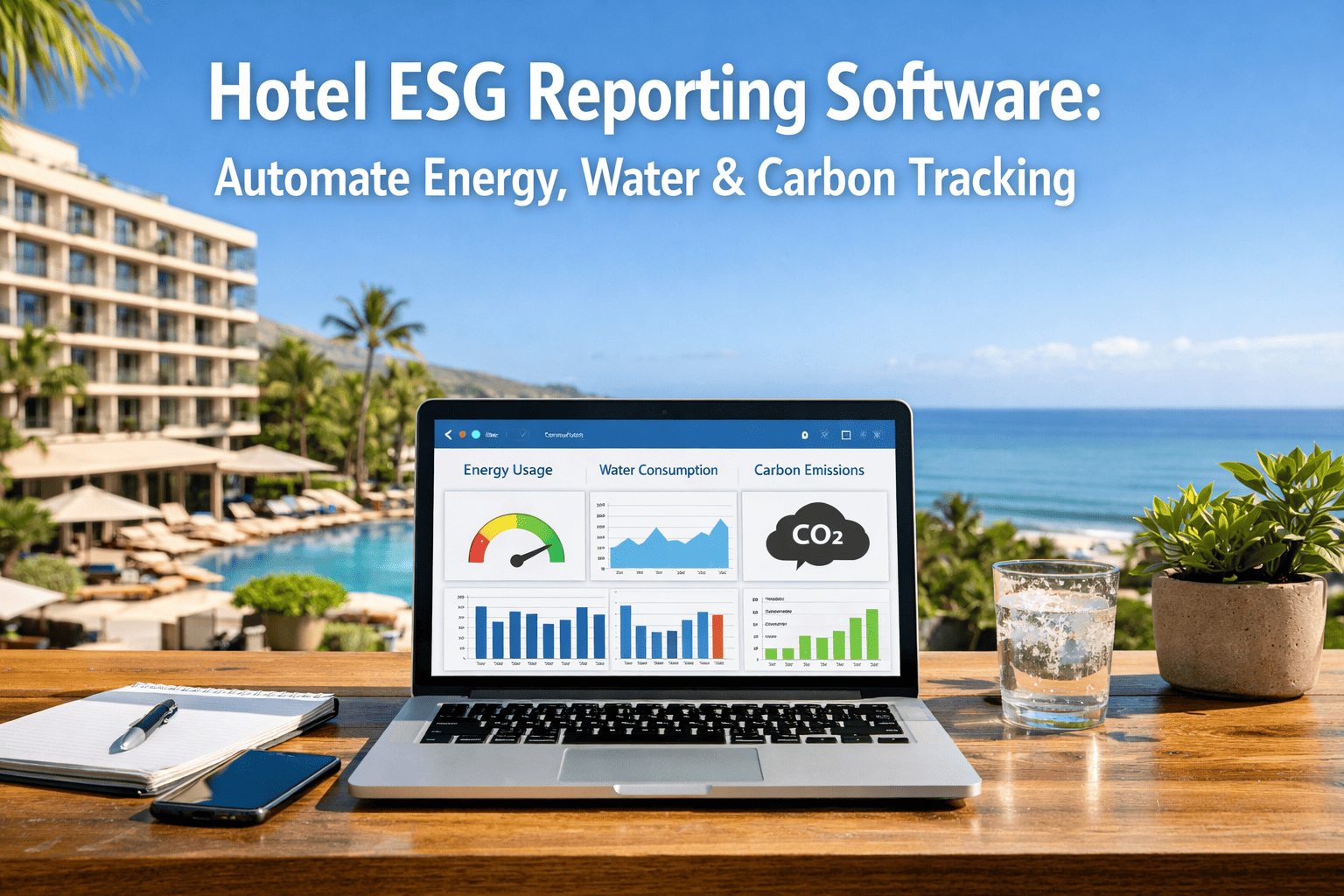
Hotel ESG Reporting Software: Automate Energy, Water & Carbon Tracking
The data your investors, brands, and guests demand already exists in your hotel. The challenge is getting it out of utility bills and spreadsheets and into a single, audit-ready ESG dashboard — automatically.
Why ESG Reporting Is Now a Business Necessity — Not a Brand Story
Three forces have converged to make ESG reporting non-negotiable for hotel operators in 2025: regulatory mandates, capital market pressure, and guest behavior. None of these are soft factors — each carries direct financial consequences for properties that are not prepared.
Compliance Mandates
The EU's Corporate Sustainability Reporting Directive (CSRD) now applies to US-based hotel companies with European entities. The ISSB has issued global sustainability disclosure standards. Building performance standards with penalties for non-compliance are expanding across US cities and states.
Investor & Lender Pressure
Banks are factoring ESG compliance into lending decisions — some refusing to finance hotels that fail to meet sustainability standards. Properties without verified ESG data face what analysts call a "brown discount" on asset valuations and limited access to green financing instruments.
Brand & Distribution Requirements
Major hotel brands — Marriott, IHG, Hilton, Accor — now require verified ESG data from managed and franchised properties. Corporate travel RFP platforms increasingly filter on sustainability certifications. Without the data, properties lose preferred vendor status.
Guest Booking Behavior
A third of all hotel guests now research a property's environmental practices before booking. Among guests under 25, that figure rises to 44%. Online travel agencies are surfacing sustainability certifications as booking filters — making ESG visibility a direct occupancy driver.
Most hotel operators cannot tell you their carbon emissions per room night — not because the number does not exist, but because the data sits in utility bills, fuel delivery records, and maintenance logs that no one has aggregated. A hotel that cannot measure its ESG performance cannot manage it — or prove it to anyone who matters.
What Hotel ESG Reporting Software Actually Tracks
Effective ESG reporting for hotels covers three core environmental metric categories, each with its own data sources, calculation methodology, and reporting framework requirements. Here is what needs to be measured — and why.
The Manual Reporting Problem — and What Automation Fixes
ESG Frameworks Hotels Must Report Against
Different stakeholders use different frameworks. A hotel reporting to an institutional investor faces different requirements than one seeking Green Key certification or submitting to a brand's corporate sustainability portal. The most common frameworks your ESG software must support:
The most widely used sustainability reporting standard globally. Covers energy, water, emissions, and waste with sector-specific guidance for hotels.
The hospitality industry's standard for calculating and communicating carbon emissions per room night and per meeting space — used by major brands and RFP platforms.
Standardized water consumption reporting per occupied room night. Enables benchmarking against the Cornell Hotel Sustainability Benchmarking Index dataset.
EU mandatory reporting directive applying to large companies and US firms with EU operations. Requires double-materiality assessment and audited ESG disclosure.
The benchmark used by real estate investors and REITs to assess sustainability performance of property portfolios. Hotels are scored annually and compared to sector peers.
For hotel companies committed to net-zero pathways aligned with the Paris Agreement. Requires measured emission baselines and verified annual reduction progress.
Key ESG KPIs Every Hotel Should Be Tracking Now
| KPI | What It Measures | Why It Matters | Reporting Frequency |
|---|---|---|---|
| CO2e per occupied room night | Carbon intensity normalized to occupancy | Primary metric for HCMI, brand portals, corporate travel RFPs | Monthly |
| Energy intensity (kWh/m2) | Energy use per square meter of floor area | Enables benchmarking across property types and star ratings | Monthly |
| Water per occupied room night (L) | Total water consumption normalized to occupancy | HWMI standard — industry average 250L, top performers under 140L | Monthly |
| Renewable energy percentage | Share of electricity from certified renewable sources | Required for RE100 commitments, CSRD disclosure, green bond reporting | Quarterly |
| Leak detection response time | Hours from leak alert to repair completion | Emerging HWMI KPI — reflects proactive water stewardship capability | Per event |
| Year-over-year emission trend | % change in Scope 1+2 emissions vs prior year | Core metric for SBTi progress, investor ESG scoring, and CDP submission | Annual |
A 186-room Holiday Inn that tracked carbon in OxMaint discovered it was operating at 14 kg CO2e per occupied room night — significantly below the brand-tier average of 22 kg. Without the measurement, that performance advantage was invisible to the brand, corporate accounts, and investors who needed exactly that number to award preferred status.
How OxMaint's ESG Dashboard Works
Connect Your Data Sources
Utility meters, maintenance work orders, fuel delivery records, and IoT sensor feeds are connected to OxMaint. Manual bill upload is also supported for properties without smart metering. All inputs are normalized into standardized consumption units automatically.
Automatic Scope Calculation
OxMaint calculates Scope 1 emissions from natural gas, fuel oil, and refrigerant data, and Scope 2 from electricity consumption using location-based grid emission factors. Carbon per occupied room night is calculated and displayed in real time — no manual formulas required.
Live ESG Dashboard
A single dashboard surfaces energy intensity, water per room night, carbon trend, and renewable energy share — updated continuously. Anomaly alerts flag unexpected consumption spikes before they distort your reporting period numbers.
One-Click Compliance Reports
Audit-ready reports are generated in minutes for any framework — HCMI, HWMI, GRI, brand sustainability portals, or investor ESG questionnaires. Timestamped, verifiable data replaces manual estimates — removing the weeks of preparation that ESG reporting season typically costs.
Your ESG Data Is Already There. OxMaint Surfaces It.
ESG Dashboard, Automated Environmental Metrics, and Certification Compliance — built for hotel engineering and sustainability teams who need verified data, not estimates.
The ESG Reporting Challenges Hotels Face Most
Frequently Asked Questions
Stop Estimating. Start Reporting With Verified ESG Data.
OxMaint gives hotel operators the ESG dashboard, automated environmental metrics, and certification compliance tools that turn scattered utility data into the verified, audit-ready sustainability story your investors, brands, and guests are demanding right now.