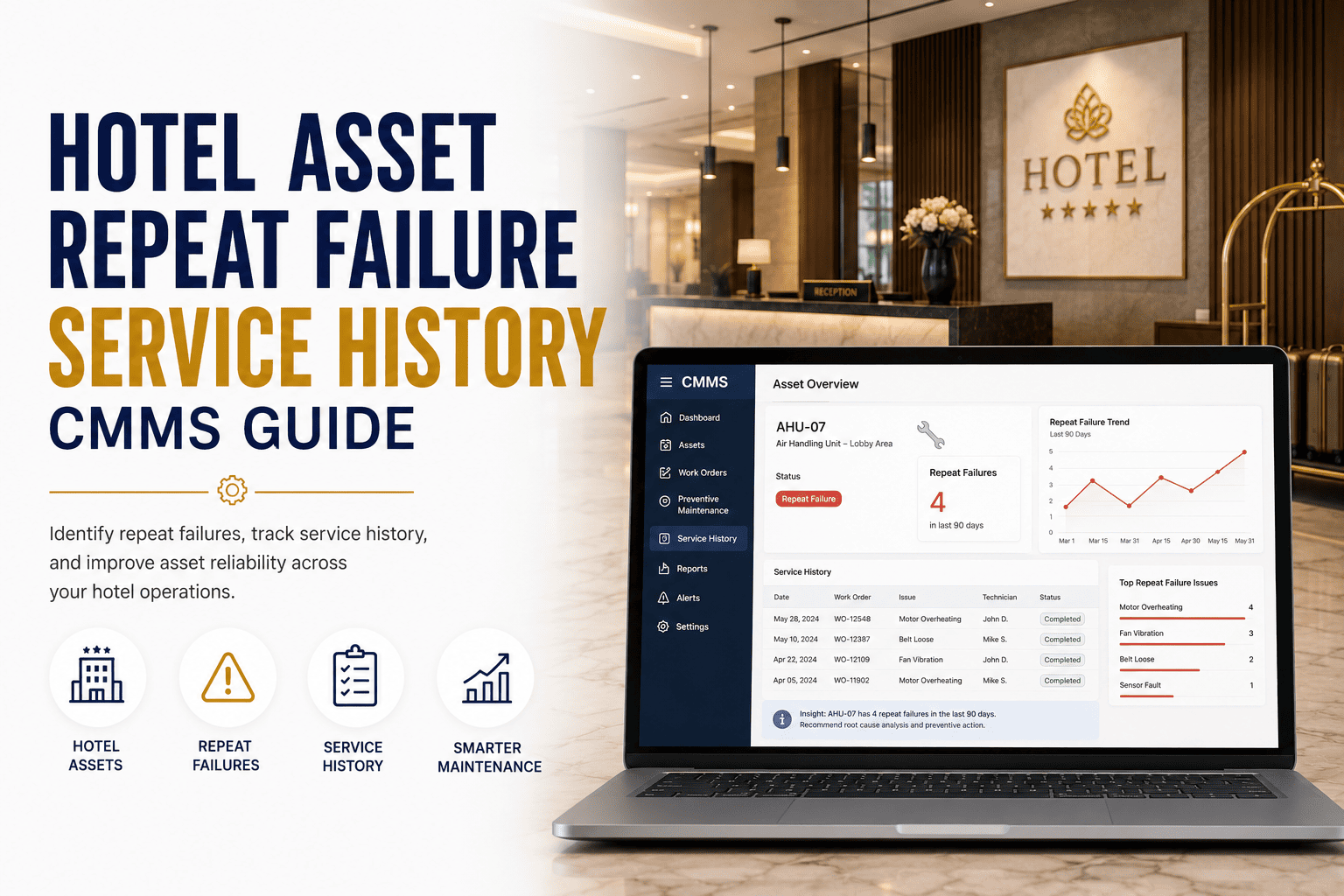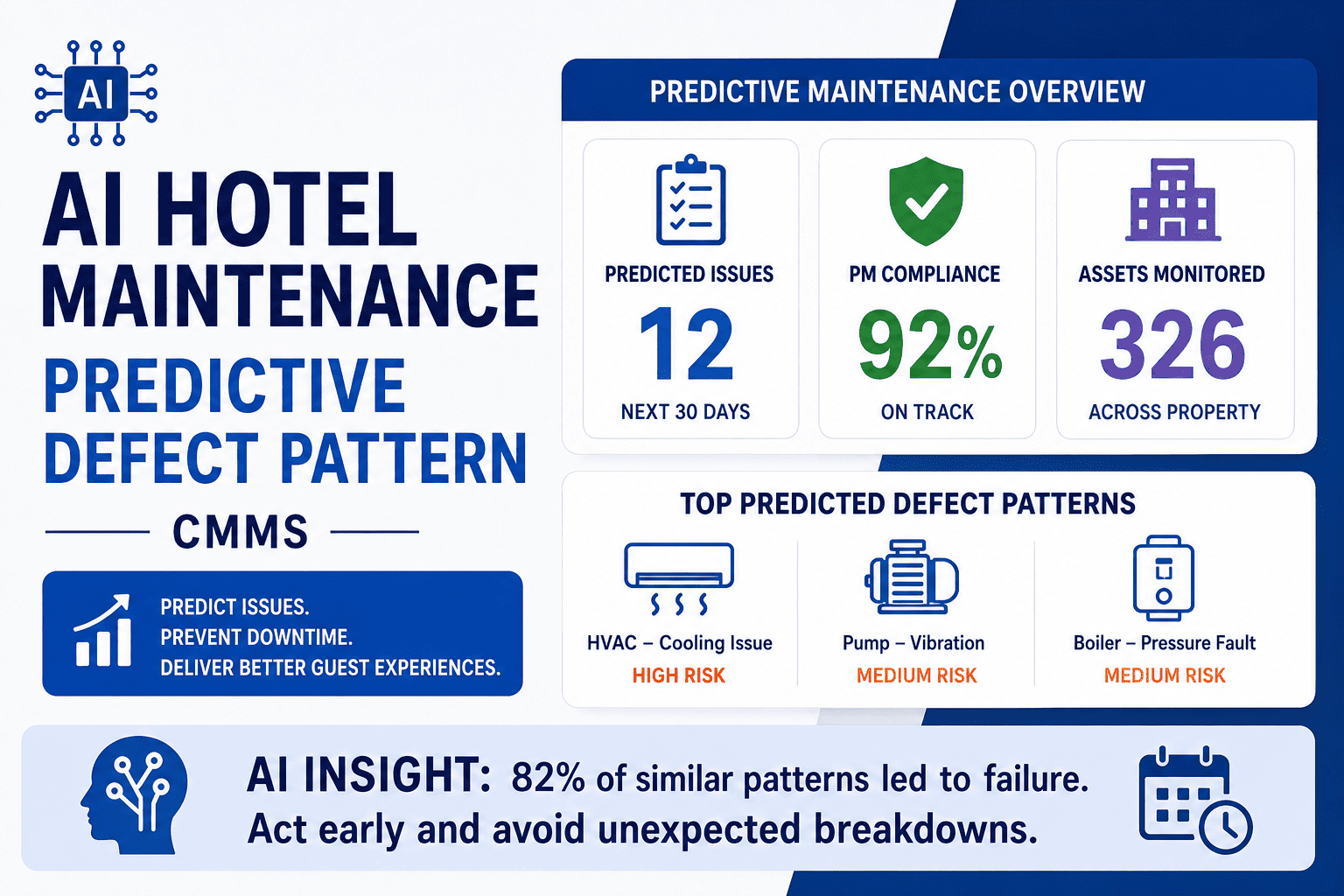
AI hotel maintenance powered by predictive defect pattern recognition is reshaping how hospitality engineering teams manage assets, guest comfort, and operational budgets in 2026. By analyzing historical work orders, guest complaints, sensor telemetry, and repeat failure logs, a CMMS with AI-driven pattern detection can flag emerging equipment defects weeks before a catastrophic breakdown occurs. This guide walks chief engineers, directors of engineering, and asset managers through the practical use cases, data prerequisites, integration steps, and measurable ROI of deploying an AI predictive defect pattern CMMS in a hotel environment — and shows how OxMaint turns scattered maintenance data into automated, proactive PM scheduling. Ready to modernize your hotel maintenance operation? Start Free Trial and see the difference AI-driven reliability makes.
AI Predictive Maintenance Guide 2026
What If Your Hotel Knew About the Next HVAC Failure — Before the Guest Did?
Repeat guest complaints, recurring work orders, and hidden sensor anomalies all form defect patterns. AI makes them visible — and automatically schedules preventive maintenance before a single room goes out of service. A 250-room hotel running predictive defect detection can recover 30–50% of unplanned downtime within the first quarter.
Defect Pattern Recognition
How AI Detects Defect Patterns in Hotel Maintenance Data
A modern hotel generates thousands of maintenance data points daily — mini-bar faults, HVAC temperature deviations, door lock battery drops, plumbing leak complaints, and elevator service calls. AI predictive maintenance doesn't just log these events; it cross-references them to identify emerging failure signatures invisible to manual review.
Guest Complaint Frequency Clustering
AI clusters repeat complaints by room, floor, wing, or asset type. Three calls about "warm air" in the east wing within 14 days triggers a predictive alert — not three disconnected work orders.
Work Order Recurrence Signatures
When the same asset receives corrective work orders at shrinking intervals (e.g., 90 days, then 61, then 38), the AI flags accelerating degradation and recommends intervention before the next failure window.
Sensor Telemetry Anomalies
Vibration, temperature, and current draw data from IoT-connected chillers, pumps, and AHUs are continuously analyzed. A 12% vibration increase over 7 days on a cooling tower fan bearing raises an early-warning flag.
Spare Parts Consumption Correlation
Unusual spikes in specific part consumption — like burner igniters or condensate pump motors — signal systemic rather than isolated issues, prompting root-cause investigation rather than repeated replacement.
Implementation Timeline
CMMS AI Predictive Hotel: 4-Month Implementation Roadmap
Deploying AI-driven defect pattern recognition in a hotel CMMS is not an overnight flip — but a structured, 16-week rollout delivers measurable downtime reduction by Month 3. Here is the proven path engineering teams follow with OxMaint.
Data Audit & Asset Hierarchy Cleanup
Standardize asset naming conventions, import historical work orders (minimum 12 months), map spare-parts inventory, and validate location hierarchies. AI pattern detection is only as good as the data foundation beneath it — garbage in, predictive noise out.
Pattern Engine Activation & Baseline Learning
OxMaint's AI engine begins ingesting live work orders, guest complaint logs, and IoT telemetry. It establishes baseline failure intervals and normal operating envelopes for each critical asset class — from rooftop units to commercial laundry equipment.
Predictive Alert Tuning & PM Auto-Scheduling
Engineers review the first wave of AI-generated defect alerts, confirm true positives, and adjust sensitivity thresholds. Validated patterns trigger automated PM work order generation — no manual scheduling required.
ROI Measurement & Continuous Optimization
Compare unplanned downtime, guest complaint resolution time, and emergency repair spend against the pre-deployment baseline. Most hotels see a 20–35% reduction in reactive work orders by Week 16, with deeper gains as the model matures.
See OxMaint's AI Defect Detection on Your Hotel's Assets
Book a 30-minute demo and we'll show you exactly how predictive pattern recognition maps to your property's equipment, guest complaint trends, and maintenance workflow — live.
Value & ROI Analysis
Hotel Failure Prediction CMMS: What It Costs to Stay Reactive
A 180-asset hotel property averaging 2.3 unplanned equipment failures per month spends approximately $42,000 annually on emergency repairs, expedited parts, overtime labor, and guest compensation. Predictive defect pattern detection changes that math — here's the breakdown.
| Cost Category | Reactive (Annual) | With AI Predictive CMMS | Savings |
|---|---|---|---|
| Emergency HVAC/chiller repairs | $18,500 | $6,200 | 66% |
| Guest compensation (out-of-service rooms) | $12,000 | $2,400 | 80% |
| Overtime & after-hours labor | $7,500 | $2,100 | 72% |
| Expedited spare parts shipping | $4,000 | $600 | 85% |
| Total Annual Cost | $42,000 | $11,300 | $30,700 |
Real-world example: A 320-room resort property in Florida deployed OxMaint's AI predictive defect detection across 14 rooftop AHUs and 3 central chillers. Within 90 days, the system flagged abnormal current draw on Chiller 2 — a compressor bearing defect confirmed by vibration analysis. Scheduled repair during a low-occupancy window cost $4,800. The avoided unplanned failure was estimated at $19,200 in emergency repair, guest relocation, and lost revenue. Payback period: less than 4 months on that single event alone.
Data Requirements
What Data Does a CMMS Hotel Defect Pattern Engine Need?
AI predictive maintenance is not magic — it's applied data science. The richer and more structured your historical maintenance data, the faster and more accurate the pattern recognition becomes. Here are the four data streams OxMaint requires to activate defect prediction.
Historical Work Orders (12+ Months)
Asset-linked, date-stamped, with completion notes and failure codes. Minimum 12 months establishes seasonal patterns; 24+ months dramatically improves prediction confidence for annual equipment cycles.
Guest Complaint & Resolution Logs
Front desk and housekeeping maintenance requests mapped to room numbers and timestamps. This is the hospitality-specific signal layer that traditional industrial CMMS platforms miss entirely.
Asset Registry & Criticality Ratings
A clean hierarchy of equipment — categorized by type, location, manufacturer, install date, and business criticality. The AI prioritizes alerts based on guest impact and revenue risk weighting.
IoT Telemetry (Optional but High-Value)
Real-time sensor feeds from BMS/BAS systems — vibration, temperature, pressure, current draw. Even partial IoT coverage on top 20% of critical assets significantly accelerates pattern detection accuracy.
OxMaint Solution
How OxMaint Powers AI Hotel Maintenance Predictive Defect Detection
OxMaint is built specifically for maintenance and reliability teams who need to move from reactive firefighting to data-driven prevention. Here's how our AI-powered CMMS and EAM platform maps directly to hotel defect pattern recognition and automated PM scheduling.
AI Pattern Detection Engine
Continuously analyzes work order history, complaint clusters, and telemetry to identify failure signatures — surfacing emerging defects 14–30 days before breakdown with 85%+ confidence scoring.
Automated PM Scheduling
When the AI predicts a failure window, OxMaint auto-generates a preventive maintenance work order — assigned, parts-reserved, and scheduled for the optimal low-occupancy window. Zero manual intervention.
Unified Asset & Inventory Tracking
Full EAM visibility into asset lifecycle, warranty status, spare-parts levels, and replacement cost forecasting — so when the AI flags a defect, parts availability is never the bottleneck.
Maintenance Analytics & KPI Dashboards
Real-time dashboards for MTBF, MTTR, PM compliance, and defect prediction accuracy — giving directors of engineering board-ready reports that prove ROI and justify capital budget requests.
Operator Proof
What Hotel Engineering Teams Say About AI-Driven CMMS
"OxMaint flagged a recurring guest complaint pattern on the 4th floor — three rooms with intermittent hot water issues over 10 days. Turns out we had a failing mixing valve on a branch line. Fixed it for $340 instead of the $4,200 in comps we would have paid. The AI saw the pattern we couldn't."
"We cut reactive work orders by 38% in the first quarter after switching from spreadsheets to OxMaint. The automated PM scheduling alone saved my team 6–8 hours a week. The predictive alerts are getting smarter every month as more data flows in."
Frequently Asked Questions
AI Hotel Maintenance Predictive Defect Pattern CMMS — FAQ
What is AI predictive defect pattern recognition in hotel maintenance?
It's the use of machine learning within a CMMS to analyze work orders, guest complaints, sensor data, and parts consumption history — identifying recurring failure signatures before they escalate into unplanned breakdowns. Instead of reacting to each work order in isolation, the AI cross-references events across time, location, and asset type to detect patterns that indicate an emerging defect, then automatically triggers preventive maintenance.
How much historical data does a hotel need before AI pattern detection works?
A minimum of 12 months of digitized, asset-linked work orders is the practical baseline for meaningful pattern detection. Hotels with 24+ months of clean data see significantly higher prediction confidence, especially for seasonal equipment like chillers and boilers. If your historical data lives in spreadsheets or paper logs, OxMaint's onboarding team helps structure and import it — Book a Demo to see how fast the migration can be.
Can OxMaint integrate with our existing hotel PMS and BMS/IoT systems?
Yes. OxMaint supports API-based integration with major hotel Property Management Systems and Building Management Systems, allowing guest complaint data and IoT telemetry to flow directly into the CMMS for AI analysis. The platform also accepts manual imports and CSV uploads during the transition period if real-time integration isn't immediately available.
How quickly can a hotel see ROI from AI predictive maintenance?
Most hotel properties see measurable ROI within 3–4 months of deployment. The first avoided catastrophic failure — such as a chiller breakdown during peak season — often pays for the entire annual CMMS subscription. Properties typically report 20–35% fewer reactive work orders in Quarter 1 and 30–50% unplanned downtime reduction by Quarter 2 as the AI model matures and alert accuracy improves.
Is AI predictive maintenance worth it for smaller hotels under 100 rooms?
Yes — smaller properties often have leaner engineering teams and less redundancy, making each unplanned failure proportionally more disruptive. OxMaint's pricing scales with property size, and even a single avoided HVAC failure or elevator outage typically delivers 3–5x return on the annual platform cost. Smaller hotels also benefit most from automated PM scheduling, which frees the chief engineer from administrative work to focus on hands-on reliability.
Stop Reacting to Failures. Start Predicting Them.
Join the hotel engineering teams using OxMaint to detect defect patterns before guests notice — and automatically schedule the maintenance that prevents downtime. See it live on your assets in 30 minutes.
Free 14-day trial · No credit card