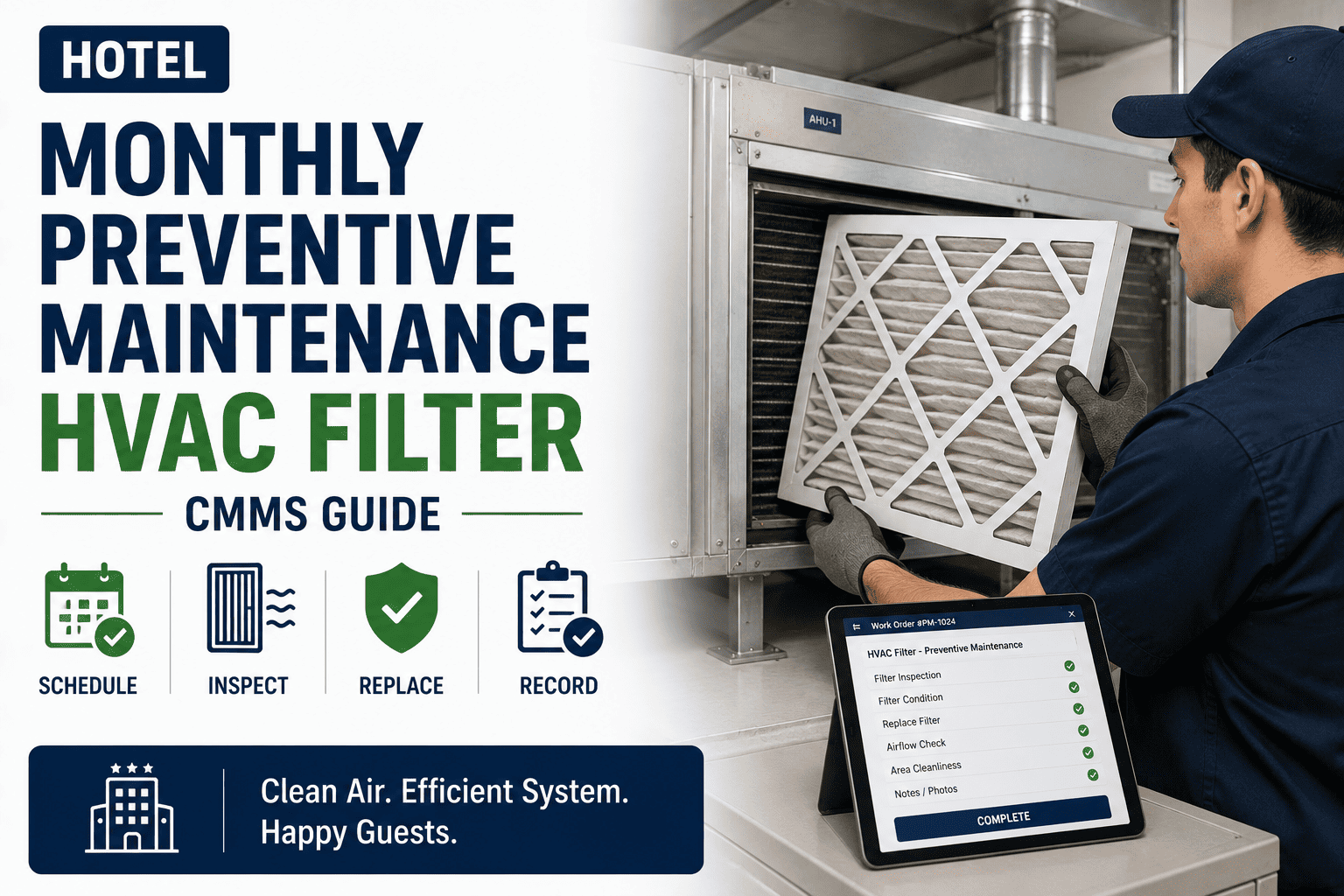
When a hotel chiller fails at 2 PM on a 38-degree summer afternoon, the first call is never to maintenance — it is from guests who are already hot, already writing reviews, and already requesting refunds. A chiller that has tripped twice in 90 days for what appears to be the same cause is not experiencing bad luck. It is experiencing a systemic failure that a calendar-based PM schedule failed to detect, document, and prevent. OxMaint's AI predictive engine monitors every HVAC asset across your property — chiller, AHU, FCU, cooling tower, VRF — surfacing failure signals 4–8 weeks before the breakdown, generating work orders autonomously, and continuously improving as your maintenance data grows. Book a demo to see OxMaint's AI HVAC monitoring configured on your property's asset hierarchy.
AI predictive maintenance for hotel HVAC is not a standalone analytics dashboard. It is an integrated failure detection, work order generation, and PM optimisation system — embedded in OxMaint's CMMS so every AI alert becomes a closed corrective action, a revised PM interval, and documented evidence of systemic improvement for brand audits, insurance reviews, and regional compliance frameworks.
Why Reactive and Calendar-Based HVAC Maintenance Fails Hotels
A chiller degrading over 6 weeks shows no visible sign on a monthly inspection. The guest who checks into a room at 28°C is the first person to report the failure — at which point the OTA review is already being drafted.
A calendar-based PM services the FCU on floor 3 every 90 days regardless of runtime, load, or actual condition. The unit degrading rapidly under high summer occupancy gets the same attention as one running at 20% load in an empty wing.
An FCU that failed for bearing wear in March fails again in August. The prior corrective action recommended a PM interval reduction that was never implemented in the CMMS. The second failure costs 3× the first — and produces a second guest complaint on the same room number.
A chiller running with fouled condenser coils draws 15–30% more energy than a clean unit — but the utility bill shows a property-wide total. Without asset-level consumption monitoring, the degrading unit runs overloaded for months before the waste is traced to its source.
Every sensor reading, every runtime hour, every temperature deviation is a data point in the failure story. OxMaint's AI reads that story before the guest does.
How OxMaint AI Predictive Maintenance Works for Hotel HVAC
OxMaint connects to your BMS, IoT sensor network, and PMS — ingesting vibration, temperature, refrigerant pressure, airflow, and occupancy data per asset, per room, 24/7. No new hardware required where existing sensors are in place.
AI models compare live sensor readings against each asset's own operational baseline — flagging deviations invisible to scheduled inspections. A chiller approach temperature rising 2°C over 3 weeks is caught. A monthly inspector walking past it is not.
Each HVAC asset receives a live health score updated continuously. Assets crossing a configurable risk threshold trigger an automated alert — ranked by failure probability, potential guest impact, and estimated intervention window before the breakdown occurs.
When an asset crosses the alert threshold, OxMaint generates a prioritised corrective work order — assigned to the right technician by trade and floor zone, with asset history and sensor evidence attached. No manual trigger, no radio call, no dispatch delay.
Every completed work order feeds the AI model. An asset that degrades faster than its PM interval allows gets a revised schedule automatically — eliminating the gap between identified interval problems and CMMS updates that causes repeat failures.
When a failure mode is identified on one FCU, OxMaint scans the full fleet for other units of the same type showing similar sensor signatures — alerting on at-risk assets before the same failure propagates across floors or wings.
HVAC Assets OxMaint AI Monitors — and What It Detects
| Asset | Failure Modes Detected | Detection Lead Time | Guest Impact if Missed |
|---|---|---|---|
| Chiller | Refrigerant undercharge, fouled condenser tubes, compressor bearing wear, approach temperature drift, COP degradation | 4–8 weeks | Full cooling loss across multiple floors. $50K–$200K emergency cost including guest compensation |
| AHU / MAU | Filter blockage, belt wear, coil fouling, drain pan overflow, fan motor bearing degradation | 2–5 weeks | Reduced air quality and temperature control across served zones. 15–30% energy overrun per blocked filter |
| Fan Coil Unit (per room) | Motor degradation, filter blockage, drain blockage, control valve seizure, refrigerant temperature drift | 1–4 weeks | Direct guest complaint and negative review. #1 source of HVAC-related OTA mentions |
| Cooling Tower | Water chemistry deviation, Legionella risk indicator, drift eliminator damage, fan bearing wear, basin fouling | Days to weeks (chemistry daily) | Regulatory shutdown risk. Legionella outbreak liability. Chiller efficiency collapse |
| VRF / VRV System | Refrigerant circuit fault, outdoor unit coil fouling, error code accumulation, indoor unit filter blockage by room | 2–6 weeks | Multiple rooms affected simultaneously from a single refrigerant circuit fault |
| BMS / Controls | Sensor calibration drift, set-point deviation, control loop failure, schedule overrun in unoccupied zones | Continuous (real-time) | Silent energy waste. Miscalibrated sensors cause 8–12% overcooling/overheating energy overrun |
No separate analytics platform. No data export. AI alerts, work orders, and PM updates all in the same system your engineering team already uses.
OxMaint AI vs. Competitors: Hotel HVAC Predictive Maintenance
Most CMMS platforms record what happened. Analytics platforms show trends. OxMaint connects the failure signal to a closed work order — in the same system, without a data export to a separate tool.
| Capability | OxMaint | MaintainX | UpKeep | Fiix | Limble | IBM Maximo | Hippo/Eptura |
|---|---|---|---|---|---|---|---|
| AI HVAC failure prediction from sensor data | Yes | No | No | No | Limited | Add-on | No |
| Autonomous work order from AI alert | Yes | No | No | No | Semi-auto | Enterprise only | No |
| Room-level FCU asset tracking | Yes | Manual setup | Manual setup | Generic | Manual setup | Yes | Partial |
| Legionella log and water treatment records | Yes | Manual WO | Manual WO | No | Manual WO | Add-on | No |
| Fleet-wide pattern alert — same failure, other assets | Yes | No | No | No | No | With APM add-on | No |
| BMS and IoT sensor integration | Yes | No | No | Limited | Limited | Yes | No |
| AI PM interval optimisation from outcomes | Yes | No | No | No | No | Custom build | No |
| Compliance export — L8, F-Gas, ASHRAE, regional | Yes | No | No | Generic | Yes | Enterprise | Manual |
| Deployment without IT project | 3–4 weeks | 4–6 weeks | 4–6 weeks | 6–10 weeks | 4–8 weeks | 3–6 months | 6–10 weeks |
Regional Compliance Coverage
OxMaint structures every AI maintenance record to satisfy jurisdiction-specific documentation requirements — exportable for brand, insurer, and regulatory review in under 2 hours.
| Region | Key Frameworks | OxMaint Record Output |
|---|---|---|
| USA / Canada | ASHRAE 62.1, EPA Section 608, OSHA 29 CFR 1910, ADA Title III, ENERGY STAR, local AHJ | Section 608 refrigerant log per asset, ASHRAE 62.1 PM records, AI alert sensor evidence, AHJ-ready export |
| UK | HSE L8 Legionella ACOP, F-Gas SI 2015/310, TM44 inspection, Fire Safety Order, HHSRS | AI-triggered L8 Legionella alerts, F-Gas refrigerant log per asset, TM44 records, EHO-ready audit export |
| Australia | AS/NZS 3666, AIRAH DA19 Legionella, WHS Act 2011, state refrigerant licensing, NCC Section J | AS/NZS 3666-aligned AI records, Legionella alert log, licensed handler work orders, WHS compliance export |
| Germany | VDI 6022, ChemVerbotsV F-Gas, DIN EN 15780, BetrSichV, TRBS 1201 | VDI 6022 hygiene monitoring records, F-Gas documentation per asset, BetrSichV PM compliance — TÜV-exportable |
| Saudi Arabia / UAE | Civil Defence HVAC requirements, UAE OSHAD-SF, ASHRAE 55 thermal comfort, municipality inspection | Civil Defence AI-monitored HVAC records, thermal comfort documentation, municipality inspection evidence archive |
OxMaint generates your full AI maintenance record export — sensor evidence, work order trail, and framework-aligned documentation — in a single click from any device.
Implementation Roadmap: AI HVAC Monitoring Live in 4 Weeks
Every chiller, AHU, FCU, cooling tower, and VRF circuit onboarded as a named asset with room-level tagging. BMS and IoT sensor feeds connected. Historical work order and failure data imported to establish AI baselines before live monitoring begins.
OxMaint's AI engine calibrated to your property's specific equipment, occupancy patterns, and failure history. Alert thresholds configured per asset class and criticality level. Legionella, F-Gas, and refrigerant log templates activated.
Autonomous work order routing configured by trade, floor zone, and priority. Critical HVAC findings block front desk room release. Engineering team trained on AI alert review and mobile work order completion — half-day on-site session.
Energy analytics dashboard activated — surfacing HVAC assets running outside efficiency parameters. Compliance export templates finalised. AI accuracy improves continuously as every closed work order feeds the model — predictions become earlier and more precise over time.
Results: What Hotel Properties Report After OxMaint AI HVAC Deployment
Within 90 days of AI HVAC monitoring go-live — faults resolved before check-in, not after the OTA review.
Frequently Asked Questions
Stop Waiting for the Guest Complaint to Find Your Next HVAC Failure
OxMaint's AI predictive engine, autonomous work orders, and condition-based PM scheduling deploy in 4 weeks on any hotel property — with every failure signal detected before check-in, not after.