Hospital Fire Safety Maintenance: NFPA Compliance Checklist
By James smith on April 4, 2026
A failed fire door latch, a sprinkler head blocked by a storage cart, or a smoke detector untested since last survey — any single gap in a hospital's fire safety maintenance programme can result in a Joint Commission citation, a CMS survey finding, or a life-safety incident. OxMaint's Preventive Maintenance module auto-generates every NFPA 25, 72, 80, and 101 inspection task on schedule — so your team checks every item, documents every finding, and produces Joint Commission-ready records without manual tracking. Use this checklist to audit your current programme, then book a demo to see how OxMaint manages it automatically.
Hospital Fire Safety · NFPA Compliance Checklist · OxMaint
A complete inspection checklist covering fire alarm, sprinkler, fire door, suppression, smoke control, and extinguisher systems — organized by frequency with NFPA standards and Joint Commission citations for each task.
Fire safety systems requiring scheduled inspection in every hospital
NFPA 101
Life Safety Code — primary standard governing hospital fire protection
EC.02.03
Most frequently cited Joint Commission standard group in hospital surveys
Annual
Minimum fire door inspection interval — every assembly, every door
Weekly Inspections
Weekly Fire Safety Checks — Every 7 Days
FPW
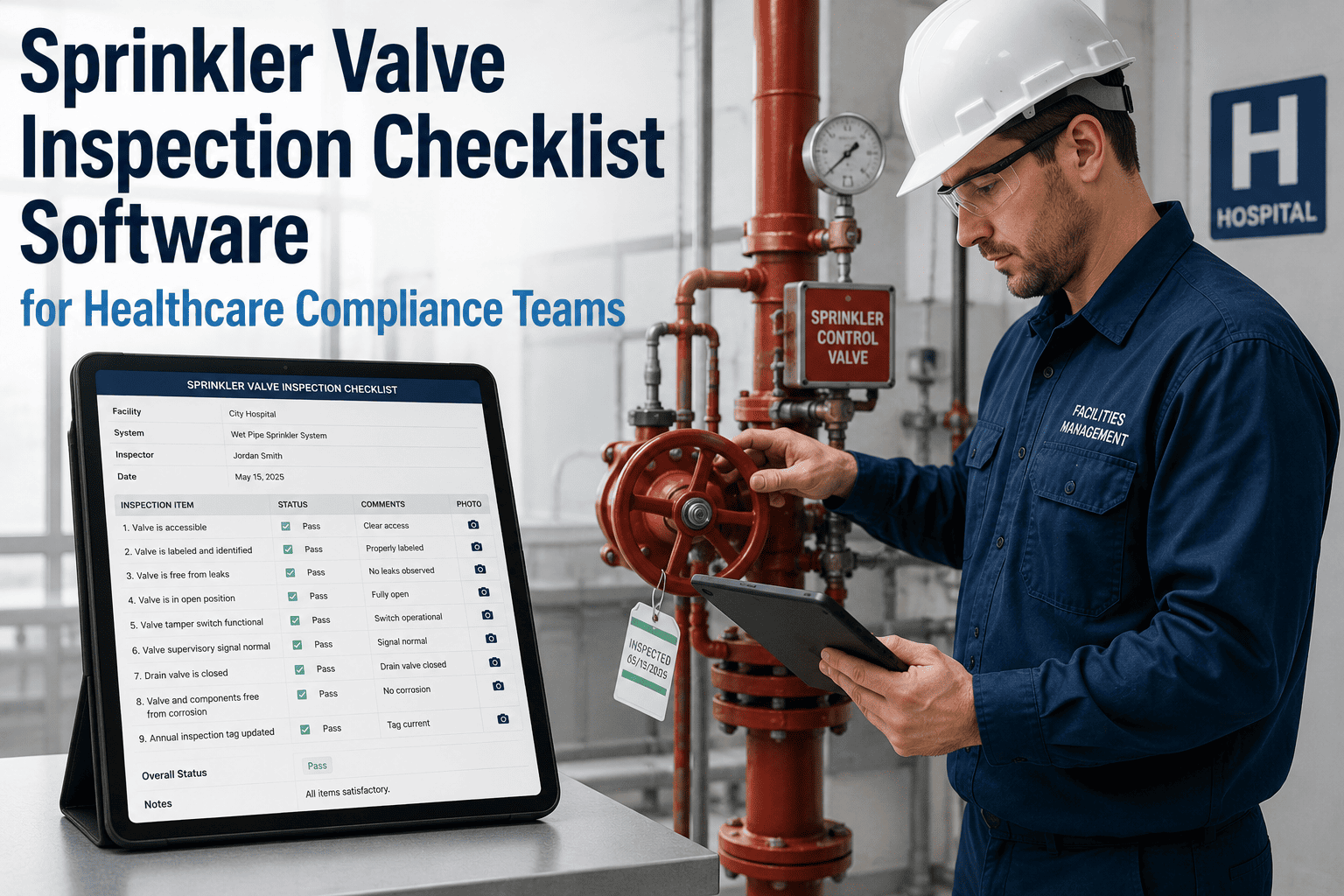
Fire Pump & Sprinkler Control Valves — Weekly Visual
NFPA 25 Table 5.1.1.1
The fire pump and all sprinkler control valves must be visually inspected weekly. A closed or partially closed control valve is the single most dangerous fire protection deficiency — it renders the entire sprinkler system non-functional without triggering any alarm.
What this section catches:
Closed control valves that render sprinklers inactive · Pump mechanical issues before failure · Power supply faults before a fire event
EGR
Egress and Exit Access — Weekly Walk
NFPA 101 §19.2
Exit routes, corridors, and egress paths must be maintained clear and unobstructed at all times. Hospital corridors double as evacuation routes and must comply with NFPA 101 corridor width and obstruction requirements continuously — not just at inspection time.
What this section catches:
Egress obstructions before a fire event · Failed emergency lighting · Propped stairwell doors that violate smoke compartmentation
Monthly visual inspection of all fire alarm initiating devices, notification appliances, and control panels is required by NFPA 72. OxMaint generates zone-by-zone monthly inspection WOs with mandatory deficiency capture before the work order can be closed.
What this section catches:
Painted or obstructed detectors that won't activate · Damaged pull stations before a fire event · FACP trouble conditions indicating system faults
Monthly visual inspection of all sprinkler heads is required under NFPA 25. Renovation, storage changes, and ceiling work between inspections are the most common source of undetected violations. Book a demo to see OxMaint's sprinkler PM tracking.
What this section catches:
Sprinkler heads that won't activate due to obstruction or coating · Pressure anomalies indicating system integrity issues
EXT
Portable Fire Extinguishers — Monthly Visual
NFPA 10 §7.3.1
Every portable fire extinguisher must be visually inspected monthly. The most common Joint Commission finding is not a missing extinguisher — it is a missing inspection record for an extinguisher that was present and charged.
What this section catches:
Discharged or tampered extinguishers · Missing or outdated service records that generate immediate JC citations
Book a Demo — See OxMaint Auto-Generating Every Item on This Checklist.
Weekly fire pump WOs · Monthly FAL zone inspections · Quarterly flow tests · Annual fire door inspections per door ID · All documented and retrievable for Joint Commission surveys in under 2 minutes.
Quarterly flow tests verify the sprinkler system's water supply and distribution are functioning correctly. Results must be recorded and compared against previous quarters and hydraulic design requirements. Sign in to OxMaint to store quarterly flow test results against each riser and pump asset.
What this section catches:
Water supply degradation before peak demand · Waterflow alarm failures that would prevent notification during a fire · Fire pump performance degradation before failure
Semiannual Inspections
Semiannual Fire Safety Checks — Every 6 Months
FAT
Fire Alarm Functional Testing — All Devices
NFPA 72 Table 14.4.5
NFPA 72 requires functional testing of all initiating devices and notification appliances semiannually. This is the most documentation-intensive inspection in the hospital fire safety programme. Every device must be tested individually and the result recorded against its device ID and location. Book a demo to see OxMaint's device-level test record management.
What this section catches:
Smoke detectors that have lost sensitivity · Failed notification appliances · Battery backup insufficient to sustain alarm during power outage · Smoke barrier breaches from recent renovation
KHS
Kitchen Hood Suppression System — Semiannual Service
NFPA 17A §7.3.3
Kitchen hood fire suppression systems in hospital food service operations must be inspected and serviced every 6 months by a licensed suppression system contractor. The service must include agent quantity, nozzle condition, and fusible link replacement.
What this section catches:
Depleted agent that would fail to suppress a kitchen fire · Blocked nozzles that cannot deliver agent to the fire area · Degraded fusible links that would delay activation
Annual Inspections
Annual Fire Safety Checks — Every 12 Months
FDR
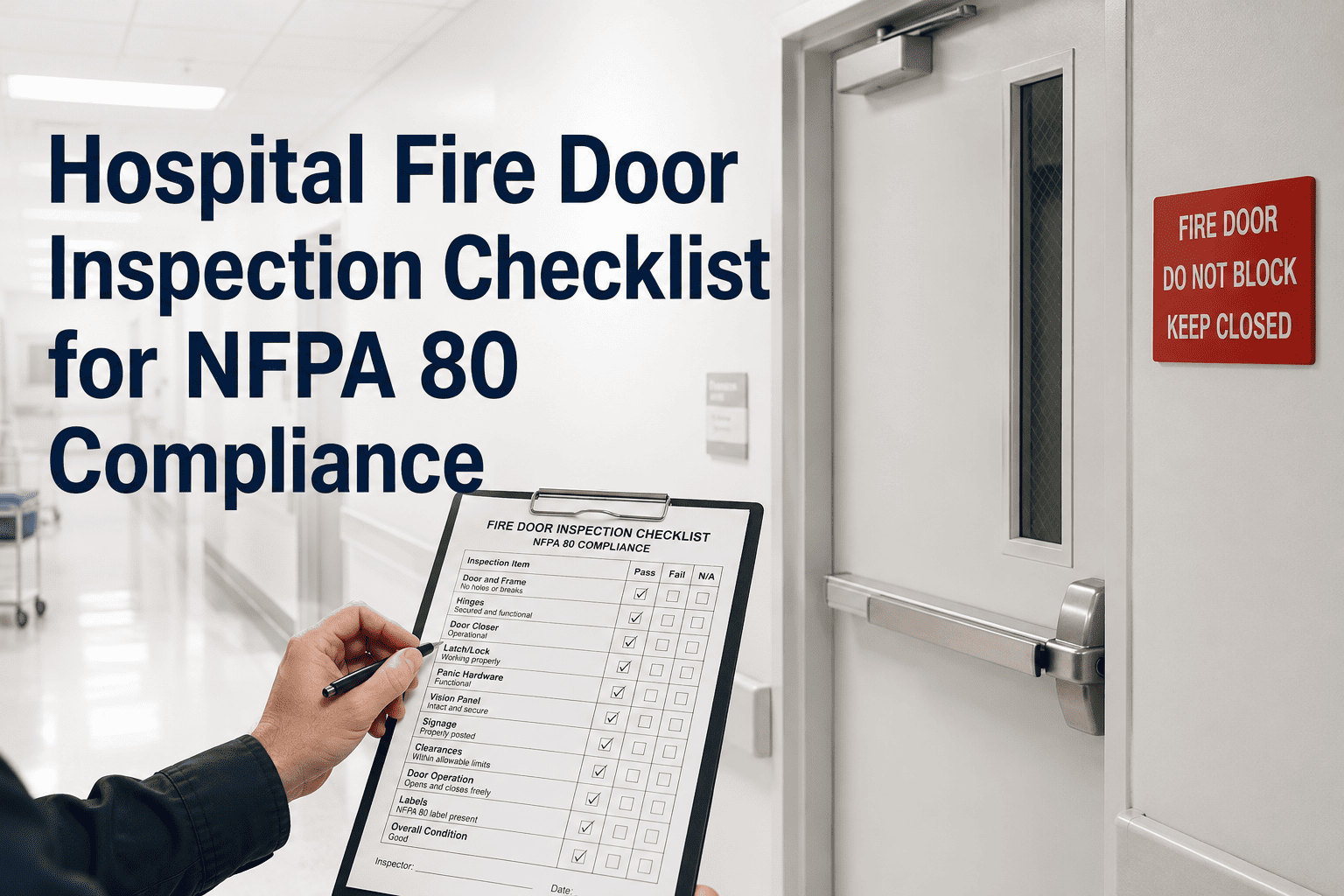
Fire Door Assemblies — Annual Inspection per NFPA 80
NFPA 80 §5.2.3 · JC EC.02.03.05
Every fire door assembly in the hospital must be inspected and tested annually — including every fire-rated door, frame, hardware, and glass element. A hospital with 500 fire doors must document 500 individual annual inspections. OxMaint creates one WO per door ID — ensuring no door is missed and every record is individually retrievable during survey.
What this section catches:
Doors that cannot contain fire and smoke during a fire event · Missing labels that cannot prove compliance · Unauthorized hold-open devices that are a direct JC citation
FDR
Fire Drills — Annual Compliance per NFPA 101
NFPA 101 §19.7.1 · JC EC.02.03.03
NFPA 101 requires a minimum of four fire drills per year in hospitals — at least one per quarter, with at least two drills conducted on each shift over the course of a year. The most common JC finding is not that drills were skipped but that shift distribution documentation is incomplete or unavailable.
What this section catches:
Missing quarterly drills that generate immediate JC citations · Inadequate shift distribution that fails the annual compliance test · Staff who do not know correct fire response procedures
NFPA Reference
Quick Reference — NFPA Standards, Intervals, and Joint Commission Citations
System
Inspection Task
Interval
NFPA Standard
JC Standard
Sprinkler
Control valve visual inspection
Weekly
NFPA 25 Table 5.1.1.1
EC.02.03.01
Fire Pump
Visual inspection — conditions, gauges, oil
Weekly
NFPA 25 Table 8.1.1.1
EC.02.03.01
Fire Alarm
All components visual inspection
Monthly
NFPA 72 Table 14.3.1
EC.02.03.01
Sprinkler
Sprinkler heads and gauges visual
Monthly
NFPA 25 Table 5.1.1.1
EC.02.03.03
Extinguishers
Visual inspection — all units
Monthly
NFPA 10 §7.3.1
EC.02.03.01
Sprinkler
Main drain test and inspector test valve
Quarterly
NFPA 25 §5.3.3
EC.02.03.03
Fire Pump
Churn test — 10 minutes no-flow
Quarterly
NFPA 25 §8.3.3
EC.02.03.01
Fire Alarm
All initiating device functional tests
Semiannual
NFPA 72 Table 14.4.5
EC.02.03.05
Kitchen Suppression
Full service — agent, links, nozzles
Semiannual
NFPA 17A §7.3.3
EC.02.03.01
Smoke Barriers
Walk survey — penetration inspection
Semiannual
NFPA 101 §19.3.7
EC.02.03.01
Fire Doors
Full assembly inspection — every door
Annual
NFPA 80 §5.2.3
EC.02.03.05
Extinguishers
Annual maintenance — internal inspection
Annual
NFPA 10 §7.4.1
EC.02.03.01
Smoke Control
Full system functional test
Annual
NFPA 92 §7.1.1
EC.02.03.05
Fire Drills
4 drills, 2 per shift, quarterly
4× per year
NFPA 101 §19.7.1
EC.02.03.03
Fire Pump
Full flow test at rated capacity
Annual
NFPA 25 §8.3.4
EC.02.03.01
Sprinkler
5-year obstruction investigation
Every 5 Years
NFPA 25 §14.2
EC.02.03.03
Extinguishers
Hydrostatic pressure test
Every 5–12 Years
NFPA 10 §8.3
EC.02.03.01
Sign in to OxMaint to configure every task in this table as an auto-generated PM work order on the correct schedule.
OxMaint for Fire Safety Compliance
How OxMaint Automates This Entire Checklist
01
Per-Device and Per-Door Asset Records — Every Item Tracked Individually
Every fire door, smoke detector, pull station, extinguisher, and sprinkler head is registered as an individual asset in OxMaint with its location, inspection schedule, and full history. When a surveyor asks for the annual inspection record for Door FD-247, the facilities manager retrieves it in under 30 seconds — not by searching a binder. Sign in to register your fire safety assets in OxMaint.
02
Deficiency-to-Repair Workflow — Every Finding Generates a Corrective WO
When a fire door inspection finds a failed latch, or a monthly sprinkler check finds an obstructed head, OxMaint auto-generates a corrective work order linked to the deficiency — with a required completion date based on urgency. The deficiency, the corrective WO, and the resolution are stored against the same asset record — the complete documentation chain Joint Commission expects. Book a demo to see deficiency-to-repair workflows.
03
JC Survey-Ready Reports — EC.02.03 Compliance in Under 2 Minutes
OxMaint generates EC.02.03 compliance reports covering: all inspection WOs by system and date range, pass/fail rates per inspection type, outstanding deficiencies and resolution status, and fire drill completion records by shift and quarter — without manual compilation. Walk any surveyor through the live dashboard or provide a PDF export within 2 minutes of their request. Sign in to see Joint Commission reporting in OxMaint.
FAQ
Hospital Fire Safety Compliance — Common Questions
How many fire drills per year does NFPA 101 require, and how are they distributed across shifts?
Does every fire door in the hospital need to be inspected annually, or only a sample?
Every fire door assembly — every door, every frame, every piece of hardware — must be individually inspected and tested annually under NFPA 80 §5.2.3. There is no statistical sampling allowance. A hospital with 600 fire doors must document 600 individual annual inspections. Book a demo to see per-door inspection tracking in OxMaint.
What happens if a deficiency is found during a fire safety inspection — how quickly must it be corrected?
Correction timelines depend on the severity and type of deficiency. Immediate life-safety hazards (closed control valve, non-functioning fire door on a Life Safety Branch) require same-day correction. Other deficiencies typically require a documented plan of correction with a completion date. The key requirement is that the deficiency, the plan, and the resolution are all documented and retrievable. Sign in to configure deficiency-to-repair workflows in OxMaint.
Can OxMaint store contractor inspection reports (fire pump, fire alarm) for Joint Commission surveys?
Yes — contractor PDF reports are attached directly to the relevant work order and asset record in OxMaint. The annual fire pump flow test report from a third-party contractor is stored against the pump asset and retrievable by asset ID or date in under 30 seconds during a survey. Book a demo to see document management in OxMaint.
Book a Demo — See OxMaint Automating Your Hospital Fire Safety Compliance Programme.
Every item on this checklist — auto-generated as a work order on schedule · Per-device and per-door records · Deficiency-to-repair workflow · Joint Commission EC.02.03 reports on demand. Always survey-ready. Never scrambling for records.