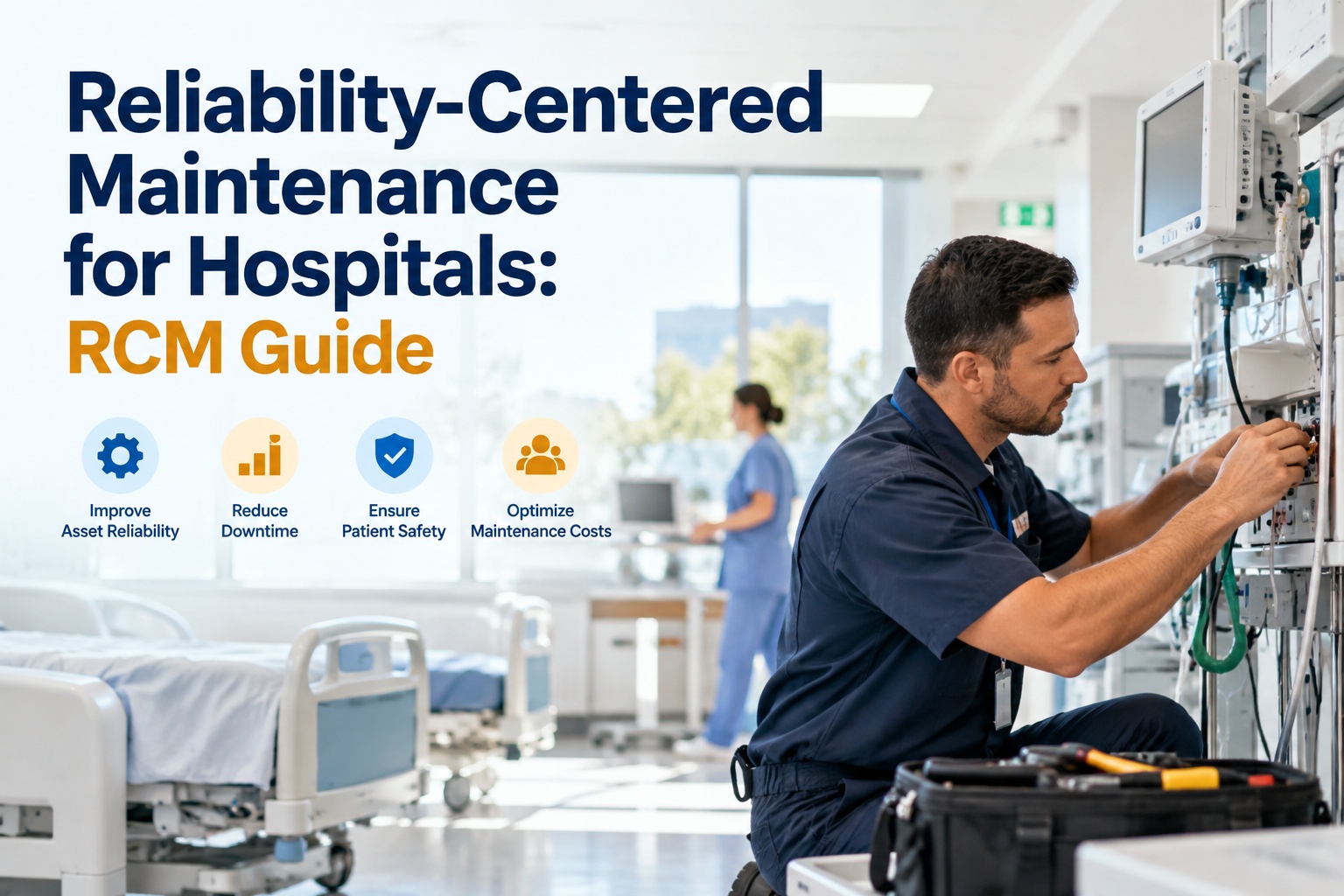
Not every asset in a hospital deserves the same maintenance strategy — and treating them as if they do is exactly how a facilities budget gets wasted on the wrong things. A ventilator and a waiting-room chair fail differently, matter differently, and should be maintained differently. Reliability-centered maintenance is the discipline of matching the maintenance strategy to how an asset actually fails and what that failure would cost — not applying one blanket PM schedule across everything. This guide walks through a practical RCM framework for hospitals — failure mode analysis, strategy selection, and the record-keeping that makes it sustainable — using OXMAINT AI, the AI-powered CMMS that turns an asset's own failure history into the evidence an RCM decision is based on.
Reliability-Centered Maintenance for Hospitals: A Practical Framework
RCM only works if the decision about how to maintain an asset is based on that asset's real failure history — not a guess, and not the same fixed-interval PM applied fleet-wide. OXMAINT AI holds that history: every inspection finding, work order and failure gets logged against the specific asset, so when it's time to decide whether a pump needs time-based PM, condition monitoring, or run-to-failure, the record to base that decision on is already there — not something someone has to go dig up.
Why One PM Schedule for Everything Wastes Effort
A fixed-interval PM schedule treats every asset the same regardless of how it actually fails. That means some low-risk assets get over-serviced, tying up technician hours, while some high-risk assets are checked on a calendar that has nothing to do with how they actually degrade. RCM exists to fix that mismatch asset by asset, failure mode by failure mode. Start free and see your own asset history mapped in OXMAINT AI.
- Every asset on the same fixed PM interval, regardless of failure pattern
- Low-risk assets serviced on a schedule more frequent than they need
- High-risk assets checked on a calendar that doesn't match how they degrade
- No record connecting a chosen PM interval to an actual failure history
- The maintenance strategy never gets revisited once it's set
- Each failure mode assigned the strategy that actually fits it
- Low-risk assets moved to run-to-failure where that's the sound choice
- High-risk, hard-to-predict assets shifted to condition-based monitoring
- Every strategy decision traceable to the failure history that justified it
- The plan updates as new failure data changes what makes sense
The RCM Decision Path
RCM isn't a single formula — it's a sequence of questions applied to each failure mode, one at a time. OXMAINT AI's asset records supply the answers to the first three questions directly; the fourth is where your team makes the call. Book a demo to walk this sequence on one of your own assets.
Matching Strategy to Failure Mode
The right strategy depends on both how detectable the failure is and how much a failure would cost. This is a general reference for how the four strategies typically get applied — your own failure and consequence data should drive the actual assignment per asset. Sign up free and assign your own strategies in OXMAINT AI.
| Strategy | Fits when | What it needs from your records |
|---|---|---|
| Time-based PM | Failure is age- or usage-related and predictable on a schedule | A service history showing the failure pattern tracks with time or run hours |
| Condition-based | A measurable signal precedes the failure with useful warning time | Trend data — vibration, temperature, oil analysis — logged consistently over time |
| Run-to-failure | Low consequence, low cost to repair, no useful early warning available | History confirming the failure is genuinely low-impact, not just untracked |
| Redesign / replace | Failure is frequent, high-consequence, and no maintenance strategy fixes it | A repeat-failure pattern strong enough to justify a capital decision |
A Strategy Is Only as Good as the Failure History Behind It.
Choosing condition-based monitoring for an asset with no trend data logged isn't RCM — it's a guess with a technical name. OXMAINT AI keeps every asset's failure and inspection history in one place, so the strategy decision has something real to stand on.
One Asset, Walked Through RCM
Here's how the decision path actually plays out on a real asset record inside OXMAINT AI. Book a demo to run this same walkthrough on your own fleet.
Fixed PM Schedule vs. RCM-Assigned Strategy
| What matters | One fixed PM schedule | RCM with OXMAINT AI |
|---|---|---|
| Basis for the interval | Manufacturer default or industry habit | This asset's own failure-mode history |
| Low-risk assets | Serviced on the same schedule as everything else | Candidates for run-to-failure where justified |
| High-risk, hard-to-predict assets | Same fixed interval as low-risk assets | Shifted to condition-based monitoring |
| Traceability of the decision | Rarely documented | Logged against the asset record |
| Revisiting the strategy | Set once, rarely reviewed | Updated as new failure data comes in |
Frequently Asked Questions
Match the Strategy to the Failure, Not the Failure to the Calendar.
Build the failure history that makes every RCM decision defensible — one asset, one failure mode, one strategy at a time, all logged in a record your team can actually revisit.


.png)


.jpg)