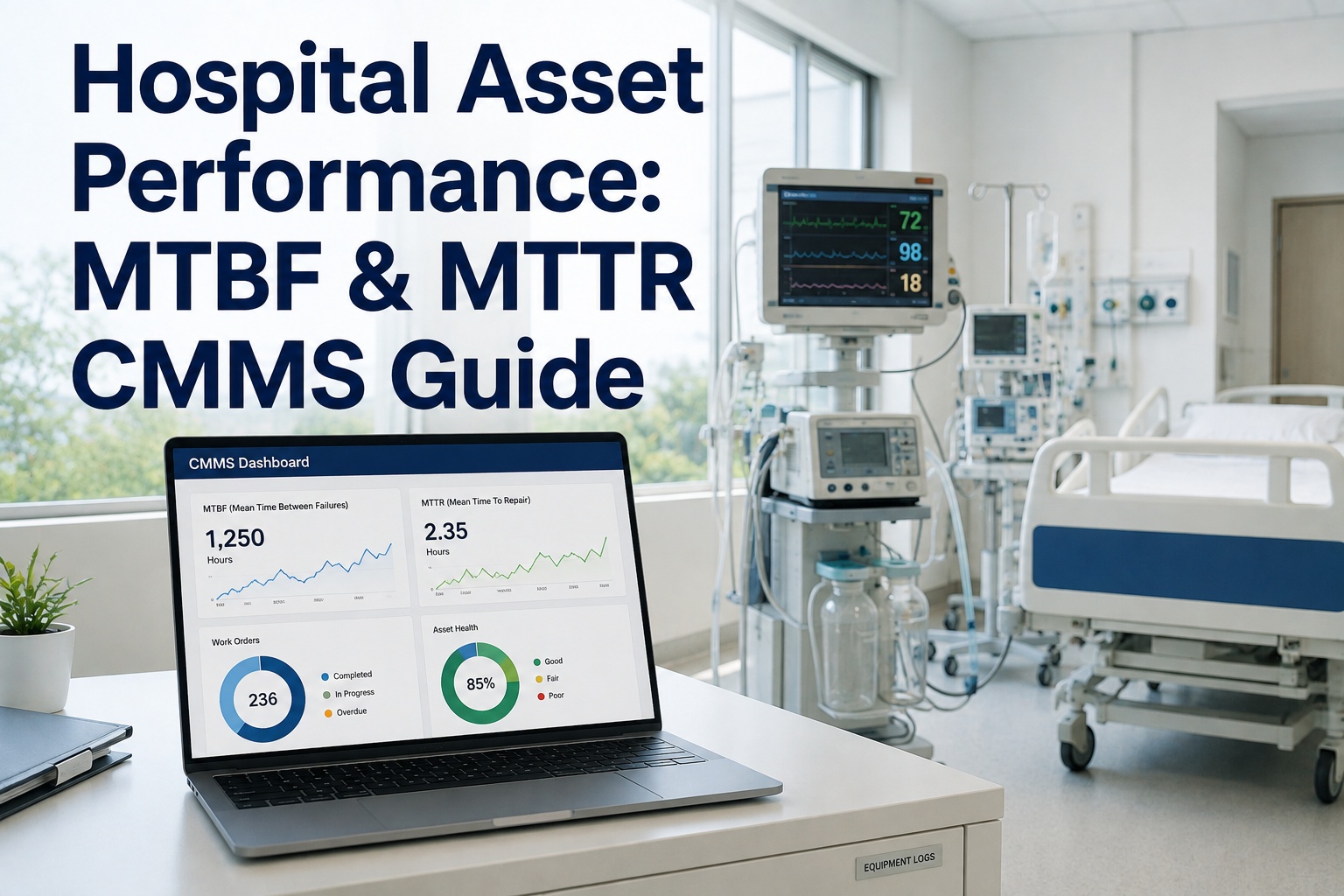
Mean Time Between Failures (MTBF) and Mean Time To Repair (MTTR) show how reliably hospital equipment performs and how quickly it is restored. For example, 8,000 operating hours and 4 failures gives an MTBF of 2,000 hours; 120 total repair hours gives an MTTR of 30 hours. Together, they determine equipment availability. This guide covers the formulas, examples, and how OXMAINT AI calculates them automatically from work order history.
Healthcare · Biomedical Engineering · Reliability Metrics · 2026
MTBF and MTTR for Hospital Equipment: Reliability Metrics
Knowing a ventilator failed isn't enough — you need to know how often it fails and how quickly it's restored. OXMAINT AI automatically tracks failures and repairs, calculates MTBF and MTTR in real time, and uses reliability trends to improve PM schedules.
Failure & Repair Logged
→
MTBF / MTTR Calculated
→
Reliability Trend Tracked
→
PM Schedule Adjusted
Three Metrics, Three Different Questions
Each metric answers something different about an asset's reliability — mixing them up is the most common mistake biomedical teams make. Sign up free and let OXMAINT AI calculate all three for your portfolio automatically.
MTBF
Mean Time Between Failures
"How often does this repairable asset fail?"
Applies to repairable equipment — a device that fails, gets fixed, and returns to service. Higher MTBF means more reliable equipment.
MTTF
Mean Time To Failure
"How long does this component last before its first failure?"
Applies to non-repairable components — a battery, a sensor, a single-use part that is replaced rather than repaired.
MTTR
Mean Time To Repair
"How fast does my team restore this equipment to service?"
A maintainability metric — from failure detection to back-in-service, not just wrench time. Lower MTTR means shorter clinical downtime.
The Formulas — Worked Through a Real Example
A CT scanner that ran 8,000 hours with 4 failures, where those 4 repairs took 120 hours total to complete. Book a demo to see this calculated automatically on your own imaging fleet.
MTBF = Total Operating Time ÷ Number of Failures
8,000 hrs ÷ 4 failures
= 2,000 hours
MTTR = Total Repair Time ÷ Number of Repairs
120 hrs ÷ 4 repairs
= 30 hours
Availability = MTBF ÷ (MTBF + MTTR) × 100
2,000 ÷ (2,000 + 30) × 100
= 98.5% availability
Where Manual Tracking Breaks Down
📋
Failures Logged Inconsistently
A failure gets noted in a repair ticket, but the operating hours and failure count needed to calculate MTBF live nowhere consistent.
⏱
Repair Time Undercounted
MTTR should run from detection to back-in-service — but paper logs often only capture the technician's active wrench time, understating the real number.
📦
Parts Not Pre-Staged
Without spare-parts data linked to the work order, MTTR inflates simply because a part had to be located or ordered mid-repair.
📊
No Per-Device Trend
A portfolio-wide average hides the one imaging unit whose MTBF has been quietly declining for months.
MTBF vs. MTTR: What Each One Actually Tells You
Low MTBF (Frequent Failures)
Points to a reliability problem — the device itself, wear, or environment
Signals a candidate for predictive monitoring or replacement review
Worsens with age, duty cycle and inadequate PM
High MTTR (Slow Repairs)
Points to a maintainability problem — parts, staffing or process
Signals a candidate for spare-parts pre-staging or workflow fixes
Improves with better data, parts availability and mobile work orders
A Portfolio-Wide Average Hides the One Device Actually Failing You.
OXMAINT AI calculates MTBF, MTTF and MTTR per device automatically — so a declining trend on one specific ventilator surfaces before it becomes a pattern.
From Failure Event to Reliability Trend
1
Failure occurs
Device fault logged against the specific asset, timestamped at detection.
→
2
Repair tracked
Work order timestamps from detection through back-in-service, not just active repair time.
→
3
MTBF & MTTR update
Both metrics recalculate automatically per device as new events log.
→
4
Trend flagged
A declining MTBF or rising MTTR on a specific device surfaces on the reliability dashboard.
→
5
PM strategy adjusted
A trending-down device becomes a candidate for tighter PM, predictive monitoring or replacement review.
What OXMAINT AI Gives Biomedical & Reliability Teams
Automatic MTBF & MTTR Calculation
Both metrics calculate per device from work order timestamps — no manual spreadsheet, no end-of-quarter reconciliation.
Full Detection-to-Service Timing
MTTR captures the complete window from fault detection to back-in-service, not just active repair time.
Per-Device Reliability Dashboard
See MTBF and MTTR trends by individual asset, not just a portfolio-wide average that hides the outlier.
Availability Tracking
Availability calculates automatically from MTBF and MTTR, giving a single number tied directly to clinical readiness.
Spare-Parts-Linked Work Orders
Parts checked against stock the moment a repair starts, reducing the part of MTTR that's really a procurement delay.
Declining-Trend Alerts
A device whose MTBF is dropping or MTTR is climbing flags automatically, before it becomes an obvious pattern.
"
We used to calculate MTBF and MTTR maybe once a year, manually, from work order exports — by the time we saw a number, it was already six months stale. Now both metrics update per device automatically, and we caught one CT scanner whose MTBF had dropped by nearly a third over two quarters before it turned into a real failure pattern. Our imaging MTTR also came down noticeably once repair timestamps started capturing the full detection-to-service window instead of just wrench time.
Director of Clinical Engineering · Regional Hospital System
Frequently Asked Questions
What's the difference between MTBF and MTTF?
MTBF applies to repairable equipment — a device that fails, gets fixed, and returns to service, like a ventilator or CT scanner. MTTF applies to non-repairable components, like a battery or single-use sensor, measuring how long it lasts before its first and only failure.
How do I calculate MTBF for a piece of hospital equipment?
Divide total operating time by the number of failures. A CT scanner running 8,000 hours with 4 failures has an MTBF of 2,000 hours — meaning it operates an average of 2,000 hours between failure events.
Why does MTTR matter as much as MTBF?
MTBF tells you how often equipment fails; MTTR tells you how long it stays down when it does. A device with a high MTBF but a very high MTTR can still generate significant clinical downtime, because rare failures that take days to resolve can outweigh frequent failures that resolve in minutes.
What does "availability" mean and how is it calculated from MTBF and MTTR?
Availability is the percentage of time equipment is actually usable, calculated as MTBF divided by the sum of MTBF and MTTR, multiplied by 100. In the CT scanner example, an MTBF of 2,000 hours and an MTTR of 30 hours produces roughly 98.5% availability.
Stop Calculating Reliability Once a Year. Track It Continuously.
Every failure and repair your team already logs can calculate MTBF, MTTR and availability automatically, per device — surfacing the trend before it becomes a pattern. That's the workflow OXMAINT AI runs.