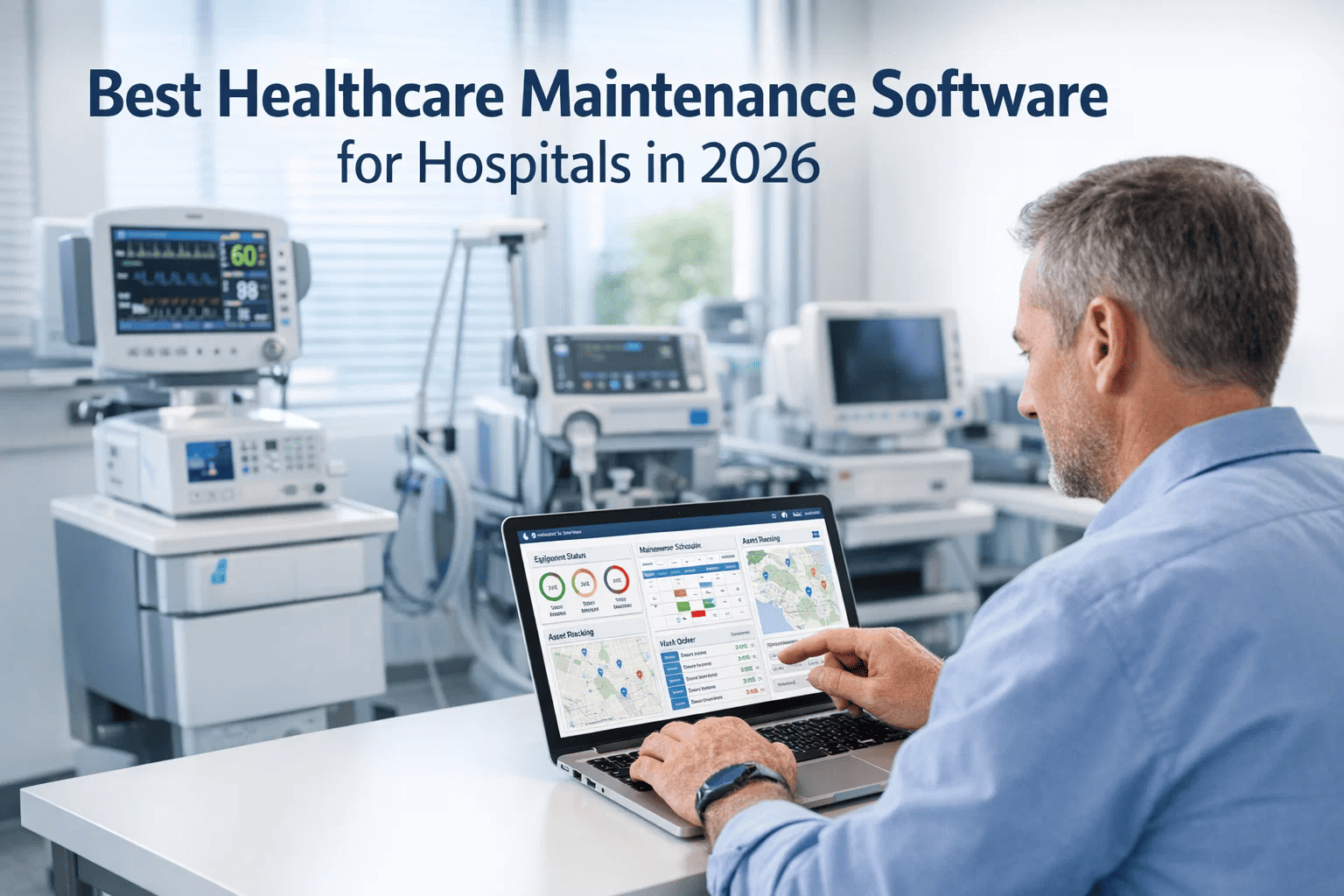
Healthcare facilities operate under a different maintenance standard than any other sector. A failed HVAC system in an office building is an inconvenience. In a hospital, it can trigger a patient safety incident, a regulatory breach, and a six-figure emergency repair — all within hours. In 2026, maintenance management in healthcare is no longer an operational support function. It is a clinical risk control mechanism, a compliance mandate, and a direct driver of patient outcomes. Facilities that treat it as anything less are carrying liability they cannot see. If your maintenance programme needs a structural upgrade, start a free 30-day trial with Oxmaint or book a demo to see how leading healthcare facilities are closing the gap between reactive and preventive operations.
Built for Healthcare Maintenance Teams
Oxmaint gives hospital and healthcare facility teams the CMMS infrastructure to schedule preventive maintenance, track asset lifecycles, and produce audit-ready compliance documentation — without the implementation overhead.
What Is Healthcare Maintenance Management?
Healthcare maintenance management is the structured process of planning, scheduling, executing, and documenting all maintenance activity across a healthcare facility — from clinical equipment and building systems to utility infrastructure and life-safety assets. It encompasses preventive maintenance schedules, corrective work orders, regulatory inspection cycles, asset lifecycle tracking, and CapEx planning for equipment replacement.
Unlike commercial property or industrial maintenance, healthcare maintenance operates under a layered compliance framework — OSHA in the USA, CQC in the UK, TGA in Australia, and Joint Commission standards internationally — where documentation gaps carry direct legal and clinical consequence. A maintenance programme that cannot produce an audit trail on demand is not compliant, regardless of what work was actually done. The standard has shifted: maintenance records must be digital, timestamped, and retrievable in real time.
The Eight Pillars of Healthcare Maintenance Excellence in 2026
Best-in-class healthcare maintenance programmes in 2026 are built on eight operational disciplines. Each pillar represents a shift from reactive, paper-based legacy practice toward structured, data-driven facility management. Missing any one of them creates systemic risk — in compliance, in cost, and in patient safety.
Where Healthcare Maintenance Programmes Fail
Most healthcare maintenance failures are not caused by technician error or budget shortfall. They are caused by structural gaps in how maintenance is planned, tracked, and documented. The following four failure modes account for the majority of regulatory findings and emergency repair spend in healthcare facilities globally. If any of these sound familiar, the fix is structural — not just procedural. Take the first step by exploring how Oxmaint's free trial addresses each of these gaps, or book a demo with our team.
How Oxmaint Powers Healthcare Maintenance Programmes
Oxmaint is built for the operational complexity of healthcare maintenance — multi-site portfolios, layered compliance requirements, critical asset dependencies, and the need for investor-grade reporting. The platform closes every structural gap that causes healthcare maintenance programmes to fail, without the implementation overhead of legacy CMMS systems.
Reactive Maintenance vs. Planned Maintenance in Healthcare
The operational and financial gap between reactive and planned maintenance in healthcare is not incremental — it is structural. Across every dimension that matters to facility directors, compliance officers, and CFOs, the difference is measurable and significant.
| Dimension | Reactive Maintenance | Planned Preventive Maintenance |
|---|---|---|
| Cost Per Event | 4.8x higher than planned equivalent. Emergency labour, expedited parts, and extended downtime. | Predictable, budgeted cost. Parts sourced in advance. Labour scheduled during low-demand windows. |
| Regulatory Compliance | Documentation gaps are common. Inspection cycles missed without a triggering system. Audit findings frequent. | Compliance is a product of the PM schedule. Every inspection documented digitally. Audit-ready at all times. |
| Clinical Risk | Equipment failure creates unplanned clinical disruption. Patient safety incidents possible when life-critical systems fail. | Failure windows predicted and prevented. Clinical teams informed of planned downtime in advance. Risk controlled. |
| Asset Lifespan | Assets run to failure. Lifespan shortened by 20–35% vs. maintained equivalents. Higher CapEx replacement frequency. | Condition maintained within operating spec. Asset lifespan maximised. Replacement driven by data, not failure. |
| Technician Productivity | Teams in constant firefighting mode. High overtime, low morale. Skilled technicians performing avoidable emergency repairs. | Planned workloads. Scheduled routes. Skilled technicians performing value-add preventive work with full asset context. |
| CapEx Predictability | Capital requests driven by failure events. Surprise budget asks. Poor visibility for finance teams and boards. | Rolling 5–10 year CapEx forecasts from asset condition data. Finance teams can plan and budget with confidence. |
Building an Effective PM Programme for Healthcare Facilities
A preventive maintenance programme in healthcare must be structured around asset criticality — not just manufacturer recommendations. The starting point is a complete asset inventory with condition scoring. From there, PM intervals are assigned based on risk consequence, regulatory requirement, and actual condition data. The result is a schedule that allocates maintenance resources where patient safety and compliance risk are highest.
Maintenance Compliance in Healthcare: What Regulators Expect in 2026
Regulatory expectations for healthcare facility maintenance have hardened significantly since 2022. Joint Commission, CQC, OSHA, and TGA standards now explicitly require digital-format maintenance records with audit trails, timestamped inspections, and evidence of corrective action within defined response windows. Paper-based records are increasingly treated as insufficient at audit. Facilities operating on spreadsheets and paper work orders are not just inefficient — they are exposed. The transition to digital maintenance management is now a compliance imperative, not an operational upgrade. To make that transition easier, start a free trial with Oxmaint and see the compliance dashboard in action, or book a demo to walk through the regulatory documentation workflow with our team.
Measurable Outcomes from Structured Healthcare Maintenance Programmes
The business case for structured, digital maintenance management in healthcare is well documented. Across asset uptime, compliance performance, cost reduction, and capital efficiency, facilities that operate structured PM programmes consistently outperform those running reactively. These are the headline metrics from facilities that have made the transition.
Healthcare maintenance teams using Oxmaint have reduced unplanned downtime by 45%, cut compliance findings by 37%, and built the CapEx forecasting models their boards and finance teams have been requesting for years. Oxmaint is designed for multi-site healthcare portfolios — fast to implement, audit-ready from day one, and built for the operational complexity that healthcare maintenance demands. No heavy onboarding. No long implementation timeline. Start with your asset registry and build from there.
Frequently Asked Questions
What is the difference between preventive and predictive maintenance in healthcare?
Preventive maintenance (PM) involves scheduled maintenance tasks performed at defined intervals — time-based, usage-based, or condition-triggered — before failure occurs. Predictive maintenance goes a step further: it uses real-time sensor data, IoT telemetry, and condition monitoring to predict when a specific asset is approaching failure, allowing intervention at the optimal point. In healthcare, most facilities benefit most from a structured PM programme first — building the asset data and schedule discipline that predictive maintenance requires. Oxmaint supports both: PM scheduling tied to asset records, and IoT integration that enables condition-based triggering as your programme matures.
How does a CMMS improve compliance in healthcare facilities?
A CMMS improves compliance by making it structurally impossible to miss a required inspection or fail to document a completed maintenance task. Regulatory inspection cycles are built into the maintenance schedule and triggered automatically. Every work order completion is recorded with a timestamp, technician signature, and outcome. When an auditor requests evidence of maintenance activity on a specific asset or system, the record is retrieved in minutes — not hours — and it is complete. Facilities using digital CMMS report 37% fewer compliance findings than those operating on paper-based systems, because compliance becomes a product of the maintenance programme rather than a separate documentation exercise.
How do healthcare facilities calculate ROI on a CMMS investment?
The ROI calculation for healthcare CMMS investment typically centres on four metrics: reduction in emergency repair spend (emergency repairs cost 4.8x more than planned maintenance — shifting 20% of reactive work to planned delivers measurable savings); reduction in regulatory finding remediation costs; improvement in asset lifespan and reduction in premature CapEx replacement; and technician productivity gains from planned vs. reactive workloads. Most facilities reach positive ROI within 6–12 months of structured CMMS implementation. The calculation strengthens further when multi-site efficiency gains are factored in — portfolio-level visibility eliminates duplicated effort and resource waste across facilities.
How quickly can a healthcare facility implement Oxmaint?
Oxmaint is designed for fast implementation without the heavy onboarding overhead of legacy CMMS systems. Most healthcare facilities have their asset registry populated and their first PM schedules running within the first two weeks. The mobile-first interface means technicians are productive from day one without extensive training requirements. For multi-site health networks, the Portfolio > Property > System > Asset > Component hierarchy makes it straightforward to structure the asset registry across all facilities from the outset. Implementation support is included — and because there are no long implementation fees or extended deployment timelines, the cost of getting started is predictable and contained.